中国全科医学 ›› 2026, Vol. 29 ›› Issue (28): 4100-4106.DOI: 10.12114/j.issn.1007-9572.2026.0061

所属专题: 社区卫生服务最新研究合辑

• 全科医疗/社区卫生服务工作研究·分级诊疗专题研究 • 上一篇    下一篇

分级诊疗背景下基层服务量的趋势特征与驱动机制:基于中断时间序列与对数平均迪氏指数分解法模型的实证研究

张锐1,2, 鲁旺3, 杨梵1,2, 罗苑1,2, 陈丹镝1,2,*()   

  1. 1.610041 四川省成都市,四川大学华西公共卫生学院/华西第四医院
    2.610041 四川省成都市,四川大学华西-协和陈志潜卫生健康研究院姑息医学研究中心
    3.610041 四川省成都市,四川省卫生健康政策和医学情报研究所
  • 收稿日期:2026-02-11 修回日期:2026-07-19 出版日期:2026-10-05 发布日期:2026-09-02
  • 通讯作者: 陈丹镝

  • 作者贡献:

    张锐提出主要研究目标,负责研究的构思与设计,研究的实施,撰写论文;张锐、鲁旺进行数据的收集与整理,统计学处理,图、表的绘制与展示;杨梵、罗苑进行论文的修订;陈丹镝负责文章的质量控制与审查,对文章整体负责,监督管理。

  • 基金资助:
    四川省基层卫生事业发展研究中心资助项目(CWFZ22-Y-12)

Trend Characteristics and Driving Mechanisms of Primary Care Service Volume under the Hierarchical Medical System: an Empirical Study Based on Its and Lmdi Models

ZHANG Rui1,2, LU Wang3, YANG Fan1,2, LUO Yuan1,2, CHEN Dandi1,2,*()   

  1. 1. West China School of Public Health/West China Fourth Hospital, Sichuan University, Chengdu 610041, China
    2. West China-Xiehe Chen Zhiqian Health Research Institute for Palliative Medicine, Sichuan University, Chengdu 610041, China
    3. Institute of Health Policy and Medical Information, Sichuan Provincial Health Development Research Center, Chengdu 610041, China
  • Received:2026-02-11 Revised:2026-07-19 Published:2026-10-05 Online:2026-09-02
  • Contact: CHEN Dandi

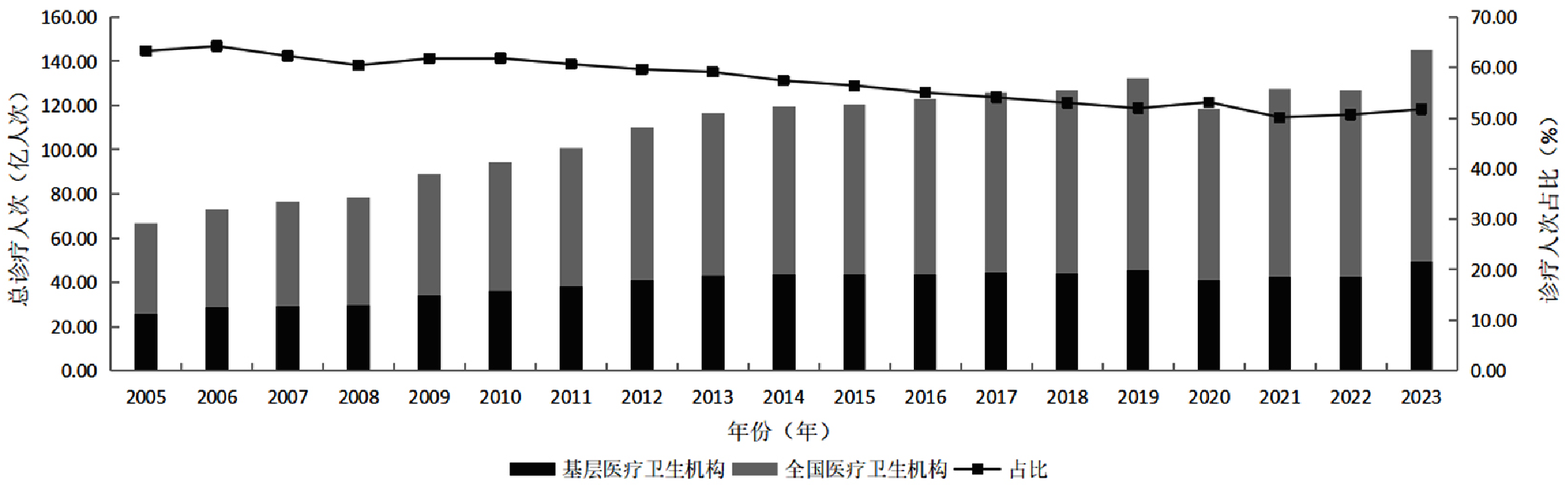
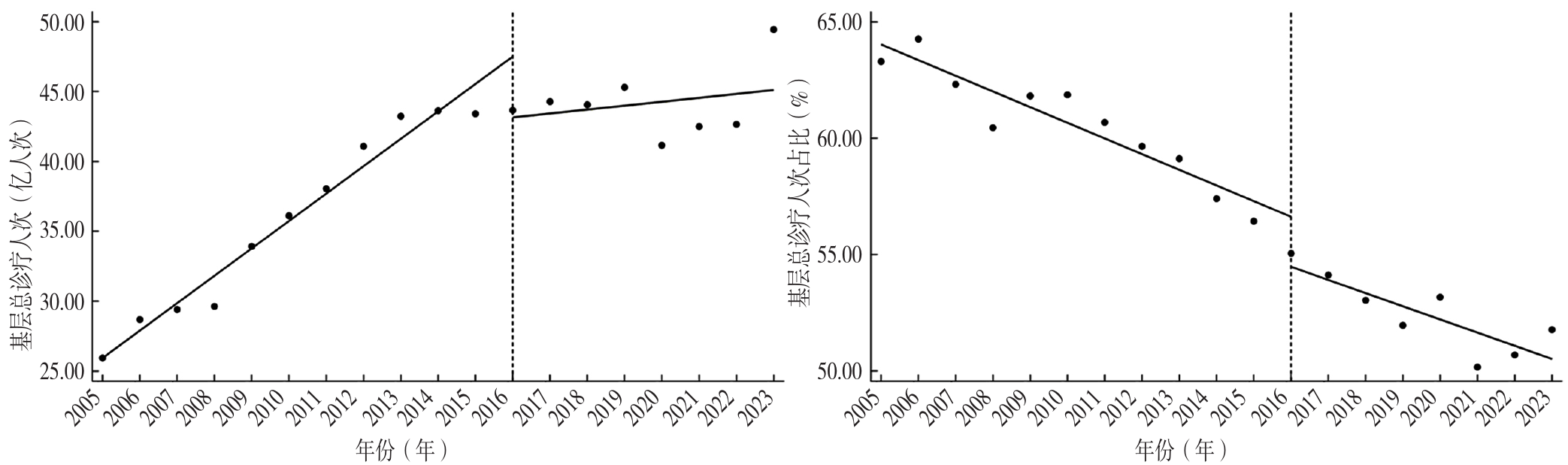
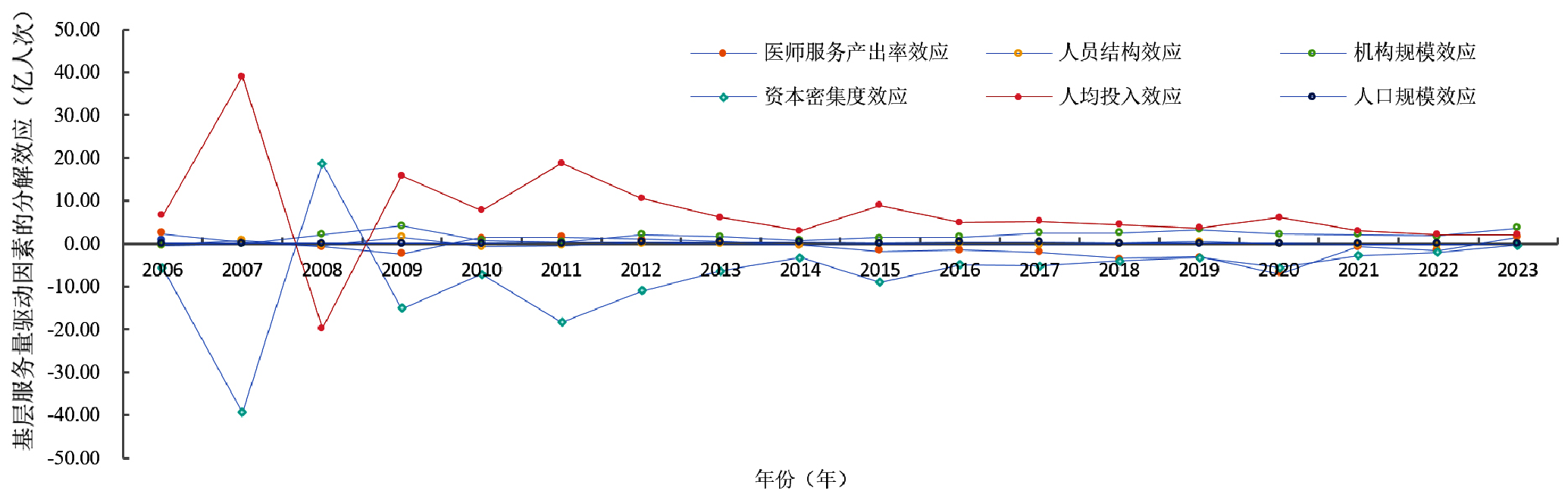
摘要: 背景 分级诊疗制度旨在推动患者首诊下沉至基层医疗卫生机构,但我国基层诊疗服务量占比仍呈下降趋势,政策实际效果及驱动机制有待评估。 目的 探究分级诊疗政策实施后基层医疗服务量的变化趋势及驱动因素,为政策优化提供实证依据。 方法 本研究数据来源于2005—2023年《中国卫生健康统计年鉴》系列资料,采用中断时间序列(ITS)分析和对数平均迪氏指数分解法(LMDI)评估政策效应并量化因素贡献。 结果 ITS模型结果显示,基层总诊疗人次年均增速为1.96亿人次(P=0.005),但占比以年均0.67%的速度下降(P<0.001)。在政策干预时点(2016年),基层总诊疗人次瞬时下降约4.35亿人次(P<0.001),占比下降2.14%(P<0.001)。政策实施后,基层总诊疗人次增长趋势减缓,年增长速度较政策干预前下降1.68亿人次(P<0.001)。LMDI分解结果显示,2005—2023年基层服务量总体变化量为23.51亿人次,人均投入效应(EP)与机构规模效应(SI)为主要正向驱动因素,但资本密集度效应(IE)为-124.09亿人次、医师服务产出率效应(PD)为-15.51亿人次,构成明显增长阻力。分阶段来看,政策实施后PD由正值转为负值,增长动力较政策实施前有所减弱。 结论 当前基层服务增长呈现出一定的高投入、低效率的特征,资源与人员效率尚未同步提升,可能制约了分级诊疗的分流效果。

关键词: 基层医疗卫生机构, 分级诊疗, 中断时间序列, 驱动机制分析, 服务能力

Abstract:

Background

The hierarchical medical system in China aims to guide patients toward primary healthcare institutions for first-contact care. Nevertheless, the proportion of visits at the primary level has continued to decline. The system's actual effectiveness and the mechanisms underlying changes in primary care service volume remain insufficiently understood.

Objective

To examine trends in primary care service volume and identify key driving factors after implementation of the hierarchical medical system, thereby providing empirical evidence for policy optimization.

Methods

Data were drawn from the China Health Statistical Yearbook series spanning 2005 to 2023. Interrupted time series (ITS) analysis was used to evaluate policy effects, and the logarithmic mean divisia index (LMDI) method was employed to decompose and quantify the contribution of each driving factor.

Results

The ITS model showed that total primary care visits increased at an annual rate of 196 million (P=0.005), yet the proportion declined by 0.67 percentage points per year (P<0.001). At the point of policy intervention (2016), primary care visits fell abruptly by approximately 435 million (P<0.001), with the proportion dropping by 2.14 percentage points (P<0.001). After policy implementation, growth slowed markedly; the annual increase was 168 million fewer than in the pre-intervention period (P<0.001). LMDI results indicated a cumulative change of 2 351 million in primary care visits from 2005 to 2023. The per capita investment effect (EP) and institutional scale effect (SI) were the main positive drivers, while the capital intensity effect (IE, -12 409 million) and physician service productivity effect (PD, -1 551 million) posed major impediments to growth. In the post-implementation period, PD shifted from positive to negative, reflecting weakened growth momentum.

Conclusion

Primary care growth in China exhibits characteristics of an extensive model marked by high input and low efficiency. Resource and workforce productivity have not kept pace with investment increases, which may constrain the patient-diversion capacity of the hierarchical medical system.

Key words: Primary healthcare institutions, Hierarchical medical system, Interrupted time series, Driving factor analysis, Service capacity