中国全科医学 ›› 2026, Vol. 29 ›› Issue (28): 4117-4124.DOI: 10.12114/j.issn.1007-9572.2025.0559

• 全科医疗/社区卫生服务工作研究·分级诊疗专题研究 • 上一篇    下一篇

分级诊疗背景下北京市肥胖症共病相关卫生服务可得性评估:基于医疗机构的调查研究

张涵1, 蔡根深1, 冯郑文1, 张恺悦1, 廉东波2, 张华1,*(), 张晶1,*()   

  1. 1.100038 北京市,首都医科大学附属北京世纪坛医院社区医疗中心
    2.100038 北京市,首都医科大学附属北京世纪坛医院减肥与代谢中心
  • 收稿日期:2026-01-26 修回日期:2026-07-19 出版日期:2026-10-05 发布日期:2026-09-02
  • 通讯作者: 张华, 张晶

  • 作者贡献:

    张涵进行文章的构思和设计,负责数据统计分析;蔡根深参与调研和论文校对;冯郑文、张恺悦负责问卷发放与回收;廉东波提供专业技术指导;张华、张晶进行论文修订,对论文质量和阐述观点进行监督管理;张涵、张华、张晶对论文整体负责。

  • 基金资助:
    首都卫生发展全科医学与社区卫生专项(首发2025-2Y-012); 国铁集团科研专项(J2025Z606); 2025年北京市属医院高质量发展改革创新举措项目

Evaluating the Availability of Health Services for Obesity Comorbidities under Hierarchical Diagnosis and Treatment in Beijing: a Healthcare Institution Survey Study

ZHANG Han1, CAI Genshen1, FENG Zhengwen1, ZHANG Kaiyue1, LIAN Dongbo2, ZHANG Hua1,*(), ZHANG Jing1,*()   

  1. 1. Community Medical Center, Beijing Century Altar Hospital Affiliated to Capital Medical University, Beijing 100038, China
    2. Weight Loss and Metabolism Center, Beijing Century Altar Hospital Affiliated to Capital Medical University, Beijing 100038, China
  • Received:2026-01-26 Revised:2026-07-19 Published:2026-10-05 Online:2026-09-02
  • Contact: ZHANG Hua, ZHANG Jing

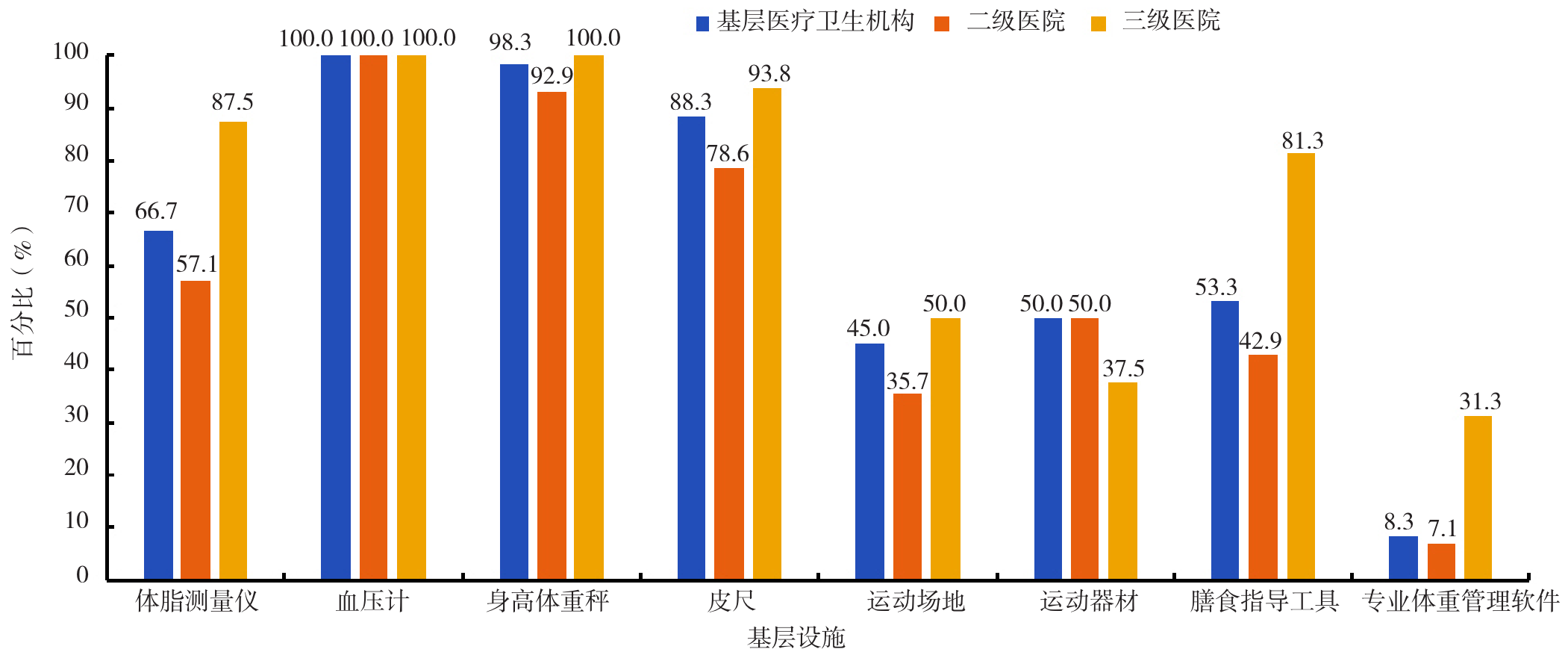
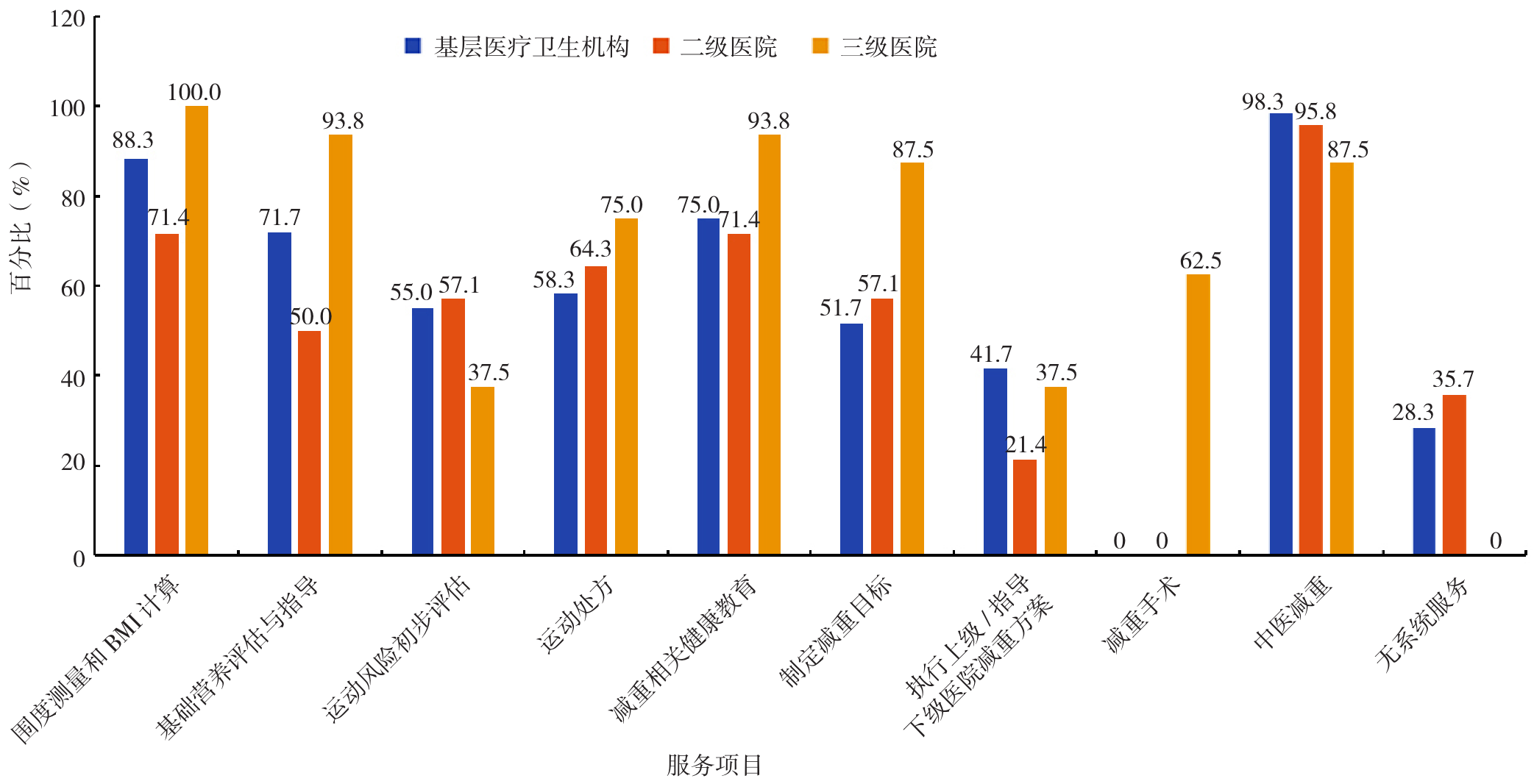
摘要: 背景 随着人口老龄化程度加剧,多病共存已成为北京市公共卫生领域面临的重大挑战。肥胖是多病共存重要的病理基础,体重管理则是改善多病共存人群健康状况的关键策略,但目前关于肥胖症共病的整合式诊疗开展现状尚不明确。 目的 评估北京市医疗机构的肥胖症共病相关卫生服务可得性,为制定肥胖合并"三高"(高血压、糖尿病、高脂血症)诊疗指南和分级诊疗政策提供科学依据。 方法 于2025年10—12月,采用多阶段随机抽样法抽取北京市基层医疗卫生机构60家、三级医院16家,采用目的抽样抽取二级医院14家作为调查对象。通过政策研读、文献汇总和专家咨询,编制基层医疗卫生机构版本、二级医院版本、三级医院版本的调查问卷,内容涵盖各级别医疗机构的体重管理相关基础设施和资源配置情况、分级诊疗定位、转诊通道建设情况、分级诊疗实践难点等。 结果 22家(36.7%)基层医疗卫生机构、7家(7/14)二级医院、14家(14/16)三级医院设立了体重管理门诊,趋势χ2检验结果显示,体重管理门诊设立率随医院级别的增高而升高(P<0.01)。在体重管理设备方面,基础评估设备中,仅二级医院的皮尺配备率<80.0%;专业设备中,二级医院的体脂测量仪配备率<60.0%,膳食指导工具配备率<50.0%,运动场地配备率<40.0%,专业体重管理软件配备率<10.0%。在体重管理服务项目方面,17家(28.3%)基层医疗卫生机构、5家(5/14)二级医院无体重管理相关系统服务,16家(16/16)三级医院均可提供系统服务。针对肥胖症共病患者,仅7家(7/14)二级医院可提供支援基层、稳定期患者转回基层等服务,仅9家(9/14)二级医院可向基层医疗卫生机构提供技术支持。在肥胖症共病患者转诊方面,各级别医疗机构均无明确转诊标准和转诊流程;三级医院开展转诊工作的主要难点为下转患者随访困难(7家),二级医院开展转诊工作的主要难点为患者不接受转诊而自行前往信任医院就诊(11家)、转诊通道不畅通(8家),基层医疗卫生机构开展转诊工作的主要难点为各级医疗机构间缺乏及时且有效的信息共享(42家)、上级医院对转诊患者反馈不足(37家)。 结论 分级诊疗背景下北京市肥胖症共病患者卫生服务可得性不足,结构失衡。建议夯实二级医院枢纽功能、构建区域性固定转诊网络、推进基层与二级医院设备专业化,并制定统一临床路径与信息共享标准,以提升体系整体效能,助力"健康中国"战略实施。

关键词: 分级诊疗, 肥胖, 慢性病共病, 卫生服务易得程度, 体重管理

Abstract:

Background

With the accelerating aging of the population, multimorbidity has become a major public health challenge in Beijing. Obesity serves as a key pathological basis for multimorbidity, and weight management is an important strategy for improving the health of patients with multimorbidity. However, the current status of integrated diagnosis and treatment for obesity and multimorbidity remains unclear.

Objective

To assess the availability of health services related to obesity comorbidities in medical institutions of Beijing, and to provide scientific evidence for the formulation of clinical guidelines and hierarchical medical policies targeting obesity combined with three highs (hypertension, diabetes mellitus, and hyperlipidemia).

Methods

From October to December 2025, a multi-stage random sampling method was adopted to select 60 primary health service institutions and 16 tertiary hospitals in Beijing. Fourteen secondary hospitals were enrolled via purposive sampling as research subjects. Based on policy review, literature review and expert consultation, three versions of questionnaires (for primary medical and health institutions, secondary hospitals and tertiary hospitals, respectively) were self-developed. The questionnaire covered infrastructure and resource allocation related to weight management, hierarchical diagnosis and treatment positioning, construction of referral pathways, and practical difficulties in hierarchical medical service delivery.

Results

Weight management clinics were established in 22 (36.7%) primary medical and health institutions, 7 (7/14) secondary hospitals and 14 (14/16) tertiary hospitals. The linear-by-linear association chi-square test revealed that the establishment rate of weight management clinics increased with the elevation of hospital grade (P<0.01). In terms of weight management equipment, among basic assessment equipment, only the possession rate of tape measures in secondary hospitals was less than 80.0%. As for specialized equipment, secondary hospitals had a possession rate of body fat analyzers below 60.0%, dietary guidance tools below 50.0%, sports venues below 40.0%, and professional weight management software below 10.0%. With regard to weight management service programs, 17 (28.3%) primary medical and health institutions and 5 (5/14) secondary hospitals failed to provide systematic weight management services, whereas all 16 tertiary hospitals offered such systematic services. For patients with obesity-related comorbidities, merely 7 (7/14) secondary hospitals could deliver services including supporting primary care institutions and transferring stable patients back to primary settings, and only 9 (9/14) secondary hospitals were capable of providing technical support to primary medical and health institutions. In respect of referrals for patients with obesity and comorbidities, no clear referral criteria or procedures were formulated in medical institutions at all levels. The primary barrier to referrals in tertiary hospitals was difficult follow-up of downward-transferred patients (7 hospitals). The main obstacles for secondary hospitals included patients’ reluctance to accept referrals and tendency to directly visit their preferred hospitals (11 hospitals), as well as unobstructed referral pathways (8 hospitals). For primary medical and health institutions, the predominant challenges were insufficient timely and effective information sharing among medical institutions at different levels (42 institutions) and inadequate feedback on referred patients from higher-level hospitals (37 institutions).

Conclusion

Under the context of tiered diagnosis and treatment, the availability of health services for patients with obesity-related comorbidities in Beijing is inadequate and structurally imbalanced. It is recommended to strengthen the hub function of secondary hospitals, establish regional fixed referral networks, promote specialized equipment deployment in primary and secondary institutions, and develop unified clinical pathways and information-sharing standards, so as to enhance the overall system efficiency and support the implementation of the "Healthy China" strategy.

Key words: Hierarchical diagnosis and treatment, Obesity, Multiple chronic conditions, Health services accessibility, Weight management