中国全科医学 ›› 2026, Vol. 29 ›› Issue (34): 5061-5070.DOI: 10.12114/j.issn.1007-9572.2026.0085

• 论著 • 上一篇    

不同BMI分层下同型半胱氨酸与社区人群脑卒中风险的关联研究

顾奕乐1,2,3, 杨祥雨1,2,3, 陆博凤1,2, 赵静雯1,2, 王筱荷1,2,3, 钟伟豪1,2, 吴登爽1,2, 刘秀梅1,3,*()   

  1. 1.100069 北京市,首都医科大学全科医学与继续教育学院
    2.100053 北京市,首都医科大学宣武医院全科医学科
    3.100078 北京市丰台区方庄社区卫生服务中心全科医学科
  • 收稿日期:2026-04-12 修回日期:2026-07-16 出版日期:2026-12-05 发布日期:2026-10-26
  • 通讯作者: 刘秀梅

  • 作者贡献:

    顾奕乐负责研究设计,采集、分析数据,实施研究,撰写文章;杨祥雨、陆博凤、赵静雯负责收集数据,进行统计学分析;王筱荷、钟伟豪、吴登爽负责核对参考文献,校对内容;刘秀梅负责指导研究,对文章整体负责,监督管理。

  • 基金资助:
    北京慢性病防治与健康教育研究会2025年"青苗行动"基层专项课题赞助支持(MBZX202501-0156); 首都卫生发展科研专项(首发2022-3-7053)

Study on the Association between Homocysteine and Stroke Risk in Community Population with Different BMI Stratification

GU Yile1,2,3, YANG Xiangyu1,2,3, LU Bofeng1,2, ZHAO Jingwen1,2, WANG Xiaohe1,2,3, ZHONG Weihao1,2, WU Dengshuang1,2, LIU Xiumei1,3,*()   

  1. 1. School of General Practice and Continuing Education, Capital Medical University, Beijing 100069, China
    2. Department of General Practice, Xuanwu Hospital, Capital Medical University, Beijing 100053, China
    3. Department of General Practice, Fangzhuang Community Health Service Center, Fengtai District, Beijing 100078, China
  • Received:2026-04-12 Revised:2026-07-16 Published:2026-12-05 Online:2026-10-26
  • Contact: LIU Xiumei

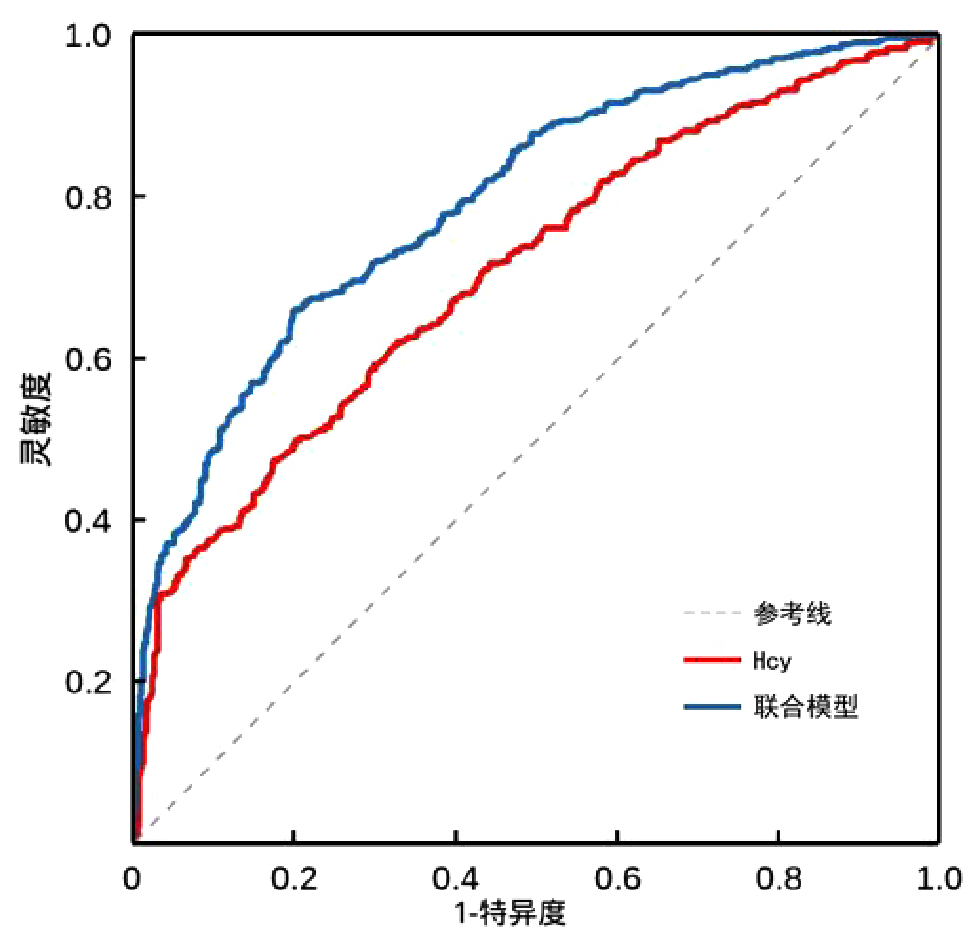
摘要: 背景 脑卒中是我国居民死亡和伤残的首要原因,社区高危人群早筛是脑卒中一级预防的关键,但BMI对血清同型半胱氨酸(Hcy)相关脑卒中风险的修饰效应尚存争议,且缺乏社区人群数据,限制了Hcy在基层的应用。 目的 探讨不同BMI分层下,Hcy与社区人群脑卒中发病风险的关联。 方法 连续纳入2025年4月—2026年2月在北京市丰台区方庄社区卫生服务中心就诊的签约患者1 154例作为研究对象,根据BMI分层,分为正常(18.5 kg/m2≤BMI<24.0 kg/m2)、超重(24.0 kg/m2≤BMI<28.0 kg/m2)、肥胖(BMI≥28.0 kg/m2);Hcy分层,分为正常Hcy(Hcy水平<15 μmol/L)、高Hcy(Hcy水平≥15 μmol/L);脑卒中风险分组,按危险因素数量分为低风险组(0~2项)、中风险组(3~5项)、高风险组(≥6项);双重高危人群定义:同时满足高Hcy组和高风险组的研究对象。通过单因素分析、多因素Logistic回归分析、Cochran-Armitage趋势检验、亚组与交互效应分析,探究BMI分层下Hcy与社区人群脑卒中中高风险的关联;采用受试者工作特征(ROC)曲线,评估Hcy及联合指标模型对社区人群脑卒中中高风险的预测价值。 结果 本研究纳入的受试者中,BMI分层中正常504例(43.67%)、超重470例(40.73%)、肥胖180例(15.60%);高Hcy 187例(16.20%),正常Hcy 967例(83.80%)。脑卒中发病低风险组594例(51.47%)、中风险组525例(45.49%)、高风险组35例(3.03%);同时满足高Hcy与脑卒中高风险的双重高危人群共26例,占总研究人群的2%。将中风险组与高风险组合并为中高风险组,单因素分析显示,中高风险组与低风险组性别、年龄、Hcy分层、BMI分层比较,差异均有统计学意义(P<0.001)。多因素Logistic回归分析结果显示,年龄每增加1岁,脑卒中中高风险的发生风险升高5%(OR=1.05,95%CI=1.03~1.06,P<0.05);女性为保护因素(OR=0.38,95%CI=0.29~0.51,P<0.05);与BMI正常者相比,超重者脑卒中中高风险的发生风险升高64%(OR=1.64,95%CI=1.23~2.20,P<0.05),肥胖者脑卒中中高风险的发生风险升高8.58倍(OR=9.58,95%CI=6.09~15.50,P<0.05);与正常Hcy者相比,高Hcy者脑卒中中高风险的发生风险升高9.50倍(OR=10.50,95%CI=6.32~18.30,P<0.05)。Hosmer-Lemeshow检验证实模型拟合良好(χ2=6.182,P=0.624)。趋势检验结果显示,Hcy水平与社区人群脑卒中中高风险呈显著的剂量反应关系(P<0.001);Hcy与BMI无显著相乘及相加交互作用(均P>0.05),其风险效应独立于BMI、性别、年龄。ROC曲线分析显示,Hcy预测脑卒中中高风险的最佳截断值为12.105 μmol/L,ROC曲线下面积(AUC)为0.707;Hcy联合年龄、性别、BMI构建的联合模型预测脑卒中中高风险的AUC达0.795,诊断效能更优。 结论 血清高Hcy、超重、肥胖均为社区脑卒中高危人群风险升高的独立影响因素;在不同BMI分层下,Hcy水平与社区人群脑卒中中高风险呈显著剂量反应关系,且Hcy对脑卒中风险效应的影响独立于BMI分层。

关键词: 脑卒中, 同型半胱氨酸, 体质指数, 高危人群, 危险分层, 诊断效能

Abstract:

Background

Stroke is the leading cause of death and disability among Chinese residents. Early screening of high-risk individuals in the community is crucial for primary prevention of stroke. However, the modifying effect of body mass index (BMI) on stroke risk associated with serum homocysteine (Hcy) remains controversial, and the lack of community-based data limits its application at the grassroots level.

Objective

To explore the association between Hcy and stroke-related risks in high-risk individuals in the community based on different BMI stratification.

Methods

A total of 1 154 contracted patients who visited the Fangzhuang Community Health Service Center in Fengtai District, Beijing, from April 2025 to February 2026, were consecutively enrolled as study subjects. The subjects were stratified by BMI into normal (18.5 kg/m2≤BMI<24.0 kg/m2), overweight (24.0 kg/m2≤BMI<28.0 kg/m2), and obesity (BMI≥28.0 kg/m2); by serum Hcy level into normal Hcy (<15 μmol/L) and hyper-Hcy (≥15 μmol/L); and by the number of risk factors into low-risk (0-2 items), moderate-risk (3-5 items), and high-risk (≥6 items) groups for stroke. The dual high-risk population was defined as subjects who simultaneously met the criteria of both the "hyper-Hcy group" and the "high-risk group". Univariate analysis, multivariate Logistic regression analysis, the Cochran-Armitage trend test, and subgroup and interaction effect analysis were employed to explore the association between Hcy and moderate-to-high stroke risk in the community population under different BMI stratification. Receiver operating characteristic (ROC) curves were used to evaluate the predictive value of Hcy and the combined indicator model for moderate-to-high stroke risk in the community population.

Results

Among the included subjects, BMI stratification showed 504 (43.67%) in the normal group, 470 (40.73%) in the overweight group, and 180 (15.60%) in the obesity group. Regarding Hcy levels, 187 (16.20%) had hyper-Hcy and 967 (83.80%) had normal Hcy. For stroke risk stratification, there were 594 (51.47%) in the low-risk group, 525 (45.49%) in the moderate-risk group, and 35 (3.03%) in the high-risk group. In addition, 26 patients (2% of the total study population) were identified as the dual high-risk population, meeting the criteria of both the hyper-Hcy group and the high-risk group. After the moderate-risk group and the high-risk group were combined into the moderate-to-high risk group, univariate analysis showed statistically significant differences in gender, age, Hcy stratification, and BMI stratification between the moderate-to-high risk group and the low-risk group (P<0.001). Multivariate Logistic regression analysis showed that for every one-year increase in age, the risk of being in the moderate-to-high stroke risk group increased by 5% (OR=1.05, 95%CI=1.03-1.06, P<0.05); being female was a protective factor (OR=0.38, 95%CI=0.29-0.51, P<0.05); compared with individuals with normal BMI, the risk of being in the moderate-to-high stroke risk group increased by 64% in overweight individuals (OR=1.64, 95%CI=1.23-2.20, P<0.05) and by 8.58 times in obese individuals (OR=9.58, 95%CI=6.09-15.50, P<0.05); and compared with individuals with normal Hcy, the risk of being in the moderate-to-high stroke risk group increased by 9.50 times in hyper-Hcy individuals (OR=10.50, 95%CI=6.32-18.30, P<0.05). The Hosmer-Lemeshow test confirmed good model fit (χ2=6.182, P=0.624). The Cochran-Armitage trend test showed a significant dose-response relationship between Hcy levels and moderate-to-high stroke risk in the community population (P<0.001). No significant multiplicative or additive interaction was observed between Hcy and BMI (both P>0.05), and the risk effect was independent of BMI, gender, and age. ROC curve analysis showed that the optimal cutoff value of Hcy for predicting moderate-to-high stroke risk was 12.105 μmol/L, with an area under the ROC curve (AUC) of 0.707; the combined model incorporating Hcy, age, gender, and BMI achieved an AUC of 0.795 for predicting moderate-to-high stroke risk, indicating superior diagnostic performance.

Conclusion

Elevated serum Hcy, overweight, and obesity are all independent factors that increase the risk of being in the moderate-to-high stroke risk group in the community population. Moreover, under different BMI stratification, Hcy levels exhibit a significant dose-response relationship with moderate-to-high stroke risk in the community population, and the effect of Hcy on stroke risk is independent of BMI stratification.

Key words: Stroke, Homocysteine, BMI, High-risk population, Risk stratification, Diagnostic performance

中图分类号: