
中国全科医学 ›› 2026, Vol. 29 ›› Issue (15): 2029-2036.DOI: 10.12114/j.issn.1007-9572.2024.0643
• 论著 • 上一篇
郑仁阔1,2, 华飞2,*( )
)
收稿日期:2025-01-09
修回日期:2025-10-03
出版日期:2026-05-20
发布日期:2026-04-14
通讯作者:
华飞
作者贡献:
郑仁阔负责提出研究思路,设计研究方案,检索文献,数据收集、整理及统计学分析,对主要研究结果进行分析与解释,撰写论文;华飞负责文章的质量控制,监督管理,修订最终版本。
ZHENG Renkuo1,2, HUA Fei2,*()
Received:2025-01-09
Revised:2025-10-03
Published:2026-05-20
Online:2026-04-14
Contact:
HUA Fei
摘要: 背景 近年来,甲状腺乳头状癌(PTC)的患病率在国内呈上升趋势。文献表明非酒精性脂肪肝(NAFLD)与PTC相关。NAFLD最新纳入代谢因素定义为代谢相关脂肪变性肝病(MASLD)与PTC发生的相关文献较少。 目的 探究PTC发病的影响因素,并评价MASLD对PTC发病的预测价值, 方法 选取苏州大学附属第三医院2023年5—9月行甲状腺肿物切除术的出院患者642例为研究对象,其中PTC患者323例归为恶性组,良性结节患者319例归为良性组。比较良性组和恶性组及不同性别患者的一般资料。采用单因素和多因素Logistic回归分析探究PTC的影响因素,构建包含各因素预测PTC发病风险的列线图预测模型,采用ROC曲线分析各因素及预测模型对PTC的预测价值。 结果 恶性组患者年龄、高密度脂蛋白胆固醇(HDL-C)、总胆固醇(TC)、甲状腺球蛋白抗体(TgAb)低于良性组,男性比例、BMI、丙氨酸氨基转移酶(ALT)、甘油三酯(TG)、促甲状腺激素(TSH)、甲状腺过氧化物酶抗体(TPOAb)、MASLD比例、全身炎症指数(SII)高于良性组(P<0.05);男性患者BMI、ALT、TG、TPOAb、中性粒细胞计数、淋巴细胞计数、单核细胞计数、MASLD比例高于女性患者,HDL-C、TC、TgAb、血小板计数、血小板与淋巴细胞比值(PLR)、淋巴细胞与单核细胞比值(LMR)、SII低于女性患者(P<0.05)。多因素Logistic回归分析结果显示,男性(OR=1.581,95%CI=1.040~2.412,P=0.033)、BMI升高(OR=1.066,95%CI=1.002~1.136,P=0.045)、TSH升高(OR=1.662,95%CI=1.401~1.997,P<0.001)是PTC发病的危险因素,年龄增长(OR=0.931,95%CI=0.916~0.945,P<0.001)是PTC发病的保护因素。根据回归方程Logit(P)=0.381+0.466×性别-0.070×年龄+0.503×TSH+0.086×BMI,建立PTC发病风险列线图预测模型,该模型预测PTC发病的AUC为0.798(95%CI=0.764~0.832),最佳截断值为0.502,灵敏度为0.721,特异度为0.752。 结论 男性、BMI升高、TSH升高为PTC发病的独立危险因素,年龄增大是保护因素,MASLD不是独立危险因素。构建的联合预测模型对PTC发病具有较好的临床预测价值。
中图分类号:
| 一般资料 | 良性组(n=319) | 恶性组(n=323) | 检验统计量值 | P值 |
|---|---|---|---|---|
| 性别(男/女) | 77/242 | 112/211 | 8.079 | 0.003 |
| 年龄( | 55.3±12.8 | 44.0±11.9 | 11.564 | <0.001 |
| BMI( | 23.9±3.1 | 25.0±3.9 | -3.921 | <0.001 |
| FPG( | 5.68±1.17 | 5.69±1.31 | -0.118 | 0.906 |
| ALT[M(P25,P75),mmol/L] | 16.90(12.65,24.25) | 18.30(12.60,26.80) | -1.418b | <0.001 |
| AST( | 23.17±10.19 | 22.91±9.34 | 0.341 | 0.733 |
| LDL-C( | 2.88±0.78 | 2.78±0.72 | 1.727 | 0.085 |
| HDL-C( | 1.40±0.33 | 1.30±0.38 | 3.625 | <0.001 |
| TC( | 4.87±0.95 | 4.69±0.91 | 2.518 | 0.012 |
| TG[M(P25,P75),mmol/L] | 1.21(0.84,1.74) | 1.26(0.85,1.93) | -0.640b | <0.001 |
| TSH( | 1.43±1.10 | 2.18±1.44 | -7.457 | <0.001 |
| TgAb[M(P25,P75),U/mL] | 17.21(14.79,20.98) | 15.03(13.62,17.89) | 5.493b | <0.001 |
| TPOAb[M(P25,P75),U/mL] | 12.52(9.45,16.21) | 13.79(9.70,19.00) | -2.485b | <0.001 |
| MASLD/非MASLD | 120/199 | 159/174 | 4.434a | 0.029 |
| 血小板计数( | 231.94±62.48 | 232.04±57.18 | -0.021 | 0.983 |
| 中性粒细胞计数( | 3.74±1.37 | 3.82±1.26 | -0.771 | 0.441 |
| 淋巴细胞计数( | 1.68±0.53 | 1.70±0.48 | -0.690 | 0.490 |
| 单核细胞计数( | 0.29±0.10 | 0.30±0.11 | -0.781 | 0.435 |
| NLR( | 2.42±1.17 | 2.42±1.17 | -0.006 | 0.995 |
| PLR( | 151.95±77.28 | 144.97±51.34 | 1.348 | 0.178 |
| LMR( | 6.10±2.06 | 6.08±1.88 | 0.181 | 0.856 |
| SII[M(P25,P75)] | 484.57(334.64,685.11) | 505.99(360.97,668.10) | -0.483b | <0.001 |
表1 良性组和恶性组患者的一般资料比较
Table 1 Comparison of general information between the two groups of patients
| 一般资料 | 良性组(n=319) | 恶性组(n=323) | 检验统计量值 | P值 |
|---|---|---|---|---|
| 性别(男/女) | 77/242 | 112/211 | 8.079 | 0.003 |
| 年龄( | 55.3±12.8 | 44.0±11.9 | 11.564 | <0.001 |
| BMI( | 23.9±3.1 | 25.0±3.9 | -3.921 | <0.001 |
| FPG( | 5.68±1.17 | 5.69±1.31 | -0.118 | 0.906 |
| ALT[M(P25,P75),mmol/L] | 16.90(12.65,24.25) | 18.30(12.60,26.80) | -1.418b | <0.001 |
| AST( | 23.17±10.19 | 22.91±9.34 | 0.341 | 0.733 |
| LDL-C( | 2.88±0.78 | 2.78±0.72 | 1.727 | 0.085 |
| HDL-C( | 1.40±0.33 | 1.30±0.38 | 3.625 | <0.001 |
| TC( | 4.87±0.95 | 4.69±0.91 | 2.518 | 0.012 |
| TG[M(P25,P75),mmol/L] | 1.21(0.84,1.74) | 1.26(0.85,1.93) | -0.640b | <0.001 |
| TSH( | 1.43±1.10 | 2.18±1.44 | -7.457 | <0.001 |
| TgAb[M(P25,P75),U/mL] | 17.21(14.79,20.98) | 15.03(13.62,17.89) | 5.493b | <0.001 |
| TPOAb[M(P25,P75),U/mL] | 12.52(9.45,16.21) | 13.79(9.70,19.00) | -2.485b | <0.001 |
| MASLD/非MASLD | 120/199 | 159/174 | 4.434a | 0.029 |
| 血小板计数( | 231.94±62.48 | 232.04±57.18 | -0.021 | 0.983 |
| 中性粒细胞计数( | 3.74±1.37 | 3.82±1.26 | -0.771 | 0.441 |
| 淋巴细胞计数( | 1.68±0.53 | 1.70±0.48 | -0.690 | 0.490 |
| 单核细胞计数( | 0.29±0.10 | 0.30±0.11 | -0.781 | 0.435 |
| NLR( | 2.42±1.17 | 2.42±1.17 | -0.006 | 0.995 |
| PLR( | 151.95±77.28 | 144.97±51.34 | 1.348 | 0.178 |
| LMR( | 6.10±2.06 | 6.08±1.88 | 0.181 | 0.856 |
| SII[M(P25,P75)] | 484.57(334.64,685.11) | 505.99(360.97,668.10) | -0.483b | <0.001 |
| 一般资料 | 女性(n=453) | 男性(n=189) | 检验统计量值 | P值 |
|---|---|---|---|---|
| 年龄( | 50.1±13.1 | 48.6±14.6 | -1.240 | 0.216 |
| BMI( | 24.0±3.5 | 25.5±3.6 | 4.744 | <0.001 |
| FBG( | 5.67±1.26 | 5.71±1.20 | 0.323 | 0.747 |
| ALT[M(P25,P75),mmol/L] | 15.80(11.70,23.20) | 22.20(15.10,34.70) | -6.582b | <0.001 |
| AST( | 22.60±9.65 | 24.09±9.98 | 1.745 | 0.082 |
| LDL-C( | 2.84±0.76 | 2.80±0.74 | -0.716 | 0.474 |
| HDL-C( | 1.42±0.36 | 1.18±0.31 | -8.399 | <0.001 |
| TC( | 4.84±0.92 | 4.64±0.94 | -2.462 | 0.014 |
| TG[M(P25,P75),mmol/L] | 1.15(0.80,1.73) | 1.37(0.97,2.12) | -3.723b | <0.001 |
| TSH( | 1.81±1.28 | 1.79±1.46 | -0.149 | 0.881 |
| TgAb[M(P25,P75),U/mL] | 16.30(14.11,20.94) | 15.34(14.00,17.79) | 2.722b | <0.001 |
| TPOAb[M(P25,P75),U/mL] | 13.02(9.62,17.78) | 13.23(9.06,18.33) | 0.401b | <0.001 |
| MASLD/非MASLD | 174/279 | 95/94 | 7.218a | 0.006 |
| 血小板计数( | 237.37±60.89 | 219.08±55.24 | -3.707 | <0.001 |
| 中性粒细胞计数( | 3.68±1.29 | 4.02±1.35 | 2.960 | 0.003 |
| 淋巴细胞计数( | 1.66±0.50 | 1.77±0.54 | 2.499 | 0.013 |
| 单核细胞计数( | 0.28±0.10 | 0.34±0.11 | 6.544 | <0.001 |
| NLR( | 2.39±1.11 | 2.48±1.29 | 0.833 | 0.405 |
| PLR( | 154.79±69.50 | 133.23±52.11 | -4.309 | <0.001 |
| LMR( | 6.31±1.98 | 5.57±1.84 | -4.504 | <0.001 |
| SII[M(P25,P75)] | 508.51(358.79,689.30) | 472.66(338.25,644.13) | 1.222b | <0.001 |
表2 不同性别患者一般资料比较
Table 2 Comparison of general information between patients of males and females
| 一般资料 | 女性(n=453) | 男性(n=189) | 检验统计量值 | P值 |
|---|---|---|---|---|
| 年龄( | 50.1±13.1 | 48.6±14.6 | -1.240 | 0.216 |
| BMI( | 24.0±3.5 | 25.5±3.6 | 4.744 | <0.001 |
| FBG( | 5.67±1.26 | 5.71±1.20 | 0.323 | 0.747 |
| ALT[M(P25,P75),mmol/L] | 15.80(11.70,23.20) | 22.20(15.10,34.70) | -6.582b | <0.001 |
| AST( | 22.60±9.65 | 24.09±9.98 | 1.745 | 0.082 |
| LDL-C( | 2.84±0.76 | 2.80±0.74 | -0.716 | 0.474 |
| HDL-C( | 1.42±0.36 | 1.18±0.31 | -8.399 | <0.001 |
| TC( | 4.84±0.92 | 4.64±0.94 | -2.462 | 0.014 |
| TG[M(P25,P75),mmol/L] | 1.15(0.80,1.73) | 1.37(0.97,2.12) | -3.723b | <0.001 |
| TSH( | 1.81±1.28 | 1.79±1.46 | -0.149 | 0.881 |
| TgAb[M(P25,P75),U/mL] | 16.30(14.11,20.94) | 15.34(14.00,17.79) | 2.722b | <0.001 |
| TPOAb[M(P25,P75),U/mL] | 13.02(9.62,17.78) | 13.23(9.06,18.33) | 0.401b | <0.001 |
| MASLD/非MASLD | 174/279 | 95/94 | 7.218a | 0.006 |
| 血小板计数( | 237.37±60.89 | 219.08±55.24 | -3.707 | <0.001 |
| 中性粒细胞计数( | 3.68±1.29 | 4.02±1.35 | 2.960 | 0.003 |
| 淋巴细胞计数( | 1.66±0.50 | 1.77±0.54 | 2.499 | 0.013 |
| 单核细胞计数( | 0.28±0.10 | 0.34±0.11 | 6.544 | <0.001 |
| NLR( | 2.39±1.11 | 2.48±1.29 | 0.833 | 0.405 |
| PLR( | 154.79±69.50 | 133.23±52.11 | -4.309 | <0.001 |
| LMR( | 6.31±1.98 | 5.57±1.84 | -4.504 | <0.001 |
| SII[M(P25,P75)] | 508.51(358.79,689.30) | 472.66(338.25,644.13) | 1.222b | <0.001 |
| 变量 | OR(95%CI) | P值 |
|---|---|---|
| 男性 | 1.668(1.185~2.358) | 0.003 |
| 年龄 | 0.931(0.918~0.944) | <0.001 |
| BMI | 1.093(1.045~1.145) | <0.001 |
| FPG | 1.008(0.888~1.144) | 0.906 |
| ALT | 1.007(0.998~1.017) | 0.122 |
| AST | 0.997(0.981~1.013) | 0.733 |
| LDL-C | 0.834(0.677~1.025) | 0.085 |
| HDL-C | 0.443(0.280~0.691) | <0.001 |
| TC | 0.806(0.679~0.954) | 0.013 |
| TG | 1.084(0.971~1.235) | 0.182 |
| TSH | 1.840(1.558~2.196) | <0.001 |
| TgAb | 1.001(0.999~1.003) | 0.273 |
| TPOAb | 1.002(1.000~1.004) | 0.129 |
| MASLD | 1.420(1.037~1.948) | 0.029 |
| 血小板计数 | 1.000(0.997~1.002) | 0.983 |
| 中性粒细胞计数 | 1.048(0.931~1.180) | 0.440 |
| 淋巴细胞计数 | 1.113(0.821~1.512) | 0.490 |
| 单核细胞计数 | 1.804(0.411~8.041) | 0.435 |
| NLR | 1.000(0.876~1.143) | 0.995 |
| PLR | 0.998(0.996~1.001) | 0.184 |
| LMR | 0.993(0.917~1.074) | 0.856 |
| SII | 1.000(0.999~1.000) | 0.659 |
表3 PTC发病影响因素的单因素Logistic回归分析
Table 3 Univariate Logistic regression analysis of influencing factors for PTC pathogenesis
| 变量 | OR(95%CI) | P值 |
|---|---|---|
| 男性 | 1.668(1.185~2.358) | 0.003 |
| 年龄 | 0.931(0.918~0.944) | <0.001 |
| BMI | 1.093(1.045~1.145) | <0.001 |
| FPG | 1.008(0.888~1.144) | 0.906 |
| ALT | 1.007(0.998~1.017) | 0.122 |
| AST | 0.997(0.981~1.013) | 0.733 |
| LDL-C | 0.834(0.677~1.025) | 0.085 |
| HDL-C | 0.443(0.280~0.691) | <0.001 |
| TC | 0.806(0.679~0.954) | 0.013 |
| TG | 1.084(0.971~1.235) | 0.182 |
| TSH | 1.840(1.558~2.196) | <0.001 |
| TgAb | 1.001(0.999~1.003) | 0.273 |
| TPOAb | 1.002(1.000~1.004) | 0.129 |
| MASLD | 1.420(1.037~1.948) | 0.029 |
| 血小板计数 | 1.000(0.997~1.002) | 0.983 |
| 中性粒细胞计数 | 1.048(0.931~1.180) | 0.440 |
| 淋巴细胞计数 | 1.113(0.821~1.512) | 0.490 |
| 单核细胞计数 | 1.804(0.411~8.041) | 0.435 |
| NLR | 1.000(0.876~1.143) | 0.995 |
| PLR | 0.998(0.996~1.001) | 0.184 |
| LMR | 0.993(0.917~1.074) | 0.856 |
| SII | 1.000(0.999~1.000) | 0.659 |
| 变量 | 模型1 | 模型2 | 模型3 | 模型4 | ||||
|---|---|---|---|---|---|---|---|---|
| OR(95%CI) | P值 | OR(95%CI) | P值 | OR(95%CI) | P值 | OR(95%CI) | P值 | |
| 男性 | 1.681(1.244~2.525) | 0.012 | 1.583(1.053~2.390) | 0.028 | 1.581(1.040~2.412) | 0.033 | 1.632(1.076~2.485) | 0.022 |
| 年龄 | 0.931(0.917~0.946) | <0.001 | 0.931(0.916~0.945) | <0.001 | 0.931(0.916~0.945) | <0.001 | 0.931(0.917~0.946) | <0.001 |
| BMI | 1.066(1.002~1.136) | 0.045 | 1.066(1.000~1.138) | 0.053 | ||||
| HDL-C | 0.852(0.473~1.525) | 0.600 | 0.991(0.541~1.807) | 0.976 | ||||
| TC | 0.993(0.814~1.211) | 0.946 | 1.010(0.820~1.243) | 0.929 | 0.996(0.814~1.216) | 0.966 | 0.997(0.808~1.229) | 0.975 |
| TSH | 1.689(1.423~2.031) | <0.001 | 1.681(1.415~2.022) | <0.001 | 1.662(1.401~1.997) | <0.001 | 1.661(1.400~1.998) | <0.001 |
| MASLD | 1.694(1.171~2.465) | 0.005 | 1.623(1.086~2.436) | 0.019 | 1.389(0.913~2.117) | 0.125 | 1.387(0.899~2.144) | 0.140 |
表4 PTC发病影响因素的多因素Logistics回归分析
Table 4 Multivariate Logistic regression analysis of influencing factors for PTC pathogenesis
| 变量 | 模型1 | 模型2 | 模型3 | 模型4 | ||||
|---|---|---|---|---|---|---|---|---|
| OR(95%CI) | P值 | OR(95%CI) | P值 | OR(95%CI) | P值 | OR(95%CI) | P值 | |
| 男性 | 1.681(1.244~2.525) | 0.012 | 1.583(1.053~2.390) | 0.028 | 1.581(1.040~2.412) | 0.033 | 1.632(1.076~2.485) | 0.022 |
| 年龄 | 0.931(0.917~0.946) | <0.001 | 0.931(0.916~0.945) | <0.001 | 0.931(0.916~0.945) | <0.001 | 0.931(0.917~0.946) | <0.001 |
| BMI | 1.066(1.002~1.136) | 0.045 | 1.066(1.000~1.138) | 0.053 | ||||
| HDL-C | 0.852(0.473~1.525) | 0.600 | 0.991(0.541~1.807) | 0.976 | ||||
| TC | 0.993(0.814~1.211) | 0.946 | 1.010(0.820~1.243) | 0.929 | 0.996(0.814~1.216) | 0.966 | 0.997(0.808~1.229) | 0.975 |
| TSH | 1.689(1.423~2.031) | <0.001 | 1.681(1.415~2.022) | <0.001 | 1.662(1.401~1.997) | <0.001 | 1.661(1.400~1.998) | <0.001 |
| MASLD | 1.694(1.171~2.465) | 0.005 | 1.623(1.086~2.436) | 0.019 | 1.389(0.913~2.117) | 0.125 | 1.387(0.899~2.144) | 0.140 |
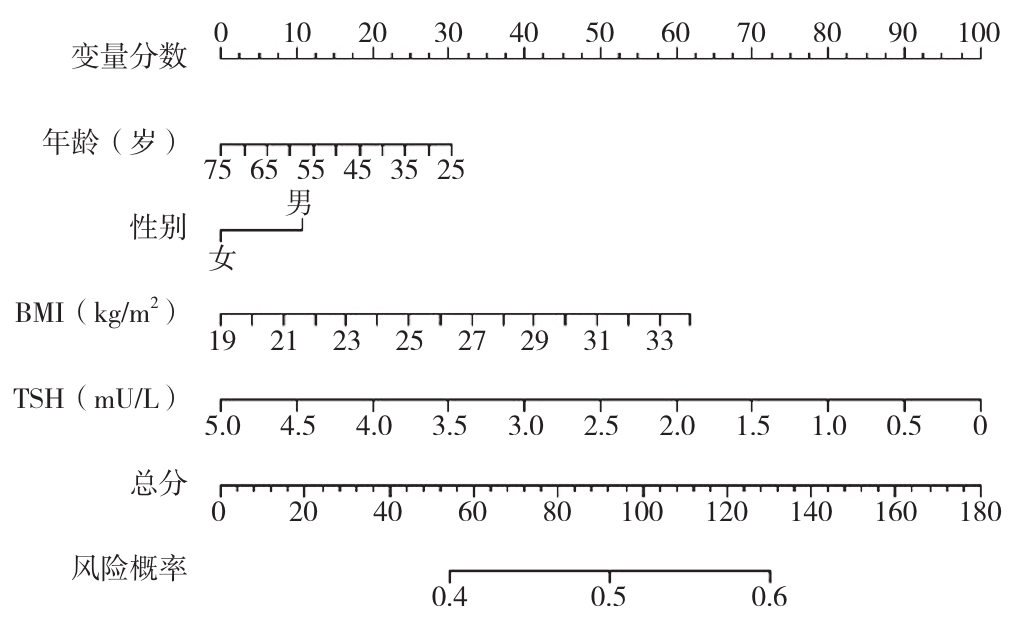
图1 PTC发病风险预测模型的列线图注:TSH=促甲状腺激素。
Figure 1 Nomogram of PTC risk prediction model
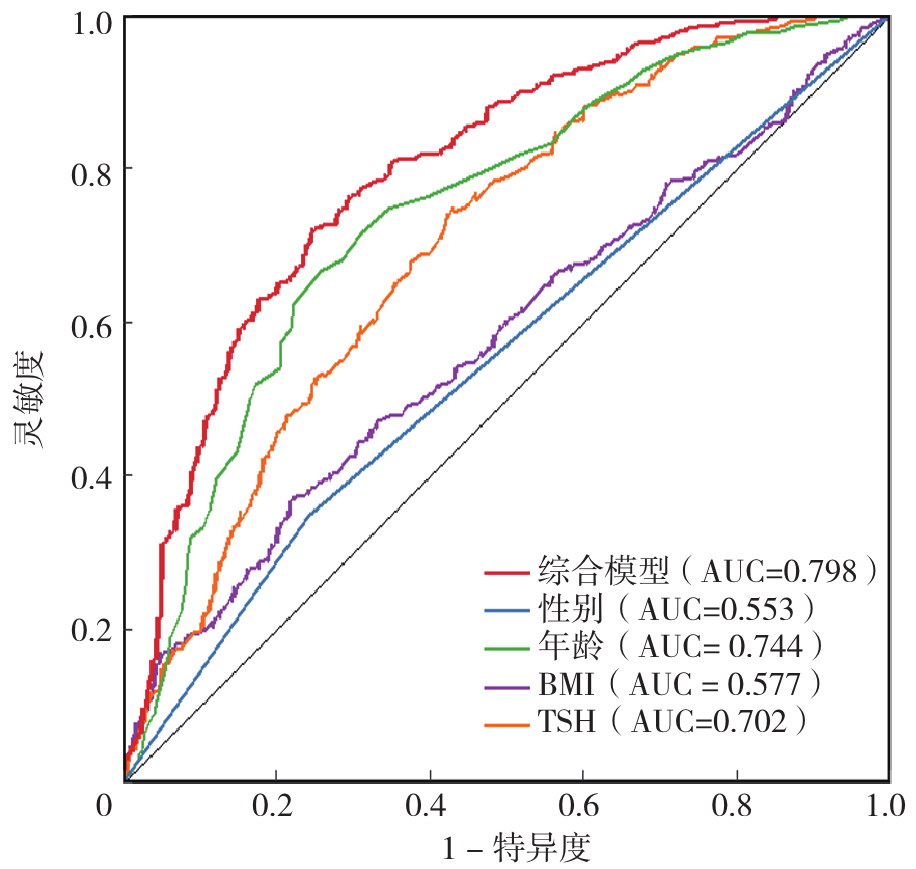
图2 性别、年龄、BMI、TSH及列线图预测模型预测PTC发病的ROC曲线注:AUC=ROC曲线下面积。
Figure 2 ROC curve of gender, age, BMI, TSH, and nomogram prediction model for predicting the incidence of PTC
| 变量 | AUC(95%CI) | 灵敏度 | 特异度 | 约登指数 | 最佳截断值 | P值 |
|---|---|---|---|---|---|---|
| 性别 | 0.553(0.518~0.588) | 0.347 | 0.759 | 0.105 | 0.5 | 0.003 |
| 年龄 | 0.744(0.705~0.782) | 0.666 | 0.743 | 0.409 | 49.5岁 | <0.001 |
| BMI | 0.577(0.533~0.622) | 0.365 | 0.784 | 0.149 | 25.9 kg/m2 | <0.001 |
| TSH | 0.702(0.662~0.742) | 0.749 | 0.571 | 0.320 | 1.315 mU/L | <0.001 |
| 预测模型 | 0.798(0.764~0.832) | 0.721 | 0.752 | 0.474 | 0.502 | <0.001 |
表5 MASLD及列线图预测模型对PTC发病的预测价值
Table 5 The predictive value of MASLD and nomogram prediction model for the incidence of PTC
| 变量 | AUC(95%CI) | 灵敏度 | 特异度 | 约登指数 | 最佳截断值 | P值 |
|---|---|---|---|---|---|---|
| 性别 | 0.553(0.518~0.588) | 0.347 | 0.759 | 0.105 | 0.5 | 0.003 |
| 年龄 | 0.744(0.705~0.782) | 0.666 | 0.743 | 0.409 | 49.5岁 | <0.001 |
| BMI | 0.577(0.533~0.622) | 0.365 | 0.784 | 0.149 | 25.9 kg/m2 | <0.001 |
| TSH | 0.702(0.662~0.742) | 0.749 | 0.571 | 0.320 | 1.315 mU/L | <0.001 |
| 预测模型 | 0.798(0.764~0.832) | 0.721 | 0.752 | 0.474 | 0.502 | <0.001 |
| [1] |
中华人民共和国国家卫生健康委员会医政医管局. 甲状腺癌诊疗指南(2022年版)[J]. 中国实用外科杂志, 2022, 42(12): 1343-1357, 1363. DOI: 10.19538/j.cjps.issn1005-2208.2022.12.02.
|
| [2] |
杨蕊旭, 范建高. 一波未平,一波又起 关于脂肪肝命名的前世今生[J]. 肝博士, 2023(6): 31-32.
|
| [3] |
|
| [4] |
|
| [5] |
|
| [6] |
|
| [7] |
|
| [8] |
范建高, 徐小元, 南月敏, 等. 代谢相关(非酒精性)脂肪性肝病防治指南(2024年版)[J]. 实用肝脏病杂志, 2024, 27(4): 494-510.
|
| [9] |
|
| [10] |
|
| [11] |
|
| [12] |
|
| [13] |
|
| [14] |
|
| [15] |
|
| [16] |
|
| [17] |
|
| [18] |
|
| [19] |
|
| [20] |
|
| [21] |
|
| [22] |
|
| [23] |
|
| [24] |
|
| [25] |
|
| [26] |
|
| [27] |
|
| [28] |
|
| [29] |
|
| [30] |
|
| [31] |
|
| [32] |
|
| [33] |
|
| [34] |
|
| [35] |
|
| [36] |
|
| [37] |
|
| [38] |
|
| [39] |
|
| [40] |
|
| [41] |
|
| [42] |
|
| [1] | 刘帆, 陈秋雨, 李婧. 亚临床高风险人群夜间高血压筛查模型的构建与验证:一项单中心队列研究[J]. 中国全科医学, 2026, 29(15): 1998-2005. |
| [2] | 余新艳, 马忠, 曹凡, 苏鹏, 林颖, 张海澄. 基于单导联可穿戴心电设备预测基层老年心血管代谢疾病患者抑郁发生风险的研究[J]. 中国全科医学, 2026, 29(10): 1300-1310. |
| [3] | 孙沁瑜, 邓毅凡, 杨天笑, 方震, 纪军, 何胜虎, 张晶. 糖化血红蛋白和载脂蛋白A-1比值、三酰甘油葡萄糖-体质指数及联合预测冠状动脉钙化严重程度的临床研究[J]. 中国全科医学, 2026, 29(09): 1137-1145. |
| [4] | 张彦景, 周春华, 李晓东, 刘琰, 王婧, 于静. 文拉法辛血药浓度超警戒值风险预测模型的临床价值研究[J]. 中国全科医学, 2026, 29(06): 777-782. |
| [5] | 张祉薇, 贺盼盼, 杨茜文, 金雪怡, 毛雪倩, 胡颖, 井立鹏. 农村老年人不同肥胖指标与衰弱的相关性研究[J]. 中国全科医学, 2026, 29(06): 699-709. |
| [6] | 阳坚, 吴传安, 周海蓉, 田峰, 迟春花. 三酰甘油葡萄糖-体质指数对2型糖尿病合并代谢相关脂肪性肝病的诊断价值研究[J]. 中国全科医学, 2025, 28(32): 4075-4081. |
| [7] | 贾高鹏, 陈秋雨. 老年急性ST段抬高型心肌梗死经皮冠状动脉介入治疗术后心绞痛复发风险预测模型构建和验证:基于CYP2C19相关基因检测[J]. 中国全科医学, 2025, 28(30): 3779-3786. |
| [8] | 周倩, 吴晓敏, 王宝华, 严若菡, 蔚苗, 吴静. 胃癌发生风险的列线图预测模型研究[J]. 中国全科医学, 2025, 28(23): 2870-2877. |
| [9] | 赵晓晴, 郭桐桐, 张欣怡, 李林虹, 张亚, 嵇丽红, 董志伟, 高倩倩, 蔡伟芹, 郑文贵, 井淇. 社区老年人认知障碍风险预测模型的构建与验证研究[J]. 中国全科医学, 2025, 28(22): 2776-2783. |
| [10] | 王爽, 吴树法, 令垚, 谭茜蔚, 曹汝岱, 曾慧婷, 孔丹莉, 丁元林, 于海兵. 基于代谢组学探究非脂质代谢物在肥胖与糖尿病视网膜病变间的中介作用:孟德尔随机化研究[J]. 中国全科医学, 2025, 28(21): 2625-2634. |
| [11] | 景涛, 戴永梅, 罗健英, 罗维, 季烨林凡, 彭驰, 张翠军, 曹彦俊, 郑清, 黄玉, 沈鹤军. 中国高中生的体质指数、膳食知识掌握水平、静坐时长及影响因素研究[J]. 中国全科医学, 2025, 28(16): 2025-2032. |
| [12] | 李冰, 奚志, 王洋, 修佳琦, 郭前成, 于晨晨, 孙斯雨, 杨霄鹏. 血压变异性和系统性免疫炎症指数与脑小血管病患者发生颅内动脉负性重塑的相关性研究[J]. 中国全科医学, 2025, 28(14): 1751-1757. |
| [13] | 颜丹虹, 甘同舟, 袁空军, 周光清. 1990—2019年中国高BMI所致的疾病负担分析与预测研究[J]. 中国全科医学, 2025, 28(10): 1200-1206. |
| [14] | 石小天, 王珊, 杨华昱, 杨一帆, 李旭, 窦国泽, 马清. 基于血常规炎性指标构建衰弱/衰弱前期发生风险列线图模型研究[J]. 中国全科医学, 2025, 28(05): 587-593. |
| [15] | 张冰青, 胡馨云, 欧阳煜钦, 向心月, 汤文娟, 冯文焕. 非肥胖2型糖尿病患者肌肉量减少危险因素的列线图预测模型研究[J]. 中国全科医学, 2024, 27(33): 4139-4146. |
| 阅读次数 | ||||||
|
全文 |
|
|||||
|
摘要 |
|
|||||