
中国全科医学 ›› 2026, Vol. 29 ›› Issue (34): 5051-5060.DOI: 10.12114/j.issn.1007-9572.2026.0056
• 论著 • 上一篇
马慧琳1, 王瑶瑶1, 李赞1, 杨晨2, 于新娟3, 韩伟4,*( )
收稿日期:2026-06-22
修回日期:2026-09-02
出版日期:2026-12-05
发布日期:2026-10-26
通讯作者:
韩伟
作者贡献:
马慧琳确定研究目标,并负责研究的设计、实施及论文撰写;王瑶瑶、李赞负责数据收集、整理、统计分析及图表绘制;杨晨参与论文修订;于新娟、韩伟负责文章的质量把控、审查及整体监督管理。
基金资助:
MA Huilin1, WANG Yaoyao1, LI Zan1, YANG Chen2, YU Xinjuan3, HAN Wei4,*()
Received:2026-06-22
Revised:2026-09-02
Published:2026-12-05
Online:2026-10-26
Contact:
HAN Wei
摘要: 背景 慢性阻塞性肺疾病(COPD)是全球及我国老年人群面临的重大公共卫生挑战,具有高致残率和高致死率。营养状况是影响COPD患者预后及社区老年人健康管理的可改变的关键因素。甘油三酯-总胆固醇-体重指数(TCBI)是一种整合脂质代谢与体质量的简易营养相关指标,但在社区老年人群COPD筛查及肺功能评估中的应用价值尚不明确。 目的 本研究旨在利用2023年青岛市慢性阻塞性肺疾病高风险人群筛查项目的大规模社区普查数据,探讨TCBI与社区老年人群筛查定义的COPD患病风险及肺功能指标的关联。 方法 本研究为横断面设计,纳入2023年青岛市COPD高风险人群筛查项目的89 368名60岁及以上居民,收集其人口学信息、既往史及生化指标。以"筛查定义的COPD[吸入支气管舒张剂前第1秒用力呼气容积(FEV1)与用力肺活量(FVC)比值(FEV1/FVC)<0.70或既往经医师明确诊断为COPD]"为主要结局指标。采用多因素Logistic回归分析TCBI与筛查定义的COPD患病风险的关联,多元线性回归分析探讨TCBI与肺功能指标[FEV1、FVC、FEV1/FVC、FEV1实测值占预计值的百分比(FEV1%pred)、呼气峰流量(PEF)]的关系,并进行敏感性分析与亚组分析。 结果 研究人群平均年龄为(72.1±5.9)岁,筛查定义的COPD患病率为23.4%(20 912/89 368)。在调整年龄、性别、吸烟状况、腰围、高血压、糖尿病、哮喘、心血管疾病及空腹血糖后,Logistic回归显示Log TCBI每增加1个单位,筛查定义的COPD患病风险降低16%(OR=0.84, 95%CI=0.79~0.89, P<0.001)。多元线性回归显示,Log TCBI与FEV1(β=0.08)、FVC(β=0.07)、FEV1/FVC(β=0.83)及PEF(β=0.21)均呈正相关(P<0.001)。敏感性分析证实上述结果在排除极端消瘦或肥胖、哮喘及严重心血管疾病或糖尿病人群后依然稳健。 结论 在青岛市高龄社区人群中,较高的TCBI水平与较低的筛查定义的COPD风险及较好的肺功能相关。TCBI作为一个整合脂质代谢与能量储备的简易指标,可能为社区老年人群COPD评估及健康管理提供新思路。
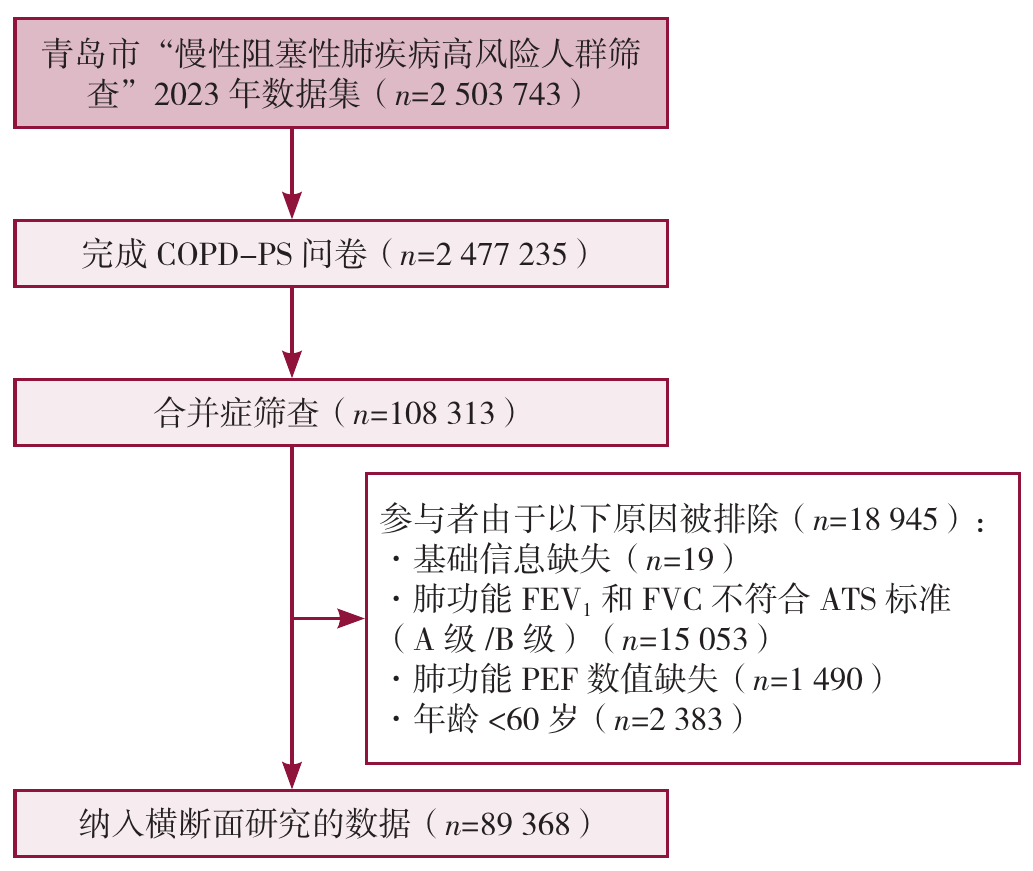
图1 研究对象筛选流程图注:FEV1=第1秒用力呼气容积,FVC=用力肺活量,PEF=呼气峰流量,ATS=美国胸科学会,COPD-PS=慢性阻塞性肺疾病人群筛查问卷。
Figure 1 Flow chart of participant selection
| 特征 | Q1组(n=22 342) | Q2组(n=22 342) | Q3组(n=22 342) | Q4组(n=22 342) | 检验统计量值 | P值 |
|---|---|---|---|---|---|---|
| 年龄( | 73.1±6.1 | 72.4±5.9 | 71.9±5.7 | 71.2±5.5 | 438.187a | <0.001 |
| 年龄[名(%)] | 1 064.198b | <0.001 | ||||
| 60~<70岁 | 6 897(30.9) | 7 782(34.8) | 8 392(37.6) | 9 343(41.8) | ||
| 70~<80岁 | 11 970(53.6) | 11 815(52.9) | 11 724(52.5) | 11 256(50.4) | ||
| ≥80岁 | 3 475(15.6) | 2 745(12.3) | 2 226(10.0) | 1 743(7.8) | ||
| 性别[名(%)] | 1 730.846b | <0.001 | ||||
| 男 | 13 023(58.3) | 10 953(49.0) | 9 709(43.5) | 8 907(39.9) | ||
| 女 | 9 319(41.7) | 11 389(51.0) | 12 633(56.5) | 13 435(60.1) | ||
| 吸烟状况[名(%)] | 156.319b | <0.001 | ||||
| 无 | 19 650(88.0) | 20 045(89.7) | 20 316(90.9) | 20 354(91.1) | ||
| 有 | 2 692(12.0) | 2 297(10.3) | 2 026(9.1) | 1 988(8.9) | ||
| BMI( | 24.1±3.2 | 25.4±3.2 | 26.3±3.2 | 27.1±3.3 | 3 683.757a | <0.001 |
| 腰围( | 83.9±9.0 | 86.8±9.6 | 88.6±9.8 | 90.6±10.1 | 1 986.446a | <0.001 |
| FBG[M(P25,P75),mmol/L] | 5.7(5.1,6.5) | 5.8(5.3,6.6) | 5.9(5.3,6.8) | 6.1(5.5,7.1) | 1 931.374c | <0.001 |
| 高血压[名(%)] | 8.087b | 0.044 | ||||
| 有 | 17 513(78.4) | 17 678(79.1) | 17 743(79.4) | 17 694 (79.2) | ||
| 无 | 4 829(21.6) | 4 664(20.9) | 4 599(20.6) | 4 648 (20.8) | ||
| 糖尿病[名(%)] | 151.039b | <0.001 | ||||
| 有 | 8 373(37.5) | 8 771(39.3) | 8 994(40.3) | 9 616 (43.0) | ||
| 无 | 13 969(62.5) | 13 571(60.7) | 13 348(59.7) | 12 726 (57.0) | ||
| CVD[名(%)] | 13.845b | 0.003 | ||||
| 有 | 1 528(6.8) | 1 444(6.5) | 1 387(6.2) | 1 347(6.0) | ||
| 无 | 20 814(93.2) | 20 898(93.5) | 20 955(93.8) | 20 995(94.0) | ||
| 哮喘[名(%)] | 9.670b | 0.022 | ||||
| 有 | 71(0.3) | 63(0.3) | 52(0.2) | 40(0.2) | ||
| 无 | 22 271(99.7) | 22 279(99.7) | 22 290(99.8) | 22 302(99.8) | ||
| 筛查定义的COPD[名(%)] | 105.166b | <0.001 | ||||
| 有 | 5 648(25.3) | 5 401 (24.2) | 5 039(22.6) | 4 805(21.5) | ||
| 无 | 16 694(74.7) | 16 941 (75.8) | 17 303(77.4) | 17 537(78.5) | ||
| FEV1[M(P25,P75),L] | 2.2(1.5,2.8) | 2.1 (1.5,2.8) | 2.1(1.5,2.8) | 2.1(1.6,2.7) | 14.205c | 0.003 |
| FVC[M(P25,P75),L] | 2.8(2.2,3.4) | 2.7 (2.1,3.3) | 2.7(2.1,3.3) | 2.7(2.2,3.3) | 55.382c | <0.001 |
| FEV1/FVC[M(P25,P75),%] | 81.0(69.0,92.0) | 81.0(70.0,91.0) | 82.0(71.0,91.0) | 82.0(72.0,91.0) | 34.075c | <0.001 |
| FEV1%预计值[M(P25,P75),%] | 91.3(66.4,117.5) | 90.9(67.3,116.3) | 91.5(69.0,116.0) | 91.5(69.9,115.5) | 7.082c | 0.069 |
| PEF[M(P25,P75),L/s] | 4.2(2.4,6.1) | 4.1(2.4,5.9) | 4.1(2.5,5.9) | 4.1(2.5,5.8) | 10.147c | 0.017 |
表1 TCBI四分位数分组调查对象的临床特征
Table 1 Basic data and biochemical characteristics of participants grouped by TCBI quartiles
| 特征 | Q1组(n=22 342) | Q2组(n=22 342) | Q3组(n=22 342) | Q4组(n=22 342) | 检验统计量值 | P值 |
|---|---|---|---|---|---|---|
| 年龄( | 73.1±6.1 | 72.4±5.9 | 71.9±5.7 | 71.2±5.5 | 438.187a | <0.001 |
| 年龄[名(%)] | 1 064.198b | <0.001 | ||||
| 60~<70岁 | 6 897(30.9) | 7 782(34.8) | 8 392(37.6) | 9 343(41.8) | ||
| 70~<80岁 | 11 970(53.6) | 11 815(52.9) | 11 724(52.5) | 11 256(50.4) | ||
| ≥80岁 | 3 475(15.6) | 2 745(12.3) | 2 226(10.0) | 1 743(7.8) | ||
| 性别[名(%)] | 1 730.846b | <0.001 | ||||
| 男 | 13 023(58.3) | 10 953(49.0) | 9 709(43.5) | 8 907(39.9) | ||
| 女 | 9 319(41.7) | 11 389(51.0) | 12 633(56.5) | 13 435(60.1) | ||
| 吸烟状况[名(%)] | 156.319b | <0.001 | ||||
| 无 | 19 650(88.0) | 20 045(89.7) | 20 316(90.9) | 20 354(91.1) | ||
| 有 | 2 692(12.0) | 2 297(10.3) | 2 026(9.1) | 1 988(8.9) | ||
| BMI( | 24.1±3.2 | 25.4±3.2 | 26.3±3.2 | 27.1±3.3 | 3 683.757a | <0.001 |
| 腰围( | 83.9±9.0 | 86.8±9.6 | 88.6±9.8 | 90.6±10.1 | 1 986.446a | <0.001 |
| FBG[M(P25,P75),mmol/L] | 5.7(5.1,6.5) | 5.8(5.3,6.6) | 5.9(5.3,6.8) | 6.1(5.5,7.1) | 1 931.374c | <0.001 |
| 高血压[名(%)] | 8.087b | 0.044 | ||||
| 有 | 17 513(78.4) | 17 678(79.1) | 17 743(79.4) | 17 694 (79.2) | ||
| 无 | 4 829(21.6) | 4 664(20.9) | 4 599(20.6) | 4 648 (20.8) | ||
| 糖尿病[名(%)] | 151.039b | <0.001 | ||||
| 有 | 8 373(37.5) | 8 771(39.3) | 8 994(40.3) | 9 616 (43.0) | ||
| 无 | 13 969(62.5) | 13 571(60.7) | 13 348(59.7) | 12 726 (57.0) | ||
| CVD[名(%)] | 13.845b | 0.003 | ||||
| 有 | 1 528(6.8) | 1 444(6.5) | 1 387(6.2) | 1 347(6.0) | ||
| 无 | 20 814(93.2) | 20 898(93.5) | 20 955(93.8) | 20 995(94.0) | ||
| 哮喘[名(%)] | 9.670b | 0.022 | ||||
| 有 | 71(0.3) | 63(0.3) | 52(0.2) | 40(0.2) | ||
| 无 | 22 271(99.7) | 22 279(99.7) | 22 290(99.8) | 22 302(99.8) | ||
| 筛查定义的COPD[名(%)] | 105.166b | <0.001 | ||||
| 有 | 5 648(25.3) | 5 401 (24.2) | 5 039(22.6) | 4 805(21.5) | ||
| 无 | 16 694(74.7) | 16 941 (75.8) | 17 303(77.4) | 17 537(78.5) | ||
| FEV1[M(P25,P75),L] | 2.2(1.5,2.8) | 2.1 (1.5,2.8) | 2.1(1.5,2.8) | 2.1(1.6,2.7) | 14.205c | 0.003 |
| FVC[M(P25,P75),L] | 2.8(2.2,3.4) | 2.7 (2.1,3.3) | 2.7(2.1,3.3) | 2.7(2.2,3.3) | 55.382c | <0.001 |
| FEV1/FVC[M(P25,P75),%] | 81.0(69.0,92.0) | 81.0(70.0,91.0) | 82.0(71.0,91.0) | 82.0(72.0,91.0) | 34.075c | <0.001 |
| FEV1%预计值[M(P25,P75),%] | 91.3(66.4,117.5) | 90.9(67.3,116.3) | 91.5(69.0,116.0) | 91.5(69.9,115.5) | 7.082c | 0.069 |
| PEF[M(P25,P75),L/s] | 4.2(2.4,6.1) | 4.1(2.4,5.9) | 4.1(2.5,5.9) | 4.1(2.5,5.8) | 10.147c | 0.017 |
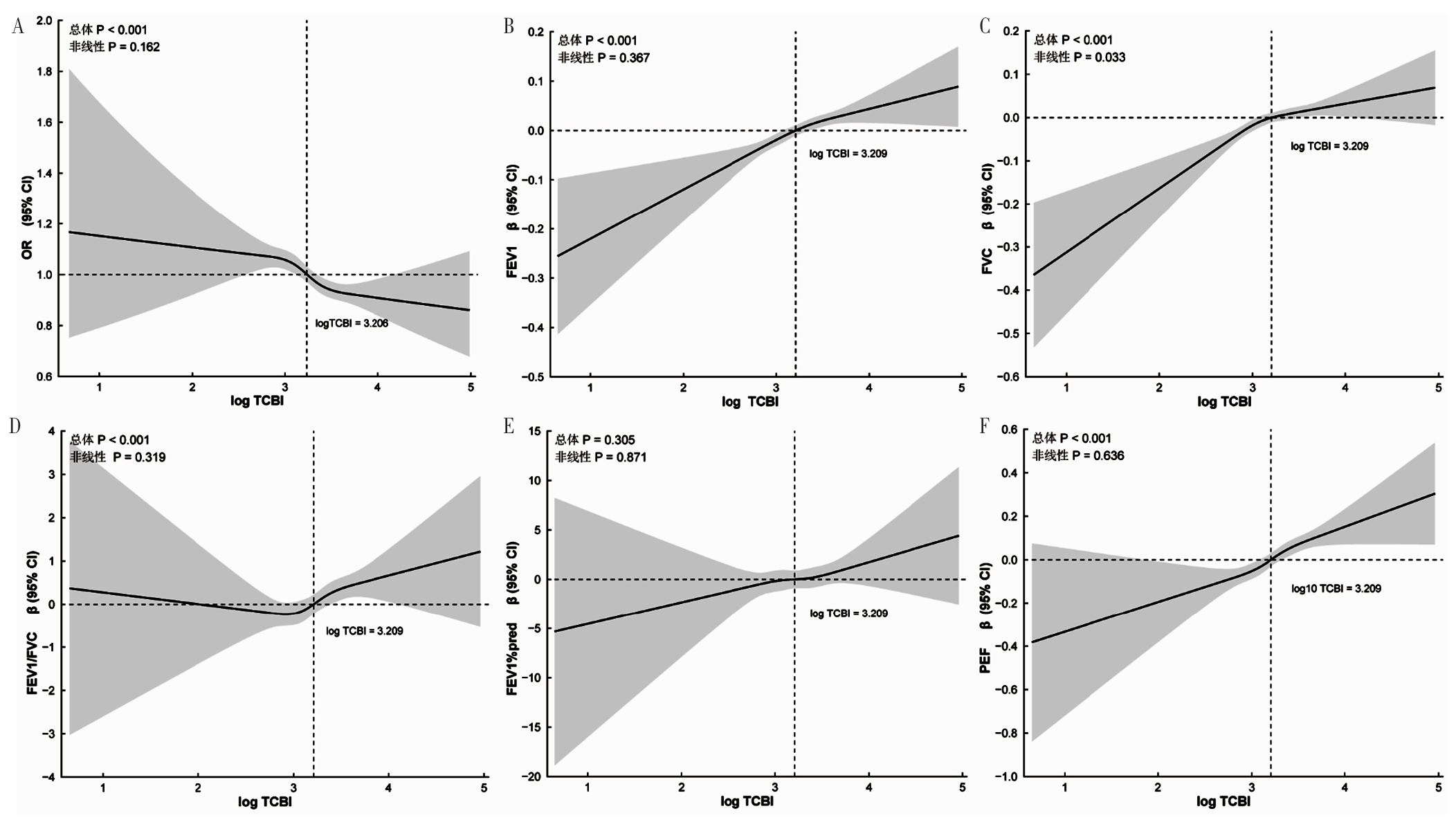
图2 TCBI与筛查定义的COPD及肺功能限制性立方样条图分析注:TCBI=甘油三酯-总胆固醇-体重指数;A为TCBI与筛查定义的COPD风险的非线性检验,B为TCBI与FEV1的非线性检验,C为TCBI与FVC的非线性检验,D为TCBI与FEV1/FVC的非线性检验,E为TCBI与FEV1%预计值的非线性检验,F为TCBI与PEF的非线性检验;根据年龄、性别、吸烟状况、腰围、高血压、糖尿病、哮喘、CVD和FBG进行调整;TCBI值进行了对数变换。
Figure 2 Restricted cubic spline analysis of the relationship between TCBI, screening-defined COPD and lung function
| 变量 | 模型1 | 模型2 | 模型3 | |||
|---|---|---|---|---|---|---|
| OR(95%CI) | P值 | OR(95%CI) | P值 | OR(95%CI) | P值 | |
| Log TCBI | 0.76(0.72~0.80) | <0.001 | 0.82(0.78~0.87) | <0.001 | 0.84(0.79~0.89) | <0.001 |
| Q1组 | 1.00 | — | 1.00 | — | 1.00 | — |
| Q2组 | 0.94(0.90~0.98) | 0.007 | 0.97(0.93~1.02) | 0.205 | 0.98(0.94~1.02) | 0.367 |
| Q3组 | 0.86(0.82~0.90) | <0.001 | 0.91(0.87~0.95) | <0.001 | 0.92(0.88~0.96) | <0.001 |
| Q4组 | 0.81(0.78~0.85) | <0.001 | 0.86(0.83~0.90) | <0.001 | 0.88(0.84~0.92) | <0.001 |
表2 TCBI与筛查定义的COPD患病风险的多因素Logistic回归分析
Table 2 Multivariable Logistic regression results for the association between TCBI and screening-defined COPD risk
| 变量 | 模型1 | 模型2 | 模型3 | |||
|---|---|---|---|---|---|---|
| OR(95%CI) | P值 | OR(95%CI) | P值 | OR(95%CI) | P值 | |
| Log TCBI | 0.76(0.72~0.80) | <0.001 | 0.82(0.78~0.87) | <0.001 | 0.84(0.79~0.89) | <0.001 |
| Q1组 | 1.00 | — | 1.00 | — | 1.00 | — |
| Q2组 | 0.94(0.90~0.98) | 0.007 | 0.97(0.93~1.02) | 0.205 | 0.98(0.94~1.02) | 0.367 |
| Q3组 | 0.86(0.82~0.90) | <0.001 | 0.91(0.87~0.95) | <0.001 | 0.92(0.88~0.96) | <0.001 |
| Q4组 | 0.81(0.78~0.85) | <0.001 | 0.86(0.83~0.90) | <0.001 | 0.88(0.84~0.92) | <0.001 |
| 变量 | 模型1 | 模型2 | 模型3 | |||
|---|---|---|---|---|---|---|
| β(95%CI) | P值 | β(95%CI) | P值 | β(95%CI) | P值 | |
| FEV1 | ||||||
| Log TCBI | -0.01(-0.03~0.01) | 0.532 | 0.03(0.01~0.05) | 0.007 | 0.08(0.06~0.10) | <0.001 |
| 组别(以Q1组为参照) | ||||||
| Q2组 | -0.02(-0.04~0.00) | 0.010 | 0.00(-0.02~0.01) | 0.571 | 0.01(0.00~0.03) | 0.130 |
| Q3组 | -0.02(-0.03~0.00) | 0.020 | 0.01(-0.01~0.02) | 0.415 | 0.03(0.02~0.05) | <0.001 |
| Q4组 | 0.00(-0.03~0.01) | 0.097 | 0.01(0.00~0.03) | 0.065 | 0.05(0.04~0.07) | <0.001 |
| FVC | ||||||
| Log TCBI | -0.05(-0.07~-0.03) | <0.001 | 0.00(-0.02~0.03) | 0.648 | 0.07(0.05~0.09) | <0.001 |
| 组别(以Q1组为参照) | ||||||
| Q2组 | -0.03(-0.05~-0.01) | <0.001 | 0.00(-0.02~0.01) | 0.584 | 0.02(0.00~0.03) | 0.037 |
| Q3组 | -0.04(-0.06~-0.03) | <0.001 | 0.00(-0.02~0.02) | 0.899 | 0.04(0.02~0.05) | <0.001 |
| Q4组 | -0.04(-0.07~-0.03) | <0.001 | 0.00(-0.02~0.01) | 0.726 | 0.05(0.03~0.07) | <0.001 |
| FEV1/FVC | ||||||
| Log TCBI | 1.50(1.10~1.90) | <0.001 | 1.10(0.72~1.50) | <0.001 | 0.83(0.41~1.30) | <0.001 |
| 组别(以Q1组为参照) | ||||||
| Q2组 | 0.28(-0.05~0.61) | 0.098 | 0.12(-0.21~0.45) | 0.482 | 0.01(-0.32~0.35) | 0.940 |
| Q3组 | 0.72(0.39~1.10) | <0.001 | 0.46(0.13~0.80) | 0.007 | 0.29(-0.05~0.63) | 0.090 |
| Q4组 | 1.20(0.85~1.50) | <0.001 | 0.88(0.54~1.20) | <0.001 | 0.64(0.29~0.99) | <0.001 |
| FEV1%预计值 | ||||||
| Log TCBI | 1.20(-0.43~2.80) | 0.148 | -1.10(-2.70~0.53) | 0.186 | 1.60(-0.12~3.30) | 0.069 |
| 组别(以Q1组为参照) | ||||||
| Q2组 | 0.02(-1.30~1.40) | 0.979 | -1.20(-2.50~0.16) | 0.085 | -0.26(-1.60~1.10) | 0.701 |
| Q3组 | 1.20(-0.12~2.50) | 0.076 | -0.62(-2.00~0.71) | 0.360 | 0.85(-0.51~2.20) | 0.221 |
| Q4组 | 0.71(-0.63~2.00) | 0.300 | -1.30(-2.70~0.02) | 0.053 | 0.74(-0.65~2.10) | 0.295 |
| PEF | ||||||
| Log TCBI | -0.04(-0.09~0.02) | 0.191 | 0.05(0.00~0.11) | 0.053 | 0.21(0.16~0.27) | <0.001 |
| 组别(以Q1组为参照) | ||||||
| Q2组 | -0.07(-0.11~-0.02) | 0.004 | -0.02(-0.07~0.02) | 0.291 | 0.03(-0.02~0.07) | 0.256 |
| Q3组 | -0.06(-0.11~-0.02) | 0.007 | 0.00(-0.04~0.05) | 0.890 | 0.09(0.04~0.13) | <0.001 |
| Q4组 | -0.05(-0.09~0.00) | 0.039 | 0.03(-0.02~0.07) | 0.211 | 0.15(0.10~0.20) | <0.001 |
表3 TCBI与肺功能关系的多元线性回归分析
Table 3 Multivariable linear regression results for the association between TCBI and lung function
| 变量 | 模型1 | 模型2 | 模型3 | |||
|---|---|---|---|---|---|---|
| β(95%CI) | P值 | β(95%CI) | P值 | β(95%CI) | P值 | |
| FEV1 | ||||||
| Log TCBI | -0.01(-0.03~0.01) | 0.532 | 0.03(0.01~0.05) | 0.007 | 0.08(0.06~0.10) | <0.001 |
| 组别(以Q1组为参照) | ||||||
| Q2组 | -0.02(-0.04~0.00) | 0.010 | 0.00(-0.02~0.01) | 0.571 | 0.01(0.00~0.03) | 0.130 |
| Q3组 | -0.02(-0.03~0.00) | 0.020 | 0.01(-0.01~0.02) | 0.415 | 0.03(0.02~0.05) | <0.001 |
| Q4组 | 0.00(-0.03~0.01) | 0.097 | 0.01(0.00~0.03) | 0.065 | 0.05(0.04~0.07) | <0.001 |
| FVC | ||||||
| Log TCBI | -0.05(-0.07~-0.03) | <0.001 | 0.00(-0.02~0.03) | 0.648 | 0.07(0.05~0.09) | <0.001 |
| 组别(以Q1组为参照) | ||||||
| Q2组 | -0.03(-0.05~-0.01) | <0.001 | 0.00(-0.02~0.01) | 0.584 | 0.02(0.00~0.03) | 0.037 |
| Q3组 | -0.04(-0.06~-0.03) | <0.001 | 0.00(-0.02~0.02) | 0.899 | 0.04(0.02~0.05) | <0.001 |
| Q4组 | -0.04(-0.07~-0.03) | <0.001 | 0.00(-0.02~0.01) | 0.726 | 0.05(0.03~0.07) | <0.001 |
| FEV1/FVC | ||||||
| Log TCBI | 1.50(1.10~1.90) | <0.001 | 1.10(0.72~1.50) | <0.001 | 0.83(0.41~1.30) | <0.001 |
| 组别(以Q1组为参照) | ||||||
| Q2组 | 0.28(-0.05~0.61) | 0.098 | 0.12(-0.21~0.45) | 0.482 | 0.01(-0.32~0.35) | 0.940 |
| Q3组 | 0.72(0.39~1.10) | <0.001 | 0.46(0.13~0.80) | 0.007 | 0.29(-0.05~0.63) | 0.090 |
| Q4组 | 1.20(0.85~1.50) | <0.001 | 0.88(0.54~1.20) | <0.001 | 0.64(0.29~0.99) | <0.001 |
| FEV1%预计值 | ||||||
| Log TCBI | 1.20(-0.43~2.80) | 0.148 | -1.10(-2.70~0.53) | 0.186 | 1.60(-0.12~3.30) | 0.069 |
| 组别(以Q1组为参照) | ||||||
| Q2组 | 0.02(-1.30~1.40) | 0.979 | -1.20(-2.50~0.16) | 0.085 | -0.26(-1.60~1.10) | 0.701 |
| Q3组 | 1.20(-0.12~2.50) | 0.076 | -0.62(-2.00~0.71) | 0.360 | 0.85(-0.51~2.20) | 0.221 |
| Q4组 | 0.71(-0.63~2.00) | 0.300 | -1.30(-2.70~0.02) | 0.053 | 0.74(-0.65~2.10) | 0.295 |
| PEF | ||||||
| Log TCBI | -0.04(-0.09~0.02) | 0.191 | 0.05(0.00~0.11) | 0.053 | 0.21(0.16~0.27) | <0.001 |
| 组别(以Q1组为参照) | ||||||
| Q2组 | -0.07(-0.11~-0.02) | 0.004 | -0.02(-0.07~0.02) | 0.291 | 0.03(-0.02~0.07) | 0.256 |
| Q3组 | -0.06(-0.11~-0.02) | 0.007 | 0.00(-0.04~0.05) | 0.890 | 0.09(0.04~0.13) | <0.001 |
| Q4组 | -0.05(-0.09~0.00) | 0.039 | 0.03(-0.02~0.07) | 0.211 | 0.15(0.10~0.20) | <0.001 |
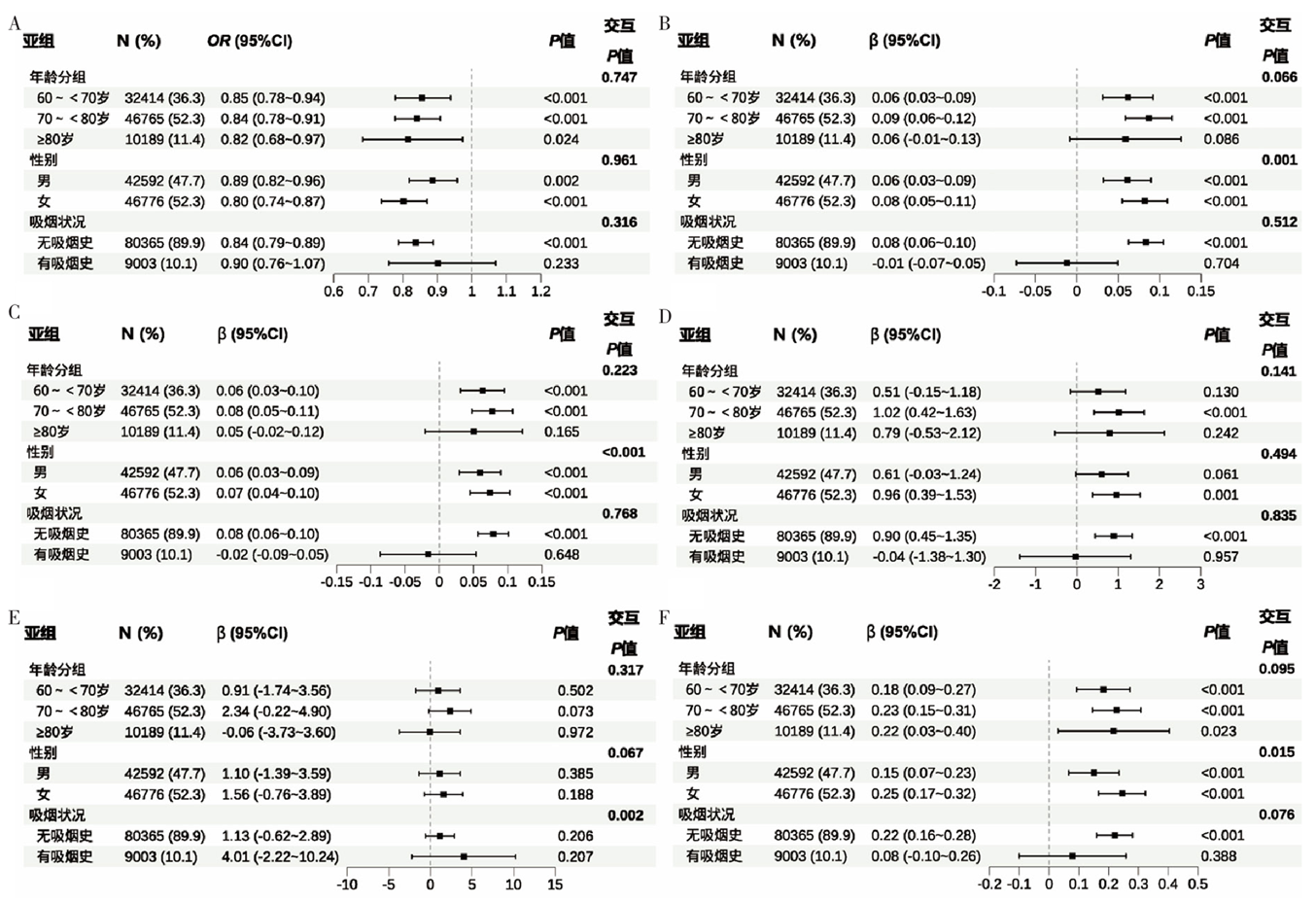
图3 TCBI与筛查定义的COPD及肺功能的亚组分析注:A为TCBI与筛查定义的COPD患病风险的亚组分析,B为TCBI与FEV1的亚组分析,C为TCBI与FVC的亚组分析,D为TCBI与FEV1/FVC的亚组分析,E为TCBI与FEV1%预计值的亚组分析,F为TCBI与PEF的亚组分析;根据年龄、性别、吸烟状况、腰围、高血压、糖尿病、哮喘、CVD和FBG进行调整;TCBI值进行了对数变换。
Figure 3 Subgroup analyses of associations between TCBI and screening-defined COPD, lung function
| 模型 | 人数 | OR(95%CI) | P值 |
|---|---|---|---|
| 主要分析 | 89 368 | 0.840(0.794~0.889) | <0.001 |
| 敏感性分析1(排除BMI<18.5 kg/m2或>35 kg/m2者) | 87 580 | 0.844(0.797~0.893) | <0.001 |
| 敏感性分析2(排除患有哮喘者) | 89 142 | 0.840(0.794~0.889) | <0.001 |
| 敏感性分析3(排除患有心血管疾病或糖尿病者) | 50 529 | 0.860(0.796~0.929) | <0.001 |
表4 TCBI与筛查定义的COPD的敏感性分析
Table 4 Sensitivity analysis of TCBI and screening COPD
| 模型 | 人数 | OR(95%CI) | P值 |
|---|---|---|---|
| 主要分析 | 89 368 | 0.840(0.794~0.889) | <0.001 |
| 敏感性分析1(排除BMI<18.5 kg/m2或>35 kg/m2者) | 87 580 | 0.844(0.797~0.893) | <0.001 |
| 敏感性分析2(排除患有哮喘者) | 89 142 | 0.840(0.794~0.889) | <0.001 |
| 敏感性分析3(排除患有心血管疾病或糖尿病者) | 50 529 | 0.860(0.796~0.929) | <0.001 |
| [1] |
GBD 2017 Chronic Respiratory Disease Collaborators. Prevalence and attributable health burden of chronic respiratory diseases, 1990-2017: a systematic analysis for the Global Burden of Disease Study 2017[J]. Lancet Respir Med, 2020, 8(6): 585-596. DOI: 10.1016/s2213-2600(20)30105-3.
|
| [2] |
|
| [3] |
中华医学会呼吸病学分会慢性阻塞性肺疾病学组,中国医师协会呼吸医师分会慢性阻塞性肺疾病工作委员会. 慢性阻塞性肺疾病诊治指南(2021年修订版)[J]. 中华结核和呼吸杂志, 2021, 44(3): 170-205. DOI: 10.3760/cma.j.cn112147-20210109-00031.
|
| [4] |
|
| [5] |
|
| [6] |
|
| [7] |
|
| [8] |
|
| [9] |
|
| [10] |
|
| [11] |
|
| [12] |
|
| [13] |
|
| [14] |
|
| [15] |
|
| [16] |
|
| [17] |
|
| [18] |
|
| [19] |
胡晓江,徐金水,姜仑. 国家基本公共卫生服务健康管理与实践手册[M]. 南京: 东南大学出版社, 2020: 99-119.
|
| [20] |
|
| [21] |
|
| [22] |
|
| [23] |
|
| [24] |
国家呼吸医学中心,中国医师协会呼吸医师分会,中国医学科学院呼吸病学研究院,等. 中国慢性阻塞性肺疾病健康管理规范[M]. 北京: 人民卫生出版社, 2021: 143.
|
| [25] |
方利文,包鹤龄,王临虹. 柳叶刀子刊:中国40岁以上居民慢性阻塞性肺疾病患病率高达13. 6%[J]. 健康之家, 2018(10): 4-6.
|
| [26] |
|
| [27] |
|
| [28] |
|
| [29] |
|
| [30] |
王凤燕,张冬莹,梁振宇,等. 面向全科医生的《慢性阻塞性肺疾病诊治指南(2021年修订版)》解读[J]. 中国全科医学, 2021, 24(29): 3660-3663, 3677. DOI: 10.12114/j.issn.1007-9572.2021.01.304.
|
| [1] | 白云飞, 张永明, 李述刚, 高晓嶙, 孙碧云, 高文娟, 杨凡, 胡钰昊, 王思翔, 朱悦彤, 王文巧. 慢性阻塞性肺疾病运动处方指南[J]. 中国全科医学, 2026, 29(34): 4993-5009. |
| [2] | 王帅航, 曹业迪, 陈飞, 朱赛楠, 高莹. 体质量调整腰围指数与甲状腺功能和自身免疫的关系:基于NHANES数据[J]. 中国全科医学, 2026, 29(30): 4406-4414. |
| [3] | 赵家义, 樊剑, 于德华. 1秒率正常的肺功能受损人群现状、挑战及应对策略[J]. 中国全科医学, 2026, 29(30): 4366-4371. |
| [4] | 张帅帅, 陈玥, 邱娇娇, 朱平, 王曙霞. 残余胆固醇炎症指数与中国中老年人生物学年龄加速的关联:一项全国性队列研究[J]. 中国全科医学, 2026, 29(30): 4397-4405. |
| [5] | 祁晶, 蔡青, 张婉婷, 顾岩. 基于微信小程序的远程肺康复对稳定期慢性阻塞性肺疾病患者多维疗效及依从性研究[J]. 中国全科医学, 2026, 29(24): 3476-3485. |
| [6] | 王龙雨, 李亚, 马倩, 贾沛霖, 张海龙. 肺一氧化碳弥散量在慢性阻塞性肺疾病中的临床应用研究进展[J]. 中国全科医学, 2026, 29(23): 3379-3384. |
| [7] | 陈莹莹, 朱高培, 薛付忠. 主动健康管理模式下山东省老年人服药依从性现状及影响因素分析[J]. 中国全科医学, 2026, 29(22): 3220-3225. |
| [8] | 范文瑜, 冯霞, 张世龙, 马兴丽, 张馨丹, 赵洋, 王海鹏. 山东省糖尿病患者医防融合服务利用行为及影响因素研究[J]. 中国全科医学, 2026, 29(22): 3192-3198. |
| [9] | 刘影, 刘世炜, 张驰, 沈姞, 张玉珊, 张洁, 桑莹宸, 王友娇, 王蕾, 周厚广, 施红. 中国老年脑卒中患者主观认知功能下降流行特征及影响因素研究[J]. 中国全科医学, 2026, 29(20): 2829-2835. |
| [10] | 张文博, 王骏龙, 张玉萍, 蒋帅, 王华启. 不同筛查指标下慢性阻塞性肺疾病前期人群发展为慢性阻塞性肺疾病风险的Meta分析[J]. 中国全科医学, 2026, 29(19): 2735-2743. |
| [11] | 郑泽陆, 周峻, 梁志, 王雪惠, 徐峰, 李欧静, 肖红, 刘晓雨, 杨青梅, 张梅, 林娜, 宓保宏, 陈卫衡. 骨关节炎患者共病特征和治疗现状:一项基于社区诊疗数据的横断面调查[J]. 中国全科医学, 2026, 29(16): 2205-2213. |
| [12] | 宋路, 兰志刚, 周葳, 冯丽萍, 刘运秋, 陈朔华, 王丽晔. 男性人群糖尿病和肺功能的相关性研究[J]. 中国全科医学, 2026, 29(12): 1572-1578. |
| [13] | 顾瀚东, 卢鸿润, 顾可羿, 韩正, 杨菲, 付晓雅, 王为强. 相对脂肪量与心血管代谢性共病发病风险的相关性研究[J]. 中国全科医学, 2026, 29(11): 1456-1462. |
| [14] | 王殊琪, 马俊, 吴韵琳, 陈凤芳, 陈娴秋, 杨文兰, 李秋红, 黄劲, 冯永红. 血清ACE和sIL-2R与男女性Ⅱ期肺结节病患者肺功能指标相关性的差异研究[J]. 中国全科医学, 2026, 29(10): 1316-1323. |
| [15] | 宋路, 王丽晔, 修春霞, 冯宝静, 冯丽萍, 高艳松, 李梦, 代妍. 慢性阻塞性肺疾病合并高血压患者肺功能与血压变异性的相关研究[J]. 中国全科医学, 2026, 29(10): 1311-1315. |
| 阅读次数 | ||||||
|
全文 |
|
|||||
|
摘要 |
|
|||||