中国全科医学 ›› 2026, Vol. 29 ›› Issue (34): 5094-5100.DOI: 10.12114/j.issn.1007-9572.2024.0571

• 论著 • 上一篇    

2010—2021年中国食管癌死亡率变化趋势分析及预测研究

王雪婷, 姚卫光*()   

  1. 510515 广东省广州市,南方医科大学卫生管理学院
  • 收稿日期:2024-10-08 修回日期:2025-06-30 出版日期:2026-12-05 发布日期:2026-10-26
  • 通讯作者: 姚卫光

  • 作者贡献:

    王雪婷负责研究的构思与设计,研究的实施,撰写论文,进行数据的收集与整理,统计学处理,图、表的绘制与展示及论文的修订;姚卫光负责文章的质量控制与审查,对文章整体负责,监督管理。

  • 基金资助:
    广州市公共卫生服务体系建设研究基地资助项目

Trend Analysis and Forecasting Study of Esophageal Cancer Mortality Rate Change in China from 2010 to 2021

WANG Xueting, YAO Weiguang*()   

  1. School of Health Management, Southern Medical University, Guangzhou 510515, China
  • Received:2024-10-08 Revised:2025-06-30 Published:2026-12-05 Online:2026-10-26
  • Contact: YAO Weiguang

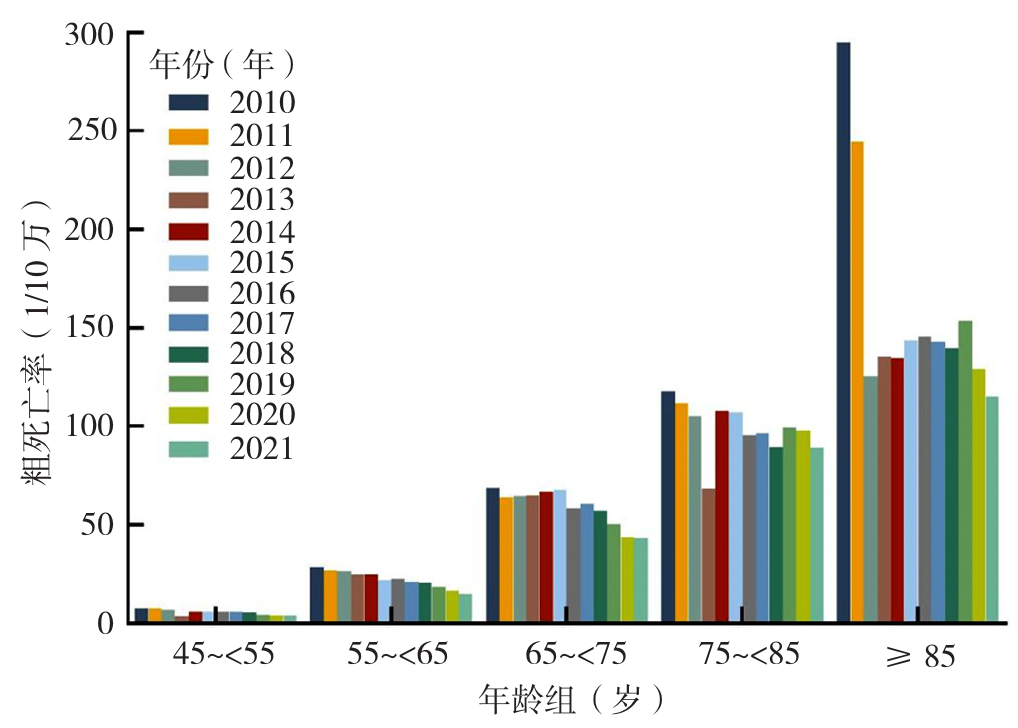
摘要: 背景 全球近一半的食管癌死亡病例集中在我国,对我国公共卫生系统造成了巨大负担,严重影响患者的生命质量。系统评估死亡趋势并进行预测,对完善食管癌防控策略具有重要参考价值。 目的 本研究旨在分析2010—2021年食管癌死亡现状及既往趋势,并预测2022—2030年的变化趋势,以期为优化食管癌防控策略提供参考依据。 方法 收集《中国死因监测结果数据集(2010—2021)》中食管癌死亡数据,利用第六次人口普查的数据进行年龄标化处理;选择粗死亡率及标化死亡率对2010—2021年中国不同年龄、性别、城乡、地区居民的死亡状况进行描述;使用Joinpoint回归模型对标化死亡率的年度变化百分比(APC)与平均年度变化百分比(AAPC)进行趋势分析;建立GM(1,1)模型对2022—2030年的食管癌死亡数据进行预测。 结果 2010—2021年中国居民食管癌总体粗死亡率由2010年的12.05/10万下降到2021年的11.70/10万,下降率为2.90%;总体食管癌标化死亡率从2010年的12.65/10万下降到2021年的7.41/10万,降幅为41.44%;粗死亡率水平呈现出明显的性别、城乡和地域差异,具体表现为男性高于女性、农村高于城市、东部地区高于中部、西部地区,年龄是重要的食管癌危险因素;2010—2021年女性食管癌标化死亡率呈下降趋势(AAPC=-5.18%,P<0.05)高于男性(AAPC=-3.96%,P<0.05);农村食管癌标化死亡率呈下降趋势(AAPC=-5.58%,P<0.05),城市下降趋势不明显;中部地区食管癌标化死亡率呈下降趋势(AAPC=-6.92%,P<0.05)高于东部地区(AAPC=-3.25%,P<0.05),西部地区无明显下降趋势;GM(1,1)模型预测2022—2030年中国食管癌和粗死亡率将下降到11.70/10万,标化死亡率将下降到6.06/10万。 结论 2010—2021年中国食管癌粗食管癌死亡状况有所改善,但疾病负担仍然沉重。应重点关注男性和老年居民,强化城乡及东西部地区的食管癌早期筛查诊治,综合考虑地区特点、人群特征及风险因素,实施更为精细化的食管癌防控工作。

关键词: 食管肿瘤, 粗死亡率, 标化死亡率, Joinpoint回归模型, GM(1,1)模型

Abstract:

Background

Nearly half of the global esophageal cancer deaths are concentrated in China, posing a significant burden on the country's public health system and severely impacting patients' quality of life. Systematically assessing death trends and making predictions is of great reference value for improving esophageal cancer prevention and control strategies.

Objective

This study aimed to assess the current status and historical trends in esophageal cancer mortality from 2010 to 2021, with projections to 2030, to inform the optimization of prevention and control strategies.

Methods

Data on esophageal cancer deaths from the China Cause of Death Surveillance Dataset(2010-2021)were analyzed. Age standardization was performed using data from the sixth population census. Crude and standardized mortality rates were used to describe mortality patterns among Chinese residents, stratified by age, sex, urban-rural residence, and geographic region. Joinpoint regression models were applied to analyze trends in standardized mortality rates, and the annual percentage change(APC)and average annual percentage change(AAPC)were calculated. Additionally, a GM (1, 1) model was constructed to predict esophageal cancer deaths from 2022 to 2030.

Results

From 2010 to 2021, the crude mortality rate of esophageal cancer in China declined from 12.05/100 000 to 11.70/100 000, representing a 2.90% drop. The standardized mortality rate showed a more significant decrease, falling from 12.65/100 000 to 7.41/100 000, a 41.44% reduction. Clear disparities exist, with males, rural areas, and the eastern region exhibiting higher mortality rates. Age is a key risk factor. Notably, the standardized mortality rate decline was steeper for females (AAPC=-5.18%, P<0.05) than males (AAPC=-3.96%, P<0.05) . In rural areas, the decline was marked (AAPC=-5.58%, P<0.05), while urban areas showed less obvious trends. Central China saw a steeper decline (AAPC=-6.92%, P<0.05) than the east (AAPC=-3.25%, P<0.05) , with the west showing no significant trend. GM (1, 1) model predicted that the crude death rate of esophageal cancer in China would decrease to 11.70/100 000 in 2022-2030. The standardized death rate will drop to 6.06/100 000.

Conclusion

While esophageal cancer mortality in China decreased during the study period, the burden remains heavy. Special attention should be given to males and the elderly. Enhanced screening, diagnosis, and treatment are needed in both urban and rural, as well as eastern and western regions. More targeted prevention and control strategies, considering regional, population, and risk factors, are warranted.

Key words: Esophageal neoplasms, Crude mortality, Standardized mortality, Joinpoint regression model, GM (1, 1) model

中图分类号: