中国全科医学 ›› 2026, Vol. 29 ›› Issue (32): 4805-4814.DOI: 10.12114/j.issn.1007-9572.2025.0100
所属专题: 阿尔茨海默病最新文章合辑
谭丽博1,2, 刘南阳3, 李浩2,*( )
)
收稿日期:2025-05-10
修回日期:2025-06-04
出版日期:2026-11-15
发布日期:2026-10-10
通讯作者:
李浩
作者贡献:
李浩负责文章的构思与设计,并与谭丽博共同讨论提出研究思路;谭丽博负责进行研究的整体规划和文献检索,负责论文起草;谭丽博、刘南阳负责文献筛选、资料提取、数据整理和分析等;刘南阳参与论文草稿的修改;李浩负责最终版本修订及审校,对文章整体负责、监督管理;所有作者确认论文终稿。
基金资助:
TAN Libo1,2, LIU Nanyang3, LI Hao2,*()
Received:2025-05-10
Revised:2025-06-04
Published:2026-11-15
Online:2026-10-10
Contact:
LI Hao
摘要: 背景 阿尔茨海默病(AD)是一种复杂的神经系统退行性疾病,其治疗给患者及家庭带来了沉重的负担。近年来中成药治疗AD的临床研究不断增加,但研究的证据支撑情况尚不清楚。 目的 分析2019—2024年中成药治疗AD的临床研究相关证据情况。 方法 检索2019—2024年的8个中英文数据库(中国知网、万方数据知识服务平台、维普网、中国生物医学文献服务系统、PubMed、Web of Science、Cochrane Library、Embase数据库)中收录的中成药治疗AD的文献,采用文字结合图表的形式展示证据分布特征。 结果 最终纳入临床试验82篇,系统综述/Meta分析30篇,网状Meta分析9篇,指南/专家共识/路径等7篇,系统评价再评价1篇,卫生技术评估1篇。近年来中成药治疗AD的关注度呈波动下降的趋势,临床研究与评价集中于21种中成药,其中对口服中成药复方苁蓉益智胶囊和复方海蛇胶囊关注度最多,注射剂主要为银杏叶提取物。临床研究主要为单中心、小规模的随机对照试验,且文献质量普遍不高。在结局指标选择方面,主要侧重于认知功能指标、替代结局指标和生活质量等指标,指标缺乏中医辨证论治的特色,指标的选择、测量等缺乏规范性。系统综述/Meta分析的整体质量较低,方法学质量以及临床实践指南和专家共识的制定和报告规范性均有待进一步提高。 结论 中成药治疗AD已开展了一些单中心、小样本的临床研究,今后需结合中成药治疗AD的临床诊疗实践特点进一步开展多中心、大样本、高质量的临床研究,以利于形成高质量的临床证据,为中成药治疗AD提供参考依据。
中图分类号:
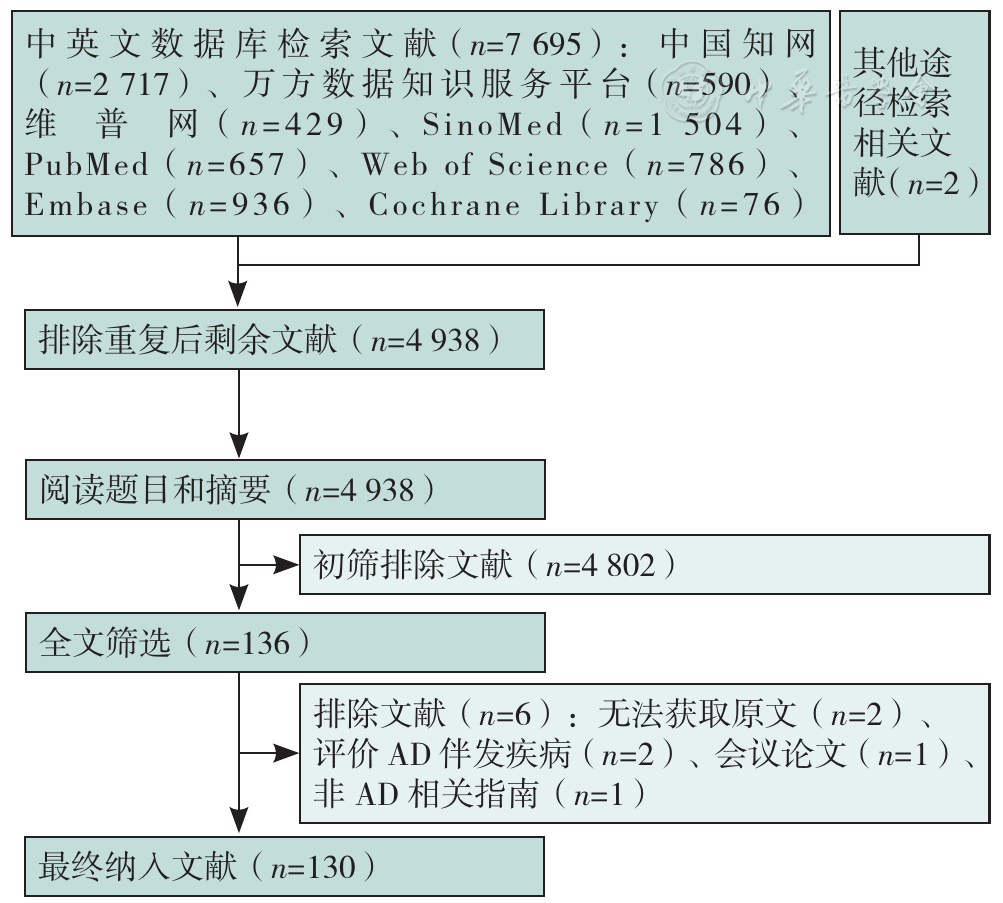
图1 文献筛选流程图注:SinoMed=中国生物医学文献服务系统,AD=阿尔茨海默病。
Figure 1 The flow diagram of studies screening process
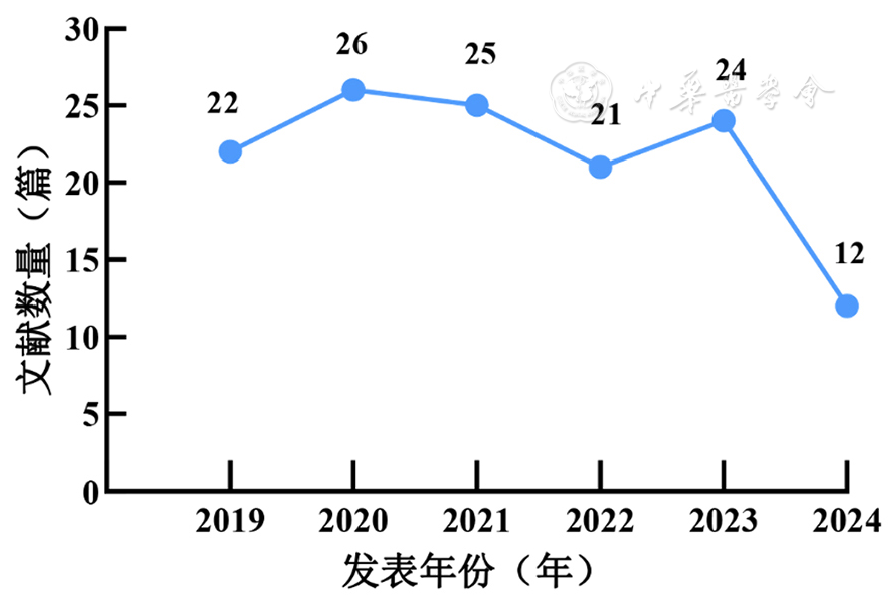
图2 中成药治疗阿尔茨海默病文献发表趋势
Figure 2 Literature publishing trend of Chinese patent medicines for AD
| 序号 | 中成药名称 | 药物使用频次(次) | 所占比例(%) |
|---|---|---|---|
| 1 | 复方苁蓉益智胶囊 | 16 | 18.82 |
| 2 | 复方海蛇胶囊 | 12 | 14.12 |
| 3 | 银杏叶提取物注射液 | 9 | 10.59 |
| 4 | 银杏叶片(胶囊) | 9 | 10.59 |
| 5 | 六味地黄丸(胶囊) | 7 | 8.24 |
| 6 | 天智颗粒 | 6 | 7.06 |
| 7 | 还少丹(胶囊) | 4 | 4.71 |
| 8 | 养血清脑丸(颗粒) | 4 | 4.71 |
| 9 | 灯盏生脉胶囊 | 2 | 2.35 |
| 10 | 复方丹参片 | 2 | 2.35 |
| 11 | 龟龄集胶囊 | 2 | 2.35 |
| 12 | 健脑胶囊 | 2 | 2.35 |
| 13 | 金匮肾气丸 | 2 | 2.35 |
| 14 | 复方活脑舒胶囊 | 1 | 1.18 |
| 15 | 黄芪注射液 | 1 | 1.18 |
| 16 | 脑心通胶囊 | 1 | 1.18 |
| 17 | 清宫寿桃丸 | 1 | 1.18 |
| 18 | 乌梅丸 | 1 | 1.18 |
| 19 | 银杏达莫注射液 | 1 | 1.18 |
| 20 | 银杏内酯注射液 | 1 | 1.18 |
| 21 | 华佗再造丸 | 1 | 1.18 |
表1 中成药治疗阿尔茨海默病的临床试验用药分布情况(n=85)
Table 1 The Chinese patent medicines distribution of clinical trials for AD
| 序号 | 中成药名称 | 药物使用频次(次) | 所占比例(%) |
|---|---|---|---|
| 1 | 复方苁蓉益智胶囊 | 16 | 18.82 |
| 2 | 复方海蛇胶囊 | 12 | 14.12 |
| 3 | 银杏叶提取物注射液 | 9 | 10.59 |
| 4 | 银杏叶片(胶囊) | 9 | 10.59 |
| 5 | 六味地黄丸(胶囊) | 7 | 8.24 |
| 6 | 天智颗粒 | 6 | 7.06 |
| 7 | 还少丹(胶囊) | 4 | 4.71 |
| 8 | 养血清脑丸(颗粒) | 4 | 4.71 |
| 9 | 灯盏生脉胶囊 | 2 | 2.35 |
| 10 | 复方丹参片 | 2 | 2.35 |
| 11 | 龟龄集胶囊 | 2 | 2.35 |
| 12 | 健脑胶囊 | 2 | 2.35 |
| 13 | 金匮肾气丸 | 2 | 2.35 |
| 14 | 复方活脑舒胶囊 | 1 | 1.18 |
| 15 | 黄芪注射液 | 1 | 1.18 |
| 16 | 脑心通胶囊 | 1 | 1.18 |
| 17 | 清宫寿桃丸 | 1 | 1.18 |
| 18 | 乌梅丸 | 1 | 1.18 |
| 19 | 银杏达莫注射液 | 1 | 1.18 |
| 20 | 银杏内酯注射液 | 1 | 1.18 |
| 21 | 华佗再造丸 | 1 | 1.18 |
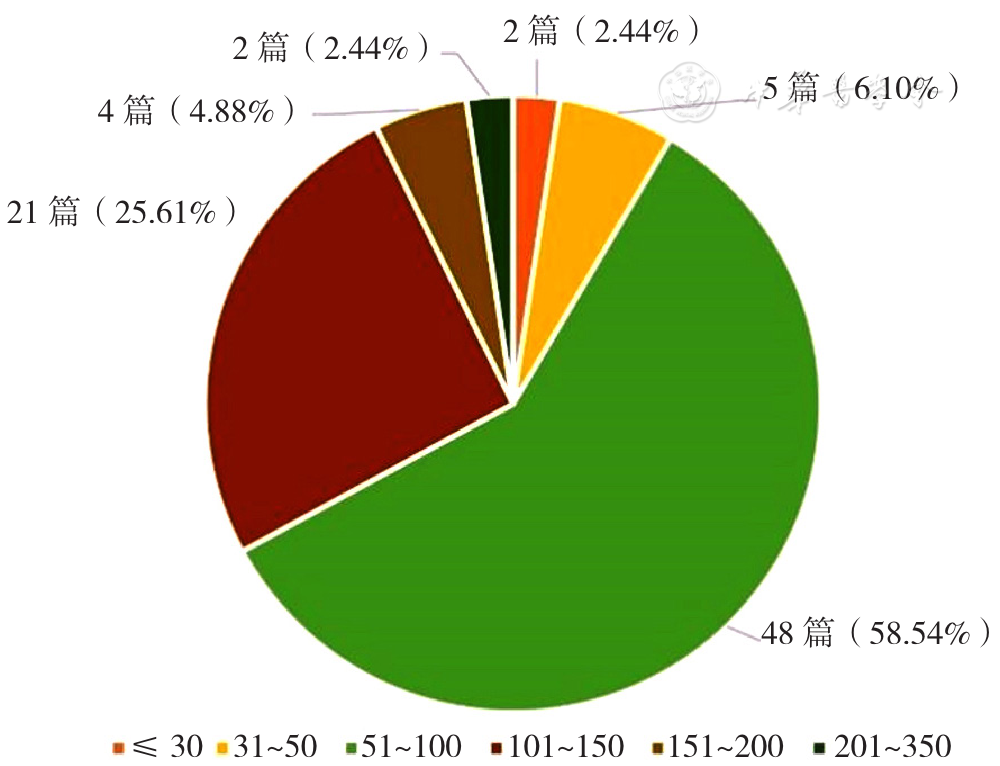
图3 中成药治疗阿尔茨海默病临床试验纳入样本量的情况
Figure 3 The sample size included in clinical trials of traditional Chinese patent medicines and simple preparations for AD
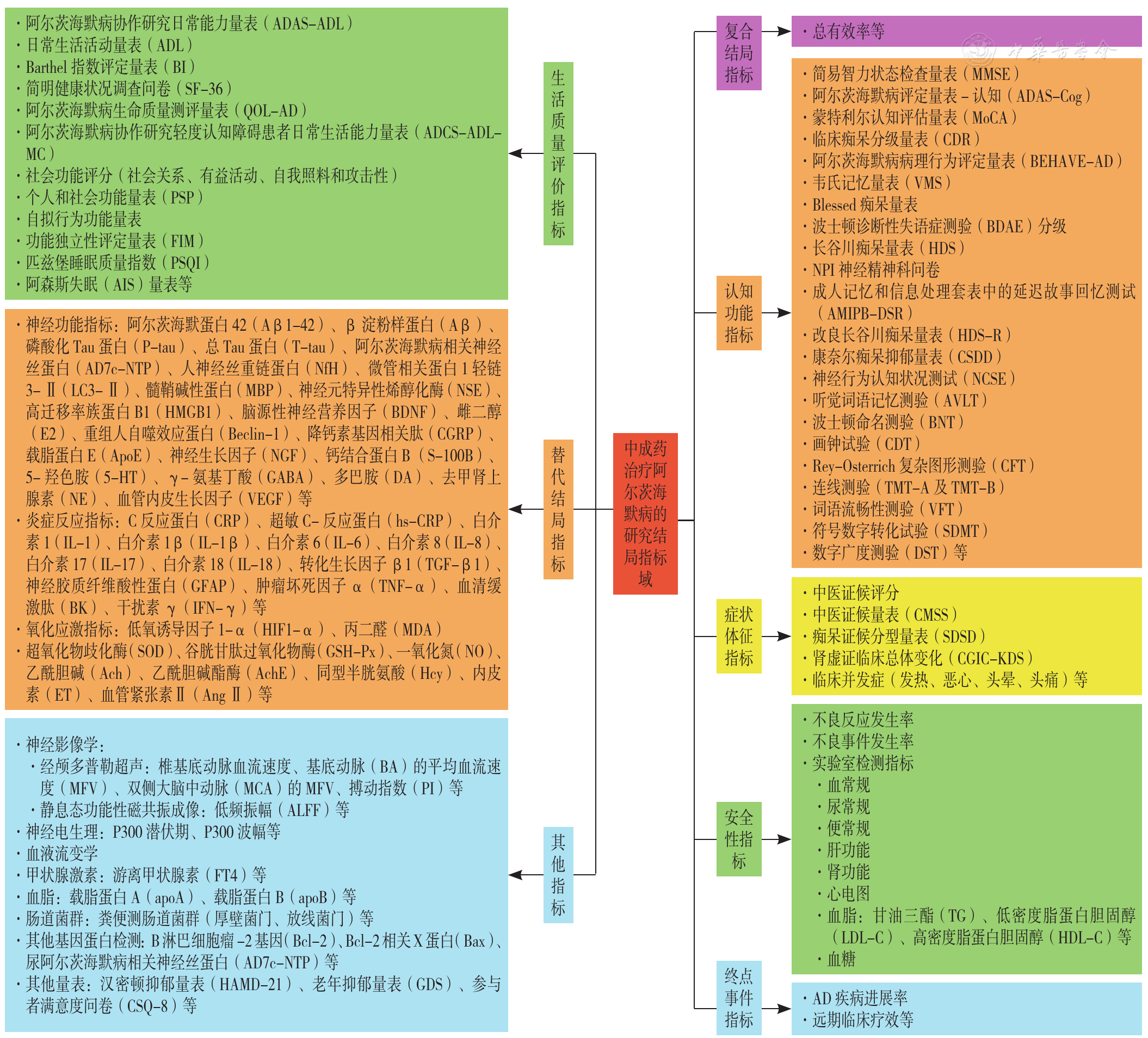
图4 中成药治疗阿尔茨海默病的研究结局指标域
Figure 4 The outcome field of clinical trials on Chinese patent medicines for AD
| 序号 | 条目1 | 条目2 | 条目3 | 条目4 | 条目5 | 条目6 | 条目7 | 条目8 | 条目9 | 条目10 | 条目11 | 条目12 | 总分 |
|---|---|---|---|---|---|---|---|---|---|---|---|---|---|
| 1 | 2 | 2 | 0 | 1 | 0 | 1 | 2 | 0 | 2 | 2 | 1 | 2 | 15 |
| 2 | 2 | 2 | 0 | 1 | 0 | 0 | 2 | 0 | 2 | 2 | 1 | 2 | 14 |
| 3 | 2 | 2 | 0 | 2 | 0 | 0 | 2 | 0 | 2 | 2 | 1 | 2 | 15 |
| 4 | 2 | 2 | 0 | 1 | 0 | 0 | 2 | 0 | 2 | 2 | 1 | 2 | 14 |
| 5 | 2 | 2 | 0 | 1 | 0 | 0 | 2 | 0 | 2 | 2 | 1 | 2 | 14 |
| 6 | 2 | 2 | 2 | 2 | 0 | 0 | 2 | 0 | 2 | 2 | 2 | 1 | 17 |
表2 中成药治疗阿尔茨海默病非随机对照试验的质量评价结果(分)
Table 2 The quality evaluation of non-randomized controlled trials on Chinese patent medicines for AD
| 序号 | 条目1 | 条目2 | 条目3 | 条目4 | 条目5 | 条目6 | 条目7 | 条目8 | 条目9 | 条目10 | 条目11 | 条目12 | 总分 |
|---|---|---|---|---|---|---|---|---|---|---|---|---|---|
| 1 | 2 | 2 | 0 | 1 | 0 | 1 | 2 | 0 | 2 | 2 | 1 | 2 | 15 |
| 2 | 2 | 2 | 0 | 1 | 0 | 0 | 2 | 0 | 2 | 2 | 1 | 2 | 14 |
| 3 | 2 | 2 | 0 | 2 | 0 | 0 | 2 | 0 | 2 | 2 | 1 | 2 | 15 |
| 4 | 2 | 2 | 0 | 1 | 0 | 0 | 2 | 0 | 2 | 2 | 1 | 2 | 14 |
| 5 | 2 | 2 | 0 | 1 | 0 | 0 | 2 | 0 | 2 | 2 | 1 | 2 | 14 |
| 6 | 2 | 2 | 2 | 2 | 0 | 0 | 2 | 0 | 2 | 2 | 2 | 1 | 17 |
| 第一作者 | 发表时间(年) | 临床有效率 | MMSE评分 | ADAS-Cog评分 | ADL评分 | 不良反应 |
|---|---|---|---|---|---|---|
| 任甫卿[ | 2022 | 多奈哌齐联合复方海蛇胶囊>联合养血清脑颗粒>联合益智聪脑颗粒>联合银杏酮酯滴丸>联合六味地黄丸 | 多奈哌齐联合灯盏生脉胶囊>联合银杏酮酯滴丸>联合六味地黄丸>联合脑血疏口服液>联合华佗再造丸 | 未报告 | 未报告 | 多奈哌齐联合天智颗粒、联合复方海蛇胶囊、联合灯盏生脉胶囊、联合复方丹参片 |
| 韩娜娜[ | 2022 | 未报告 | 针灸>经颅直流电刺激>认知疗法>美金刚>石杉碱甲>卡巴拉汀>多奈哌齐>银杏叶提取物>安慰剂>加兰他敏 | 未报告 | 未报告 | 银杏叶提取物>针灸>安慰剂>美金刚>石杉碱甲>多奈哌齐>加兰他敏>卡巴拉汀 |
| 王雪松[ | 2021 | 针刺+中药最优,多奈哌齐+尼莫地平最差 | 针刺+认知功能训练最优,安慰剂最差 | 针刺最优,安慰剂最差 | 针刺+音乐疗法最优,针刺+盐酸多奈哌齐最差 | 针刺:针刺部位出血、瘀斑;多奈哌齐:头晕、失眠、梦境异常等;多奈哌齐、中药、尼莫地平:腹泻、恶心、呕吐、厌食和便秘 |
| 刘长宁[ | 2022 | 复方苁蓉益智胶囊联合西药>复方海蛇胶囊联合西药>天智颗粒联合西药>银杏叶联合西药>六味地黄丸联合西药>复方丹参片联合西药>西药 | 复方苁蓉益智胶囊联合西药>红景天胶囊联合西药>六味地黄丸联合西药>复方海蛇胶囊联合西药>复方丹参片联合西药>天智颗粒联合西药>银杏叶联合西药>灯盏生脉胶囊联合西药>西药 | 复方苁蓉益智胶囊联合西药>复方海蛇胶囊联合西药>复方丹参片联合西药>六味地黄丸联合西药>红景天胶囊联合西药>灯盏生脉胶囊联合西药>西药 | 银杏叶联合西药>复方海蛇胶囊联合西药>天智颗粒联合西药>六味地黄丸联合西药>复方丹参片联合西药>西药 | 天智颗粒联合西药>复方海蛇胶囊联合西药>银杏叶联合西药>复方苁蓉益智胶囊联合西药>西药>六味地黄丸联合西药>复方丹参片联合西药>灯盏生脉胶囊联合西药 |
| Liu[ | 2023 | 加减薯蓣片>复方苁蓉益智胶囊+西药>复方海蛇胶囊+西药>天智颗粒+西药 | 复方苁蓉益智胶囊+西药>红景天胶囊+西药>六味地黄片+西药>复方海蛇胶囊+西药>复方丹参片+西药>天智颗粒+西药 | 复方苁蓉益智胶囊+西药>复方海蛇胶囊+西药>复方丹参片+西药>红景天胶囊+西药>六味地黄片+西药 | 银杏叶+西药>复方海蛇胶囊+西药>天智颗粒+西药>复方丹参片+西药>六味地黄片+西药 | 复方海蛇胶囊>天智颗粒+西药>复方海蛇胶囊+西药>银杏叶+西药>复方苁蓉益智胶囊+西药 |
表3 网状Meta分析评价指标及推荐排序
Table 3 The evaluation outcomes and recommendation ranking of network meta-analysis
| 第一作者 | 发表时间(年) | 临床有效率 | MMSE评分 | ADAS-Cog评分 | ADL评分 | 不良反应 |
|---|---|---|---|---|---|---|
| 任甫卿[ | 2022 | 多奈哌齐联合复方海蛇胶囊>联合养血清脑颗粒>联合益智聪脑颗粒>联合银杏酮酯滴丸>联合六味地黄丸 | 多奈哌齐联合灯盏生脉胶囊>联合银杏酮酯滴丸>联合六味地黄丸>联合脑血疏口服液>联合华佗再造丸 | 未报告 | 未报告 | 多奈哌齐联合天智颗粒、联合复方海蛇胶囊、联合灯盏生脉胶囊、联合复方丹参片 |
| 韩娜娜[ | 2022 | 未报告 | 针灸>经颅直流电刺激>认知疗法>美金刚>石杉碱甲>卡巴拉汀>多奈哌齐>银杏叶提取物>安慰剂>加兰他敏 | 未报告 | 未报告 | 银杏叶提取物>针灸>安慰剂>美金刚>石杉碱甲>多奈哌齐>加兰他敏>卡巴拉汀 |
| 王雪松[ | 2021 | 针刺+中药最优,多奈哌齐+尼莫地平最差 | 针刺+认知功能训练最优,安慰剂最差 | 针刺最优,安慰剂最差 | 针刺+音乐疗法最优,针刺+盐酸多奈哌齐最差 | 针刺:针刺部位出血、瘀斑;多奈哌齐:头晕、失眠、梦境异常等;多奈哌齐、中药、尼莫地平:腹泻、恶心、呕吐、厌食和便秘 |
| 刘长宁[ | 2022 | 复方苁蓉益智胶囊联合西药>复方海蛇胶囊联合西药>天智颗粒联合西药>银杏叶联合西药>六味地黄丸联合西药>复方丹参片联合西药>西药 | 复方苁蓉益智胶囊联合西药>红景天胶囊联合西药>六味地黄丸联合西药>复方海蛇胶囊联合西药>复方丹参片联合西药>天智颗粒联合西药>银杏叶联合西药>灯盏生脉胶囊联合西药>西药 | 复方苁蓉益智胶囊联合西药>复方海蛇胶囊联合西药>复方丹参片联合西药>六味地黄丸联合西药>红景天胶囊联合西药>灯盏生脉胶囊联合西药>西药 | 银杏叶联合西药>复方海蛇胶囊联合西药>天智颗粒联合西药>六味地黄丸联合西药>复方丹参片联合西药>西药 | 天智颗粒联合西药>复方海蛇胶囊联合西药>银杏叶联合西药>复方苁蓉益智胶囊联合西药>西药>六味地黄丸联合西药>复方丹参片联合西药>灯盏生脉胶囊联合西药 |
| Liu[ | 2023 | 加减薯蓣片>复方苁蓉益智胶囊+西药>复方海蛇胶囊+西药>天智颗粒+西药 | 复方苁蓉益智胶囊+西药>红景天胶囊+西药>六味地黄片+西药>复方海蛇胶囊+西药>复方丹参片+西药>天智颗粒+西药 | 复方苁蓉益智胶囊+西药>复方海蛇胶囊+西药>复方丹参片+西药>红景天胶囊+西药>六味地黄片+西药 | 银杏叶+西药>复方海蛇胶囊+西药>天智颗粒+西药>复方丹参片+西药>六味地黄片+西药 | 复方海蛇胶囊>天智颗粒+西药>复方海蛇胶囊+西药>银杏叶+西药>复方苁蓉益智胶囊+西药 |
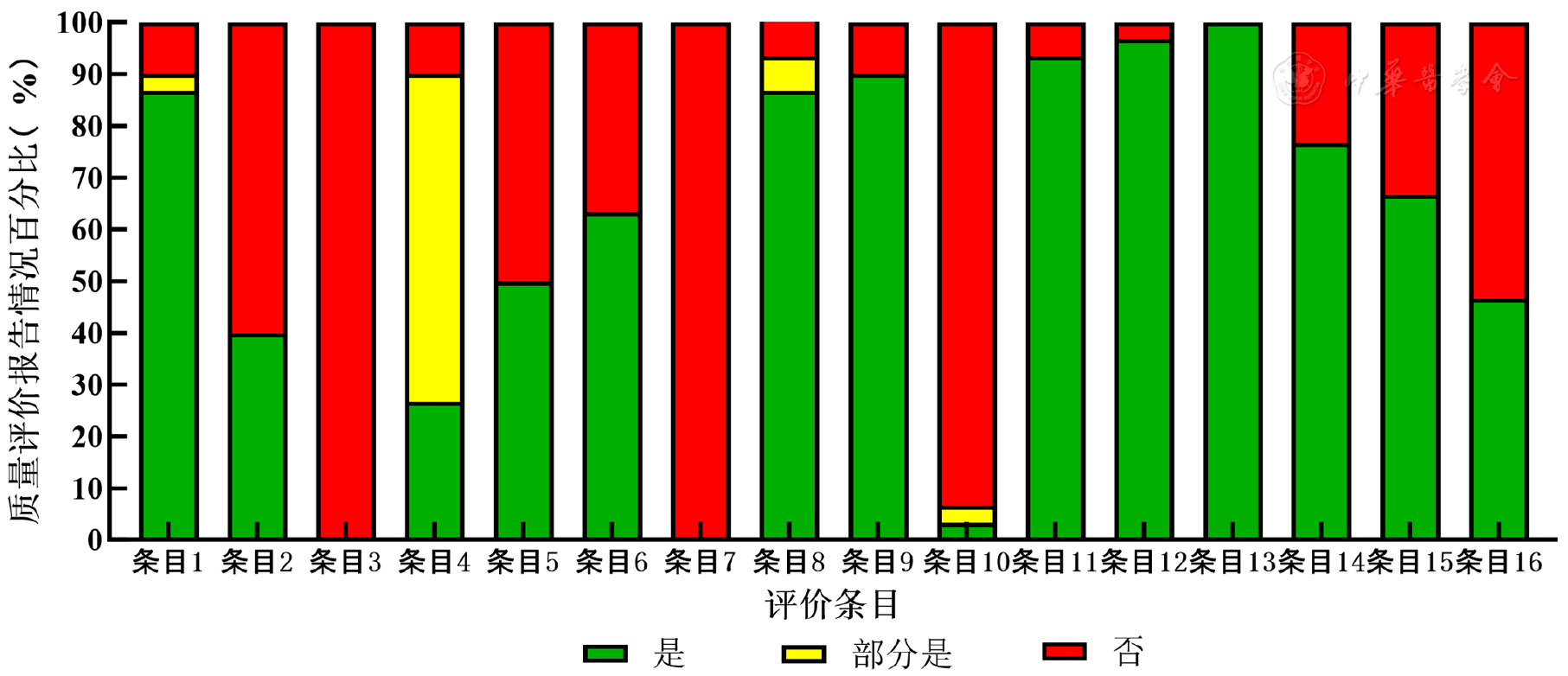
图5 系统综述/Meta分析的AMSTAR-2质量评价结果注:条目1为研究问题和纳入标准是否包括PICO;条目2为是否有方案;条目3为是否说明纳入研究类型及理由;条目4为是否检索策略全面;条目5为是否双人独立检索文献;条目6为是否双人独立完成数据提取;条目7为是否提供排除清单及原因;条目8为是否描述纳入研究的基本特征;条目9为是否采用合适的工具评价偏倚风险;条目10为是否报告了纳入研究的资金来源;条目11为是否采用了合适的统计方法进行结果合并分析;条目12为是否评估纳入研究的偏倚风险对Meta分析的影响;条目13为是否解释每个研究结果时考虑纳入研究的偏倚风险;条目14为是否对结果的异质性的讨论;条目15为是否对发表偏倚进行充分分析讨论;条目16为是否报告所有潜在的利益冲突。
Figure 5 The quality evaluation results of systematic review/Meta-analysis by AMSTAR-2 tool
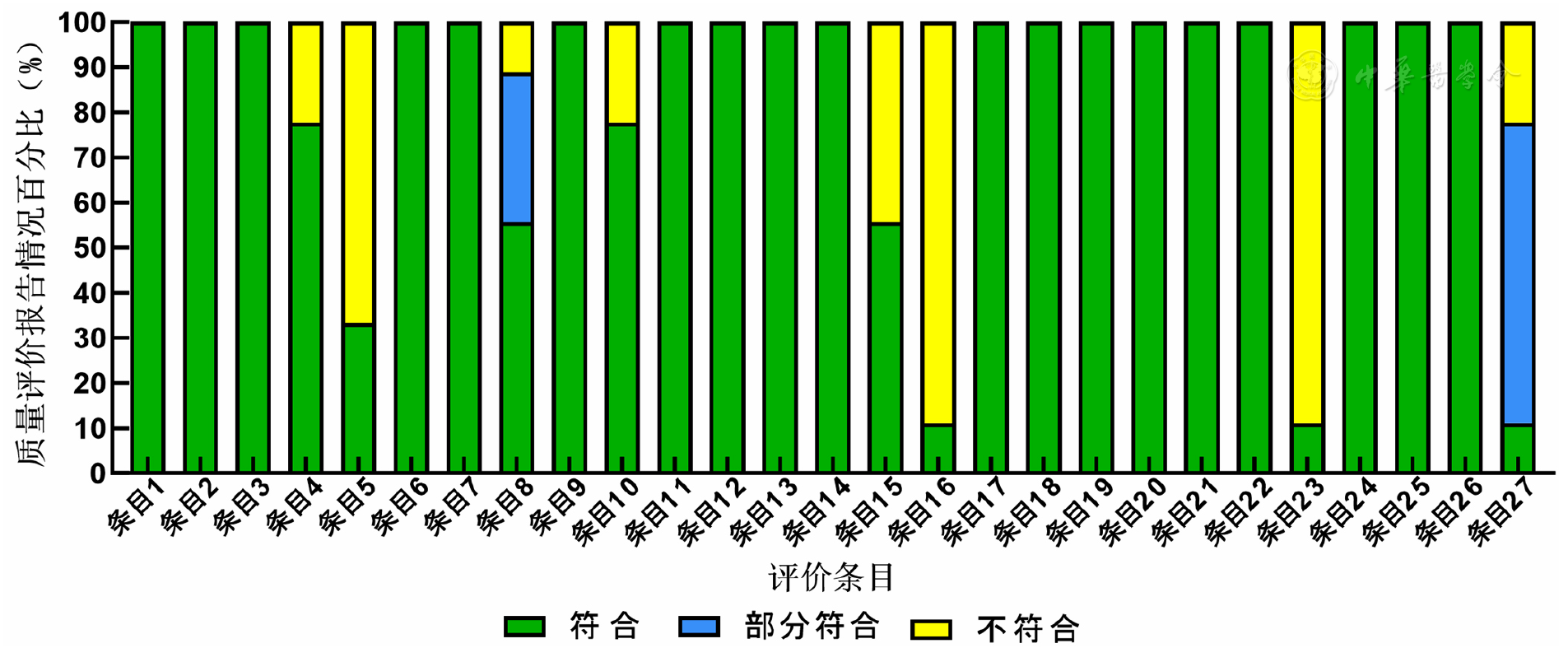
图6 网状Meta分析的文献报告质量评价结果注:条目1为标题应识别报告是网状Meta分析;条目2为提供结构式摘要;条目3为介绍当前已知的研究理论基础,并提及制作该网状Meta分析的原因和必要性;条目4为通过PICOS格式明确描述研究问题;条目5为研究方案及注册情况;条目6为详细的文献纳入标准;条目7为检索的全部信息来源及检索日期;条目8为完整的检索策略;条目9为描述研究选择的过程;条目10为描述从研究报告中提取数据的方法;条目11为列出和说明所有与PICOS、资金来源等资料相关的条目及推断和简化形式;条目12为单项研究偏倚风险的评价方法;条目13为描述主要的合并效应指标和其他综合效应指标的使用,及呈现Meta分析综合结果的修正方法;条目14为描述处理数据和合并每个治疗网络研究结果的方法;条目15为说明可能影响合并结果的偏倚(如发表偏倚);条目16为其他分析方法(如亚组分析和敏感性分析);条目17为研究初筛、符合纳入标准的文献数量,给出排除文献理由并最好列出流程图;条目18为网状结构呈现;条目19为各单项研究可能存在偏倚的结果;条目20为所有结局指标(获益或危害)研究结果;条目21为每项Meta分析的结果;条目22为研究间可能存在偏倚的评价结果;条目23为其他分析的结果;条目24为总结研究的主要发现;条目25为讨论研究层面及结局层面的局限性;条目26为对研究结果的总结性解读,及其对进一步研究的启示;条目27为研究的资金来源及在研究中发挥的作用描述。
Figure 6 The reporting quality evaluation results of network meta-analysis
| 指南/共识名称 | 发表年份(年) | 中成药 | 证型 | 推荐应用 |
|---|---|---|---|---|
| 阿尔茨海默病中医诊疗指南(修订)[ | 2019 | 复方苁蓉益智胶囊、肉苁蓉总苷胶囊 | 髓海不足证 | 40岁以上阿尔茨海默病 |
| 银杏叶提取物注射液临床应用中国专家共识(2019)[ | 2019 | 银杏叶提取物注射液 | 未报告证型 | 阿尔茨海默病或血管性痴呆,可改善认知功能障碍、改善脑微循环、保护脑组织、改善神经系统功能 |
| Treatment of dementia and mild cognitive impairment with or without cerebrovascular disease:expert consensus on the use of Ginkgo biloba extract,EGb 761®[ | 2019 | 银杏叶提取物EGb 761® | 未报告证型 | 阿尔茨海默病、血管性痴呆、痴呆伴发精神行为障碍 |
| 中国阿尔茨海默病痴呆诊疗指南(2020年版)[ | 2021 | 清宫寿桃丸、银杏叶提取物、天智颗粒 | 未报告证型 | 清宫寿桃丸对前驱期阿尔茨海默病认知有益,银杏叶提取物对早中期阿尔茨海默病痴呆认知、行为和功能有轻微疗效 |
| 阿尔茨海默病中西医结合诊疗中国专家共识[ | 2024 | 复方苁蓉益智胶囊、六味地黄丸、复方海蛇胶囊、复方丹参片、银杏叶片(胶囊)、天智颗粒 | 未报告证型 | 阿尔茨海默病 |
| 痴呆病(阿尔茨海默病)中医诊疗标准[ | 2023 | 复方苁蓉益智胶囊 | 脾肾阳虚,痰瘀阻络证 | 痴呆病(阿尔茨海默病) |
| 痴呆病(阿尔茨海默病)标准化中医临床路径[ | 2023 | 根据辨证选择不同的中成药治疗 | 肾精亏虚、髓海不足证; 脾肾亏虚、痰瘀互结证; 心肾两虚、水火不济证; 心肝火旺、毒损脑络证 | 痴呆病(阿尔茨海默病) |
表4 指南/共识/临床路径中推荐的中成药治疗阿尔茨海默病情况
Table 4 Chinese patent medicines for AD recommended in guidelines,consensus or clinical pathways
| 指南/共识名称 | 发表年份(年) | 中成药 | 证型 | 推荐应用 |
|---|---|---|---|---|
| 阿尔茨海默病中医诊疗指南(修订)[ | 2019 | 复方苁蓉益智胶囊、肉苁蓉总苷胶囊 | 髓海不足证 | 40岁以上阿尔茨海默病 |
| 银杏叶提取物注射液临床应用中国专家共识(2019)[ | 2019 | 银杏叶提取物注射液 | 未报告证型 | 阿尔茨海默病或血管性痴呆,可改善认知功能障碍、改善脑微循环、保护脑组织、改善神经系统功能 |
| Treatment of dementia and mild cognitive impairment with or without cerebrovascular disease:expert consensus on the use of Ginkgo biloba extract,EGb 761®[ | 2019 | 银杏叶提取物EGb 761® | 未报告证型 | 阿尔茨海默病、血管性痴呆、痴呆伴发精神行为障碍 |
| 中国阿尔茨海默病痴呆诊疗指南(2020年版)[ | 2021 | 清宫寿桃丸、银杏叶提取物、天智颗粒 | 未报告证型 | 清宫寿桃丸对前驱期阿尔茨海默病认知有益,银杏叶提取物对早中期阿尔茨海默病痴呆认知、行为和功能有轻微疗效 |
| 阿尔茨海默病中西医结合诊疗中国专家共识[ | 2024 | 复方苁蓉益智胶囊、六味地黄丸、复方海蛇胶囊、复方丹参片、银杏叶片(胶囊)、天智颗粒 | 未报告证型 | 阿尔茨海默病 |
| 痴呆病(阿尔茨海默病)中医诊疗标准[ | 2023 | 复方苁蓉益智胶囊 | 脾肾阳虚,痰瘀阻络证 | 痴呆病(阿尔茨海默病) |
| 痴呆病(阿尔茨海默病)标准化中医临床路径[ | 2023 | 根据辨证选择不同的中成药治疗 | 肾精亏虚、髓海不足证; 脾肾亏虚、痰瘀互结证; 心肾两虚、水火不济证; 心肝火旺、毒损脑络证 | 痴呆病(阿尔茨海默病) |
| [1] |
方伯言,王丽,闫天翼, 无创神经调控技术辅助阿尔茨海默病治疗的中国专家共识[J].中国神经免疫学和神经病学杂志, 2023, 30(6): 387-394.
|
| [2] |
|
| [3] |
南淞华,彭超杰,李振家, 等. 中医药靶向调控线粒体质量控制防治阿尔兹海默病的研究进展[J]. 中药新药与临床药理, 2024, 35(12): 1944-1951. DOI: 10.19378/j.issn.1003-9783.2024.12.019.
|
| [4] |
徐勇,王军,王虹峥, 等. 2023中国阿尔茨海默病数据与防控策略[J]. 阿尔茨海默病及相关病杂志, 2023, 6(3): 175-192, 173.
|
| [5] |
|
| [6] |
|
| [7] |
应春苗,麻玉成,樊飞燕, 等. 中药调控神经干细胞治疗阿尔茨海默病的作用机制[J]. 中国组织工程研究, 2023, 27(15): 2385-2394.
|
| [8] |
田文国,王春芳,陈金鹏, 等. 中药抗阿尔茨海默病的作用及其机制研究进展[J]. 中草药, 2022, 53(10): 3195-3208.
|
| [9] |
于鹏真,闫菁菁,梁贝贝, 等. 中成药防治高脂血症的临床证据图[J]. 中国循证医学杂志, 2024, 24(9): 1061-1069.
|
| [10] |
李小禹,曾维银,谭青青, 等.囊袋张力环植入对高度近视白内障治疗效果的meta分析[J]. 中华实验眼科杂志, 2023, 41(7): 675-682.
|
| [11] |
丁天祥,乔利杰,邢作英, 等. 近5年中成药治疗冠心病心力衰竭的临床研究证据图分析[J]. 中成药, 2024, 46(7): 2423-2428. DOI: 10.3969/j.issn.1001-1528.2024.07.050.
|
| [12] |
李志霞,杨俊,叶欣, 等. 系统综述与网状Meta分析的PRISMA扩展声明[J]. 中国循证心血管医学杂志, 2016, 8(6): 656-660, 665, 679. DOI: 10.3969/j.issn.1674-4055.2016.06.05.
|
| [13] |
王吉耀,王强,王小钦, 等. 中国临床实践指南评价体系的制定与初步验证[J]. 中华医学杂志, 2018, 98(20): 1544-1548. DOI: 10.3760/cma.j.issn.0376-2491.2018.20.004.
|
| [14] |
陈红丽,张戈,赵青, 等. 近10年国内护理专家共识文献质量评价与分析[J]. 中国护理管理, 2020, 20(3): 399-406. DOI: 10.3969/j.issn.1672-1756.2020.03.017.
|
| [15] |
晏毅龙,王永盛,李颖, 等. 卫生技术评估报告现状与质量分析[J]. 中国循证医学杂志, 2023, 23(8): 945-950.
|
| [16] |
任甫卿,陈路,程苗苗, 等. 12种口服中成药联合多奈哌齐治疗痴呆的贝叶斯网状Meta分析[J]. 世界中医药, 2022, 17(18): 2587-2593, 2601. DOI: 10.3969/j.issn.1673-7202.2022.18.010.
|
| [17] |
韩娜娜,嵇波,方洋, 等. 多种干预措施治疗轻中度阿尔茨海默病有效性和安全性的网状meta分析[J]. 中国医药导报, 2022, 19(32): 67-74, 79.
|
| [18] |
王雪松. 针刺相关疗法对轻中度AD患者认知功能影响的网状Meta分析[D]. 武汉: 湖北中医药大学, 2021.
|
| [19] |
刘长宁,张立娟,侯翰如, 等. 中成药治疗阿尔茨海默病的网状Meta分析[J]. 中草药, 2022, 53(19): 6123-6138.
|
| [20] |
|
| [21] |
熊凡捷,赵薇,宋凯, 等. 中医疗法与胆碱酯酶抑制剂治疗阿尔茨海默病的网状Meta分析[J]. 成都中医药大学学报, 2022, 45(2): 104-112. DOI: 10.13593/j.cnki.51-1501/r.2022.02.104.
|
| [22] |
白钰如. 针灸治疗老年性痴呆(AD)的网状Meta分析及取穴规律探讨[D]. 广州: 广州中医药大学, 2019.
|
| [23] |
李建平,曾宇华,卢巍, 等. 电针联合复方丹参片治疗老年性痴呆的临床观察[J]. 中国现代医生, 2018, 56(23): 64-67.
|
| [24] |
|
| [25] |
|
| [26] |
胡晓灵.阿尔茨海默病中医诊疗指南(修订)[C]//阿尔茨海默病防治协会,日本富士山麓医院,国际老年痴呆协会中国委员会. 2019中日科学家防治阿尔茨海默病高层论坛论文集, 2019.
|
| [27] |
北京脑血管病防治协会银杏叶提取物注射液临床应用专家共识写作组. 银杏叶提取物注射液临床应用中国专家共识(2019)[J]. 中华老年医学杂志, 2019, 38(11): 1198-1204.
|
| [28] |
|
| [29] |
田金洲,解恒革,王鲁宁, 等. 中国阿尔茨海默病痴呆诊疗指南(2020年版)[J]. 中华老年医学杂志, 2021, 40(3): 269-283. DOI: 10.3760/cma.j.issn.0254-9026.2021.03.001.
|
| [30] |
中国老年保健协会阿尔茨海默病分会,中国中药协会脑病药物研究专业委员会. 阿尔茨海默病中西医结合诊疗中国专家共识[J]. 中华行为医学与脑科学杂志, 2024, 33(2): 97-108. DOI: 10.3760/cma.j.cn371468-20231225-00319.
|
| [31] |
杨文明,谢文婷,李祥. 痴呆病(阿尔茨海默病)中医诊疗标准[J]. 中医药临床杂志, 2023, 35(7): 1448-1451.
|
| [32] |
杨文明,谢文婷,李祥. 痴呆病(阿尔茨海默病)标准化中医临床路径[J]. 中医药临床杂志, 2023, 35(7): 1452-1455.
|
| [33] |
任晓蕾,刘一,詹轶秋, 等. 银杏叶提取物治疗阿尔茨海默病有效性、安全性和经济性的快速卫生技术评估[J]. 中国药房, 2020, 31(22): 2786-2790.
|
| [34] |
|
| [35] |
张英英,申晨,张颖, 等. 以"总有效率"作为中医药疗效评价指标存在的误区[J]. 中国药物评价, 2020, 37(5): 337-340. DOI: 10.3969/j.issn.2095-3593.2020.05.005.
|
| [36] |
国家药品监督管理局药品审评中心.国家药监局药审中心关于发布《基于人用经验的中药复方制剂新药临床研发指导原则(试行)》《基于"三结合"注册审评证据体系下的沟通交流指导原则(试行)》的通告(2022年第24号)[A/OL].(2022-04-29)[2025-01-15].
|
| [37] |
国家药品监督管理局药品审评中心.国家药监局药审中心关于发布《中药改良型新药研究技术指导原则(试行)》的通告(2024年第24号)[A/OL].(2024-05-13)[2025-01-15].
|
| [1] | 李姣, 向庆伟, 刘进进, 彭朗, 周剑杰, 杨琼, 梅应兵, 柳慧, 方英嵩, 谭子虎. 阿尔茨海默病患者跌倒相关住院风险预测模型的构建与验证研究[J]. 中国全科医学, 2026, 29(32): 4721-4729. |
| [2] | 李姣, 周剑杰, 彭朗, 梅应兵, 谭子虎. 阿尔茨海默病合并社区获得性肺炎发生不良预后风险预测模型的构建与验证研究[J]. 中国全科医学, 2026, 29(29): 4248-4257. |
| [3] | 李海瑾, 朱宸立, 李卉, 冯郑文, 乔雨晨, 杜娟. 失智症诊断后管理相关指南的质量评价与内容分析[J]. 中国全科医学, 2026, 29(25): 3569-3576. |
| [4] | 丘淑娴, 吴婉婷, 赵玫, 张海峰, 李涛, 于欣, 王华丽. 阿尔茨海默病知识量表在社区医生中的因子结构分析研究[J]. 中国全科医学, 2026, 29(23): 3336-3341. |
| [5] | 汪洋, 邹川, 郭梦若, 何柳华, 陆许航, 桂贤忠, 徐志杰, 林恺, 金花, 姚弥, 杨辉, 于德华. 全科医务人员在人工智能的辅助下提炼高质量研究问题的五个步骤[J]. 中国全科医学, 2026, 29(22): 3094-3102. |
| [6] | 冯贞贞, 刘文瑞, 李建生, 关徐涛, 全建峰, 高宏, 田建辉, 荣震, 侯炜, 周洵. 全国不同区域的2 340例肺癌患者临床特征及基础证候分布差异研究[J]. 中国全科医学, 2026, 29(20): 2860-2866. |
| [7] | 简迎春, 曾永秦, 张海平, 王争地, 安科, 严瑞. 线粒体功能障碍在慢性代谢性疾病中的研究进展[J]. 中国全科医学, 2026, 29(18): 2577-2584. |
| [8] | 赵世超, 何静, 李治颖, 常汇晨, 王颖. 山东省基层卫生人员的自主性动机及其变化分析:基于自我决定理论的调查研究[J]. 中国全科医学, 2026, 29(18): 2461-2471. |
| [9] | 周慧, 唐欲博, 陈杰, 唐可京, 元刚, 姚弥. 遵循SPIRIT和CONSORT标准对随机对照试验中使用替代终点的扩展指南解读[J]. 中国全科医学, 2026, 29(15): 2107-2112. |
| [10] | 中国中医药研究促进会, 中国民族医药学会整合医学分会, 陶丽丽, 刘逸南, 王强, 雷燕. 中成药防治泛血管疾病及其靶器官损害的专家共识[J]. 中国全科医学, 2026, 29(09): 1089-1108. |
| [11] | 黄文静, 邱珊娇, 陈章, 李安春, 何智光. RACGP《全科医学的预防活动指南》解读与讨论:阿尔茨海默病早期识别路径与基层实践[J]. 中国全科医学, 2026, 29(07): 823-829. |
| [12] | 刘永成, 刘思雨, 梁小雨, 郝校鹏, 魏玥, 董国菊. 射血分数保留型心力衰竭随机对照试验的超声心动图结局指标研究[J]. 中国全科医学, 2025, 28(33): 4140-4147. |
| [13] | 李婧菱, 刘宁, 郭军. 癌症患者安宁疗护质量评估工具方法学质量和测量学特性的系统评价:基于COSMIN指南[J]. 中国全科医学, 2025, 28(31): 3981-3988. |
| [14] | 张慧, 杨健军, 何国枢, 邢国强, 任菁菁. 中国全科医师中成药处方认知现状与培训需求调查研究[J]. 中国全科医学, 2025, 28(31): 3954-3960. |
| [15] | 邱鲲羽, 顾洁, 范梅香, 邓燕, 刘轶蕾, 黄延焱. 饮酒情况对阿尔茨海默病患者大脑结构变化的影响:基于体素大脑形态学分析[J]. 中国全科医学, 2025, 28(31): 3942-3947. |
| 阅读次数 | ||||||
|
全文 |
|
|||||
|
摘要 |
|
|||||