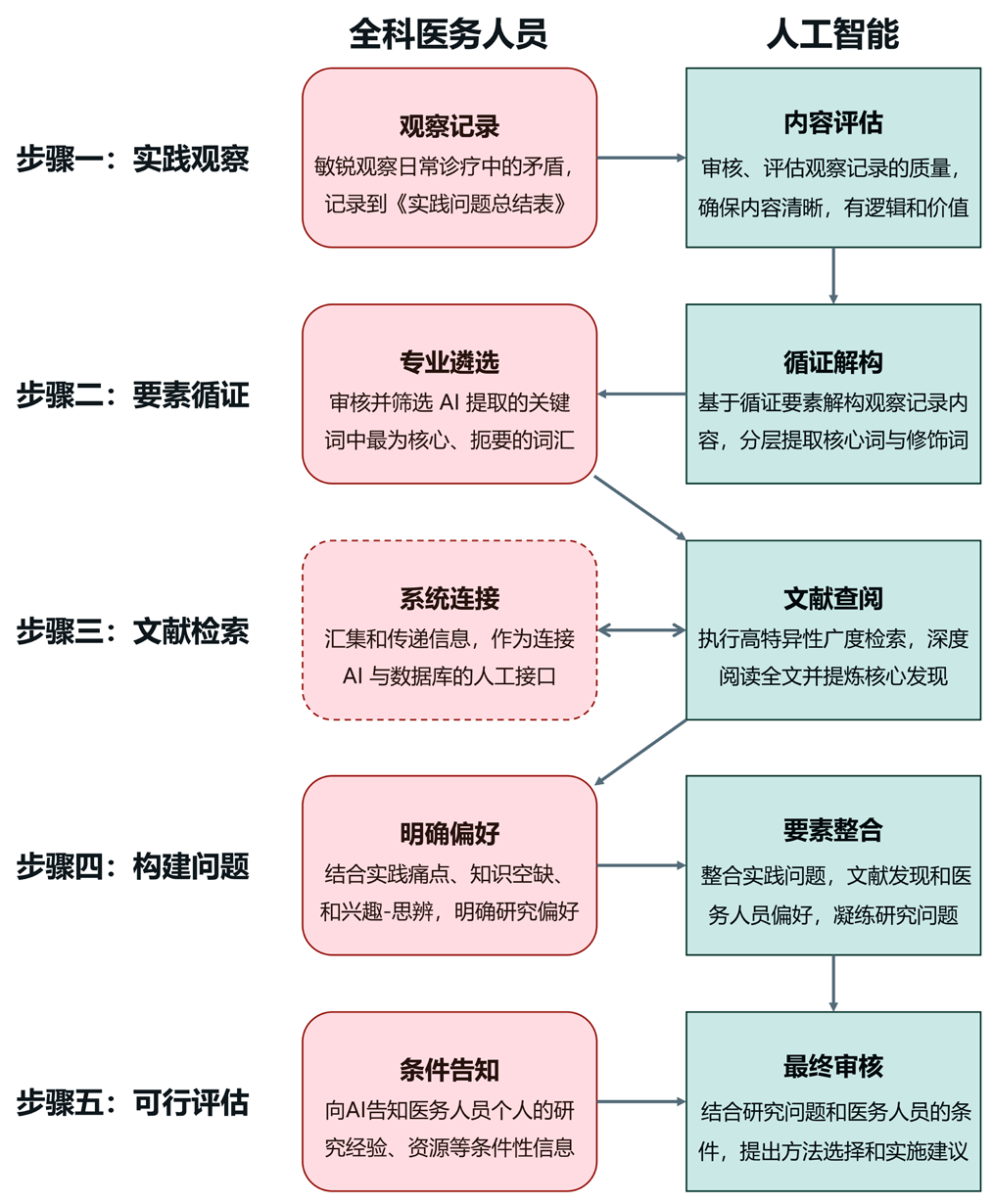
| [1] |
Hulley S B, Cummings S R, Browner W S, et al. Designing clinical research[M]. 4th ed. Philadelphia: Lippincott Williams & Wilkins, 2013.
|
| [2] |
|
| [3] |
|
| [4] |
|
| [5] |
《中国全科医学》定性和混合方法研究质量评价小组. 2021年中国基层卫生和全科医学研究方法学质量评价报告:定性研究和混合方法研究部分[J]. 中国全科医学, 2024, 27(10): 1173-1178.
|
| [6] |
Ventres W, Whiteside-Mansell L. Getting started in research, redefined: five questions for clinically focused physicians in family medicine[J]. Family medicine and community health, 2019, 7(2): e000017.
|
| [7] |
Aslam S, Emmanuel P. Formulating a researchable question: a critical step for facilitating good clinical research[J]. Indian J Sex Transm Dis, 2010, 31(1): 47-50.
|
| [8] |
Cañón M, Buitrago-Gómez Q. The research question in clinical practice: a guideline for its formulation[J]. Revista Colombiana De Psiquiatría (English Ed), 2018, 47(3): 193-200.
|
| [9] |
Phillips W R. How to choose your topic and define your research question[M]// Goodyear-Smith F, Mash B. How to do primary care research. Boca Raton: CRC Press, 2019: 13-24.
|
| [10] |
Ouyang L, Wu J, Jiang X, et al. Training language models to follow instructions with human feedback[J]. Advances in Neural Information Processing Systems, 2022, 35: 27730-27744.
|
| [11] |
Eysenbach G. The role of ChatGPT, generative language models, and artificial intelligence in medical education: a conversation with ChatGPT and a call for papers[J]. JMIR Medical Education, 2023, 9(1): e46885.
|
| [12] |
Vatsal S, Dubey H. A survey of prompt engineering methods in large language models for different nlp tasks[J]. arXiv preprint arXiv:2407.12994, 2024.
|
| [13] |
Zaghir J, Naguib M, Bjelogrlic M, et al. Prompt engineering paradigms for medical applications: scoping review[J]. Journal of Medical Internet Research, 2024, 26: e60501.
|
| [14] |
毛泽东. 实践论[M]// 毛泽东选集(第一卷). 北京: 人民出版社, 1991: 282-298.
|
| [15] |
毛泽东. 矛盾论[M]// 毛泽东选集(第一卷). 北京: 人民出版社, 1991: 299-340.
|
| [16] |
Peters M D J, Godfrey C, McInerney P, et al. Chapter 11: scoping reviews (2020 version)[M]// Aromataris E, Munn Z. JBI manual for evidence synthesis. JBI, 2020.
|
| [17] |
Arksey H, O'Malley L. Scoping studies: towards a methodological framework[J]. Int J Soc Res Methodol, 2005, 8(1): 19-32.
|
| [18] |
Pols D H J, Bramer W M, Bindels P J E, et al. Development and validation of search filters to identify articles on family medicine in online medical databases[J]. The Annals of Family Medicine, 2015, 13(4): 364-366.
|
| [19] |
Moher D, Liberati A, Tetzlaff J, et al. Preferred reporting items for systematic reviews and meta-analyses: the PRISMA statement[J]. BMJ, 2009, 339: b2535.
|
| [20] |
Sollaci L B, Pereira M G. The introduction, methods, results, and discussion (IMRAD) structure: a fifty-year survey[J]. Journal of the Medical Library Association, 2004, 92(3): 364-371.
|
| [21] |
International Committee of Medical Journal Editors. Recommendations for the conduct, reporting, editing, and publication of scholarly work in medical journals[EB/OL]. (2024-01-01)[2025-11-07].
|
| [22] |
Snilstveit B, Vojtkova M, Bhavsar A, et al. Evidence & Gap Maps: a tool for promoting evidence-informed policy and strategic research priorities[J]. Journal of Clinical Epidemiology, 2016, 79: 120-129.
|
| [23] |
Pawson R, Tilley N. Realist evaluation[M]. London: Sage, 1997.
|
| [24] |
Damschroder L J, Aron D C, Keith R E, et al. Fostering implementation of health services research findings into practice: a consolidated framework for advancing implementation science[J]. Implementation Science, 2009, 4: 50.
|
| [25] |
Glaser B G, Strauss A L. The discovery of grounded theory: strategies for qualitative research[M]. Chicago: Aldine, 1967.
|
| [26] |
Sackett D L, Straus S E, Richardson W S, et al. Evidence-based medicine: how to practice and teach EBM[M]. 2nd ed. Edinburgh: Churchill Livingstone, 2000.
|
| [27] |
Creswell J W, Creswell J D. Research design: qualitative, quantitative, and mixed methods approaches[M]. 5th ed. Thousand Oaks: SAGE Publications, 2018.
|
| [28] |
Cohen J. Statistical power analysis for the behavioral sciences[M]. 2nd ed. Hillsdale: Erlbaum, 1988.
|
| [29] |
国家卫生计生委. 涉及人的生物医学研究伦理审查办法[EB/OL]. (2016-10-12)[2025-11-07].
|
| [30] |
Green L A, Hickner J. A short history of primary care practice-based research networks: from concept to essential research laboratories[J]. J Am Board Fam Med, 2006, 19(1): 1-10.
|
| [31] |
钱学森, 于景元, 戴汝为. 一个科学新领域——开放的复杂巨系统及其方法论[J]. 自然杂志, 1990, 13(1): 3-10.
|

 )
)