
中国全科医学 ›› 2026, Vol. 29 ›› Issue (19): 2735-2743.DOI: 10.12114/j.issn.1007-9572.2025.0553
所属专题: 呼吸疾病文章合辑
张文博1, 王骏龙1, 张玉萍1, 蒋帅2, 王华启3,4,*( )
)
收稿日期:2025-09-15
修回日期:2026-04-20
出版日期:2026-07-05
发布日期:2026-06-05
通讯作者:
王华启
作者贡献:
张文博负责研究构思与设计、研究资料的收集和整理、论文初稿编撰;王骏龙、张玉萍负责数据的提取、数据质量评价和论文整体内容修改完善;蒋帅、王华启负责研究的协调与指导、整体研究方案的制订与优化,确保研究方向的科学性和可行性,对稿件整体负责。
基金资助:
ZHANG Wenbo1, WANG Junlong1, ZHANG Yuping1, JIANG Shuai2, WANG Huaqi3,4,*()
Received:2025-09-15
Revised:2026-04-20
Published:2026-07-05
Online:2026-06-05
Contact:
WANG Huaqi
摘要: 背景 慢性阻塞性肺疾病(以下简称慢阻肺病)是全球三大致死性疾病之一,早期预防对于减轻全球卫生保健负担尤为重要。为了加强临床医生对慢阻肺病高危人群的认识,GOLD指南明确提出了慢阻肺病前期一词。与正常人群相比,慢阻肺病前期人群慢阻肺病发病率更高,但鲜有研究对各指标的相对有效性进行定量分析。 目的 阐明不同筛查指标下慢阻肺病前期患者最终发展为慢阻肺病的情况,并量化其进展为慢阻肺病的风险,比较不同筛查指标的临床价值。 方法 检索中国知网、万方数据知识服务平台、维普网、PubMed、Embase和Web of Science数据库建库至2025-11-30发表的关于慢阻肺病前期进展为慢阻肺病的队列研究,由两名研究者独立进行文献检索、筛选、数据提取、质量评估,然后采用R 4.4.1进行Meta分析,针对不同筛查指标所定义的慢阻肺病前期组与对照组中的慢阻肺病发病率差异,计算其HR、RR、OR,评估其危险性。 结果 共纳入23项研究,涵盖了6个分组标准:非阻塞性慢性支气管炎(NOCB)、保留比率的肺功能受损(PRISm)、第一秒用力呼气容积/用力肺活量(FEV1/FVC)<75%、低一氧化碳弥散量(DLCO)、第三秒用力呼气容积/第六秒用力呼气容积(FEV3/FEV6)<正常值下限(LLN)和可变性气流受限。其中,FEV1/FVC<75%与慢阻肺病发病相关性最强(RR=11.98,95%CI=3.91~36.72),其他指标关联强度由强到弱依次为:可变性气流受限(RR=4.51,95%CI=2.37~8.57)、低DLCO(RR=4.05,95%CI=1.49~11.05)、PRISm(RR=2.33,95%CI=1.72~3.14)、FEV3/FEV6<LLN(RR=2.11,95%CI=1.48~3.03)、NOCB(RR=1.36,95%CI=1.02~1.81)。 结论 具有NOCB、PRISm、低DLCO、可变性气流受限、FEV3/FEV6<LLN和FEV1/FVC<75%的人群发展为慢阻肺病的风险高于对照,其中FEV1/FVC<75%的人群风险最大。
中图分类号:
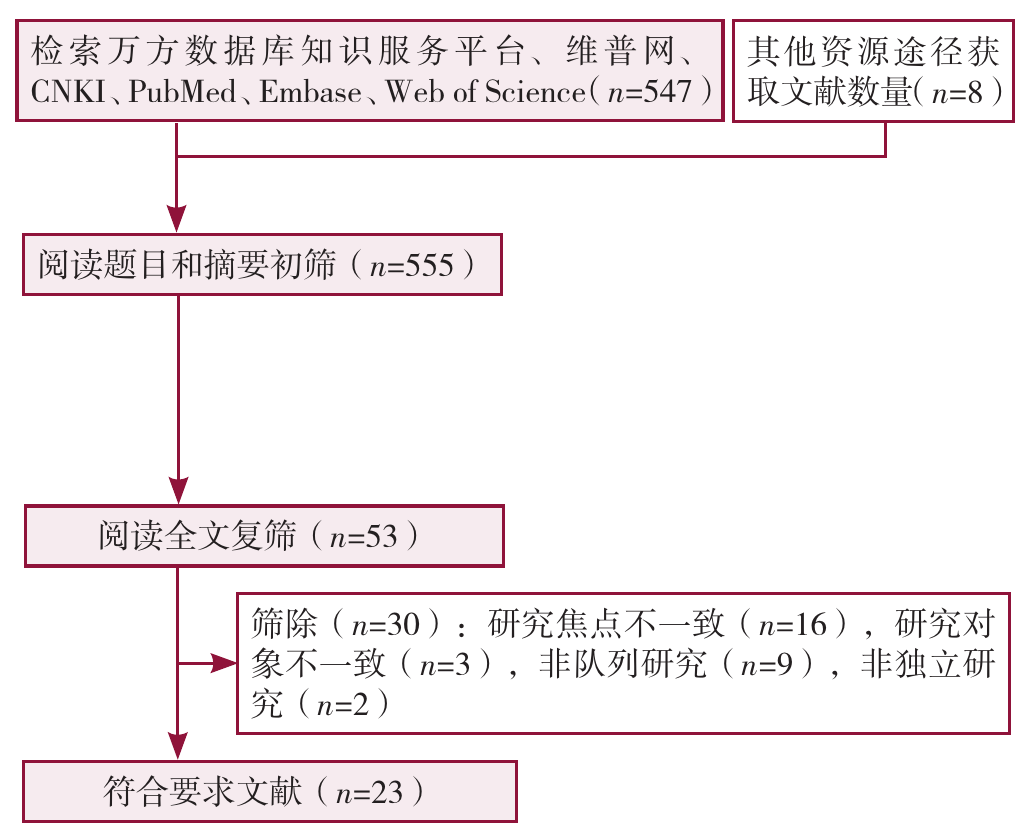
图1 文献筛选流程图
Figure 1 Flowchart of article selection
| 第一作者(年份) | 地区/国家 | 研究类型 | 慢阻肺病前期 | 对照组 | 样本量(例) | 平均年龄(岁) | 随访时间(年) | 指标 | 效应量 | 95%置信区间 |
|---|---|---|---|---|---|---|---|---|---|---|
| Vestbo(2002)[ | 丹麦哥本哈根 | 前瞻性队列研究 | 慢性咳嗽 | BD前FEV1/FVC≥0.7 | 11 207 | 51.7 | 15 | NOCB | 1.2 | 0.9~1.6 |
| Lindberg(2005)[ | 瑞典北部 | 前瞻性队列研究 | 慢性进行性咳嗽 | BD前FEV1/FVC≥0.7 | 939 | - | 10 | NOCB | 1.8 | 1.23~2.63 |
| Allinson(2016)[ | 英格兰/苏格兰/威尔士 | 前瞻性队列研究 | 慢性气道分泌物增加 | BD前FEV1/FVC≥LLN | 1 079 | 43 | 17~21 | NOCB | 3.89 | 2.05~7.38 |
| Kalhan(2018)[ | 美国芝加哥 | 前瞻性队列研究 | 支气管炎 | BD前FEV1/FVC≥0.7 | 2 749 | 25.1 | 30 | NOCB | 2.04 | 1.19~3.51 |
| Wu(2021)[ | 中国广东省 | 前瞻性队列研究 | BD前FEV1/FVC<0.7且BD后FEV1/FVC≥0.7 | BD后FEV1/FVC≥0.7 | 918 | 58.5 | 1 | 可变性气流受限 | 3.22 | 2.23~4.64 |
| Buhr(2022)[ | SPIROMICS队列(美国) | 前瞻性队列研究 | BD前FEV1/FVC<0.7且BD后FEV1/FVC≥0.7 | BD后FEV1/FVC≥0.7 | 778 | 61.3 | 3 | 可变性气流受限 | 6.2 | 4.62~8.33 |
| Tan(2024)[ | 塔斯马尼亚(澳大利亚) | 前瞻性队列研究 | BD前FEV1/FVC<第10百分位数(0.69,SD=0.031) | BD后FEV1/FVC≥LLN | 801 | 44.8 | 8.3 | FEV1/FVC | 35.8 | 8.89~144.16 |
| Harvey(2015)[ | 美国纽约 | 前瞻性队列研究 | 正常的肺功能检查合并低弥散能力(<80%预测值) | BD后FEV1/FVC≥0.7 | 105 | 45~46 | 7 | DLCO | 6.40 | 1.32~30.99 |
| Yee(2022)[ | SPIROMICS队列(美国) | 前瞻性队列研究 | FEV3/FEV6<LLN而FEV1/FVC正常 | BD后FEV1/FVC≥0.7 | 832 | H:57.1 N:60.5 | 4 | FEV3/FEV6 | 2.11 | 1.48~3.03 |
| Wan(2021)[ | 美国 | 前瞻性队列研究 | FEV1/FVC≥ 0.7而FEV1 < 80%预计值 | BD后FEV1/FVC≥0.7 | 1 069 | 57.3 | 5 | PRISm | 3.09 | 2.09~4.57 |
| BD后FEV1/FVC≥0.7 | 1 030 | 62.3 | 1.94 | 1.34~2.81 | ||||||
| Kogo(2022)[ | 美国 | 前瞻性队列研究 | FEV1/FVC≥ 0.7且FEV1 < 80%预计值 | FEV1/FVC≥70% | 5 086 | H:62 N:59 | 5 | PRISm | 2.17 | 1.73~2.72 |
| BD前FEV1/FVC<第5百分位数(0.72,SD=0.01) | H:62 N:49 | FEV1/FVC | 4.61 | 3.01~7.07 | ||||||
| Divo(2023)[ | 洛夫莱斯吸烟者队列 | 回顾性队列研究 | BD前FEV1/FVC < 0.75 | BD后FEV1/FVC≥0.7 | 830 | H:58 N:53 | 6.3 | FEV1/FVC | 15.32 | 9.14~25.68 |
| 持续咳嗽和咳痰>3个月,至少持续2年 | NOCB | 1.87 | 1.09~3.21 | |||||||
| Fan(2024)[ | 中国 | 前瞻性队列研究 | 慢性咳嗽>4次/d以及咳痰>2次/d,持续时间>4 d,每年>3个月 | BD后FEV1/FVC≥0.7 | 3 529 | H:59.7 N:54.1 | 3.59 | NOCB | 2.84 | 1.38~5.84 |
| FEV1/FVC≥ 0.7且FEV1 < 80%预计值 | PRISm | 1.57 | 1.03~2.40 | |||||||
| Park(2018)[ | 韩国 | 前瞻性队列研究 | FEV1/FVC≥ 0.7且FEV1 < 80%预计值 | BD后FEV1/FVC≥0.7 | 1 979 | H:56.0 N:54.6 | 3 | PRISm | 3.87 | 2.01 ~7.46 |
| Tan(2024)[ | 澳大利亚 | 前瞻性队列研究 | 正常的肺功能检查合并低DLCO (<80%预测值) | BD后FEV1/FVC≥LLN | 266 | H:56.6 N:53.6 | 2.3 | DLCO | 2.97 | 0.81~10.90 |
| de Marco(2007)[ | 欧洲12国 | 前瞻性队列研究 | 慢性咳嗽、咳痰 | BD前FEV1/FVC≥0.7 | 4 933 | 20~44 | 8.9 | NOCB | 1.85 | 1.17~2.93 |
| Guerra(2009)[ | 美国图森 | 前瞻性队列研究 | 慢性支气管炎 | BD前FEV1/FVC≥0.7 | 1 412 | 49.1 | 22 | NOCB | 1.37 | 0.98~1.92 |
| Yamane(2010)[ | 日本广岛 | 前瞻性队列研究 | 持续咳嗽和咳痰>3个月,至少持续2年 | BD前FEV1/FVC≥0.7 | 783 | 49.6 | 2.8 | NOCB | 4.53 | 1.72~11.93 |
| Probst-Hensch (2010)[ | 瑞士 | 前瞻性队列研究 | 持续咳嗽和咳痰>3个月,至少持续2年 | BD前FEV1/FVC≥0.7 | 765 | — | 11 | NOCB | 1.23 | 1.00~1.51 |
| Balte(2020)[ | 美国 | 前瞻性队列研究 | 持续咳嗽和咳痰>3个月,至少持续2年 | BD前FEV1/FVC≥0.7 | 22 325 | 53 | 9.8 | NOCB | 1.20 | 0.87~1.65 |
| Perez-Padilla(2023)[ | 拉丁美洲 | 前瞻性队列研究 | FEV1/FVC≥0.7而FEV1<80%预计值 | BD后FEV1/FVC≥0.7 | 1 723 | 55.1 | 5.9 | PRISm | 2.51 | 1.43~4.40 |
| Zheng(2023)[ | 欧洲 | 前瞻性队列研究 | FEV1/FVC≥0.7而FEV1 <80%预计值 | FEV1/FVC≥70% | 19 987 | H:54.5 N:54.2 | 6 | PRISm | 1.37 | 1.19~1.58 |
| Jo(2024)[ | 韩国 | 前瞻性队列研究 | FEV1/FVC≥0.7而FEV1<80%预计值 | BD前FEV1/FVC≥0.7 | 3 607 | 49.8 | 12 | PRISm | 5.36 | 2.79~10.29 |
表1 纳入研究的基本特征
Table 1 Basic characteristics of included articles
| 第一作者(年份) | 地区/国家 | 研究类型 | 慢阻肺病前期 | 对照组 | 样本量(例) | 平均年龄(岁) | 随访时间(年) | 指标 | 效应量 | 95%置信区间 |
|---|---|---|---|---|---|---|---|---|---|---|
| Vestbo(2002)[ | 丹麦哥本哈根 | 前瞻性队列研究 | 慢性咳嗽 | BD前FEV1/FVC≥0.7 | 11 207 | 51.7 | 15 | NOCB | 1.2 | 0.9~1.6 |
| Lindberg(2005)[ | 瑞典北部 | 前瞻性队列研究 | 慢性进行性咳嗽 | BD前FEV1/FVC≥0.7 | 939 | - | 10 | NOCB | 1.8 | 1.23~2.63 |
| Allinson(2016)[ | 英格兰/苏格兰/威尔士 | 前瞻性队列研究 | 慢性气道分泌物增加 | BD前FEV1/FVC≥LLN | 1 079 | 43 | 17~21 | NOCB | 3.89 | 2.05~7.38 |
| Kalhan(2018)[ | 美国芝加哥 | 前瞻性队列研究 | 支气管炎 | BD前FEV1/FVC≥0.7 | 2 749 | 25.1 | 30 | NOCB | 2.04 | 1.19~3.51 |
| Wu(2021)[ | 中国广东省 | 前瞻性队列研究 | BD前FEV1/FVC<0.7且BD后FEV1/FVC≥0.7 | BD后FEV1/FVC≥0.7 | 918 | 58.5 | 1 | 可变性气流受限 | 3.22 | 2.23~4.64 |
| Buhr(2022)[ | SPIROMICS队列(美国) | 前瞻性队列研究 | BD前FEV1/FVC<0.7且BD后FEV1/FVC≥0.7 | BD后FEV1/FVC≥0.7 | 778 | 61.3 | 3 | 可变性气流受限 | 6.2 | 4.62~8.33 |
| Tan(2024)[ | 塔斯马尼亚(澳大利亚) | 前瞻性队列研究 | BD前FEV1/FVC<第10百分位数(0.69,SD=0.031) | BD后FEV1/FVC≥LLN | 801 | 44.8 | 8.3 | FEV1/FVC | 35.8 | 8.89~144.16 |
| Harvey(2015)[ | 美国纽约 | 前瞻性队列研究 | 正常的肺功能检查合并低弥散能力(<80%预测值) | BD后FEV1/FVC≥0.7 | 105 | 45~46 | 7 | DLCO | 6.40 | 1.32~30.99 |
| Yee(2022)[ | SPIROMICS队列(美国) | 前瞻性队列研究 | FEV3/FEV6<LLN而FEV1/FVC正常 | BD后FEV1/FVC≥0.7 | 832 | H:57.1 N:60.5 | 4 | FEV3/FEV6 | 2.11 | 1.48~3.03 |
| Wan(2021)[ | 美国 | 前瞻性队列研究 | FEV1/FVC≥ 0.7而FEV1 < 80%预计值 | BD后FEV1/FVC≥0.7 | 1 069 | 57.3 | 5 | PRISm | 3.09 | 2.09~4.57 |
| BD后FEV1/FVC≥0.7 | 1 030 | 62.3 | 1.94 | 1.34~2.81 | ||||||
| Kogo(2022)[ | 美国 | 前瞻性队列研究 | FEV1/FVC≥ 0.7且FEV1 < 80%预计值 | FEV1/FVC≥70% | 5 086 | H:62 N:59 | 5 | PRISm | 2.17 | 1.73~2.72 |
| BD前FEV1/FVC<第5百分位数(0.72,SD=0.01) | H:62 N:49 | FEV1/FVC | 4.61 | 3.01~7.07 | ||||||
| Divo(2023)[ | 洛夫莱斯吸烟者队列 | 回顾性队列研究 | BD前FEV1/FVC < 0.75 | BD后FEV1/FVC≥0.7 | 830 | H:58 N:53 | 6.3 | FEV1/FVC | 15.32 | 9.14~25.68 |
| 持续咳嗽和咳痰>3个月,至少持续2年 | NOCB | 1.87 | 1.09~3.21 | |||||||
| Fan(2024)[ | 中国 | 前瞻性队列研究 | 慢性咳嗽>4次/d以及咳痰>2次/d,持续时间>4 d,每年>3个月 | BD后FEV1/FVC≥0.7 | 3 529 | H:59.7 N:54.1 | 3.59 | NOCB | 2.84 | 1.38~5.84 |
| FEV1/FVC≥ 0.7且FEV1 < 80%预计值 | PRISm | 1.57 | 1.03~2.40 | |||||||
| Park(2018)[ | 韩国 | 前瞻性队列研究 | FEV1/FVC≥ 0.7且FEV1 < 80%预计值 | BD后FEV1/FVC≥0.7 | 1 979 | H:56.0 N:54.6 | 3 | PRISm | 3.87 | 2.01 ~7.46 |
| Tan(2024)[ | 澳大利亚 | 前瞻性队列研究 | 正常的肺功能检查合并低DLCO (<80%预测值) | BD后FEV1/FVC≥LLN | 266 | H:56.6 N:53.6 | 2.3 | DLCO | 2.97 | 0.81~10.90 |
| de Marco(2007)[ | 欧洲12国 | 前瞻性队列研究 | 慢性咳嗽、咳痰 | BD前FEV1/FVC≥0.7 | 4 933 | 20~44 | 8.9 | NOCB | 1.85 | 1.17~2.93 |
| Guerra(2009)[ | 美国图森 | 前瞻性队列研究 | 慢性支气管炎 | BD前FEV1/FVC≥0.7 | 1 412 | 49.1 | 22 | NOCB | 1.37 | 0.98~1.92 |
| Yamane(2010)[ | 日本广岛 | 前瞻性队列研究 | 持续咳嗽和咳痰>3个月,至少持续2年 | BD前FEV1/FVC≥0.7 | 783 | 49.6 | 2.8 | NOCB | 4.53 | 1.72~11.93 |
| Probst-Hensch (2010)[ | 瑞士 | 前瞻性队列研究 | 持续咳嗽和咳痰>3个月,至少持续2年 | BD前FEV1/FVC≥0.7 | 765 | — | 11 | NOCB | 1.23 | 1.00~1.51 |
| Balte(2020)[ | 美国 | 前瞻性队列研究 | 持续咳嗽和咳痰>3个月,至少持续2年 | BD前FEV1/FVC≥0.7 | 22 325 | 53 | 9.8 | NOCB | 1.20 | 0.87~1.65 |
| Perez-Padilla(2023)[ | 拉丁美洲 | 前瞻性队列研究 | FEV1/FVC≥0.7而FEV1<80%预计值 | BD后FEV1/FVC≥0.7 | 1 723 | 55.1 | 5.9 | PRISm | 2.51 | 1.43~4.40 |
| Zheng(2023)[ | 欧洲 | 前瞻性队列研究 | FEV1/FVC≥0.7而FEV1 <80%预计值 | FEV1/FVC≥70% | 19 987 | H:54.5 N:54.2 | 6 | PRISm | 1.37 | 1.19~1.58 |
| Jo(2024)[ | 韩国 | 前瞻性队列研究 | FEV1/FVC≥0.7而FEV1<80%预计值 | BD前FEV1/FVC≥0.7 | 3 607 | 49.8 | 12 | PRISm | 5.36 | 2.79~10.29 |
| 第一作者(年份) | 研究对象选择 | 组间可比性 | 结果测量 | 质量(总分) | |||||
|---|---|---|---|---|---|---|---|---|---|
| 暴露组的代表性 | 非暴露组代表性 | 暴露因素的确定 | 结局指标 | 结局指标评价 | 随访时间 | 完整性 | |||
| Vestbo(2002) | 1 | 1 | 1 | 1 | 2 | 1 | 1 | 1 | Good(9) |
| Lindberg(2005) | 1 | 1 | 1 | 1 | 2 | 1 | 1 | 1 | Good(9) |
| Allinson(2016) | 1 | 1 | 1 | 1 | 2 | 1 | 1 | 1 | Good(9) |
| Kalhan(2018) | 0 | 1 | 1 | 1 | 2 | 1 | 1 | 1 | Good(8) |
| Divo(2023) | 0 | 1 | 1 | 1 | 1 | 1 | 1 | 1 | Good(7) |
| Fan(2024) | 1 | 1 | 1 | 1 | 2 | 1 | 1 | 1 | Good(9) |
| de Marco(2007) | 1 | 1 | 1 | 1 | 2 | 1 | 1 | 1 | Good(9) |
| Guerra(2009) | 1 | 1 | 1 | 1 | 1 | 1 | 1 | 1 | Good(8) |
| Yamane(2010) | 0 | 1 | 1 | 1 | 0 | 1 | 1 | 1 | Fair(6) |
| Probst-Hensch(2010) | 1 | 1 | 1 | 1 | 2 | 1 | 1 | 1 | Good(9) |
| Tan(2024) | 0 | 1 | 1 | 1 | 2 | 1 | 1 | 1 | Good(8) |
| Balte(2020) | 1 | 1 | 1 | 1 | 2 | 1 | 1 | 1 | Good(9) |
| Wan(2022)(1) | 0 | 1 | 1 | 1 | 2 | 1 | 1 | 1 | Good(8) |
| Wan(2021)(2) | 1 | 1 | 1 | 1 | 2 | 1 | 1 | 1 | Good(9) |
| Kogo(2022) | 1 | 1 | 1 | 1 | 2 | 1 | 1 | 1 | Good(9) |
| Park(2018) | 1 | 1 | 0 | 1 | 2 | 1 | 1 | 1 | Good(8) |
| Tan(2024) | 1 | 1 | 1 | 1 | 1 | 1 | 1 | 1 | Good(8) |
| Perez-Padilla(2023) | 1 | 1 | 1 | 1 | 1 | 1 | 1 | 1 | Good(8) |
| Buhr(2022) | 1 | 1 | 1 | 1 | 2 | 1 | 1 | 1 | Good(9) |
| Harvey(2015) | 0 | 1 | 1 | 1 | 1 | 1 | 1 | 1 | Good(7) |
| Yee(2022) | 1 | 1 | 1 | 1 | 1 | 1 | 1 | 1 | Good(8) |
| Wu(2021) | 1 | 1 | 1 | 1 | 2 | 1 | 1 | 1 | Good(9) |
| Zheng(2023) | 1 | 1 | 1 | 1 | 2 | 1 | 1 | 1 | Good(9) |
| Jo(2024) | 1 | 1 | 1 | 1 | 1 | 1 | 1 | 1 | Good(8) |
表2 纽卡斯尔-渥太华量表评分及纳入研究的质量评估(分)
Table 2 Newcastle-Ottawa Scale scores and quality assessment of all studies included
| 第一作者(年份) | 研究对象选择 | 组间可比性 | 结果测量 | 质量(总分) | |||||
|---|---|---|---|---|---|---|---|---|---|
| 暴露组的代表性 | 非暴露组代表性 | 暴露因素的确定 | 结局指标 | 结局指标评价 | 随访时间 | 完整性 | |||
| Vestbo(2002) | 1 | 1 | 1 | 1 | 2 | 1 | 1 | 1 | Good(9) |
| Lindberg(2005) | 1 | 1 | 1 | 1 | 2 | 1 | 1 | 1 | Good(9) |
| Allinson(2016) | 1 | 1 | 1 | 1 | 2 | 1 | 1 | 1 | Good(9) |
| Kalhan(2018) | 0 | 1 | 1 | 1 | 2 | 1 | 1 | 1 | Good(8) |
| Divo(2023) | 0 | 1 | 1 | 1 | 1 | 1 | 1 | 1 | Good(7) |
| Fan(2024) | 1 | 1 | 1 | 1 | 2 | 1 | 1 | 1 | Good(9) |
| de Marco(2007) | 1 | 1 | 1 | 1 | 2 | 1 | 1 | 1 | Good(9) |
| Guerra(2009) | 1 | 1 | 1 | 1 | 1 | 1 | 1 | 1 | Good(8) |
| Yamane(2010) | 0 | 1 | 1 | 1 | 0 | 1 | 1 | 1 | Fair(6) |
| Probst-Hensch(2010) | 1 | 1 | 1 | 1 | 2 | 1 | 1 | 1 | Good(9) |
| Tan(2024) | 0 | 1 | 1 | 1 | 2 | 1 | 1 | 1 | Good(8) |
| Balte(2020) | 1 | 1 | 1 | 1 | 2 | 1 | 1 | 1 | Good(9) |
| Wan(2022)(1) | 0 | 1 | 1 | 1 | 2 | 1 | 1 | 1 | Good(8) |
| Wan(2021)(2) | 1 | 1 | 1 | 1 | 2 | 1 | 1 | 1 | Good(9) |
| Kogo(2022) | 1 | 1 | 1 | 1 | 2 | 1 | 1 | 1 | Good(9) |
| Park(2018) | 1 | 1 | 0 | 1 | 2 | 1 | 1 | 1 | Good(8) |
| Tan(2024) | 1 | 1 | 1 | 1 | 1 | 1 | 1 | 1 | Good(8) |
| Perez-Padilla(2023) | 1 | 1 | 1 | 1 | 1 | 1 | 1 | 1 | Good(8) |
| Buhr(2022) | 1 | 1 | 1 | 1 | 2 | 1 | 1 | 1 | Good(9) |
| Harvey(2015) | 0 | 1 | 1 | 1 | 1 | 1 | 1 | 1 | Good(7) |
| Yee(2022) | 1 | 1 | 1 | 1 | 1 | 1 | 1 | 1 | Good(8) |
| Wu(2021) | 1 | 1 | 1 | 1 | 2 | 1 | 1 | 1 | Good(9) |
| Zheng(2023) | 1 | 1 | 1 | 1 | 2 | 1 | 1 | 1 | Good(9) |
| Jo(2024) | 1 | 1 | 1 | 1 | 1 | 1 | 1 | 1 | Good(8) |
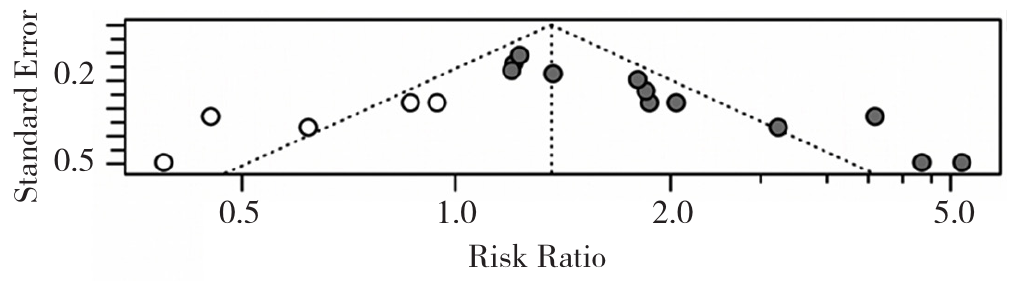
图2 Trim-and-Fill处理后的漏斗图
Figure 2 Funnel Plot After Trim- and-Fill
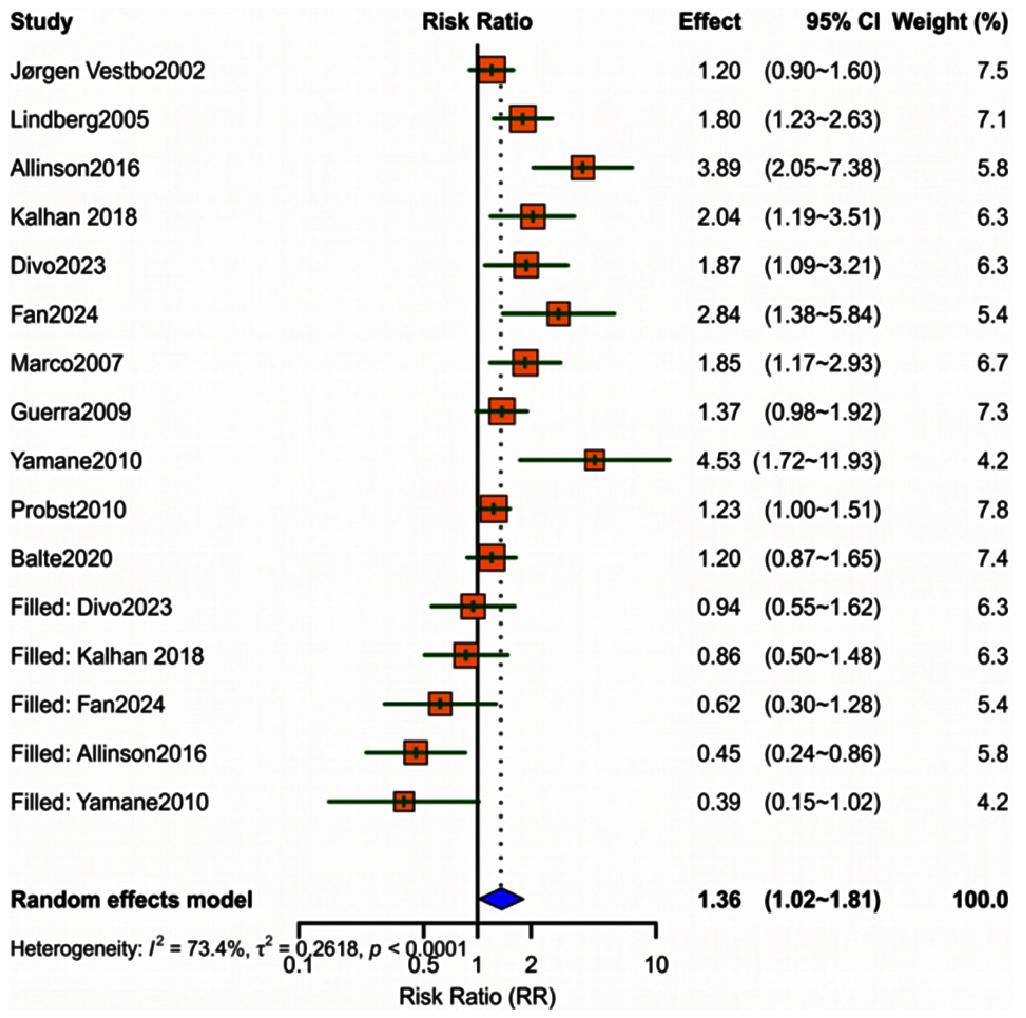
图3 NOCB发生慢阻肺病风险的森林图注:NOCB=非阻塞性慢性支气管炎,慢阻肺病=慢性阻塞性肺疾病。
Figure 3 Forest plot of the risk of COPD occurrence in NOCB
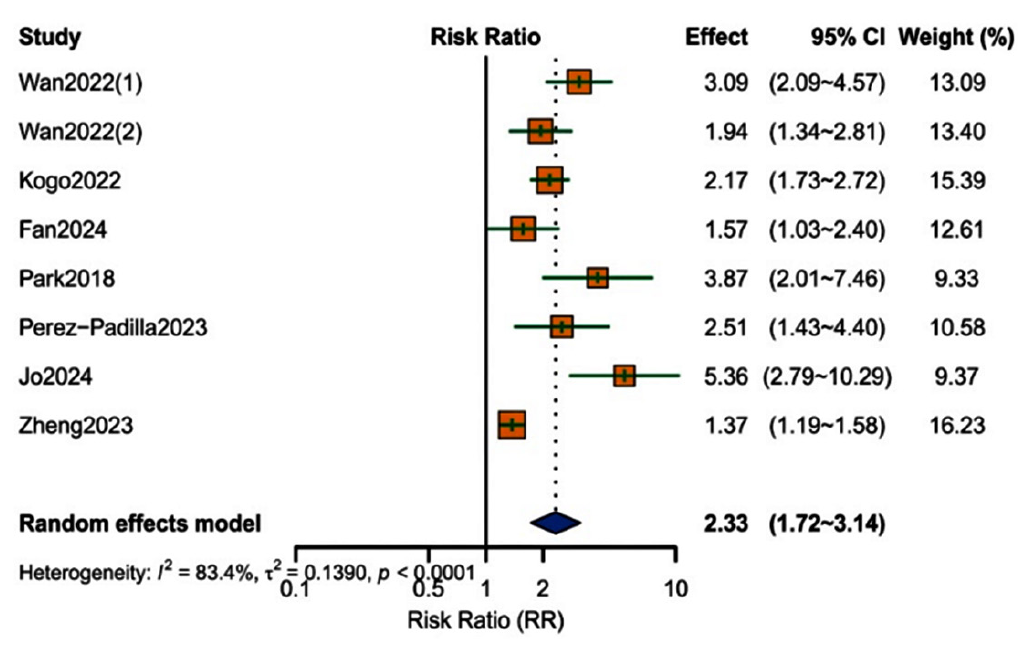
图4 PRISm发生慢阻肺病风险的森林图注:PRISm=保留比率的肺功能受损。
Figure 4 Forest plot of the risk of COPD occurrence in PRISm
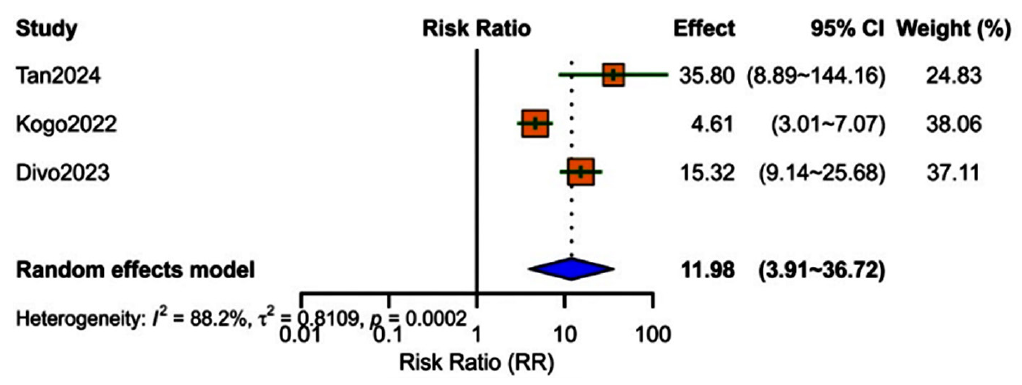
图5 FEV1/FVC< 0.75发生慢阻肺病风险的森林图注:FEV1/FVC=第一秒用力呼气容积/用力肺活量。
Figure 5 Forest plot of the risk of COPD occurrence in FEV1/FVC< 0.75
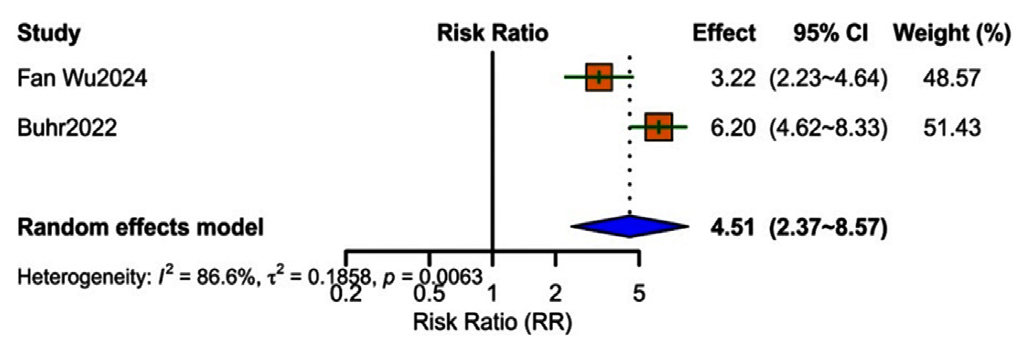
图6 可变性气流受限发生慢阻肺病风险的森林图
Figure 6 Forest plot of the risk of COPD occurrence in variable airflow limitation
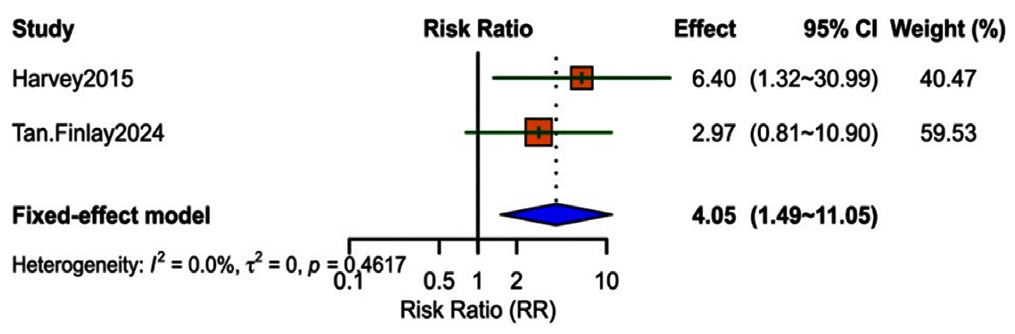
图7 低一氧化碳弥散量发生慢阻肺病风险的森林图
Figure 7 Forest plot of the risk of COPD occurrence in low DLCO
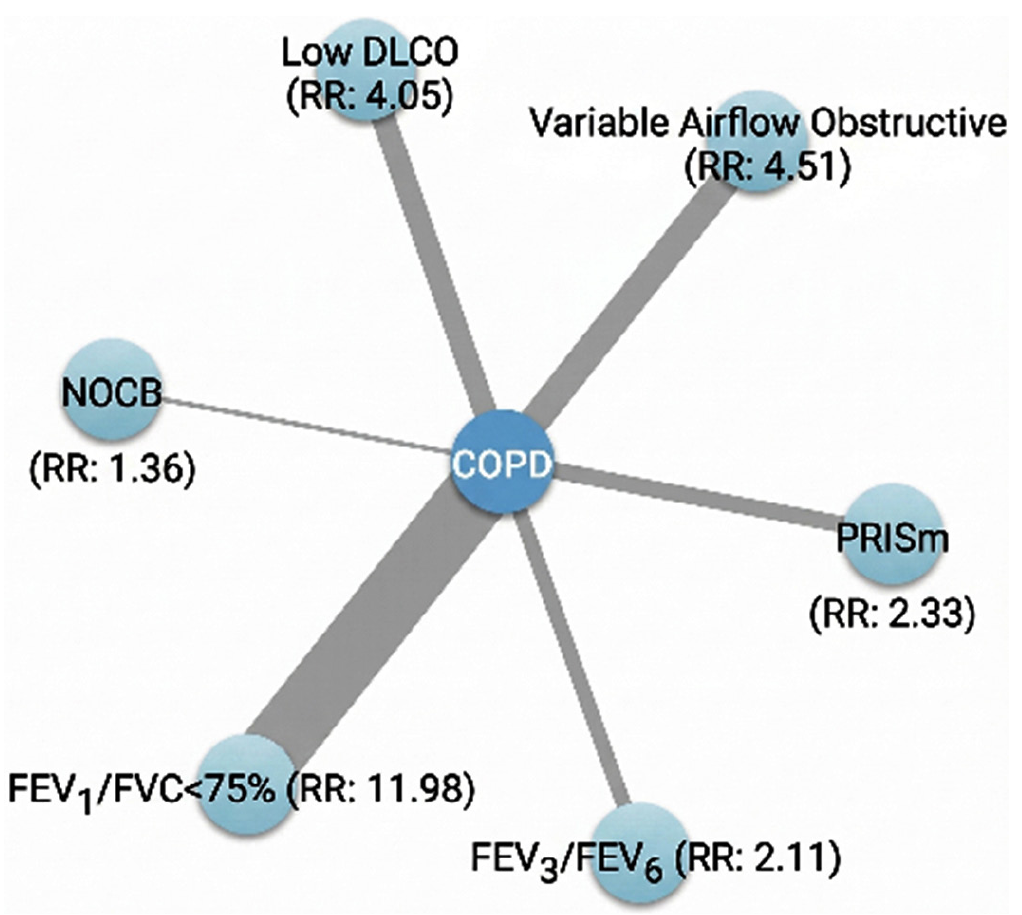
图8 不同指标与慢阻肺病发生的关系注:FEV3=第三秒用力呼气容积,FEV6=第六秒用力呼气容积。
Figure 8 The relationship between different various indicators and the occurrence of COPD
| [1] |
|
| [2] |
|
| [3] |
2026 GOLD Report and Pocket Guide - Global Initiative for Chronic Obstructive Lung Disease - GOLD[EB/OL]. [2025-11-30].
|
| [4] |
|
| [5] |
|
| [6] |
|
| [7] |
|
| [8] |
|
| [9] |
|
| [10] |
|
| [11] |
Ottawa Hospital Research Institute[EB/OL]. [2025-01-07].
|
| [12] |
|
| [13] |
|
| [14] |
|
| [15] |
|
| [16] |
|
| [17] |
|
| [18] |
|
| [19] |
|
| [20] |
|
| [21] |
|
| [22] |
|
| [23] |
|
| [24] |
|
| [25] |
|
| [26] |
|
| [27] |
|
| [28] |
|
| [29] |
|
| [30] |
|
| [31] |
|
| [32] |
|
| [33] |
|
| [34] |
|
| [35] |
|
| [36] |
|
| [37] |
|
| [38] |
|
| [39] |
|
| [40] |
|
| [41] |
|
| [1] | 宋路, 王丽晔, 修春霞, 冯宝静, 冯丽萍, 高艳松, 李梦, 代妍. 慢性阻塞性肺疾病合并高血压患者肺功能与血压变异性的相关研究[J]. 中国全科医学, 2026, 29(10): 1311-1315. |
| [2] | 田颖, 潘殿柱. 慢性阻塞性肺疾病急性加重期患者并发肾功能受损的相关因素分析[J]. 中国全科医学, 2026, 29(07): 885-892. |
| [3] | 陈楚萍, 刘力滴, 杨梓钰, 张鹏, 张瑞, 袁波, 沈灿, 杨荣, 李东泽, 廖晓阳, 雷弋. 基于《2024年意大利共识:慢性阻塞性肺疾病的三联吸入治疗》对中国慢性阻塞性肺疾病患者管理的启示[J]. 中国全科医学, 2026, 29(06): 688-692. |
| [4] | 慢性阻塞性肺疾病中西医结合诊疗指南工作组. 慢性阻塞性肺疾病中西医结合诊疗指南(2025版)[J]. 中国全科医学, 2026, 29(04): 409-422. |
| [5] | 邵家琛, 李顺平, 杨汀, 张春瑜, 路立勇, 袁佳麒. 利用离散选择试验测量慢性阻塞性肺疾病患者治疗与装置偏好的综述[J]. 中国全科医学, 2025, 28(36): 4648-4654. |
| [6] | 商鲁翔, 朱明琪, 周贤惠, 高梅, 汤宝鹏, 侯应龙. 中国成年人心房颤动患病率及影响因素的荟萃分析[J]. 中国全科医学, 2025, 28(33): 4192-4198. |
| [7] | 徐百川, 王艳, 张彭, 李艺婷, 刘飞来, 谢洋. 慢性阻塞性肺疾病共病肺癌筛查工具分析[J]. 中国全科医学, 2025, 28(30): 3847-3852. |
| [8] | 金锋, 黎旺玲, 谢飞. 基于"慢阻肺防治平台"的闭环管理案例研究[J]. 中国全科医学, 2025, 28(16): 2059-2064. |
| [9] | 陈典, 隆寰宇, 张丛溪, 褚岚和, 李姝润, 陈亚红. 2025年GOLD慢性阻塞性肺疾病诊断、治疗、管理及预防全球策略更新要点解读[J]. 中国全科医学, 2025, 28(16): 1937-1949. |
| [10] | 郦奇锋, 隆寰宇, 王泽茂, 封敏, 陈亚红, 胡征. 物联网技术在基层医疗卫生机构肺功能检查与管理中的应用[J]. 中国全科医学, 2025, 28(13): 1674-1675. |
| [11] | 宋荣维, 吴春香, 于杰, 路宇晴, 张锋英. 基于社区居民的保留比率的肺量计异常人群特征研究[J]. 中国全科医学, 2025, 28(10): 1185-1192. |
| [12] | 吴俊, 张玲, 顾东伟, 郑磊, 赵祝香, 赵子文. 单纯性支气管扩张症与支气管扩张症-慢性阻塞性肺疾病重叠综合征患者的病原菌对比研究[J]. 中国全科医学, 2025, 28(06): 729-736. |
| [13] | 潘子涵, 李姝润, 陈亚红. 物联网技术在慢性阻塞性肺疾病管理中的研究进展与展望[J]. 中国全科医学, 2024, 27(35): 4446-4454. |
| [14] | 杨天祎, 司徒炫明, 曲木诗玮, 王思远, 江山, 杨汀. 30秒坐立试验联合慢性阻塞性肺疾病患者自我评估测试评分对运动性低氧的预测价值及临床应用研究[J]. 中国全科医学, 2024, 27(33): 4119-4124. |
| [15] | 秦燕勤, 董浩然, 杨静帆, 李海博, 赵鹏, 李建生. 补肺益肾组分方Ⅲ组分配伍对慢性阻塞性肺疾病大鼠气道重塑的干预作用研究[J]. 中国全科医学, 2024, 27(33): 4196-4203. |
| 阅读次数 | ||||||
|
全文 |
|
|||||
|
摘要 |
|
|||||