中国全科医学 ›› 2026, Vol. 29 ›› Issue (04): 530-537.DOI: 10.12114/j.issn.1007-9572.2024.0598

• 论著·全科医学教育研究 • 上一篇    

基于社会认知职业理论的农村订单定向医学生职业认同影响机制研究

陈小英, 朱雪波*(), 陈悦   

  1. 325035 浙江省温州市,温州医科大学医学人文与管理学院 医学人文研究院
  • 收稿日期:2024-10-24 修回日期:2025-11-10 出版日期:2026-02-05 发布日期:2026-01-15
  • 通讯作者: 朱雪波

  • 作者贡献:

    陈小英进行研究设计,论文撰写,论文修改;陈悦负责数据收集与整理,统计学处理,论文撰写;朱雪波负责文章的质量控制与审查,对文章做出批评性审阅。

  • 基金资助:
    国家社会科学基金"十三五"规划教育学一般课题(BIA200197); 浙江省大学生科技创新活动计划(新苗人才计划)(2024R413B076)

Research on the Mechanism Influencing Professional Identity of Rural Targeted-admission Medical Students Based on Social Cognitive Career Theory

CHEN Xiaoying, ZHU Xuebo*(), CHEN Yue   

  1. College of Medical Humanities and Management/Institute for Medical Humanities, Wenzhou Medical University, Wenzhou 325035, China
  • Received:2024-10-24 Revised:2025-11-10 Published:2026-02-05 Online:2026-01-15
  • Contact: ZHU Xuebo

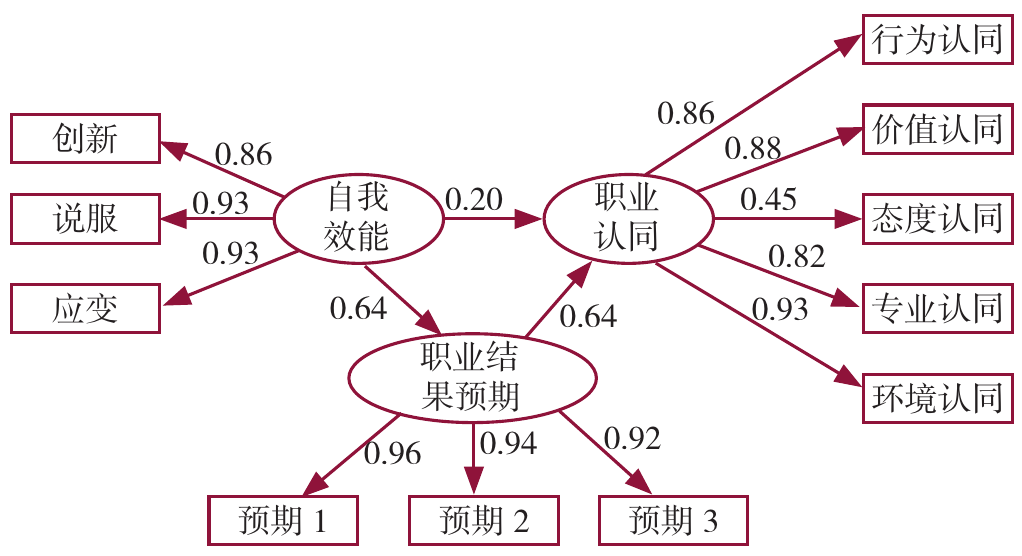
摘要: 背景 我国农村订单定向医学生(以下简称定向医学生)培养项目自2010年开展以来,为基层医疗卫生机构培养了大批优秀卫生人才,对于提高基层医疗服务可及性,实现健康公平具有重大意义,当前定向医学生的职业认同问题是关注的焦点。 目的 调查浙江省定向医学生的职业认同水平,基于社会认知职业理论探究职业认同、自我效能和职业结果预期的关系,为提升定向医学生的职业认同水平提供理论依据和实践参考。 方法 2024年1—6月采用多阶段分层随机抽样方法,对浙江省455名定向医学生进行电子问卷调查,调查内容包括基本信息、免费医学生职业认同量表、自我效能量表和职业结果预期量表。采用Pearson相关性分析评估职业认同、自我效能和职业结果预期不同变量之间的相关程度,采用AMOS 28软件构建结构方程模型,探究定向医学生职业认同、自我效能、职业结果预期3个变量之间的关系。 结果 本研究共发放问卷455份,有效回收问卷428份,有效率为94.07%。浙江省定向医学生的免费医学生职业认同量表平均得分为(3.68±0.56)分,自我效能量表平均得分为(5.21±0.97)分,职业结果预期量表平均得分为(3.13±0.45)分。Pearson相关分析显示,职业认同、自我效能和职业结果预期呈正相关(r1=0.526,r2=0.603,P<0.001);结构方程模型结果显示,自我效能、职业结果预期能显著预测职业认同(β1=0.201,β2=0.645,P<0.001),职业结果预期在自我效能和职业认同起到部分中介作用。 结论 浙江省定向医学生职业认同处于中等水平,自我效能、职业认同与职业结果预期存在正相关关系,职业结果预期在自我效能与职业认同之间起到部分中介作用。可以通过提升定向医学生的自我效能和职业结果预期,来提高定向医学生职业认同。

关键词: 教育,医学, 农村订单定向医学生, 职业认同, 自我效能, 职业结果预期, 中介分析

Abstract:

Background

China's rural-oriented tuition-waived medical education programme has successfully trained a large number of excellent health professionals for grassroots medical institutions. This programme is significant in improving the accessibility of medical services and achieving health equity. Currently, the professional identity of directional medical students is a major concern.

Objective

The aim of this study is to examine the level of career identity of Zhejiang rural-oriented tuition-waived medical students(RTMSs), to explore the relationship between career identity, self-efficacy and vocational outcome expectations, and to provide theoretical basis and practical reference for improving the level of career identity of RTMSs.

Methods

From January to June 2024, a multistage stratified random sampling method was used to administer an electronic questionnaire to 455 designated medical students in Zhejiang. The survey covered basic information, the Free Medical Students' Professional Identity Scale, the Self-Efficacy Scale, and the Occupational Outcome Expectation Scale. Pearson correlation analysis was used to assess the relationships among professional identity, self-efficacy, and occupational outcome expectations, and AMOS 28 software was used to construct a structural equation model to explore the relationships among these three variables.

Results

A total of 455 questionnaires were distributed in this study. 428 valid questionnaires were recovered, with an effective recovery rate of 94.07%. The mean score of the professional identity scale for free medical students in Zhejiang Province was (3.68±0.56) points, the mean score of the self-efficacy scale was (5.21±0.97) points, and the mean score of the career outcome expectation scale was (3.13±0.45) points. Pearson correlation analysis showed significant positive correlations among professional identity, self-efficacy, and career outcome expectations (r1=0.526, r2=0.603, P<0.001). Structural equation modeling results indicated that self-efficacy and career outcome expectations significantly predicted professional identity (β1=0.201, β2=0.645, P<0.001), and career outcome expectations played a partial mediating role between self-efficacy and professional identity.

Conclusion

The career identity of rural RTMSs in Zhejiang is at a medium level, and there is a positive correlation between self-efficacy, career identity and vocational outcome expectations, and vocational outcome expectations play a partly mediating role between self-efficacy and career identity. The self-efficacy and vocational outcome expectations of RTMSs can be improved to enhance the career identity of RTMSs.

Key words: Education, medical, Rural-oriented tuition-waived medical students, Career identity, Self-efficacy, Vocational outcome expectations, Mediation analysis