
中国全科医学 ›› 2026, Vol. 29 ›› Issue (11): 1463-1472.DOI: 10.12114/j.issn.1007-9572.2024.0695
肖瑶1, 林秀文2, 吴倩芳2, 凌鑫3, 梁艺龄2, 刘嘉玲2, 石磊1,4,5,6,*( )
)
收稿日期:2024-11-28
修回日期:2025-04-16
出版日期:2026-04-15
发布日期:2026-03-12
通讯作者:
石磊
肖瑶负责文章的构思与设计以及论文的撰写、修订;林秀文、吴倩芳负责进行文献的检索、数据收集与分析;凌鑫负责结果的分析与解释;梁艺龄、刘嘉玲负责信息提取、质量评价;石磊负责文章的质量控制及审校。
基金资助:
XIAO Yao1, LIN Xiuwen2, WU Qianfang2, LING Xin3, LIANG Yiling2, LIU Jialing2, SHI Lei1,4,5,6,*()
Received:2024-11-28
Revised:2025-04-16
Published:2026-04-15
Online:2026-03-12
Contact:
SHI Lei
摘要: 背景 随着我国人口老龄化加速,多重慢病患病率持续增长,对共病患者群体的生命质量及经济效益评价产生了显著影响。目前对多重慢病患者健康效用值的Meta分析仍然匮乏。 目的 系统评价中国多重慢病患者的健康效用值,为探究多重慢病对健康相关生命质量的影响与卫生技术评估提供科学参考。 方法 计算机检索中国知网、万方数据知识服务平台、维普网、中国生物医学文献数据库、中国生物医学文献服务系统、PubMed、Web of Science、Cochrane Library、Embase数据库,收集关于中国多重慢病患者健康效用值的相关研究,检索时限为建库至2024-08-01。采用美国卫生保健质量和研究机构(AHRQ)推荐的横断面研究质量评价清单评价纳入文献的偏倚风险,使用EndNote X9进行文献管理,采用Excel 13.0和Stata 18.0进行数据处理与分析。 结果 共纳入47篇文献,多重慢病患者总体健康效用值为0.790(0.779~0.800)。不同调查年龄的多重慢病患者健康效用值从≥18岁的0.807(0.793~0.820)下降至≥75岁的0.720(0.693~0.747)。不同性别、样本量、测量工具的亚组分析中,男性、样本量>500例、使用EQ-5D-5L的研究健康效用值更高,分别为0.859(0.838~0.880)、0.823(0.803~0.843)、0.809(0.795~0.823)。不同共病模式中,血脂异常、消化系统疾病、糖尿病、高血压、癌症、心脏病、脑血管病合并任意慢病的共病患者健康效用值分别为0.819(0.784~0.854)、0.808(0.780~0.836)、0.795(0.781~0.808)、0.793(0.770~0.816)、0.762(0.718~0.806)、0.731(0.700~0.762)、0.679(0.610~0.748)。 结论 我国多重慢病患者健康效用值(0.790)低于居民整体健康效用值(0.960)。不同研究测量的多重慢病患者健康效用值异质性较大,多重慢病给患者生命质量带来较大的影响,未来还应对不同特征不同共病模式的多重慢病患者健康效用值进行更加深入的研究。
中图分类号:
| 步骤 | 检索策略 |
|---|---|
| #1 | comorbidity [MeSh] OR disease cluster [MeSh] OR multi morbidity [MeSh] OR multi pathology [MeSh] OR pluri pathology [MeSh] OR poly morbidity [MeSh] OR poly pathology [MeSh] OR multiple chronic condition [MeSh] OR multiple chronic disease [MeSh] OR multiple chronic illness [MeSh] OR multiple diagnose [MeSh] OR morbidity patterns [Title/Abstract] |
| #2 | Euro-qol [Title/Abstract] OR euroqol [Title/Abstract] OR EuroQoL-five dimensions [Title/Abstract] OR EQ-5D [Title/Abstract] OR EQ5D [Title/Abstract] |
| #3 | conjoint analysis [Title/Abstract] OR contingent valuation [Title/Abstract] OR cost utility analysis [Title/Abstract] OR cost-benefit [Title/Abstract] OR cost-effective [Title/Abstract] OR cost-effectiveness [Title/Abstract] OR cost-utility [Title/Abstract] OR cost-utilization [Title/Abstract] OR cua [Title/Abstract] OR daly [Title/Abstract] OR disability adjusted life [Title/Abstract] OR health related quality of life [Title/Abstract] OR Health state utility values [Title/Abstract] OR health utility [Title/Abstract] OR health utility value [Title/Abstract] OR health value [Title/Abstract] OR health-related quality of life [Title/Abstract] OR health-related quality of life [Title/Abstract] OR healthy year equivalent [Title/Abstract] OR hrql [Title/Abstract] OR hrqol [Title/Abstract] OR hye [Title/Abstract] OR life qualities [Title/Abstract] OR life quality [Title/Abstract] OR life value [Title/Abstract] OR life values [Title/Abstract] OR preference [Title/Abstract] OR qald [Title/Abstract] OR qale [Title/Abstract] OR qaly [Title/Abstract] OR qol [Title/Abstract] OR qualities of life [Title/Abstract] OR quality adjusted life expectancy [Title/Abstract] OR quality of life [Title/Abstract] OR quality of well being [Title/Abstract] OR quality of well-being [Title/Abstract] OR quality-adjusted life years [Title/Abstract] OR utility index [Title/Abstract] OR value of life [Title/Abstract] OR values of life [Title/Abstract] |
| #4 | People's Republic of China [Title/Abstract] OR Chinese People's Republic [Title/Abstract] OR China [Title/Abstract] OR Chinese [Title/Abstract] OR Hong Kong [Title/Abstract] OR Macau [Title/Abstract] OR Taiwan [Title/Abstract] |
| #5 | #1 and(#2 or #3)and #4 |
表1 PubMed检索策略
Table 1 PubMed search strategies
| 步骤 | 检索策略 |
|---|---|
| #1 | comorbidity [MeSh] OR disease cluster [MeSh] OR multi morbidity [MeSh] OR multi pathology [MeSh] OR pluri pathology [MeSh] OR poly morbidity [MeSh] OR poly pathology [MeSh] OR multiple chronic condition [MeSh] OR multiple chronic disease [MeSh] OR multiple chronic illness [MeSh] OR multiple diagnose [MeSh] OR morbidity patterns [Title/Abstract] |
| #2 | Euro-qol [Title/Abstract] OR euroqol [Title/Abstract] OR EuroQoL-five dimensions [Title/Abstract] OR EQ-5D [Title/Abstract] OR EQ5D [Title/Abstract] |
| #3 | conjoint analysis [Title/Abstract] OR contingent valuation [Title/Abstract] OR cost utility analysis [Title/Abstract] OR cost-benefit [Title/Abstract] OR cost-effective [Title/Abstract] OR cost-effectiveness [Title/Abstract] OR cost-utility [Title/Abstract] OR cost-utilization [Title/Abstract] OR cua [Title/Abstract] OR daly [Title/Abstract] OR disability adjusted life [Title/Abstract] OR health related quality of life [Title/Abstract] OR Health state utility values [Title/Abstract] OR health utility [Title/Abstract] OR health utility value [Title/Abstract] OR health value [Title/Abstract] OR health-related quality of life [Title/Abstract] OR health-related quality of life [Title/Abstract] OR healthy year equivalent [Title/Abstract] OR hrql [Title/Abstract] OR hrqol [Title/Abstract] OR hye [Title/Abstract] OR life qualities [Title/Abstract] OR life quality [Title/Abstract] OR life value [Title/Abstract] OR life values [Title/Abstract] OR preference [Title/Abstract] OR qald [Title/Abstract] OR qale [Title/Abstract] OR qaly [Title/Abstract] OR qol [Title/Abstract] OR qualities of life [Title/Abstract] OR quality adjusted life expectancy [Title/Abstract] OR quality of life [Title/Abstract] OR quality of well being [Title/Abstract] OR quality of well-being [Title/Abstract] OR quality-adjusted life years [Title/Abstract] OR utility index [Title/Abstract] OR value of life [Title/Abstract] OR values of life [Title/Abstract] |
| #4 | People's Republic of China [Title/Abstract] OR Chinese People's Republic [Title/Abstract] OR China [Title/Abstract] OR Chinese [Title/Abstract] OR Hong Kong [Title/Abstract] OR Macau [Title/Abstract] OR Taiwan [Title/Abstract] |
| #5 | #1 and(#2 or #3)and #4 |
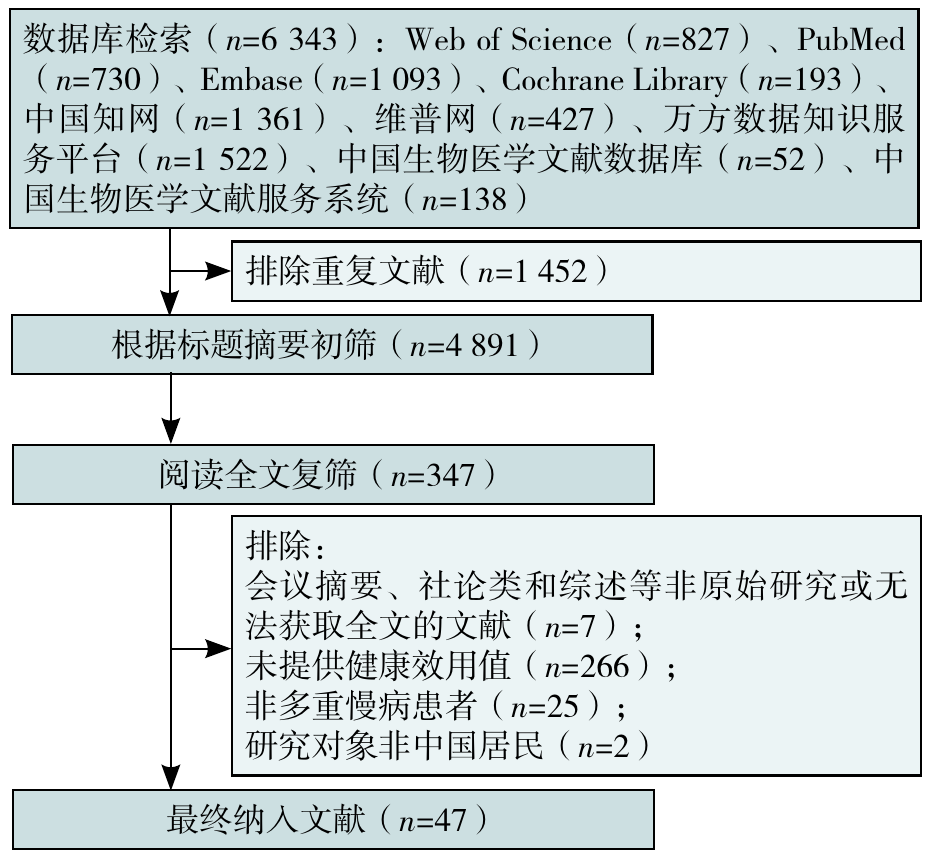
图1 文献筛选流程图
Figure 1 Flowchart of literature screening
| 第一作者 | 研究年份(年) | 研究地区 | 健康效用值( | 总样本量(例)/女性样本量(例) | 年龄(岁) | 积分体系版本 | AHRQ(分) |
|---|---|---|---|---|---|---|---|
| 周珊[ | 2023—2023 | 北京市 | 0.853±0.246 | 214/104 | ≥60 | LUO版 | 8 |
| 王兆京[ | 2014—2015 | 大连市 | 0.740±0.340 | 394/203 | NA | DOLAN版 | 6 |
| 汪婷[ | 2019—2021 | 铜陵市 | 0.785±0.085 | 89/43 | ≥60 | LIU版 | 8 |
| 田纬[ | 2018 | 中国28个省、自治区、直辖市 | 0.854±0.189a | 3 661/1 757 | ≥55 | ZHUO版 | 6 |
| 鲁宗芳[ | 2019 | 青海省 | 0.810±0.219b | 628/NA | ≥60 | LUO版 | 8 |
| 鲁宗芳[ | 2019 | 青海省 | 0.768±0.135b | 339/NA | ≥45 | LUO版 | 8 |
| 鲁宗芳[ | 2019 | 青海省 | 0.720±0.241b | 152/NA | ≥45 | LUO版 | 8 |
| 陈明明[ | 2021—2022 | 天津市 | 0.945±0.08a | 101/NA | 18~84 | LUO版 | 8 |
| 鲍欣雨[ | 2016—2017 | 珠江三角洲地区 | 0.902±0.182 | 893/NA | ≥15 | LIU版 | 7 |
| 施博文[ | 2018 | 中国28个省、自治区、直辖市 | 0.664±0.242b | 4 186/NA | ≥60 | LIU版 | 7 |
| 赵明烨[ | 2021 | 深圳市 | 0.860±0.005 | 468/NA | ≥18 | LUO版 | 6 |
| 李翔[ | 2015 | NA | (0.720±0.160)~(0.760±0.140) | (94/NA)~(314/NA) | ≥60 | TSUCHIYA版 | 6 |
| 刘业发[ | 2020 | 中国25个省、自治区、直辖市 | (0.433±0.451)~(0.767±0.074)a | (93/NA)~(444/NA) | 26~95 | NA | 8 |
| 赵钦风[ | 2018 | 山东省 | 0.800±0.240 | 1 818/1 008 | ≥65 | LIU版 | 9 |
| 齐鸣瑞[ | NA | 兰州市 | 0.928±0.092 | 172/98 | ≥60 | NA | 9 |
| 木日扎提·买买提[ | 2019—2020 | 新疆维吾尔自治区 | (0.763±0.250)~(0.831±0.200) | 1 180/NA | NA | LUO版 | 9 |
| 卯骏聪[ | 2016—2018 | 昆明市 | (0.520±0.360)~(0.530±0.340) | 104/47 | ≥18 | LUO版 | 7 |
| 刘妹妹[ | 2022 | 兰州市 | 0.819±0.241b | 143/33 | NA | LUO版 | 9 |
| 李改云[ | 2018 | 中国28个省、自治区、直辖市 | 0.854±0.067a | 6 338/3 379 | ≥60 | ZHUO版 | 7 |
| 高兆溶[ | 2020 | 山东省 | 0.903±0.138b | 3 137/NA | ≥15 | LUO版 | 7 |
| 秉岩[ | 2021—2022 | 上海市 | 0.898±0.066a | 593/288 | ≥40 | ZHUO版 | 9 |
| 苏蕴[ | 2018 | 中国28个省、自治区、直辖市 | 0.699±0.191b | 1 165/NA | ≥60 | LIU版 | 7 |
| 朱银潮[ | 2010 | 中国23个省、自治区、直辖市 | (0.748±0.147)~(0.804±0.086) | (588/304)~(5 029/2 573) | ≥15 | TSUCHIYA版 | 8 |
| KUO[ | 2009、2013 | 台湾省 | (0.636±0.416)~(0.842±0.276) | (206/NA)~(1 607/NA) | ≥18 | LEE版 | 7 |
| WANG[ | 2010 | 北京市 | (0.850±0.216)~(0.888±0.173) | (268/NA)~(1 558/NA) | ≥40 | TSUCHIYA版 | 7 |
| SIT[ | 2021 | 香港特别行政区 | 0.867±0.075a | 163/94 | ≥18 | DOLAN版 | 8 |
| MAK[ | 2015—2018 | 香港特别行政区 | 0.750±0.110 | 40/22 | ≥18 | NA | 7 |
| LU[ | 2014—2015 | 苏州市 | 0.935±0.094 | 2 053/1 557 | ≥60 | LIU版(农村人群)c | 7 |
| LIU[ | 2011—2013 | 台湾省 | (0.540±0.370)~(0.810±0.280) | (58/34)~(365/199) | ≥65 | LEE版 | 4 |
| ZHANG[ | 2016 | 重庆市 | 0.720±0.090 | 311/213 | ≥65 | TSUCHIYA版 | 6 |
| WONG[ | NA | 香港特别行政区 | 0.830±0.030b | 124/NA | ≥18 | WONG版 | 5 |
| WONG[ | NA | 香港特别行政区 | 0.822±0.241b | 1 601/NA | ≥18 | WONG版 | 4 |
| YAO[ | 2013 | 中国31个省、自治区、直辖市 | 0.941±0.112 | 10 471/NA | ≥15 | ZHUO版 | 4 |
| WONG[ | NA | 香港特别行政区 | 0.800±0.260 | 1 642/898 | ≥60 | WONG版 | 3 |
| ZHAO[ | 2008—2009 | 北京市、昆明市 | 0.721±0.067a | 268/NA | 20~59 | DOLAN版 | 4 |
| ZENG[ | 2019 | 重庆市 | 0.830±0.210 | 215/NA | ≥18 | LIU版 | 5 |
| DU[ | 2019 | 临沂市 | (0.935±0.103)~(0.935±0.104)a | (98/NA)~(303/NA) | ≥60 | LUO版 | 8 |
| LIANG[ | 2016 | 江苏省 | 0.780±0.280 | 4 779/3 034 | ≥18 | LUO版 | 5 |
| WONG[ | 2014 | 香港特别行政区 | (0.460±0.370)~(0.800±0.240) | (17/NA)~(1 466/NA) | ≥18 | WONG版 | 5 |
| FENG[ | 2017—2020 | 山东省 | 0.844±0.216b | 630/NA | ≥18 | LUO版 | 4 |
| SU[ | 2017 | 山东省 | 0.803±0.263b | 161/NA | ≥18 | LUO版 | 5 |
| XU[ | 2019 | 全国范围 | 0.430±0.310 | 369/NA | NA | LUO版 | 7 |
| ZHANG[ | 2016—2017 | 香港特别行政区 | 0.800±0.200 | 1 077/753 | ≥60 | WONG版 | 4 |
| BAO[ | NA | 佛山市 | 0.876±0.189b | 3 773/NA | ≥45 | LIU版 | 5 |
| ZENG[ | 2015—2016 | 黑龙江省 | 0.606±0.348a | 50/NA | ≥18 | LUO版 | 5 |
| ZHANG[ | NA | 中国9个城市 | (0.740±0.240)~(0.850±0.170) | (590/NA)~(2 046/NA) | NA | NA | 4 |
| CHIN[ | NA | 香港特别行政区 | 0.922±0.096b | 200/110 | ≥18 | LUO版 | 6 |
表2 纳入研究的基本特征及质量评价
Table 2 Characteristics and quality evaluation of the studies included in the meta-analysis
| 第一作者 | 研究年份(年) | 研究地区 | 健康效用值( | 总样本量(例)/女性样本量(例) | 年龄(岁) | 积分体系版本 | AHRQ(分) |
|---|---|---|---|---|---|---|---|
| 周珊[ | 2023—2023 | 北京市 | 0.853±0.246 | 214/104 | ≥60 | LUO版 | 8 |
| 王兆京[ | 2014—2015 | 大连市 | 0.740±0.340 | 394/203 | NA | DOLAN版 | 6 |
| 汪婷[ | 2019—2021 | 铜陵市 | 0.785±0.085 | 89/43 | ≥60 | LIU版 | 8 |
| 田纬[ | 2018 | 中国28个省、自治区、直辖市 | 0.854±0.189a | 3 661/1 757 | ≥55 | ZHUO版 | 6 |
| 鲁宗芳[ | 2019 | 青海省 | 0.810±0.219b | 628/NA | ≥60 | LUO版 | 8 |
| 鲁宗芳[ | 2019 | 青海省 | 0.768±0.135b | 339/NA | ≥45 | LUO版 | 8 |
| 鲁宗芳[ | 2019 | 青海省 | 0.720±0.241b | 152/NA | ≥45 | LUO版 | 8 |
| 陈明明[ | 2021—2022 | 天津市 | 0.945±0.08a | 101/NA | 18~84 | LUO版 | 8 |
| 鲍欣雨[ | 2016—2017 | 珠江三角洲地区 | 0.902±0.182 | 893/NA | ≥15 | LIU版 | 7 |
| 施博文[ | 2018 | 中国28个省、自治区、直辖市 | 0.664±0.242b | 4 186/NA | ≥60 | LIU版 | 7 |
| 赵明烨[ | 2021 | 深圳市 | 0.860±0.005 | 468/NA | ≥18 | LUO版 | 6 |
| 李翔[ | 2015 | NA | (0.720±0.160)~(0.760±0.140) | (94/NA)~(314/NA) | ≥60 | TSUCHIYA版 | 6 |
| 刘业发[ | 2020 | 中国25个省、自治区、直辖市 | (0.433±0.451)~(0.767±0.074)a | (93/NA)~(444/NA) | 26~95 | NA | 8 |
| 赵钦风[ | 2018 | 山东省 | 0.800±0.240 | 1 818/1 008 | ≥65 | LIU版 | 9 |
| 齐鸣瑞[ | NA | 兰州市 | 0.928±0.092 | 172/98 | ≥60 | NA | 9 |
| 木日扎提·买买提[ | 2019—2020 | 新疆维吾尔自治区 | (0.763±0.250)~(0.831±0.200) | 1 180/NA | NA | LUO版 | 9 |
| 卯骏聪[ | 2016—2018 | 昆明市 | (0.520±0.360)~(0.530±0.340) | 104/47 | ≥18 | LUO版 | 7 |
| 刘妹妹[ | 2022 | 兰州市 | 0.819±0.241b | 143/33 | NA | LUO版 | 9 |
| 李改云[ | 2018 | 中国28个省、自治区、直辖市 | 0.854±0.067a | 6 338/3 379 | ≥60 | ZHUO版 | 7 |
| 高兆溶[ | 2020 | 山东省 | 0.903±0.138b | 3 137/NA | ≥15 | LUO版 | 7 |
| 秉岩[ | 2021—2022 | 上海市 | 0.898±0.066a | 593/288 | ≥40 | ZHUO版 | 9 |
| 苏蕴[ | 2018 | 中国28个省、自治区、直辖市 | 0.699±0.191b | 1 165/NA | ≥60 | LIU版 | 7 |
| 朱银潮[ | 2010 | 中国23个省、自治区、直辖市 | (0.748±0.147)~(0.804±0.086) | (588/304)~(5 029/2 573) | ≥15 | TSUCHIYA版 | 8 |
| KUO[ | 2009、2013 | 台湾省 | (0.636±0.416)~(0.842±0.276) | (206/NA)~(1 607/NA) | ≥18 | LEE版 | 7 |
| WANG[ | 2010 | 北京市 | (0.850±0.216)~(0.888±0.173) | (268/NA)~(1 558/NA) | ≥40 | TSUCHIYA版 | 7 |
| SIT[ | 2021 | 香港特别行政区 | 0.867±0.075a | 163/94 | ≥18 | DOLAN版 | 8 |
| MAK[ | 2015—2018 | 香港特别行政区 | 0.750±0.110 | 40/22 | ≥18 | NA | 7 |
| LU[ | 2014—2015 | 苏州市 | 0.935±0.094 | 2 053/1 557 | ≥60 | LIU版(农村人群)c | 7 |
| LIU[ | 2011—2013 | 台湾省 | (0.540±0.370)~(0.810±0.280) | (58/34)~(365/199) | ≥65 | LEE版 | 4 |
| ZHANG[ | 2016 | 重庆市 | 0.720±0.090 | 311/213 | ≥65 | TSUCHIYA版 | 6 |
| WONG[ | NA | 香港特别行政区 | 0.830±0.030b | 124/NA | ≥18 | WONG版 | 5 |
| WONG[ | NA | 香港特别行政区 | 0.822±0.241b | 1 601/NA | ≥18 | WONG版 | 4 |
| YAO[ | 2013 | 中国31个省、自治区、直辖市 | 0.941±0.112 | 10 471/NA | ≥15 | ZHUO版 | 4 |
| WONG[ | NA | 香港特别行政区 | 0.800±0.260 | 1 642/898 | ≥60 | WONG版 | 3 |
| ZHAO[ | 2008—2009 | 北京市、昆明市 | 0.721±0.067a | 268/NA | 20~59 | DOLAN版 | 4 |
| ZENG[ | 2019 | 重庆市 | 0.830±0.210 | 215/NA | ≥18 | LIU版 | 5 |
| DU[ | 2019 | 临沂市 | (0.935±0.103)~(0.935±0.104)a | (98/NA)~(303/NA) | ≥60 | LUO版 | 8 |
| LIANG[ | 2016 | 江苏省 | 0.780±0.280 | 4 779/3 034 | ≥18 | LUO版 | 5 |
| WONG[ | 2014 | 香港特别行政区 | (0.460±0.370)~(0.800±0.240) | (17/NA)~(1 466/NA) | ≥18 | WONG版 | 5 |
| FENG[ | 2017—2020 | 山东省 | 0.844±0.216b | 630/NA | ≥18 | LUO版 | 4 |
| SU[ | 2017 | 山东省 | 0.803±0.263b | 161/NA | ≥18 | LUO版 | 5 |
| XU[ | 2019 | 全国范围 | 0.430±0.310 | 369/NA | NA | LUO版 | 7 |
| ZHANG[ | 2016—2017 | 香港特别行政区 | 0.800±0.200 | 1 077/753 | ≥60 | WONG版 | 4 |
| BAO[ | NA | 佛山市 | 0.876±0.189b | 3 773/NA | ≥45 | LIU版 | 5 |
| ZENG[ | 2015—2016 | 黑龙江省 | 0.606±0.348a | 50/NA | ≥18 | LUO版 | 5 |
| ZHANG[ | NA | 中国9个城市 | (0.740±0.240)~(0.850±0.170) | (590/NA)~(2 046/NA) | NA | NA | 4 |
| CHIN[ | NA | 香港特别行政区 | 0.922±0.096b | 200/110 | ≥18 | LUO版 | 6 |
| 亚组 | 文献数(篇)/数据组数(组) | I2(%) | P值 | 效应模型 | 健康效用值(95%CI) | P值 |
|---|---|---|---|---|---|---|
| 年龄 | <0.001 | |||||
| ≥18岁 | 15/39[ | 97.4 | <0.001 | 随机 | 0.807(0.793~0.820) | |
| ≥45岁 | 3/7[ | 98.5 | <0.001 | 随机 | 0.794(0.740~0.849) | |
| ≥60岁 | 12/20[ | 99.7 | <0.001 | 随机 | 0.787(0.750~0.823) | |
| ≥75岁 | 1/1[ | 0.720(0.693~0.747) | ||||
| 共病数 | 0.491 | |||||
| 2种 | 17/19[ | 99.1 | <0.001 | 随机 | 0.825(0.797~0.853) | |
| 3种 | 9/11[ | 97.3 | <0.001 | 随机 | 0.806(0.763~0.849) | |
| 4种 | 3/5[ | 95.8 | <0.001 | 随机 | 0.749(0.608~0.890) | |
| 调查时间 | 0.854 | |||||
| 2015年前 | 10/34[ | 99.3 | <0.001 | 随机 | 0.787(0.760~0.813) | |
| 2015年及以后 | 37/70[ | 99.8 | <0.001 | 随机 | 0.790(0.778~0.801) | |
| 患者来源 | 0.078 | |||||
| 医院 | 26/60[ | 99.4 | <0.001 | 随机 | 0.778(0.764~0.792) | |
| 社区 | 21/44[ | 99.7 | <0.001 | 随机 | 0.800(0.780~0.820) | |
| 是否为中位数转化的效用值 | 0.127 | |||||
| 是 | 14/27[ | 99.4 | <0.001 | 随机 | 0.771(0.744~0.798) | |
| 否 | 33/77[ | 99.6 | <0.001 | 随机 | 0.794(0.781~0.807) | |
| 样本量 | <0.001 | |||||
| <50例 | 10/18[ | 95.2 | <0.001 | 随机 | 0.774(0.725~0.824) | |
| 50~500例 | 26/47[ | 99.3 | <0.001 | 随机 | 0.755(0.734~0.775) | |
| >500例 | 22/39[ | 99.8 | <0.001 | 随机 | 0.823(0.803~0.843) | |
| 测量工具 | 0.001 | |||||
| EQ-5D-5L | 23/49[ | 98.5 | <0.001 | 随机 | 0.809(0.795~0.823) | |
| EQ-5D-3L | 23/54[ | 99.7 | <0.001 | 随机 | 0.774(0.755~0.793) | |
| EQ-5D-3L积分体系 | <0.001 | |||||
| LEE版 | 2/12[ | 95.2 | <0.001 | 随机 | 0.757(0.724~0.791) | |
| LIU版 | 7/13[ | 99.6 | <0.001 | 随机 | 0.775(0.717~0.834) | |
| DOLAN版 | 3/3[ | 99.5 | <0.001 | 随机 | 0.776(0.666~0.887) | |
| TSUCHIYA版 | 4/12[ | 98.8 | <0.001 | 随机 | 0.789(0.771~0.807) | |
| ZHUO版 | 4/4[ | 99.9 | <0.001 | 随机 | 0.887(0.833~0.940) | |
| LIU版(农村人群) | 1/1[ | 0.935(0.931~0.939) | ||||
| 未标明 | 2/9[ | 99.3 | <0.001 | 随机 | 0.705(0.659~0.750) | |
| EQ-5D-5L积分体系 | <0.001 | |||||
| WONG版 | 5/14[ | 96.7 | <0.001 | 随机 | 0.789(0.763~0.814) | |
| LUO版 | 17/34[ | 98.7 | <0.001 | 随机 | 0.809(0.788~0.830) | |
| 未标明 | 1/1[ | 0.928(0.914~0.942) | ||||
表3 不同亚组慢性病患者健康效用值
Table 3 Health state utility values of persons with multimorbidity among different subgroups
| 亚组 | 文献数(篇)/数据组数(组) | I2(%) | P值 | 效应模型 | 健康效用值(95%CI) | P值 |
|---|---|---|---|---|---|---|
| 年龄 | <0.001 | |||||
| ≥18岁 | 15/39[ | 97.4 | <0.001 | 随机 | 0.807(0.793~0.820) | |
| ≥45岁 | 3/7[ | 98.5 | <0.001 | 随机 | 0.794(0.740~0.849) | |
| ≥60岁 | 12/20[ | 99.7 | <0.001 | 随机 | 0.787(0.750~0.823) | |
| ≥75岁 | 1/1[ | 0.720(0.693~0.747) | ||||
| 共病数 | 0.491 | |||||
| 2种 | 17/19[ | 99.1 | <0.001 | 随机 | 0.825(0.797~0.853) | |
| 3种 | 9/11[ | 97.3 | <0.001 | 随机 | 0.806(0.763~0.849) | |
| 4种 | 3/5[ | 95.8 | <0.001 | 随机 | 0.749(0.608~0.890) | |
| 调查时间 | 0.854 | |||||
| 2015年前 | 10/34[ | 99.3 | <0.001 | 随机 | 0.787(0.760~0.813) | |
| 2015年及以后 | 37/70[ | 99.8 | <0.001 | 随机 | 0.790(0.778~0.801) | |
| 患者来源 | 0.078 | |||||
| 医院 | 26/60[ | 99.4 | <0.001 | 随机 | 0.778(0.764~0.792) | |
| 社区 | 21/44[ | 99.7 | <0.001 | 随机 | 0.800(0.780~0.820) | |
| 是否为中位数转化的效用值 | 0.127 | |||||
| 是 | 14/27[ | 99.4 | <0.001 | 随机 | 0.771(0.744~0.798) | |
| 否 | 33/77[ | 99.6 | <0.001 | 随机 | 0.794(0.781~0.807) | |
| 样本量 | <0.001 | |||||
| <50例 | 10/18[ | 95.2 | <0.001 | 随机 | 0.774(0.725~0.824) | |
| 50~500例 | 26/47[ | 99.3 | <0.001 | 随机 | 0.755(0.734~0.775) | |
| >500例 | 22/39[ | 99.8 | <0.001 | 随机 | 0.823(0.803~0.843) | |
| 测量工具 | 0.001 | |||||
| EQ-5D-5L | 23/49[ | 98.5 | <0.001 | 随机 | 0.809(0.795~0.823) | |
| EQ-5D-3L | 23/54[ | 99.7 | <0.001 | 随机 | 0.774(0.755~0.793) | |
| EQ-5D-3L积分体系 | <0.001 | |||||
| LEE版 | 2/12[ | 95.2 | <0.001 | 随机 | 0.757(0.724~0.791) | |
| LIU版 | 7/13[ | 99.6 | <0.001 | 随机 | 0.775(0.717~0.834) | |
| DOLAN版 | 3/3[ | 99.5 | <0.001 | 随机 | 0.776(0.666~0.887) | |
| TSUCHIYA版 | 4/12[ | 98.8 | <0.001 | 随机 | 0.789(0.771~0.807) | |
| ZHUO版 | 4/4[ | 99.9 | <0.001 | 随机 | 0.887(0.833~0.940) | |
| LIU版(农村人群) | 1/1[ | 0.935(0.931~0.939) | ||||
| 未标明 | 2/9[ | 99.3 | <0.001 | 随机 | 0.705(0.659~0.750) | |
| EQ-5D-5L积分体系 | <0.001 | |||||
| WONG版 | 5/14[ | 96.7 | <0.001 | 随机 | 0.789(0.763~0.814) | |
| LUO版 | 17/34[ | 98.7 | <0.001 | 随机 | 0.809(0.788~0.830) | |
| 未标明 | 1/1[ | 0.928(0.914~0.942) | ||||
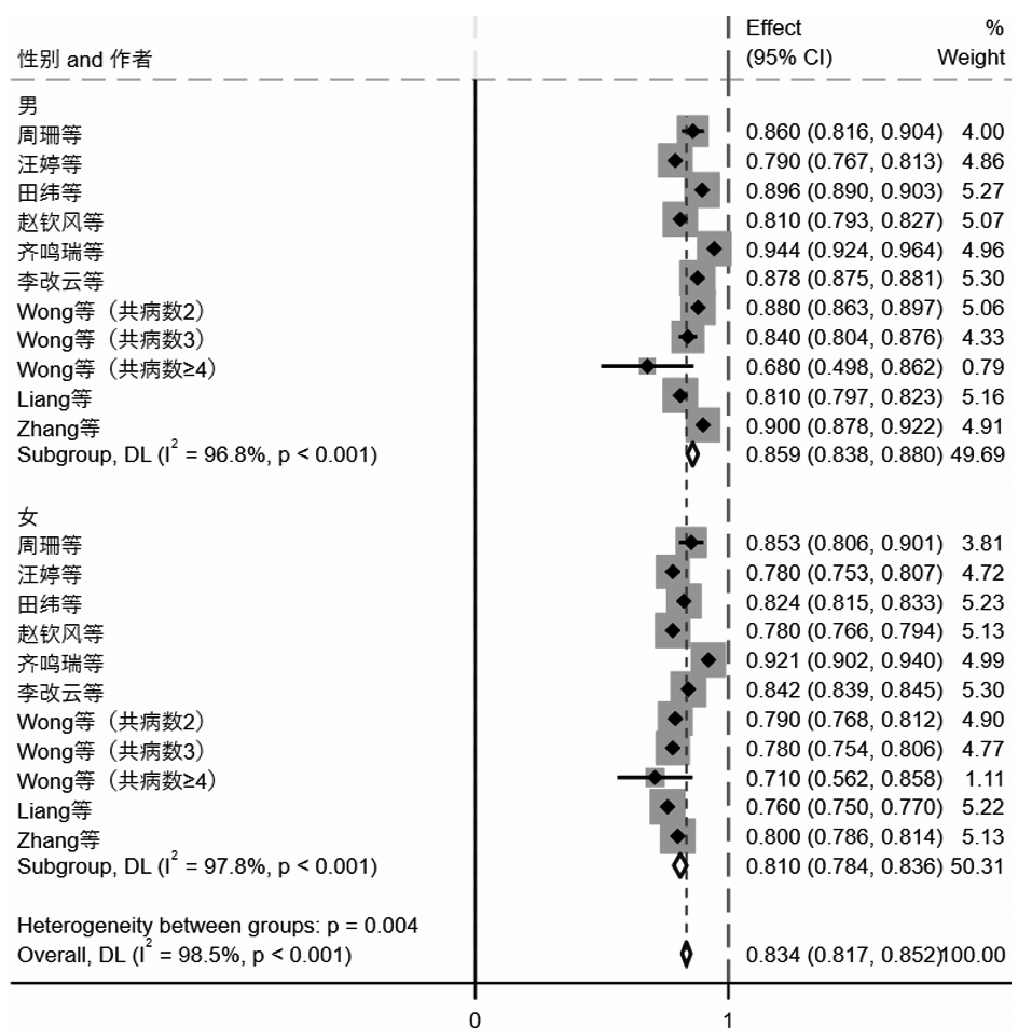
图2 不同性别多重慢病患者健康效用值
Figure 2 Forest plot of the health state utility values of persons with multimorbidity among different gender
| 变量 | 系数(标准误) | 95%CI | P值 |
|---|---|---|---|
| 常数 | 0.412(0.076) | 0.263~0.562 | <0.001 |
| 样本量 | 0a(0a) | 0a~0a | 0.001 |
| 女性比例 | 0.485(0.110) | 0.268~0.701 | <0.001 |
| ≥60岁与<60岁 | -0.067(0.027) | -0.121~-0.013 | 0.014 |
| 中位数转化与非中位数转化 | 0.090(0.031) | 0.028~0.151 | 0.004 |
| 医院患者与社区患者 | 0.007(0.027) | -0.046~0.060 | 0.800 |
| 2015年前与2015年及以后 | 0.004(0.028) | -0.052~0.060 | 0.890 |
| EQ-5D-5L与EQ-5D-3L | 0.026(0.025) | -0.023~0.075 | 0.300 |
| 横断面研究与纵向研究 | 0.109(0.041) | 0.029~0.189 | 0.008 |
表4 多重慢病患者健康效用值Meta回归分析
Table 4 Meta-regression analysis of health utility values in persons with multimorbidity
| 变量 | 系数(标准误) | 95%CI | P值 |
|---|---|---|---|
| 常数 | 0.412(0.076) | 0.263~0.562 | <0.001 |
| 样本量 | 0a(0a) | 0a~0a | 0.001 |
| 女性比例 | 0.485(0.110) | 0.268~0.701 | <0.001 |
| ≥60岁与<60岁 | -0.067(0.027) | -0.121~-0.013 | 0.014 |
| 中位数转化与非中位数转化 | 0.090(0.031) | 0.028~0.151 | 0.004 |
| 医院患者与社区患者 | 0.007(0.027) | -0.046~0.060 | 0.800 |
| 2015年前与2015年及以后 | 0.004(0.028) | -0.052~0.060 | 0.890 |
| EQ-5D-5L与EQ-5D-3L | 0.026(0.025) | -0.023~0.075 | 0.300 |
| 横断面研究与纵向研究 | 0.109(0.041) | 0.029~0.189 | 0.008 |
| 共病模式 | 文献数(篇)/数据组数(组) | I2(%) | P值 | 效应模型 | 健康效用值(95%CI) |
|---|---|---|---|---|---|
| 血脂异常+任意慢病 | 7/10[ | 99.8 | <0.001 | 随机 | 0.819(0.784~0.854) |
| 消化系统疾病+任意慢病 | 5/9[ | 79.7 | <0.001 | 随机 | 0.808(0.780~0.836) |
| 糖尿病+任意慢病 | 20/42[ | 89.8 | <0.001 | 随机 | 0.795(0.781~0.808) |
| 糖尿病+血脂异常 | 7/9[ | 99.8 | <0.001 | 随机 | 0.809(0.771~0.847) |
| 糖尿病+高血压 | 12/14[ | 99.6 | <0.001 | 随机 | 0.802(0.776~0.828) |
| 糖尿病+心脏病 | 8/10[ | 96.1 | <0.001 | 随机 | 0.776(0.746~0.806) |
| 糖尿病+脑血管病 | 5/5[ | 98.3 | <0.001 | 随机 | 0.683(0.610~0.757) |
| 高血压+任意慢病 | 19/31[ | 99.7 | <0.001 | 随机 | 0.793(0.770~0.816) |
| 高血压+心脏病 | 4/4[ | 99.4 | <0.001 | 随机 | 0.799(0.725~0.873) |
| 癌症+任意慢病 | 7/10[ | 88.0 | <0.001 | 随机 | 0.762(0.718~0.806) |
| 心脏病+任意慢病 | 10/20[ | 98.6 | <0.001 | 随机 | 0.731(0.700~0.762) |
| 脑血管病+任意慢病 | 8/8[ | 98.4 | <0.001 | 随机 | 0.679(0.610~0.748) |
表5 多重慢病患者不同共病模式健康效用值
Table 5 Health utility values of different comorbid modes in persons with multimorbidity
| 共病模式 | 文献数(篇)/数据组数(组) | I2(%) | P值 | 效应模型 | 健康效用值(95%CI) |
|---|---|---|---|---|---|
| 血脂异常+任意慢病 | 7/10[ | 99.8 | <0.001 | 随机 | 0.819(0.784~0.854) |
| 消化系统疾病+任意慢病 | 5/9[ | 79.7 | <0.001 | 随机 | 0.808(0.780~0.836) |
| 糖尿病+任意慢病 | 20/42[ | 89.8 | <0.001 | 随机 | 0.795(0.781~0.808) |
| 糖尿病+血脂异常 | 7/9[ | 99.8 | <0.001 | 随机 | 0.809(0.771~0.847) |
| 糖尿病+高血压 | 12/14[ | 99.6 | <0.001 | 随机 | 0.802(0.776~0.828) |
| 糖尿病+心脏病 | 8/10[ | 96.1 | <0.001 | 随机 | 0.776(0.746~0.806) |
| 糖尿病+脑血管病 | 5/5[ | 98.3 | <0.001 | 随机 | 0.683(0.610~0.757) |
| 高血压+任意慢病 | 19/31[ | 99.7 | <0.001 | 随机 | 0.793(0.770~0.816) |
| 高血压+心脏病 | 4/4[ | 99.4 | <0.001 | 随机 | 0.799(0.725~0.873) |
| 癌症+任意慢病 | 7/10[ | 88.0 | <0.001 | 随机 | 0.762(0.718~0.806) |
| 心脏病+任意慢病 | 10/20[ | 98.6 | <0.001 | 随机 | 0.731(0.700~0.762) |
| 脑血管病+任意慢病 | 8/8[ | 98.4 | <0.001 | 随机 | 0.679(0.610~0.748) |
| [1] |
|
| [2] |
|
| [3] |
|
| [4] |
陈鸣声,司磊. 慢性病共病对患者门诊次数、住院床日与灾难性卫生支出的影响研究[J]. 中国卫生政策研究, 2021, 14(11): 17-24. DOI: 10.3969/j.issn.1674-2982.2021.11.003.
|
| [5] | |
| [6] |
周珊,刘艳丽,李娜, 等. 老年多病共存患者健康相关生命质量及影响因素研究[J]. 中华全科医学, 2024, 22(5): 721-724. DOI: 10.16766/j.cnki.issn.1674-4152.003488.
|
| [7] | |
| [8] |
周莉,刘冰清,温泽淮. 中医药领域卫生经济学研究中欧洲五维健康量表的应用现状分析[J]. 中药新药与临床药理, 2024, 35(3): 438-444. DOI: 10.19378/j.issn.1003-9783.2024.03.017.
|
| [9] |
|
| [10] |
|
| [11] |
|
| [12] |
|
| [13] |
|
| [14] |
|
| [15] |
|
| [16] |
|
| [17] |
|
| [18] |
史钊,董怡然,李顺平. 中国糖尿病患者健康效用值系统综述与Meta分析[J]. 现代预防医学, 2022, 49(6): 1091-1098.
|
| [19] |
|
| [20] |
刘海宁,吴昊,姚灿, 等. Meta分析中连续性数据的深度提取方法[J]. 中国循证医学杂志, 2017, 17(1): 117-121. DOI: 10.7507/1672-2531.201612004.
|
| [21] |
|
| [22] |
朱银潮. 2型糖尿病患者口服药物治疗模式和生活质量现状的研究[D]. 杭州: 浙江大学, 2013.
|
| [23] |
赵钦风. 山东省老年多重慢性病患者的健康相关生命质量研究[D]. 济南: 山东大学, 2021.
|
| [24] |
赵明烨,任溢男,唐平, 等. 深圳市2型糖尿病及合并症患者健康相关生命质量研究[J]. 职业与健康, 2023, 39(2): 221-226, 232. DOI: 10.13329/j.cnki.zyyjk.2023.0040.
|
| [25] |
王兆京,李姝洁,张瑜, 等. 2型糖尿病患者生命质量评价及相关因素[J]. 中国老年学杂志, 2018, 38(17): 4292-4295. DOI: 10.3969/j.issn.1005-9202.2018.17.073.
|
| [26] |
汪婷,陈任,闵源, 等. 老年住院共病患者生活质量评估及影响因素分析[J]. 安徽医学, 2022, 43(12): 1402-1407.
|
| [27] |
田纬,陶梦梦,李坤坤, 等. 中国老年多重慢性病患者健康相关生命质量及其影响因素研究[J]. 中国全科医学, 2024, 27(11): 1303-1309. DOI: 10.12114/j.issn.1007-9572.2023.0593.
|
| [28] |
苏蕴. 老年慢性病共病患者健康相关生命质量分析[D]. 郑州: 郑州大学, 2023.
|
| [29] |
施博文,熊巨洋. 慢性病共病对中国老年人健康相关生命质量的影响研究[J]. 人口与发展, 2024, 30(1): 120-128.
|
| [30] |
齐鸣瑞. 高血压-糖尿病共病老年人的健康相关生命质量研究[D]. 兰州: 甘肃中医药大学, 2023.
|
| [31] |
木日扎提·买买提. 新疆某地区高血压、糖尿病管理实施现况及生命质量评价[D]. 乌鲁木齐: 新疆医科大学, 2021.
|
| [32] |
卯骏聪. 抑郁、焦虑对慢性心力衰竭患者预后的影响[D]. 昆明: 昆明医科大学, 2018.
|
| [33] |
鲁宗芳,魏来,陈翀宇, 等. 基于EQ-5D量表的青海省农牧区老年慢性病患者健康相关生命质量研究[J]. 医学与社会, 2021, 34(11): 11-15. DOI: 10.13723/j.yxysh.2021.11.003.
|
| [34] |
鲁宗芳,魏来,陈翀宇, 等. 青海省农牧区中老年慢性病患者健康相关生命质量及其影响因素[J]. 中国慢性病预防与控制, 2021, 29(4): 273-277. DOI: 10.16386/j.cjpccd.issn.1004-6194.2021.04.008.
|
| [35] |
鲁宗芳,陈翀宇,简红江. 西宁市农村中老年人自评健康状况调查及其影响因素研究[J]. 中国农村卫生事业管理, 2022, 42(7): 515-520. DOI: 10.19955/j.cnki.1005-5916.2022.07.012.
|
| [36] |
刘业发,丁荣晶,孟晓萍, 等. 冠心病患者自我报告的生活质量现状及其影响因素分析 [J]. 中华内科杂志, 2023, 62(4): 384-392.
|
| [37] |
刘妹妹. 基于EQ-5D-5L量表的失代偿期肝硬化患者健康相关生命质量的研究及其影响因素分析[D]. 兰州: 兰州大学, 2023.
|
| [38] |
李翔,许樟荣,王爱红, 等. 中国城市三甲医院老年2型糖尿病患者生活质量及其影响因素[J]. 中华老年多器官疾病杂志, 2020, 19(11): 845-850. DOI: 10.11915/j.issn.1671-5403.2020.11.195.
|
| [39] |
李改云. 我国慢性病共病老年人的健康相关生命质量及医疗服务利用状况研究[D]. 兰州: 兰州大学, 2023.
|
| [40] |
高兆溶. 泰安市慢性病患者电子健康素养与生命质量的关系探究[D]. 济南: 山东大学, 2021.
|
| [41] |
陈明明,王雪,邓翠玉, 等. 基于EQ-5D效用值积分体系的尿石症患者健康相关生活质量研究[J]. 天津护理, 2023, 31(1): 60-64.
|
| [42] |
秉岩. 社区中老年糖尿病共病患者的治疗负担水平及影响因素研究[D]. 上海: 中国人民解放军海军军医大学, 2023.
|
| [43] |
鲍欣雨,谢易娴,张晓霞, 等. 多重慢病对社区居民健康相关生命质量的影响分析[J]. 中国卫生经济, 2019, 38(3): 74-77.
|
| [44] |
|
| [45] |
|
| [46] |
|
| [47] |
|
| [48] |
|
| [49] |
|
| [50] |
|
| [51] |
|
| [52] |
|
| [53] |
|
| [54] |
|
| [55] |
|
| [56] |
|
| [57] |
|
| [58] |
|
| [59] |
|
| [60] |
|
| [61] |
|
| [62] |
|
| [63] |
|
| [64] |
|
| [65] |
|
| [66] |
|
| [67] |
|
| [68] |
郑晓,田峰,陈一鸣, 等. 2002—2022年我国多重慢病领域研究热点及演进趋势分析[J]. 中国全科医学, 2023, 26(21): 2567-2573. DOI: 10.12114/j.issn.1007-9572.2023.0066.
|
| [69] |
朱娟,王乐,何世娇, 等. 中国乳腺癌健康效用值研究的系统评价[J]. 中国循证医学杂志, 2017, 17(9): 1066-1071.
|
| [70] |
黄佳文,朱娟,黄慧瑶, 等. 中国肝癌及相关疾病状态健康效用值及失能权重研究的系统评价[J]. 中国循证医学杂志, 2018, 18(5): 410-417.
|
| [71] |
姚强,张耀光,徐玲. 中国居民健康相关生命质量状况及影响因素研究——基于国家卫生服务调查实证分析[J]. 人口与发展, 2018, 24(3): 85-95.
|
| [72] |
李侗桐,方任飞,谢铮. 北京市老年人生命质量的社会决定因素[J]. 北京大学学报(医学版), 2014, 46(3): 450-454.
|
| [73] |
张文倩,叶玲珑,罗杰诚, 等. 中国老年人健康类型识别及其性别差异研究[J]. 中国卫生统计, 2021, 38(2): 188-192.
|
| [74] |
费方荣,胡如英,钟节鸣, 等. 2018年浙江省15岁以上居民健康期望寿命测算[J]. 中国卫生统计, 2021, 38(1): 43-46.
|
| [75] |
边原,冯双,龙恩武, 等. 基于EQ-5D量表的高血压患者生命质量评价及其用药现状[J]. 中国新药与临床杂志, 2017, 36(3): 166-172. DOI: 10.14109/j.cnki.xyylc.2017.03.010.
|
| [76] |
杜进林,谢志岿,肖俊辉. 分级诊疗制度下深圳市居民就医意愿及其影响因素分析[J]. 现代预防医学, 2019, 46(19): 3552-3556.
|
| [77] |
|
| [78] |
|
| [79] |
王凯旋,刘世贤,史钊, 等. 1型糖尿病患者健康效用值系统综述与Meta分析[J]. 中国药物经济学, 2022, 17(8): 16-21, 31.
|
| [80] |
周挺,官海静,刘国恩, 等. 基于EQ-5D量表的中国疾病人群生命质量系统评价[J]. 中国循证医学杂志, 2016, 16(2): 135-142. DOI: 10.7507/1672-2531.20160024.
|
| [81] |
严春文,李林美,潘莉, 等. 长期低剂量鹧鸪茶与中风的关系:一项基于海南的横断面研究[J]. 海南医学院学报, 2024, 30(23): 1798-1804. DOI: 10.13210/j.cnki.jhmu.20240828.001.
|
| [1] | 郭治宏, 陈盈盈, 刘德伍. 抗生素骨水泥联合负压封闭引流技术治疗糖尿病足有效性和安全性的Meta分析[J]. 中国全科医学, 2026, 29(30): 4503-4512. |
| [2] | 胡玉婷, 严颖, 闫明婕, 王惠君, 韩虎. 不同骨改良药物治疗实体瘤骨转移或多发性骨髓瘤患者疗效的网状Meta分析[J]. 中国全科医学, 2026, 29(30): 4489-4502. |
| [3] | 赵聪娟, 金田田, 梁婕, 王贝宁, 高燕. 胰高血糖素样肽1受体激动剂对糖尿病肾脏病患者治疗效果比较:一项网状Meta分析[J]. 中国全科医学, 2026, 29(29): 4326-4336. |
| [4] | 姜妍琳, 王喆, 翟睿, 张梦洁, 陈溪, 王俊宏. 中药复方治疗注意缺陷多动障碍优势方案筛选研究:基于网状Meta分析和熵权TOPSIS法[J]. 中国全科医学, 2026, 29(27): 3985-3994. |
| [5] | 李雪妮, 刘格婧, 刘永铭. 司美格鲁肽治疗心力衰竭疗效和安全性的Meta分析[J]. 中国全科医学, 2026, 29(24): 3509-3519. |
| [6] | 王睿, 罗说明, 杨靓, 王鹏, 赵洋, 王淇, 周智广. 中国老年人糖尿病患病率:一项系统综述和Meta分析[J]. 中国全科医学, 2026, 29(24): 3500-3508. |
| [7] | 裴如青, 周郁秋, 张思宇, 刘西俊. 中国精神分裂症患者复发影响因素的Meta分析[J]. 中国全科医学, 2026, 29(23): 3359-3370. |
| [8] | 王璇, 申颖, 奚谦, 赵璨, 莫云坚, 张文婷. 广西壮族自治区乡镇卫生院多重慢病患者治疗负担现状及影响因素研究[J]. 中国全科医学, 2026, 29(20): 2808-2815. |
| [9] | 李俞彤, 赵丹廷, 江枫, 王艳娜, 刘益宗, 梁文娟, 陆家海. 呼吸道合胞病毒mRNA疫苗与重组蛋白亚单位疫苗有效性和安全性的系统评价与Meta分析[J]. 中国全科医学, 2026, 29(19): 2744-2752. |
| [10] | 田安妮, 杨晶, 孙晶, 王诗纯. 康复机器人辅助训练对不同阶段脑卒中患者手运动功能恢复效果的Meta分析[J]. 中国全科医学, 2026, 29(14): 1911-1920. |
| [11] | 詹立, 衡朝阳, 何俍钰, 赵捷, 陈杰, 邢晋山. 靶向B细胞成熟抗原的嵌合抗原受体-T细胞疗法治疗中国复发/难治性多发性骨髓瘤患者疗效及安全性的Meta分析[J]. 中国全科医学, 2026, 29(14): 1921-1930. |
| [12] | 王菲, 韩伟钰, 孙韬. 艾灸联合三阶梯疗法治疗癌性疼痛的网状Meta分析[J]. 中国全科医学, 2026, 29(09): 1203-1211. |
| [13] | 胡琦, 徐宁, 马喜民, 贺嘉慧, 乔慧. 宁夏回族自治区南部山区农村女性健康相关生命质量及其对卫生服务利用的影响研究[J]. 中国全科医学, 2026, 29(08): 988-996. |
| [14] | 裴志怡, 张晓欣, 林佳艺, 张向毅, 康晓凤. 基于患者决策辅助工具国际标准的心血管领域患者决策辅助工具质量及应用效果的系统评价[J]. 中国全科医学, 2026, 29(07): 945-952. |
| [15] | 张玲, 黄双英, 徐慧, 梅慧婷, 洪咏萍. 不同运动方式对老年人跌倒效能影响的网状Meta分析[J]. 中国全科医学, 2026, 29(06): 741-751. |
| 阅读次数 | ||||||
|
全文 |
|
|||||
|
摘要 |
|
|||||