中国全科医学 ›› 2026, Vol. 29 ›› Issue (04): 509-517.DOI: 10.12114/j.issn.1007-9572.2024.0533

• 论著 • 上一篇    

慢性病患者基层用药体验量表的研制及其信效度检验

邵佳娴1,2,3, 曹海虹4, 孙志红5, 李晓娜1,2,3, 高敏1,2,3, 李子源1,2,3, 时永利1,2,3, 董平1,2,3, 尹文强1,2,3, 陈钟鸣1,2,3,*()   

  1. 1.261053 山东省潍坊市,山东第二医科大学管理学院
    2.261053 山东省潍坊市,"健康山东"重大社会风险预测与治理协同创新中心
    3.200032 上海市,国民健康社会风险预警协同创新中心
    4.261000 山东省潍坊市人民医院
    5.264003 山东省烟台市,烟台山医院
  • 收稿日期:2024-07-30 修回日期:2025-03-30 出版日期:2026-02-05 发布日期:2026-01-15
  • 通讯作者: 陈钟鸣

  • 作者贡献:

    陈钟鸣提出研究命题并进行研究设计,对文章整体负责;邵佳娴负责研究实施,撰写论文;曹海虹、孙志红、李晓娜、高敏、李子源、时永利进行数据的收集与整理,统计学处理,图、表的绘制与展示;尹文强负责对文章进行监督管理。

    本文首次刊登于Chinese General Practice Journal 2025年第1期(https://www.sciencedirect.com/science/article/pii/S295055932500001X)

  • 基金资助:
    国家自然科学基金面上项目(72274140); 山东省级人才工程(tsqn202312250); 山东省人文社会科学课题(2022-JCGL-02)

Development of a Primary Medication Experience Scale For Patients with Chronic Disease

SHAO Jiaxian1,2,3, CAO Haihong4, SUN Zhihong5, LI Xiaona1,2,3, GAO Min1,2,3, LI Ziyuan1,2,3, SHI Yongli1,2,3, DONG Ping1,2,3, YIN Wenqiang1,2,3, CHEN Zhongming1,2,3,*()   

  1. 1. School of Management, Shandong Second Medical University, Weifang 261053, China
    2. "Healthy Shandong" Major Social Risk Prediction and Governance Collaborative Innovation Center, Weifang 261053, China
    3. The National Health and Social Risk Early Warning Collaborative innovation Center, Shanghai 200032, China
    4. Weifang People's Hospital, Weifang 261000, China
    5. Yantai Shan Hospital, Yantai 264003, China
  • Received:2024-07-30 Revised:2025-03-30 Published:2026-02-05 Online:2026-01-15
  • Contact: CHEN Zhongming

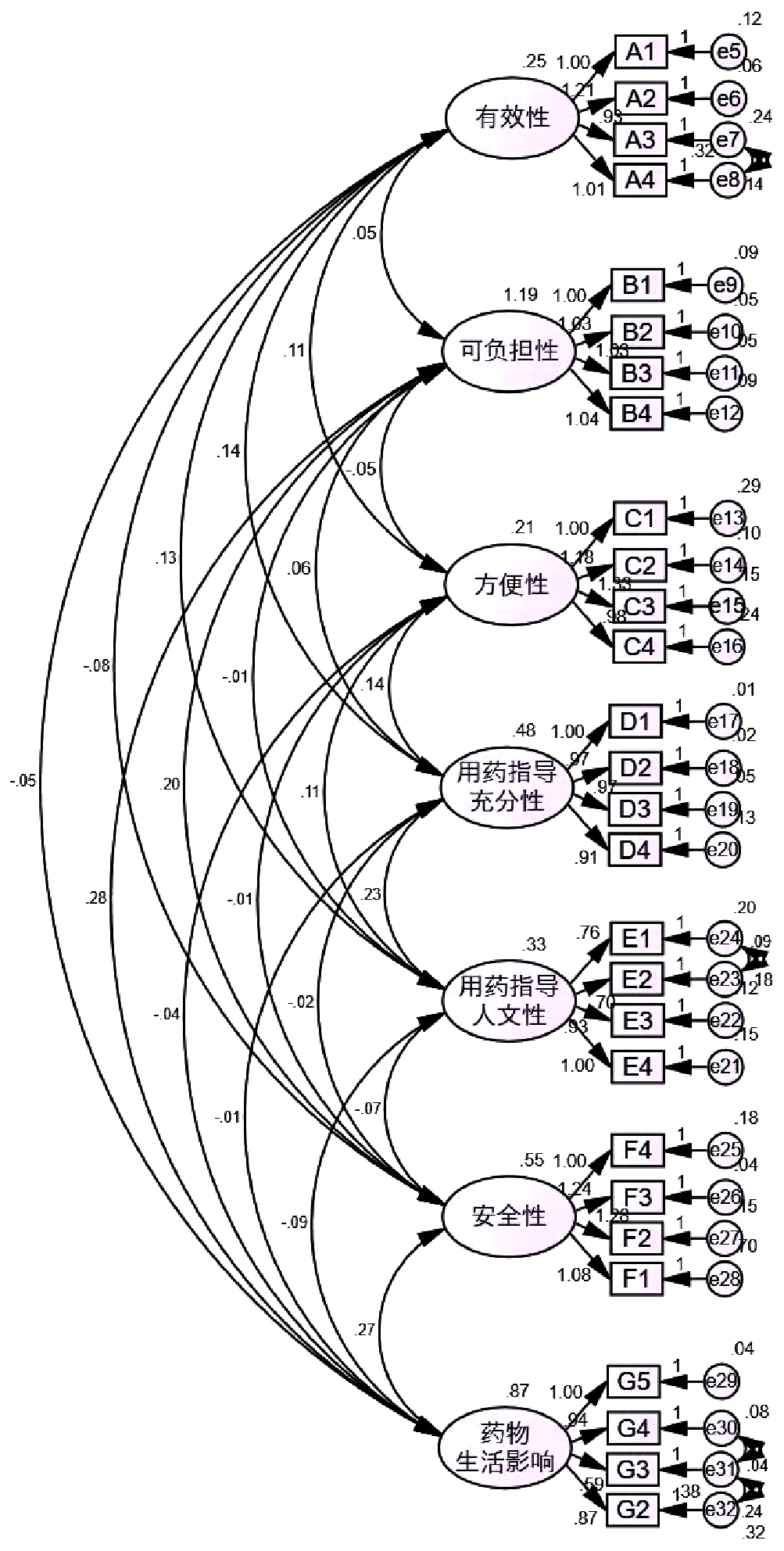
摘要: 背景 改善患者用药体验是提高患者用药依从性的关键因素,也是改善患者预后和医疗安全的必要条件。目前我国慢性病患者基层用药体验测量工具欠缺,严重掣肘了基层医疗卫生机构药事服务和管理的研究和实践工作。 目的 本研究旨在研制适用于我国慢性病管理实践的慢性病患者基层用药体验量表,并进行信效度检验,以期为慢性病患者健康管理研究和实践提供工具支持。 方法 本研究采用定性与定量相结合的方式进行量表研制。通过文献分析法初步构建量表条目池,通过半结构化访谈法并在感知价值理论指导下形成初步的慢性病患者基层用药体验量表。通过德尔菲专家咨询法对初步编制的慢性病患者基层用药体验量表进行咨询论证,并修改完善。于2023年10月,在山东省基层医疗卫生机构采用随机抽样方法,选取基层就诊的慢性病患者进行现场调研,对量表进行语言文化调试及量表的信度和效度检验,对量表做出进一步的优化和调整,最终形成慢性病患者基层用药体验量表。 结果 通过文献分析法提取了14个用药体验相关维度,通过半结构化访谈法初步构建了包含8个维度、40个条目的量表条目池。通过德尔菲专家咨询法对量表进行了修改完善,两轮专家积极性分别为95%和100%,专家权威系数平均值分别为0.86和0.88,专家对量表提出了较为科学权威的修改意见和建议,形成了包含7个维度、29个条目的量表。通过现场调研,量表的信效度检验结果较好,量表条目临界比值法分析结果显示,P值均<0.05,总表及各维度Cronbach's α系数均>0.800,折半信度均>0.700,组内相关系数(ICC)均>0.800。旋转后各条目因子载荷量均>0.500;验证性因子分析模型拟合指标结果为卡方自由度比(CMIN/DF)=1.485,适配度指数(GFI)=0.902,渐进残差均方和平方根(RMSEA)=0.039,均方根残差(RMR)=0.03,比较适配指数(CFI)=0.981,规准适配指数(NFI)=0.945,增值适配指数(IFI)=0.981,量表建构信度(CR)值均>0.7,平均方差提取值(AVE)均>0.500。最终形成了包括功能价值、情感价值、社会价值3个一级维度、7个二级维度、28个测量条目的慢性病患者基层用药体验量表。 结论 本研究研制的慢性病患者基层用药体验量表具有较好的信度和效度,具有较好的本土适宜性,可以用于慢性病患者基层用药体验调查研究。

关键词: 慢性病, 用药体验, 患者体验, 量表研制

Abstract:

Background

Improving the patient medication experience is a key factor in improving patient medication adherence, and it is also necessary to improve patient outcomes and medical safety. At present, there is a lack of measurement tools for the primary medication experience of patients with chronic diseases in China, which seriously restricts the research and practice of pharmaceutical service and management in primary medical institutions.

Objective

The purpose of this study was to develop the Primary Medication Experience Scale for Chronic Disease Patients, which is applicable to the practice of chronic disease management in China, and to conduct reliability and validity tests, with the aim of providing instrumental support for research and practice of health management for chronic disease patients.

Methods

This study used a combination of qualitative and quantitative methods to develop the scale. First, a pool of scale items was generated through the literature review method, and a preliminary primary medication experience scale for patients with chronic diseases was formed through the semi-structured interview method and under the guidance of the perceived value theory. Through the Delphi expert consultation method, the preliminary primary medication experience scale for patients with chronic diseases was consulted and validated, and revised and improved. In October 2023, a random sampling method was used in primary healthcare institutions in Shandong Province to select chronic disease patients attending primary healthcare institutions for on-site research, to debug the scale in terms of language and culture and to test the reliability and validity of the scale, and to make further optimization and adjustment of the scale, to finally form the Scale of Experience of Primary Medication Use for Chronic Disease Patients.

Results

Through literature analysis, 14 dimensions related to medication experience were extracted. A preliminary scale item pool comprising 8 dimensions and 40 items was constructed through semi-structured interviews. The scale was modified and refined using the Delphi expert consultation method. The expert response rates in two rounds were 95% and 100%, respectively, with mean expert authority coefficients of 0.86 and 0.88, respectively. The experts provided scientifically sound and authoritative suggestions and recommendations for revisions, resulting in a scale containing 7 dimensions and 29 items. Through field investigation, the reliability and validity testing results of the scale were satisfactory. The critical ratio analysis of scale items showed that all P values were <0.05. Cronbach's α coefficients for the total scale and all dimensions were >0.800, split-half reliability coefficients were all >0.700, and intraclass correlation coefficients (ICC) were all >0.800. After rotation, all item factor loadings were >0.500. The confirmatory factor analysis model fit indices were: chi-square to degrees of freedom ratio (CMIN/DF) = 1.485, goodness-of-fit index (GFI) = 0.902, root mean square error of approximation (RMSEA) = 0.039, root mean square residual (RMR) = 0.03, comparative fit index (CFI) = 0.981, normed fit index (NFI) = 0.945, incremental fit index (IFI) = 0.981. The composite reliability (CR) values were all >0.7, and average variance extracted (AVE) values were all >0.500. Ultimately, a primary care medication experience scale for patients with chronic diseases was developed, comprising 3 first-level dimensions (functional value, emotional value, and social value), 7 second-level dimensions, and 28 measurement items.

Conclusion

The primary medication experience scale for chronic disease patients developed in this study has good reliability and validity, has certain local appropriateness and scientific validity, and can be used in the survey research of primary medication experience for chronic disease patients.

Key words: Chronically disease, Medication experience, Patients experience, Scale development

中图分类号: