中国全科医学 ›› 2026, Vol. 29 ›› Issue (29): 4337-4344.DOI: 10.12114/j.issn.1007-9572.2025.0278

• 论著·方法学研究 • 上一篇    下一篇

中医健康行为阶段性影响因素量表的编制及信效度检验

王思雪1, 袁越1, 熊丽莎1, 周纯祎1, 袁项青1, 方雪莲1, 张艾琳1, 王云翠1,2,3,*()   

  1. 1.430065 湖北省武汉市,湖北中医药大学护理学院
    2.430065 湖北省武汉市,老年脑健康中医药防护技术与新产品研发教育部工程研究中心
    3.430065 湖北省武汉市,湖北时珍实验室
  • 收稿日期:2025-08-10 修回日期:2025-10-30 出版日期:2026-10-15 发布日期:2026-09-02
  • 通讯作者: 王云翠

  • 作者贡献:

    王思雪、袁越、王云翠进行论文的构思与研究的设计;王思雪、袁越负责研究的实施;王思雪、袁越、熊丽莎、周纯祎、袁项青、方雪莲、张艾琳负责数据收集;王思雪进行数据统计分析及论文撰写;袁越、熊丽莎、袁项青负责论文修订;王云翠负责论文写作指导、质量控制及审校,对论文整体负责。

  • 基金资助:
    国家自然科学基金资助项目(72374068); 湖北省中医药创新发展联合基金(2025AFD497)

Development of the Traditional Chinese Medicine Health Behaviors Stage-specific Influencing Factors Scale and Its Reliability and Validity Testing

WANG Sixue1, YUAN Yue1, XIONG Lisha1, ZHOU Chunyi1, YUAN Xiangqing1, FANG Xuelian1, ZHANG Ailin1, WANG Yuncui1,2,3,*()   

  1. 1. School of Nursing, Hubei University of Chinese Medicine, Wuhan 430065, China
    2. Engineering Research Center of TCM Protection Technology and New Product Development for the Elderly Brain Health, Ministry of Education, Wuhan 430065, China
    3. Hubei Shizhen Laboratory, Wuhan 430065, China
  • Received:2025-08-10 Revised:2025-10-30 Published:2026-10-15 Online:2026-09-02
  • Contact: WANG Yuncui

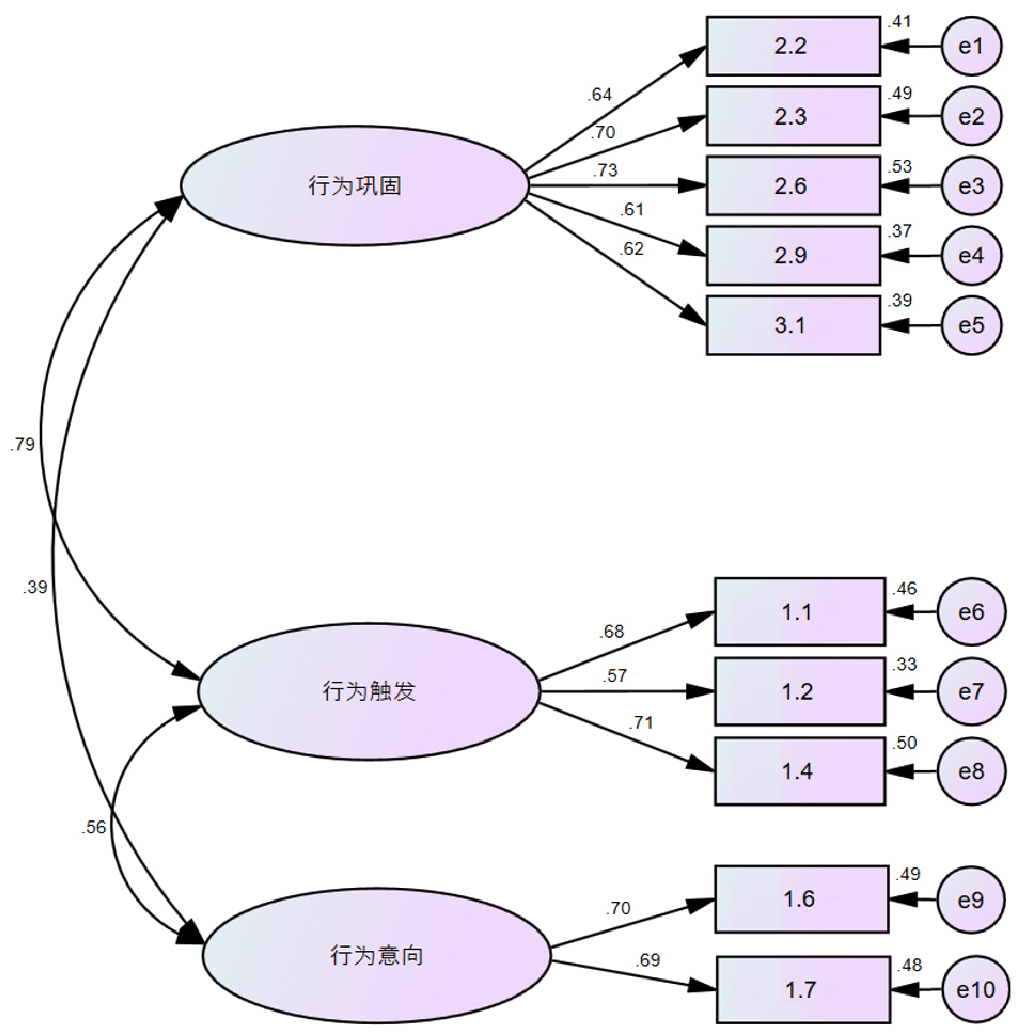
摘要: 背景 践行中医健康行为对提升个体及居民整体健康水平至关重要,但社会实践率并不理想,明确各阶段中医健康行为的影响因素是制订针对性策略的前提条件,然而目前尚无用于探索居民中医健康行为影响因素的工具。 目的 编制中医健康行为阶段性影响因素量表并检验其信效度,为识别居民中医健康行为的促进和阻碍因素提供评估工具。 方法 以理论域框架和多理论模型为指导,通过文献回顾、半结构式访谈构建初始条目池;经德尔菲专家函询、预调查后拟定测试版量表。2024年10—12月,采用便利抽样法在湖北省、四川省和广东省进行调查,共发放问卷597份,回收有效问卷547份,有效率为91.62%,对量表条目进行筛选,并检验量表信效度。 结果 通过文献回顾、半结构式访谈等方式初步构建了3个维度、28个条目的初始量表。通过专家函询对量表进行修改完善,2轮专家函询的积极系数均为100.0%,专家权威系数分别为0.889、0.903,肯德尔协调系数分别为0.151、0.114(P<0.05)。结合专家意见及小组讨论结果对初始量表进行修改,形成了3个维度、26个条目的测试量表。经过信效度检验后,最终形成的中医健康行为阶段性影响因素量表包括3个维度、10个条目。探索性因子显示3个因子累积方差贡献率为63.231%,各条目载荷值为0.605~0.834。验证性因子分析模型拟合指标卡方值与自由度比值(χ2/df)=2.012、渐进残差均方和平方根(RMSEA)=0.061、均方根残差(RMR)=0.032、适配度指数(GFI)=0.956、规范适配指数(NFI)=0.919、增值适配指数(IFI)=0.957、Tucker-Lewis指数(TLI)=0.939,提示模型拟合程度良好。聚敛效度和区分效度指标在可接受的范围内。中医健康行为阶段性影响因素量表内容效度指数为0.970,各条目水平内容效度指数为0.890~1.000。中医健康行为阶段性影响因素量表总体Cronbach's α系数为0.818,折半信度为0.778,信度良好。 结论 中医健康行为阶段性影响因素量表的信效度较好,能够作为健康管理者在开展中医健康行为影响因素研究中的测评工具。

关键词: 中医健康行为, 影响因素, 量表, 信度, 效度

Abstract:

Background

Practicing Traditional Chinese Medicine (TCM) health behaviors is crucial for improving individual and overall community health. However, the practice rate remains suboptimal. Identifying stage-related influencing factors of TCM health behaviors is a prerequisite for formulating targeted strategies, yet no specific tool has been developed to explore such factors among residents.

Objective

To develop the TCM Health Behaviors Stage-specific Influencing Factors Scale and test its reliability and validity, providing an assessment tool for identifying facilitators and barriers to TCM health behaviors.

Methods

Guided by the theoretical domains framework and multi-theory model of health behavior change, an initial item pool was constructed through literature review and qualitative interviews. A trial version of the scale was developed after Delphi expert consultation and pre-survey. From October 2024 to December 2024, convenience sampling was conducted in Hubei, Sichuan and Guangdong provinces. 597 questionnaires were distributed, 547 valid questionnaires were recovered, with a validity rate of 91.62%, and the scale entries were screened and tested for scale reliability and validity.

Results

An initial scale with 3 dimensions and 28 items was preliminarily constructed through literature review and semi-structured qualitative interviews. The scale was modified and improved through expert consultation. The enthusiasm of experts in both rounds was 100.0%. The expert authority coefficients were 0.889 and 0.903, respectively, and the Kendall coordination coefficients were 0.151 and 0.114, respectively (P<0.05). Combined with the experts' opinions and the results of group discussions, the scale was modified, forming a test scale with 3 dimensions and 26 items. After reliability and validity tests, the TCM Health Behaviors Stage-specific Influencing Factors Scales included 3 dimensions and 10 items. Exploratory factors showed that the cumulative variance contribution rate of the 3 factors was 63.231%, and the load values of each item were between 0.605 and 0.834. For the confirmatory factor analysis model fit indices, the ratio of chi-square value to degrees of freedom (χ2/df) =2.012, the root mean square error of approximation (RMSEA) =0.061, the root mean square residual (RMR) =0.032, the goodness-of-fit index (GFI) =0.956, the normed fit index (NFI) =0.919, the incremental fit index (IFI) =0.957, and the Tucker-Lewis index (TLI) =0.939, suggesting a good model fit. The convergent validity and discriminant validity indices were within acceptable ranges. The content validity of the TCM Health Behaviors Stage-specific Influencing Factors Scales level was 0.970, and the content validity indices at each item level were between 0.890 and 1.000. The overall Cronbach's α coefficient of the TCM Health Behaviors Stage-specific Influencing Factors Scales was 0.818, and the split-half reliability was 0.778, indicating good reliability.

Conclusion

The scale for measuring stage-related influencing factors of TCM health behaviors exhibits good reliability and validity, serving as a practical measurement tool for health managers to study influencing factors of TCM health behaviors.

Key words: Traditional Chinese Medicine health behaviors, Influence factor, Scale, Reliability, Validity

中图分类号: