
中国全科医学 ›› 2026, Vol. 29 ›› Issue (29): 4326-4336.DOI: 10.12114/j.issn.1007-9572.2025.0252
所属专题: 内分泌代谢性疾病最新文章合辑
赵聪娟1,2, 金田田1,2, 梁婕1,2, 王贝宁1,2, 高燕1,2,3,*( )
)
收稿日期:2025-06-30
修回日期:2025-10-11
出版日期:2026-10-15
发布日期:2026-09-02
通讯作者:
高燕
作者贡献:
赵聪娟负责使用软件统计分析、论文撰写;金田田负责收集筛选资料、纳入文献数据的提取;梁婕负责提取数据并进行质量评估;王贝宁负责起草论文;高燕负责最终版本修订、文章的质量控制及审校,对文章整体负责。
基金资助:
ZHAO Congjuan1,2, JIN Tiantian1,2, LIANG Jie1,2, WANG Beining1,2, GAO Yan1,2,3,*()
Received:2025-06-30
Revised:2025-10-11
Published:2026-10-15
Online:2026-09-02
Contact:
GAO Yan
摘要: 背景 糖尿病肾脏病是糖尿病微血管并发症之一,严重影响患者的生命质量,由于肾功能异常,传统的降糖药物使用非常受限。目前胰高血糖素样肽1(GLP-1)受体激动剂在降糖的同时也表现出肾脏保护等多重收益,但鉴于GLP-1受体激动剂种类繁多,缺乏相关临床循证医学证据,难以评估不同种类GLP-1受体激动剂治疗效果的优劣。 目的 系统评价不同GLP-1受体激动剂对糖尿病肾脏病患者肾功能、蛋白尿、血糖控制的治疗效果。 方法 计算机检索PubMed、Embase、Cochrane Library、Web of Science、中国知网、万方数据知识服务平台、维普网、中国生物医学文献服务系统相关文献,检索方案为主题词与自由词相结合,检索时限为从建库至2025-03-16。纳入使用不同GLP-1受体激动剂治疗糖尿病肾脏病患者的随机对照试验,试验组接受GLP-1受体激动剂治疗,对照组接受另1种GLP-1受体激动剂或者传统标准治疗。由2名研究人员提取资料并进行文献质量评价,使用Stata 16.0软件进行网状Meta分析和图形绘制,利用累积排序曲线下面积(SUCRA)图估计不同GLP-1受体激动剂各项结局指标疗效的排名。 结果 共纳入27项研究,7 019例患者,涉及7种GLP-1受体激动剂,分别为:艾塞那肽、度拉糖肽、司美格鲁肽、利拉鲁肽、聚乙二醇洛塞那肽、贝那鲁肽、阿必鲁肽。网状Meta分析结果显示:艾塞那肽(WMD=10.21,95%CI=3.09~17.34)、聚乙二醇洛塞那肽(WMD=9.76,95%CI=1.07~18.46)、利拉鲁肽(WMD=7.13,95%CI=2.79~11.47)治疗的患者估算肾小球滤过率(eGFR)水平高于传统标准治疗(P<0.05)。司美格鲁肽(WMD=-24.03,95%CI=-47.72~-0.33)、艾塞那肽(WMD=-17.55,95%CI=-32.68~-2.42)、利拉鲁肽(WMD=-10.92,95%CI=-19.05~-2.80)治疗的患者血肌酐(Scr)水平低于传统标准治疗(P<0.05)。艾塞那肽(WMD=-192.45,95%CI=-353.07~-31.83)治疗的患者尿白蛋白/肌酐比值(UACR)水平低于传统标准治疗(P<0.05)。度拉糖肽(WMD=-228.51,95%CI=-282.19~-174.83)、艾塞那肽(WMD=-159.67,95%CI=-295.06~-24.28)、利拉鲁肽(WMD=-34.24,95%CI=-47.58~-20.90)、贝那鲁肽(WMD=-16.68,95%CI=-32.05~-1.30)治疗的患者尿白蛋白排泄率(UAER)低于传统标准治疗(P<0.05)。度拉糖肽(WMD=-194.27,95%CI=-249.58~-138.96)治疗的患者UAER水平低于利拉鲁肽(P<0.05)。度拉糖肽(WMD=-211.83,95%CI=-267.67~-156.00)、艾塞那肽(WMD=-142.99,95%CI=-279.26~-6.73)治疗的患者UAER水平低于贝那鲁肽(P<0.05)。度拉糖肽(WMD=-2.44,95%CI=-4.05~-0.83)、司美格鲁肽(WMD=-2.00,95%CI=-3.80~-0.20)、利拉鲁肽(WMD=-0.93,95%CI=-1.64~-0.22)治疗的患者空腹血糖(FPG)低于传统标准治疗(P<0.05)。度拉糖肽(WMD=-2.34,95%CI=-4.58~-0.10)治疗的患者FPG低于阿必鲁肽(P<0.05)。聚乙二醇洛塞那肽(WMD=-1.22,95%CI=-2.09~-0.35)、司美格鲁肽(WMD=-0.81,95%CI=-1.41~-0.21)、利拉鲁肽(WMD=-0.60,95%CI=-0.87~-0.34)治疗的患者糖化血红蛋白(HbA1c)低于传统标准治疗(P<0.05)。通过SUCRA排序,在延缓eGFR下降、降低UACR方面,艾塞那肽排第1位;在降低Scr方面,司美格鲁肽排第1位;在降低UAER、FPG方面,度拉糖肽排第1位;在减低HbA1c方面,聚乙二醇洛塞那肽排第1位。 结论 通过网状Meta分析对7种GLP-1受体激动剂的疗效进行对比,发现在降低UAER、控制FPG方面,度拉糖肽可能是最优选择。在改善肾功能方面,不同GLP-1受体激动剂无明显差异。未来仍需要开展样本量更大、药物种类更全面的高质量随机对照试验加以验证。
中图分类号:
| 第一作者 | 发表年份(年) | 国家/地区 | 样本量(例) | 干预组 | 对照组 | 随访周期 | eGFR[mL·min-1·(1.73 m2)-1] | 性别比例(男/女) | 年龄( | |
|---|---|---|---|---|---|---|---|---|---|---|
| 试验组 | 对照组 | |||||||||
| Perkovic[ | 2024 | 美洲、欧洲、亚洲、非洲 | 3 533 | 司美格鲁肽1.0 mg,1次/周皮下注射+基线降糖药物 | placebo+基线降糖药物 | 3.4年 | 50~75 | 69.7/30.3 | 66.6±9.0 | 66.7±9.0 |
| Von Scholten[ | 2017 | 丹麦 | 27 | 利拉鲁肽1.8 mg,1次/d皮下注射+标准治疗 | placebo+标准治疗 | 12周 | NA | 81.5/19.5 | NA | NA |
| Wang[ | 2020 | 中国 | 92 | 艾塞那肽5~10 μg,2次/d皮下注射+甘精胰岛素 | 赖脯胰岛素+甘精胰岛素 | 24周 | ≥30 | 69.6/30.4 | 55.9±8.9 | 56.2±8 |
| Tuttle[ | 2018/ 2019 | 巴西、匈牙利、墨西哥、波兰、罗马尼亚、南非、西班牙、乌克兰和美国 | 481 | 度拉糖肽1.5 mg,1次/周皮下注射+赖脯胰岛素 | 甘精胰岛素+赖脯胰岛素 | 52周 | NA | 51/49 | 64.7±8.8 | 64.3±8.4 |
| 度拉糖肽0.75 mg,1次/周皮下注射+赖脯胰岛素 | NA | 54.7/45.3 | 64.7±8.6 | |||||||
| 杨淼[ | 2023 | 中国 | 84 | 度拉糖肽1.5 mg,1次/周皮下注射+甘精胰岛素 | 甘精胰岛素 | 12周 | NA | 67.9/32.1 | 45.7±3.3 | 45.7±3.2 |
| 董莉[ | 2018 | 中国 | 86 | 利拉鲁肽1.8 mg,1次/d皮下注射+甘精、门冬胰岛素 | 甘精、门冬胰岛素 | 24周 | <60 | 50/50 | 53.7±6.2 | 54.6±8.7 |
| 王欣[ | 2021 | 中国 | 61 | 利拉鲁肽0.6~1.8 mg,1次/d皮下注射+常规降糖药物 | 甘精胰岛素+常规降糖药物 | 24周 | NA | 52.5/47.5 | 56.1±7.23 | 56.67±6.13 |
| 任珍珍[ | 2022 | 中国 | 60 | 艾塞那肽5~10 μg,2次/d皮下注射+常规降糖药物 | 常规降糖药物 | 24周 | NA | 76.7/23.3 | 56.7±7.8 | 57.7±7.8 |
| 周丽君[ | 2019 | 中国 | 80 | 艾塞那肽10 μg,2次/d皮下注射+二甲双胍+奥美沙坦 | 二甲双胍+奥美沙坦 | 24周 | NA | 57.5/42.5 | 55.7±12.2 | 56.4±11.9 |
| 彭湾湾[ | 2020 | 中国 | 80 | PEX168 0.2 mg,1次/周皮下注射+二甲双胍+缬沙坦 | 二甲双胍+缬沙坦 | 12周 | NA | 55/45 | 51.7±9.9 | 52.2±10.5 |
| 沈艳萍[ | 2017 | 中国 | 60 | 利拉鲁肽0.6~1.2 mg,1次/d皮下注射+奥美沙坦 | 胰岛素+奥美沙坦 | 24周 | NA | 55/45 | NA | NA |
| 张博雅[ | 2020 | 中国 | 32 | 利拉鲁肽1.2 mg,1次/周皮下注射+常规治疗及缬沙坦口服 | 常规治疗及缬沙坦口服 | 8周 | NA | 59.4/40.6 | 52.3±4.8 | 51.8±4.9 |
| 陶娅[ | 2021 | 中国 | 86 | 利拉鲁肽1.2~1.8 mg,1次/d皮下注射+常规降糖药物 | 常规降糖药物+胰岛素 | 24周 | NA | 60.5/39.5 | 67.4±6.1 | 65.9±6.9 |
| 刘星星[ | 2025 | 中国 | 300 | 聚乙二醇洛塞那肽0.1 mg,1次/周皮下注射+二甲双胍 | 利拉鲁肽0.6~1.2 mg,1次/d皮下注射+二甲双胍 | 8周 | NA | 50.7/49.3 | 47.4±6.3 | 46.3±7.2 |
| 张亮[ | 2025 | 中国 | 60 | 利拉鲁肽1.8 mg,1次/d皮下注射+常规降糖药物 | 常规降糖药物 | 12周 | 30~89 | 55/45 | 61.3±6.9 | 60.7±7.0 |
| 张箐鸿[ | 2020 | 中国 | 58 | 利拉鲁肽0.6~1.8 mg,1次/d皮下注射+胰岛素 | 胰岛素 | 24周 | NA | 48.3/51.7 | 61.7±11.2 | 61.2±9.5 |
| Idorn[ | 2016 | 丹麦 | 20 | 利拉鲁肽1.8 mg,1次/d皮下注射+基线降糖药物 | placebo+基线降糖药物 | 12周 | <15 | 85/15 | 68.3±3.1 | 65.9±3.2 |
| 袁丽[ | 2022 | 中国 | 94 | 司美格鲁肽0.5 mg,1次/周皮下注射+二甲双胍 | 艾塞那肽5~10 μg,2次/d皮下注射+二甲双胍 | 12周 | NA | 55.3/44.7 | 52.67±7.85 | 52.25±8.65 |
| 王元真[ | 2018 | 中国 | 142 | 贝那鲁肽0.1~0.2 mg,3次/d皮下注射+常规治疗 | 常规治疗 | 4周 | NA | 57.7/42.3 | 55.4±12.2 | 53.4±12.4 |
| 范思铭[ | 2020 | 中国 | 134 | 贝那鲁肽0.1~0.2 mg,3次/d皮下注射+常规治疗 | 常规治疗 | 4周 | NA | 53/47 | 54.5±3.5 | 53.3±3.5 |
| 李莉霞[ | 2024 | 中国 | 100 | 利拉鲁肽0.6~1.2 mg,1次/d皮下注射 | 二甲双胍 | 12周 | NA | 43/57 | 48.3±2.2 | 48.5±2.1 |
| 阮毅[ | 2021 | 中国 | 124 | 利拉鲁肽0.6~1.8 mg,1次/d皮下注射+胰岛素/口服降糖药物 | 胰岛素/口服降糖药物 | 8周 | NA | 62.1/37.9 | 72.3±3.8 | 72.0±3.9 |
| 赵春云[ | 2014 | 中国 | 45 | 利拉鲁肽0.6~1.8 mg,1次/d皮下注射+缬沙坦 | 胰岛素+缬沙坦 | 24周 | NA | NA | NA | NA |
| Liu[ | 2022 | 中国 | 84 | 利拉鲁肽0.6~1.8 mg,1次/d皮下注射+常规治疗 | 常规治疗 | 12周 | NA | 51.2/48.8 | 46.9±11.3 | 45.4±10.3 |
| Leiter[ | 2014 | 多中心 | 495 | 阿必鲁肽30~50 mg,1次/周皮下注射+常规降糖药物 | 西他列汀+常规降糖药物 | 52周 | 15~89 | 53.7/46.3 | 63.2±8.4 | 63.5±9.0 |
| Mosenzon[ | 2019 | 丹麦、芬兰、以色列、波兰、俄罗斯、瑞典、英国和美国 | 324 | 司美格鲁肽14 mg,1次/d口服+常规降糖治疗 | placebo+常规降糖治疗 | 31周 | 30~59 | 48.1/51.9 | 71±8 | 70±8 |
| Davies[ | 2016 | 法国、波兰、俄罗斯、乌克兰、英国和美国 | 277 | 利拉鲁肽1.8 mg,1次/d皮下注射+常规降糖药物+胰岛素 | placebo+常规降糖药物+胰岛素 | 26周 | 30~59 | 50.5/49.5 | 68.0±8.3 | 66.3±8.0 |
表1 纳入研究的基本特征
Table 1 Basic characteristics of the included studies
| 第一作者 | 发表年份(年) | 国家/地区 | 样本量(例) | 干预组 | 对照组 | 随访周期 | eGFR[mL·min-1·(1.73 m2)-1] | 性别比例(男/女) | 年龄( | |
|---|---|---|---|---|---|---|---|---|---|---|
| 试验组 | 对照组 | |||||||||
| Perkovic[ | 2024 | 美洲、欧洲、亚洲、非洲 | 3 533 | 司美格鲁肽1.0 mg,1次/周皮下注射+基线降糖药物 | placebo+基线降糖药物 | 3.4年 | 50~75 | 69.7/30.3 | 66.6±9.0 | 66.7±9.0 |
| Von Scholten[ | 2017 | 丹麦 | 27 | 利拉鲁肽1.8 mg,1次/d皮下注射+标准治疗 | placebo+标准治疗 | 12周 | NA | 81.5/19.5 | NA | NA |
| Wang[ | 2020 | 中国 | 92 | 艾塞那肽5~10 μg,2次/d皮下注射+甘精胰岛素 | 赖脯胰岛素+甘精胰岛素 | 24周 | ≥30 | 69.6/30.4 | 55.9±8.9 | 56.2±8 |
| Tuttle[ | 2018/ 2019 | 巴西、匈牙利、墨西哥、波兰、罗马尼亚、南非、西班牙、乌克兰和美国 | 481 | 度拉糖肽1.5 mg,1次/周皮下注射+赖脯胰岛素 | 甘精胰岛素+赖脯胰岛素 | 52周 | NA | 51/49 | 64.7±8.8 | 64.3±8.4 |
| 度拉糖肽0.75 mg,1次/周皮下注射+赖脯胰岛素 | NA | 54.7/45.3 | 64.7±8.6 | |||||||
| 杨淼[ | 2023 | 中国 | 84 | 度拉糖肽1.5 mg,1次/周皮下注射+甘精胰岛素 | 甘精胰岛素 | 12周 | NA | 67.9/32.1 | 45.7±3.3 | 45.7±3.2 |
| 董莉[ | 2018 | 中国 | 86 | 利拉鲁肽1.8 mg,1次/d皮下注射+甘精、门冬胰岛素 | 甘精、门冬胰岛素 | 24周 | <60 | 50/50 | 53.7±6.2 | 54.6±8.7 |
| 王欣[ | 2021 | 中国 | 61 | 利拉鲁肽0.6~1.8 mg,1次/d皮下注射+常规降糖药物 | 甘精胰岛素+常规降糖药物 | 24周 | NA | 52.5/47.5 | 56.1±7.23 | 56.67±6.13 |
| 任珍珍[ | 2022 | 中国 | 60 | 艾塞那肽5~10 μg,2次/d皮下注射+常规降糖药物 | 常规降糖药物 | 24周 | NA | 76.7/23.3 | 56.7±7.8 | 57.7±7.8 |
| 周丽君[ | 2019 | 中国 | 80 | 艾塞那肽10 μg,2次/d皮下注射+二甲双胍+奥美沙坦 | 二甲双胍+奥美沙坦 | 24周 | NA | 57.5/42.5 | 55.7±12.2 | 56.4±11.9 |
| 彭湾湾[ | 2020 | 中国 | 80 | PEX168 0.2 mg,1次/周皮下注射+二甲双胍+缬沙坦 | 二甲双胍+缬沙坦 | 12周 | NA | 55/45 | 51.7±9.9 | 52.2±10.5 |
| 沈艳萍[ | 2017 | 中国 | 60 | 利拉鲁肽0.6~1.2 mg,1次/d皮下注射+奥美沙坦 | 胰岛素+奥美沙坦 | 24周 | NA | 55/45 | NA | NA |
| 张博雅[ | 2020 | 中国 | 32 | 利拉鲁肽1.2 mg,1次/周皮下注射+常规治疗及缬沙坦口服 | 常规治疗及缬沙坦口服 | 8周 | NA | 59.4/40.6 | 52.3±4.8 | 51.8±4.9 |
| 陶娅[ | 2021 | 中国 | 86 | 利拉鲁肽1.2~1.8 mg,1次/d皮下注射+常规降糖药物 | 常规降糖药物+胰岛素 | 24周 | NA | 60.5/39.5 | 67.4±6.1 | 65.9±6.9 |
| 刘星星[ | 2025 | 中国 | 300 | 聚乙二醇洛塞那肽0.1 mg,1次/周皮下注射+二甲双胍 | 利拉鲁肽0.6~1.2 mg,1次/d皮下注射+二甲双胍 | 8周 | NA | 50.7/49.3 | 47.4±6.3 | 46.3±7.2 |
| 张亮[ | 2025 | 中国 | 60 | 利拉鲁肽1.8 mg,1次/d皮下注射+常规降糖药物 | 常规降糖药物 | 12周 | 30~89 | 55/45 | 61.3±6.9 | 60.7±7.0 |
| 张箐鸿[ | 2020 | 中国 | 58 | 利拉鲁肽0.6~1.8 mg,1次/d皮下注射+胰岛素 | 胰岛素 | 24周 | NA | 48.3/51.7 | 61.7±11.2 | 61.2±9.5 |
| Idorn[ | 2016 | 丹麦 | 20 | 利拉鲁肽1.8 mg,1次/d皮下注射+基线降糖药物 | placebo+基线降糖药物 | 12周 | <15 | 85/15 | 68.3±3.1 | 65.9±3.2 |
| 袁丽[ | 2022 | 中国 | 94 | 司美格鲁肽0.5 mg,1次/周皮下注射+二甲双胍 | 艾塞那肽5~10 μg,2次/d皮下注射+二甲双胍 | 12周 | NA | 55.3/44.7 | 52.67±7.85 | 52.25±8.65 |
| 王元真[ | 2018 | 中国 | 142 | 贝那鲁肽0.1~0.2 mg,3次/d皮下注射+常规治疗 | 常规治疗 | 4周 | NA | 57.7/42.3 | 55.4±12.2 | 53.4±12.4 |
| 范思铭[ | 2020 | 中国 | 134 | 贝那鲁肽0.1~0.2 mg,3次/d皮下注射+常规治疗 | 常规治疗 | 4周 | NA | 53/47 | 54.5±3.5 | 53.3±3.5 |
| 李莉霞[ | 2024 | 中国 | 100 | 利拉鲁肽0.6~1.2 mg,1次/d皮下注射 | 二甲双胍 | 12周 | NA | 43/57 | 48.3±2.2 | 48.5±2.1 |
| 阮毅[ | 2021 | 中国 | 124 | 利拉鲁肽0.6~1.8 mg,1次/d皮下注射+胰岛素/口服降糖药物 | 胰岛素/口服降糖药物 | 8周 | NA | 62.1/37.9 | 72.3±3.8 | 72.0±3.9 |
| 赵春云[ | 2014 | 中国 | 45 | 利拉鲁肽0.6~1.8 mg,1次/d皮下注射+缬沙坦 | 胰岛素+缬沙坦 | 24周 | NA | NA | NA | NA |
| Liu[ | 2022 | 中国 | 84 | 利拉鲁肽0.6~1.8 mg,1次/d皮下注射+常规治疗 | 常规治疗 | 12周 | NA | 51.2/48.8 | 46.9±11.3 | 45.4±10.3 |
| Leiter[ | 2014 | 多中心 | 495 | 阿必鲁肽30~50 mg,1次/周皮下注射+常规降糖药物 | 西他列汀+常规降糖药物 | 52周 | 15~89 | 53.7/46.3 | 63.2±8.4 | 63.5±9.0 |
| Mosenzon[ | 2019 | 丹麦、芬兰、以色列、波兰、俄罗斯、瑞典、英国和美国 | 324 | 司美格鲁肽14 mg,1次/d口服+常规降糖治疗 | placebo+常规降糖治疗 | 31周 | 30~59 | 48.1/51.9 | 71±8 | 70±8 |
| Davies[ | 2016 | 法国、波兰、俄罗斯、乌克兰、英国和美国 | 277 | 利拉鲁肽1.8 mg,1次/d皮下注射+常规降糖药物+胰岛素 | placebo+常规降糖药物+胰岛素 | 26周 | 30~59 | 50.5/49.5 | 68.0±8.3 | 66.3±8.0 |
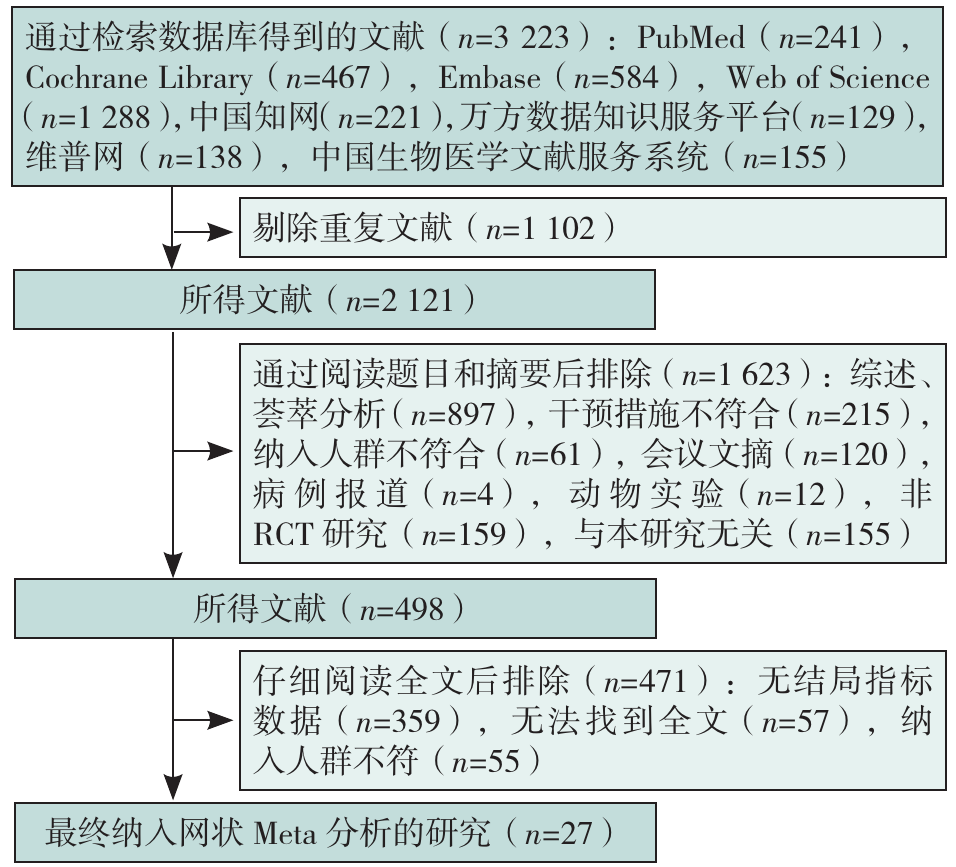
图1 文献筛选流程图注:RCT=随机对照实验。
Figure 1 Flow chart of literature screening
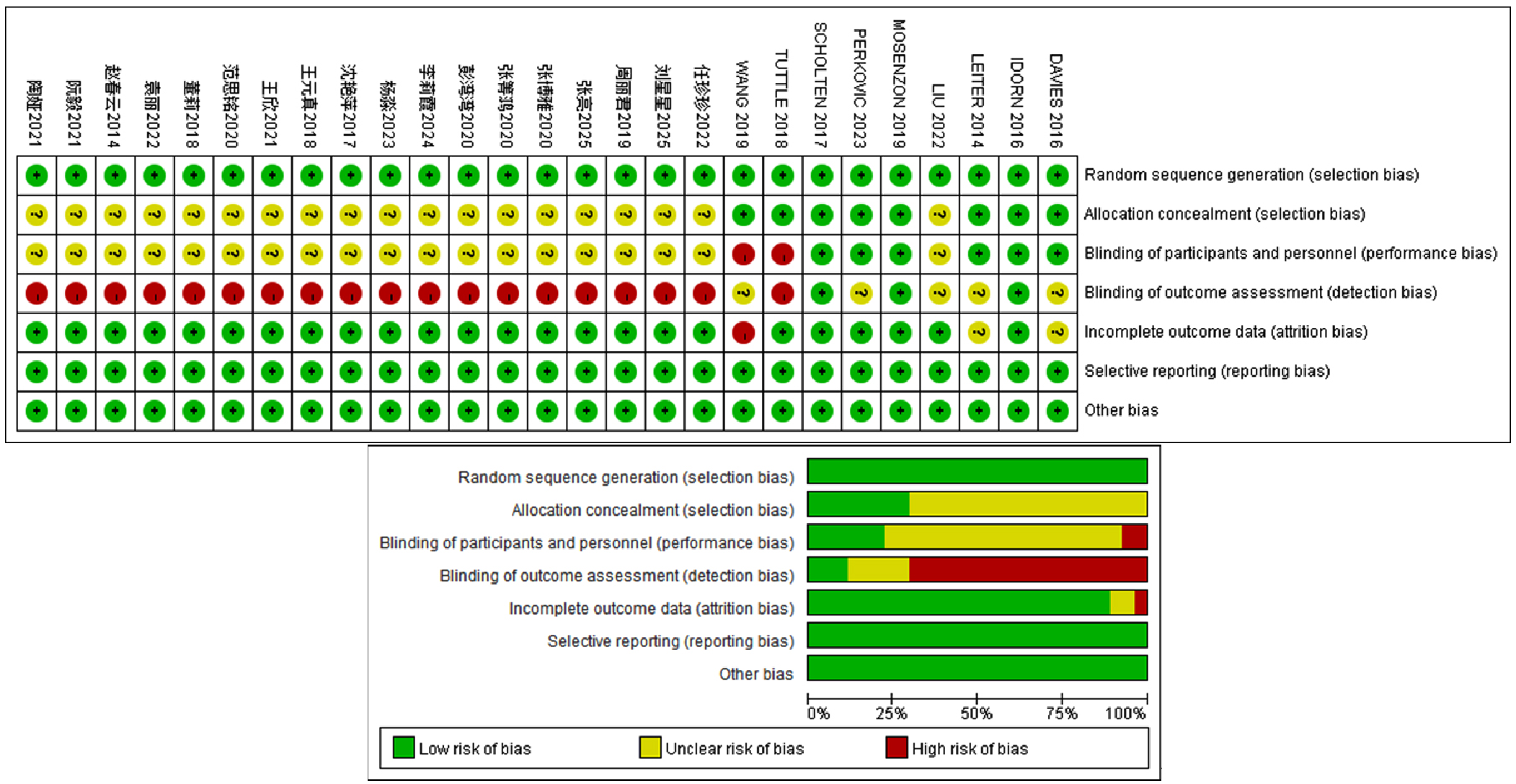
图2 所有纳入研究的风险偏倚图注:TUTTLE 2018指文献[5,6]的风险偏倚结果;SCHOLTEN 2017指文献[3]的风险偏倚结果。
Figure 2 Risk bias plots for all included studies
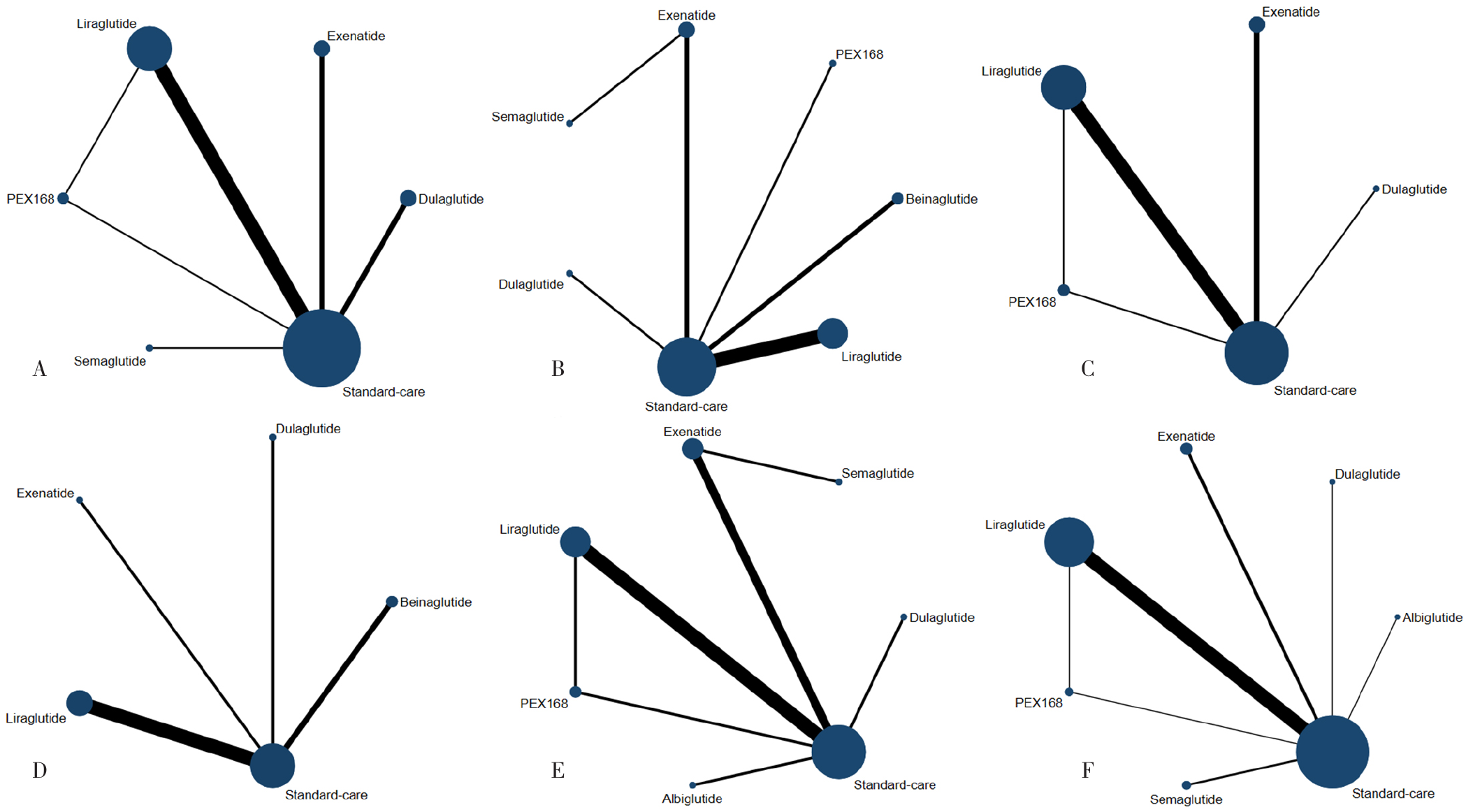
图3 不同GLP-1RAs治疗DKD患者各结局指标的证据网络注:A为不同GLP-1RA治疗DKD患者eGFR结局指标的证据网络,B为不同GLP-1RA治疗DKD患者Scr结局指标的证据网络,C为不同GLP-1RA治疗DKD患者UACR结局指标的证据网络,D为不同GLP-1RA治疗DKD患者UAER结局指标的证据网络,E为不同GLP-1RA治疗DKD患者FPG结局指标的证据网络,F为不同GLP-1RA治疗DKD患者HbA1c结局指标的证据网络;Exenatide=艾塞那肽,Dulaglutide=度拉糖肽,Semaglutide=司美格鲁肽,Liraglutide=利拉鲁肽,PEX168=聚乙二醇洛塞那肽,Beinaglutide=贝那鲁肽,Albiglutide=阿必鲁肽,Standard-care=标准治疗,GLP-1RA=胰高血糖素样肽1受体激动剂,DKD=糖尿病肾脏病,eGFR=估算肾小球滤过率,Scr=血肌酐,UACR=尿白蛋白/肌酐比值,UAER=尿白蛋白排泄率,FPG=空腹血糖,HbA1c=糖化血红蛋白。
Figure 3 Evidence network for various outcome measures in patients with diabetic kidney disease treated with different GLP-1RAs
| 干预措施 | 艾塞那肽 | 聚乙二醇洛塞那肽 | 利拉鲁肽 | 司美格鲁肽 | 度拉糖肽 |
|---|---|---|---|---|---|
| 聚乙二醇洛塞那肽 | 0.45(-10.79~11.69) | ||||
| 利拉鲁肽 | 3.08(-5.25~11.41) | 2.63(-6.01~11.28) | |||
| 司美格鲁肽 | 6.91(-6.33~20.16) | 6.46(-7.69~20.62) | 3.83(-8.15~15.81) | ||
| 度拉糖肽 | 8.16(-1.47~17.78) | 7.71(-3.14~18.55) | 5.08(-2.72~12.87) | 1.24(-11.66~14.15) | |
| 标准治疗 | 10.21(3.09~17.34)a | 9.76(1.07~18.46)a | 7.13(2.79~11.47)a | 3.30(-7.86~14.46) | 2.06(-4.42~8.54) |
表2 不同种类GLP-1RA对DKD患者eGFR影响的联赛表[WMD(95%CI)]
Table 2 League table of effects of different classes of GLP-1RA on eGFR in DKD patients
| 干预措施 | 艾塞那肽 | 聚乙二醇洛塞那肽 | 利拉鲁肽 | 司美格鲁肽 | 度拉糖肽 |
|---|---|---|---|---|---|
| 聚乙二醇洛塞那肽 | 0.45(-10.79~11.69) | ||||
| 利拉鲁肽 | 3.08(-5.25~11.41) | 2.63(-6.01~11.28) | |||
| 司美格鲁肽 | 6.91(-6.33~20.16) | 6.46(-7.69~20.62) | 3.83(-8.15~15.81) | ||
| 度拉糖肽 | 8.16(-1.47~17.78) | 7.71(-3.14~18.55) | 5.08(-2.72~12.87) | 1.24(-11.66~14.15) | |
| 标准治疗 | 10.21(3.09~17.34)a | 9.76(1.07~18.46)a | 7.13(2.79~11.47)a | 3.30(-7.86~14.46) | 2.06(-4.42~8.54) |
| 干预措施 | 司美格鲁肽 | 艾塞那肽 | 利拉鲁肽 | 度拉糖肽 | 聚乙二醇洛塞那肽 | 贝那鲁肽 |
|---|---|---|---|---|---|---|
| 艾塞那肽 | -6.48(-24.71~11.75) | |||||
| 利拉鲁肽 | -13.11(-38.16~11.94) | -6.63(-23.80~10.55) | ||||
| 度拉糖肽 | -14.01(-44.05~16.03) | -7.53(-31.40~16.35) | -0.90(-21.07~19.27) | |||
| 聚乙二醇洛塞那肽 | -17.01(-47.61~13.60) | -10.53(-35.11~14.06) | -3.90(-24.91~17.11) | -3.00(-29.77~23.77) | ||
| 贝那鲁肽 | -17.16(-44.28~9.97) | -10.68(-30.76~9.41) | -4.05(-19.56~11.45) | -3.15(-25.85~19.55) | -0.15(-23.60~23.30) | |
| 标准治疗 | -24.03(-47.72~-0.33)a | -17.55(-32.68~-2.42)a | -10.92(-19.05~-2.80)a | -10.02(-28.48~8.44) | -7.02(-26.40~12.36) | -6.87(-20.08~6.33) |
表3 不同种类GLP-1RA对DKD患者Scr影响的联赛表[WMD(95%CI)]
Table 3 League table of effects of different classes of GLP-1RA on Scr in DKD patients
| 干预措施 | 司美格鲁肽 | 艾塞那肽 | 利拉鲁肽 | 度拉糖肽 | 聚乙二醇洛塞那肽 | 贝那鲁肽 |
|---|---|---|---|---|---|---|
| 艾塞那肽 | -6.48(-24.71~11.75) | |||||
| 利拉鲁肽 | -13.11(-38.16~11.94) | -6.63(-23.80~10.55) | ||||
| 度拉糖肽 | -14.01(-44.05~16.03) | -7.53(-31.40~16.35) | -0.90(-21.07~19.27) | |||
| 聚乙二醇洛塞那肽 | -17.01(-47.61~13.60) | -10.53(-35.11~14.06) | -3.90(-24.91~17.11) | -3.00(-29.77~23.77) | ||
| 贝那鲁肽 | -17.16(-44.28~9.97) | -10.68(-30.76~9.41) | -4.05(-19.56~11.45) | -3.15(-25.85~19.55) | -0.15(-23.60~23.30) | |
| 标准治疗 | -24.03(-47.72~-0.33)a | -17.55(-32.68~-2.42)a | -10.92(-19.05~-2.80)a | -10.02(-28.48~8.44) | -7.02(-26.40~12.36) | -6.87(-20.08~6.33) |
| 干预措施 | 艾塞那肽 | 利拉鲁肽 | 聚乙二醇洛塞那肽 | 度拉糖肽 |
|---|---|---|---|---|
| 利拉鲁肽 | -166.75(-351.94~18.44) | |||
| 聚乙二醇洛塞那肽 | -164.78(-417.60~88.05) | 1.97(-193.30~197.24) | ||
| 度拉糖肽 | -192.09(-503.66~119.48) | -25.34(-307.71~257.03) | -27.31(-358.00~303.38) | |
| 标准治疗 | -192.45(-353.07~-31.83)a | -25.70(-117.91~66.50) | -27.67(-222.93~167.58) | -0.36(-267.38~266.65) |
表4 不同种类GLP-1RA对DKD患者UACR影响的联赛表[WMD(95%CI)]
Table 4 League table of effects of different classes of GLP-1RA on UACR in DKD patients
| 干预措施 | 艾塞那肽 | 利拉鲁肽 | 聚乙二醇洛塞那肽 | 度拉糖肽 |
|---|---|---|---|---|
| 利拉鲁肽 | -166.75(-351.94~18.44) | |||
| 聚乙二醇洛塞那肽 | -164.78(-417.60~88.05) | 1.97(-193.30~197.24) | ||
| 度拉糖肽 | -192.09(-503.66~119.48) | -25.34(-307.71~257.03) | -27.31(-358.00~303.38) | |
| 标准治疗 | -192.45(-353.07~-31.83)a | -25.70(-117.91~66.50) | -27.67(-222.93~167.58) | -0.36(-267.38~266.65) |
| 干预措施 | 度拉糖肽 | 艾塞那肽 | 利拉鲁肽 | 贝那鲁肽 |
|---|---|---|---|---|
| 艾塞那肽 | -68.84(-214.49~76.81) | |||
| 利拉鲁肽 | -194.27(-249.58~-138.96)a | -125.43(-261.48~10.62) | ||
| 贝那鲁肽 | -211.83(-267.67~-156.00)a | -142.99(-279.26~-6.73)a | -17.56(-37.92~2.79) | |
| 标准治疗 | -228.51(-282.19~-174.83)a | -159.67(-295.06~-24.28)a | -34.24(-47.58~-20.90)a | -16.68(-32.05~-1.30)a |
表5 不同种类GLP-1RA对DKD患者UAER影响的联赛表[WMD(95%CI)]
Table 5 League table of effects of different classes of GLP-1RA on UAER in DKD patients
| 干预措施 | 度拉糖肽 | 艾塞那肽 | 利拉鲁肽 | 贝那鲁肽 |
|---|---|---|---|---|
| 艾塞那肽 | -68.84(-214.49~76.81) | |||
| 利拉鲁肽 | -194.27(-249.58~-138.96)a | -125.43(-261.48~10.62) | ||
| 贝那鲁肽 | -211.83(-267.67~-156.00)a | -142.99(-279.26~-6.73)a | -17.56(-37.92~2.79) | |
| 标准治疗 | -228.51(-282.19~-174.83)a | -159.67(-295.06~-24.28)a | -34.24(-47.58~-20.90)a | -16.68(-32.05~-1.30)a |
| 干预措施 | 度拉糖肽 | 司美格鲁肽 | 利拉鲁肽 | 聚乙二醇洛塞那肽 | 艾塞那肽 | 阿必鲁肽 |
|---|---|---|---|---|---|---|
| 司美格鲁肽 | -0.44(-2.86~1.97) | |||||
| 利拉鲁肽 | -1.51(-3.27~0.25) | -1.07(-3.01~0.87) | ||||
| 聚乙二醇洛塞那肽 | -1.48(-3.43~0.47) | -1.04(-3.16~1.07) | 0.02(-1.08~1.12) | |||
| 艾塞那肽 | -1.75(-3.58~0.07) | -1.31(-2.89~0.27) | -0.24(-1.37~0.88) | -0.27(-1.67~1.14) | ||
| 阿必鲁肽 | -2.34(-4.58~-0.10)a | -1.90(-4.28~0.49) | -0.83(-2.55~0.88) | -0.86(-2.77~1.06) | -0.59(-2.37~1.20) | |
| 标准治疗 | -2.44(-4.05~-0.83)a | -2.00(-3.80~-0.20)a | -0.93(-1.64~-0.22)a | -0.96(-2.06~0.15) | -0.69(-1.55~0.18) | -0.10(-1.66~1.46) |
表6 不同种类GLP-1RA对DKD患者FPG影响的联赛表[WMD(95%CI)]
Table 6 League table of effects of different classes of GLP-1RA on FPG in DKD patients
| 干预措施 | 度拉糖肽 | 司美格鲁肽 | 利拉鲁肽 | 聚乙二醇洛塞那肽 | 艾塞那肽 | 阿必鲁肽 |
|---|---|---|---|---|---|---|
| 司美格鲁肽 | -0.44(-2.86~1.97) | |||||
| 利拉鲁肽 | -1.51(-3.27~0.25) | -1.07(-3.01~0.87) | ||||
| 聚乙二醇洛塞那肽 | -1.48(-3.43~0.47) | -1.04(-3.16~1.07) | 0.02(-1.08~1.12) | |||
| 艾塞那肽 | -1.75(-3.58~0.07) | -1.31(-2.89~0.27) | -0.24(-1.37~0.88) | -0.27(-1.67~1.14) | ||
| 阿必鲁肽 | -2.34(-4.58~-0.10)a | -1.90(-4.28~0.49) | -0.83(-2.55~0.88) | -0.86(-2.77~1.06) | -0.59(-2.37~1.20) | |
| 标准治疗 | -2.44(-4.05~-0.83)a | -2.00(-3.80~-0.20)a | -0.93(-1.64~-0.22)a | -0.96(-2.06~0.15) | -0.69(-1.55~0.18) | -0.10(-1.66~1.46) |
| 干预措施 | 聚乙二醇洛塞那肽 | 司美格鲁肽 | 利拉鲁肽 | 度拉糖肽 | 艾塞那肽 | 阿必鲁肽 |
|---|---|---|---|---|---|---|
| 司美格鲁肽 | -0.41(-1.47~0.65) | |||||
| 利拉鲁肽 | -0.62(-1.52~0.29) | -0.21(-0.87~0.45) | ||||
| 度拉糖肽 | -0.63(-1.95~0.69) | -0.22(-1.38~0.94) | -0.01(-1.04~1.01) | |||
| 艾塞那肽 | -0.91(-1.92~0.10) | -0.50(-1.29~0.29) | -0.29(-0.87~0.28) | -0.28(-1.40~0.84) | ||
| 阿必鲁肽 | 0.69(-0.64~2.01) | -1.21(-2.43~0.01) | -0.59(-1.49~0.30) | -0.58(-1.89~0.73) | -0.30(-1.29~0.69) | |
| 标准治疗 | -1.22(-2.09~-0.35)a | -0.81(-1.41~-0.21)a | -0.60(-0.87~-0.34)a | -0.59(-1.58~0.40) | -0.31(-0.82~0.20) | 0.80(-0.24~1.84) |
表7 不同种类GLP-1RA对DKD患者HbA1c影响的联赛表[WMD(95%CI)]
Table 7 League table of effects of different classes of GLP-1RA on HbA1c in DKD patients
| 干预措施 | 聚乙二醇洛塞那肽 | 司美格鲁肽 | 利拉鲁肽 | 度拉糖肽 | 艾塞那肽 | 阿必鲁肽 |
|---|---|---|---|---|---|---|
| 司美格鲁肽 | -0.41(-1.47~0.65) | |||||
| 利拉鲁肽 | -0.62(-1.52~0.29) | -0.21(-0.87~0.45) | ||||
| 度拉糖肽 | -0.63(-1.95~0.69) | -0.22(-1.38~0.94) | -0.01(-1.04~1.01) | |||
| 艾塞那肽 | -0.91(-1.92~0.10) | -0.50(-1.29~0.29) | -0.29(-0.87~0.28) | -0.28(-1.40~0.84) | ||
| 阿必鲁肽 | 0.69(-0.64~2.01) | -1.21(-2.43~0.01) | -0.59(-1.49~0.30) | -0.58(-1.89~0.73) | -0.30(-1.29~0.69) | |
| 标准治疗 | -1.22(-2.09~-0.35)a | -0.81(-1.41~-0.21)a | -0.60(-0.87~-0.34)a | -0.59(-1.58~0.40) | -0.31(-0.82~0.20) | 0.80(-0.24~1.84) |
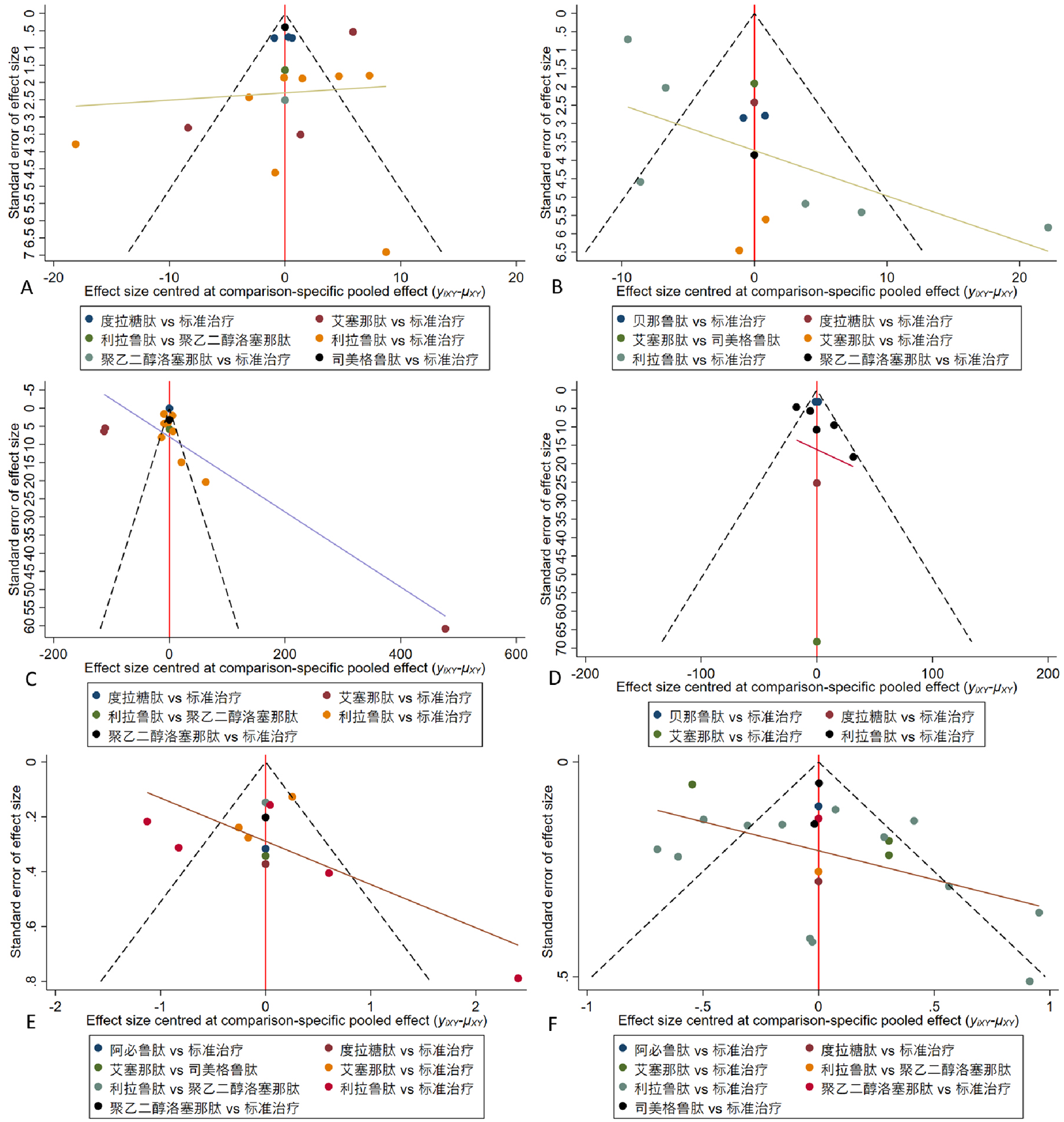
图4 不同GLP-1RA治疗DKD患者各结局指标的比较-校正漏斗图注:A为不同GLP-1RA治疗DKD患者eGFR结局指标的比较-校正漏斗图,B为不同GLP-1RA治疗DKD患者Scr结局指标的比较-校正漏斗图,C为不同GLP-1RA治疗DKD患者UACR结局指标的比较-校正漏斗图,D为不同GLP-1RA治疗DKD患者UAER结局指标的比较-校正漏斗图,E为不同GLP-1RA治疗DKD患者FPG结局指标的比较-校正漏斗图,F为不同GLP-1RA治疗DKD患者HbA1c结局指标的比较-校正漏斗图。
Figure 4 Comparison of various outcome measures in DKD patients treated with different GLP-1RA—corrected funnel plots
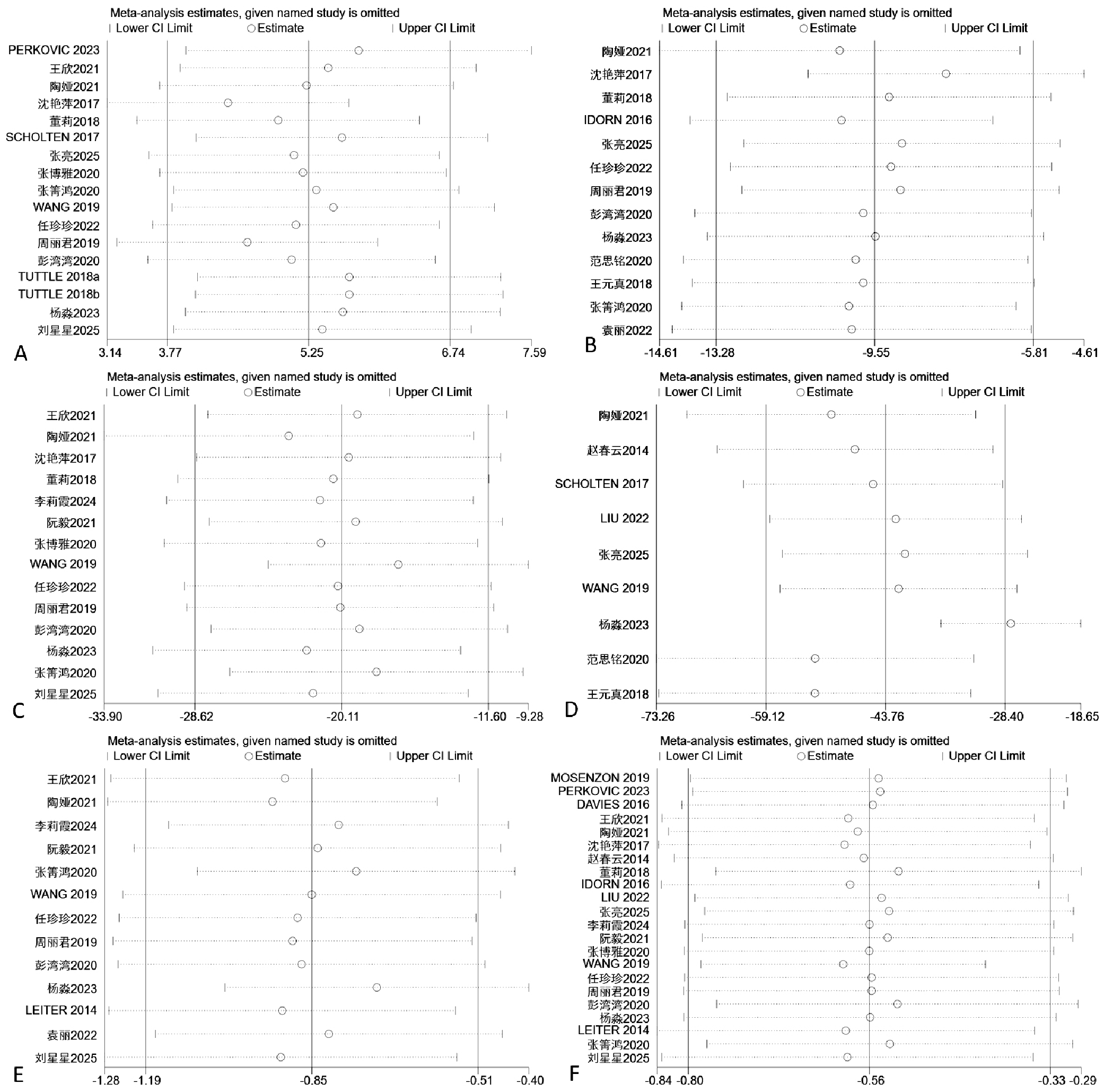
图5 不同GLP-1RA治疗DKD患者各结局指标的敏感性分析图注:A为不同GLP-1RA治疗DKD患者eGFR结局指标的敏感性分析图,B为不同GLP-1RA治疗DKD患者Scr结局指标的敏感性分析图,C为不同GLP-1RA治疗DKD患者UACR结局指标的敏感性分析图,D为不同GLP-1RA治疗DKD患者UAER结局指标的敏感性分析图,E为不同GLP-1RA治疗DKD患者FPG结局指标的敏感性分析图,F为不同GLP-1RA治疗DKD患者HbA1c结局指标的敏感性分析图;SCHOLTEN 2017指文献[3]的风险偏倚结果。
Figure 5 Sensitivity analysis plots for each outcome measure in DKD patients treated with different GLP-1RA
| [1] |
|
| [2] |
|
| [3] |
|
| [4] |
|
| [5] |
|
| [6] |
|
| [7] |
杨淼. 度拉糖肽在糖尿病肾病中的应用效果及对肾功能的影响[J]. 中国医学创新, 2023, 20(28): 26-30.
|
| [8] |
董莉,赵积海. 利拉鲁肽对微量白蛋白尿期糖尿病肾病患者肾功能的影响[J]. 临床荟萃, 2018, 33(5): 420-423.
|
| [9] |
王欣,雷琳,卢彩平, 等. 利拉鲁肽治疗超重、肥胖2型糖尿病并肾脏疾病的临床观察[J]. 河北医科大学学报, 2021, 42(12): 1401-1405.
|
| [10] |
任珍珍,陈继玲,汪伟环, 等. 艾塞那肽对早期糖尿病肾病患者尿微量白蛋白、肾功能、胰岛β细胞功能的影响[J]. 临床内科杂志, 2022, 39(8): 550-552.
|
| [11] |
周丽君,卢国元,沈艳萍. 艾塞那肽对早期糖尿病肾病患者肾脏的保护作用[J]. 西安交通大学学报(医学版), 2019, 40(6): 967-972.
|
| [12] |
彭湾湾,钟雯,薛君力, 等. 聚乙二醇洛塞那肽注射液对早期2型糖尿病肾病患者的肾脏保护作用[J]. 实用医学杂志, 2020, 36(18): 2495-2499.
|
| [13] |
沈艳萍,乔青,李明, 等. 利拉鲁肽调控PI3K-Akt-mTOR通路改善糖尿病肾病患者病情[J]. 华中科技大学学报(医学版), 2017, 46(4): 466-470.
|
| [14] |
张博雅,徐淼,赵延君, 等. 利拉鲁肽对早期糖尿病肾病的治疗效果分析[J]. 医学食疗与健康, 2020, 18(16): 79, 82.
|
| [15] |
陶娅,王晋竹,王金帆, 等. 胰高血糖素样肽-1受体激动剂治疗糖尿病肾病的有效性及安全性分析[J]. 临床和实验医学杂志, 2021, 20(16): 1707-1712.
|
| [16] |
刘星星,杨寒. 洛塞那肽和利拉鲁肽辅助治疗对糖尿病肾病的效果及对氧化应激指标和Hcy、Cys-C、β2-MG水平的影响[J]. 辽宁医学杂志, 2025, 39(1): 32-35.
|
| [17] |
张亮,卞帅博,裴启秀, 等. 利拉鲁肽对糖尿病肾病患者肾功能及CTRP3水平的影响[J]. 临床合理用药, 2025, 18(7): 41-44. DOI: 10.15887/j.cnki.13-1389/r.2025.07.011.
|
| [18] |
张箐鸿. 西格列汀与利拉鲁肽对DKD早期病变影响的比较[D]. 乌鲁木齐: 新疆医科大学, 2020.
|
| [19] |
|
| [20] |
袁丽. 司美格鲁肽治疗糖尿病肾病的效果观察[J]. 糖尿病新世界, 2022, 25(18): 191-194. DOI: 10.16658/j.cnki.1672-4062.2022.18.191.
|
| [21] |
王元真,赵汉儒,陈兴强. 贝那鲁肽治疗糖尿病肾病的近期疗效及对肾功能与炎症因子的影响[J]. 中国医院药学杂志, 2018, 38(10): 1095-1098. DOI: 10.13286/j.cnki.chinhosppharmacyj.2018.10.17.
|
| [22] |
范思铭,罗若佳,史晓腾. 贝那鲁肽对糖尿病肾病患者肾功能及血清MCP-1、CRP、TNF-α水平的影响[J]. 医学理论与实践, 2020, 33(17): 2835-2837. DOI: 10.19381/j.issn.1001-7585.2020.17.023.
|
| [23] |
李莉霞. GLP-1受体激动剂利拉鲁肽对糖尿病肾病患者血糖控制及肾功能的影响[J]. 中国医药指南, 2024, 22(28): 79-81. DOI: 10.15912/j.issn.1671-8194.2024.28.021.
|
| [24] |
阮毅,李菁,黄肖容. 利拉鲁肽治疗老年早期2型糖尿病肾病的临床分析[J]. 实用老年医学, 2021, 35(6): 568-571.
|
| [25] |
赵春云,郭洪涛,代红沙, 等. 利拉鲁肽治疗早期2型糖尿病肾病疗效观察[J]. 山东医药, 2014, 54(26): 47-49.
|
| [26] |
|
| [27] |
|
| [28] |
|
| [29] |
|
| [30] |
|
| [31] |
|
| [32] |
|
| [33] |
|
| [34] |
|
| [35] |
|
| [1] | 肖智利, 卢晨霞, 朱绘, 张佳, 陈壮壮, 孙巍, 刘向楚煊, 罗成, 肖明中, 李晓东. 持续葡萄糖监测技术在糖肝共管中的应用现状与展望[J]. 中国全科医学, 2026, 29(31): 4521-4527. |
| [2] | 程玉, 杨荣, 龙仁, 廖晓阳, 赵洋. 社区基本医疗的随机对照试验研究设计、实施和案例解析[J]. 中国全科医学, 2026, 29(31): 4528-4535. |
| [3] | 田向阳, 周迎生, 高莹. 糖尿病行为与生活方式干预展望[J]. 中国全科医学, 2026, 29(31): 4513-4520. |
| [4] | 魏学娟, 王利华, 王丽, 任静林, 闫海青, 于海洋, 刘景峰. 智能语音外呼辅助传统干预对社区老年"三高"共病患者健康管理的效果研究:一项随机对照试验[J]. 中国全科医学, 2026, 29(31): 4635-4640. |
| [5] | 苏蝶, 张岩, 陈小松, 韩玉霞, 闫永彬, 段俊亚, 陈新颖, 赵成昊. 中医药治疗儿童难治性肺炎支原体肺炎随机对照试验结局指标分析[J]. 中国全科医学, 2026, 29(31): 4609-4618. |
| [6] | 张壹品, 张育康, 谷欣宇, 钱群群, 程露露, 李冬静, 陈朝晖. 理筋正骨手法联合动态神经肌肉稳定技术治疗慢性非特异性腰痛的临床疗效及神经机制初探:一项随机对照研究[J]. 中国全科医学, 2026, 29(30): 4445-4452. |
| [7] | 胡玉婷, 严颖, 闫明婕, 王惠君, 韩虎. 不同骨改良药物治疗实体瘤骨转移或多发性骨髓瘤患者疗效的网状Meta分析[J]. 中国全科医学, 2026, 29(30): 4489-4502. |
| [8] | 占道伟, 魏绪旺, 胡旻雷, 徐颖梅, 杨喜兵, 罗开涛. 针刺联合替罗非班治疗对溶栓后缺血性脑卒中患者早期神经功能恶化的影响:一项随机对照试验[J]. 中国全科医学, 2026, 29(29): 4241-4247. |
| [9] | 石力, 周振坤, 刘婕, 潘国凤. 基于经筋理论针罐结合治疗绝经后女性压力性尿失禁的随机对照试验[J]. 中国全科医学, 2026, 29(28): 4141-4146. |
| [10] | 邓玮, 黄梦婷, 易胜利, 林杨, 许力丹, 任哲学, 朱秀琼, 李烨莎, 任梦鸽, 柯大智, 李桂琼, 吴志勤, 骆傲然, 何发培. AI赋能全科临床思维的培养与实施效果研究[J]. 中国全科医学, 2026, 29(28): 4078-4085. |
| [11] | 姜妍琳, 王喆, 翟睿, 张梦洁, 陈溪, 王俊宏. 中药复方治疗注意缺陷多动障碍优势方案筛选研究:基于网状Meta分析和熵权TOPSIS法[J]. 中国全科医学, 2026, 29(27): 3985-3994. |
| [12] | 瞿芙容, 金佳琪, 薛桂君, 吕庆国, 李治鹏, 李静, 李舍予. BMJ基于心肾事件预防与体质量管理的2型糖尿病治疗药物动态临床实践指南解读[J]. 中国全科医学, 2026, 29(27): 3873-3878. |
| [13] | 薛翠荣, 魏巍, 吴任远, 薛雅琴, 徐辉江, 吕惟江, 蒋丹丹. 高血压和2型糖尿病人群慢性肾脏病患病率及管理现状:一项社区横断面研究[J]. 中国全科医学, 2026, 29(25): 3650-3654. |
| [14] | 董澳, 赵乃慧, 欧文丽, 陈朔华, 汪国栋, 戴璐尧, 刘灿章, 吴寿岭, 杨秀红. 心脏代谢指数与慢性肾脏病发病风险的关联:一项前瞻性队列研究[J]. 中国全科医学, 2026, 29(25): 3614-3623. |
| [15] | 刘俞彤, 梅力, 尹平, 李峰, 王茜, 姚望, 陈跃来, 苑成梅. 针刺联合抗焦虑药物治疗广泛性焦虑障碍患者伴发失眠症状的探索性多中心随机对照试验[J]. 中国全科医学, 2026, 29(25): 3670-3677. |
| 阅读次数 | ||||||
|
全文 |
|
|||||
|
摘要 |
|
|||||