中国全科医学 ›› 2026, Vol. 29 ›› Issue (29): 4217-4225.DOI: 10.12114/j.issn.1007-9572.2025.0383

• 全科医疗/社区卫生服务工作研究·家庭医生签约服务专题研究 • 上一篇    下一篇

农村老年人家庭医生签约服务的表达需要和感知需要一致性:对宁夏回族自治区456名常住居民的问卷调查

黄嘉婷, 柳玲娜, 宁艳花*(), 史晶, 李欣锦, 杨彩玲, 姚静   

  1. 750004 宁夏回族自治区银川市,宁夏医科大学护理学院
  • 收稿日期:2025-11-20 修回日期:2026-04-19 出版日期:2026-10-15 发布日期:2026-09-02
  • 通讯作者: 宁艳花
  • 本文为中文翻译版本,原文Consistency between Expressed and Perceived Needs for Family Doctor Contracted Services among Rural Older Adults: a Survey of 456 Residents in Ningxia发表于Chinese General Practice Journal,已获得授权。翻译与出版遵循COPE和ICMJE关于二次发表的指南。


    作者贡献:

    黄嘉婷、柳玲娜、史晶、李欣锦、杨彩玲、姚静负责数据收集;黄嘉婷、柳玲娜负责数据整理与分析;黄嘉婷负责文献检索与论文撰写;宁艳花对文章进行质量控制、审校修订、监督管理。

  • 基金资助:
    国家自然科学基金资助项目(72264031)

Consistency between Expressed and Perceived Needs for Family Doctor Contracted Services among Rural Older Adults: a Survey of 456 Residents in Ningxia

HUANG Jiating, LIU Lingna, NING Yanhua*(), SHI Jing, LI Xinjin, YANG Cailing, YAO Jing   

  1. School of Nursing, Ningxia Medical University, Yinchuan 750004, China
  • Received:2025-11-20 Revised:2026-04-19 Published:2026-10-15 Online:2026-09-02
  • Contact: NING Yanhua

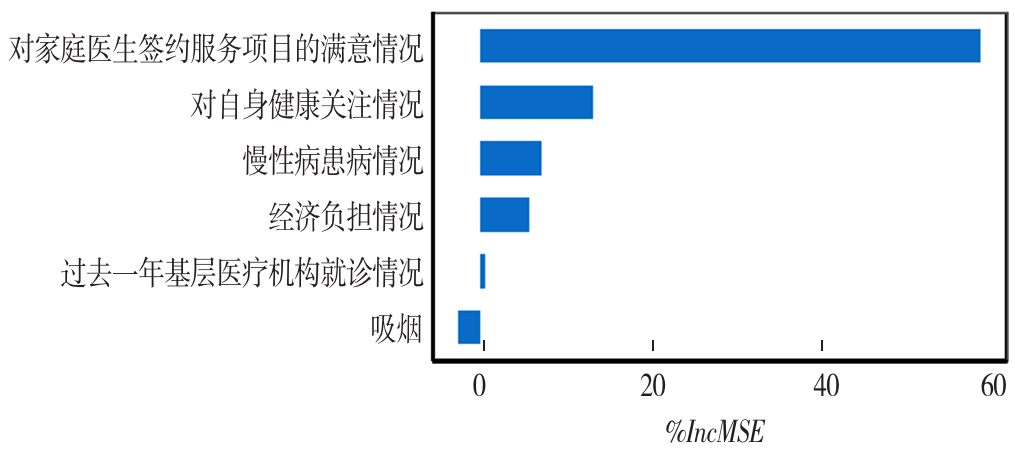
摘要: 背景 农村老年人家庭医生签约服务面临着患者体验普遍不佳、获益感不足等问题,还存在"签约不履约"和"未续约"等现象,这些问题的深层原因尚需进一步调查。 目的 了解宁夏回族自治区农村老年人家庭医生签约服务的表达需要和感知需要现状,以及表达需要与感知需要一致性的影响因素。 方法 本研究为横断面研究,于2024年7—9月,在宁夏回族自治区5个地级市采用便利抽样法各选取2个县,每个县分别选取1个行政村,以10个样本村的常住老年人为研究对象(n=456)。使用一般资料调查表、家庭医生签约服务表达需要和感知需要情况调查表收集研究对象的相关资料。采用多元线性逐步回归分析探讨农村老年人家庭医生签约服务表达需要和感知需要一致性的影响因素,采用随机森林模型对其影响因素进行重要性排序。 结果 农村老年人家庭医生签约服务表达需要和感知需要一致性得分为(11.6±5.3)分,相较于总分23分而言,整体处于较低水平。基本公共卫生服务项目(如建立健康档案)的表达需要高达96.1%(438/456),感知需要达96.7%(441/456),满意度达92.9%(424/456),均处于较高水平;相比之下,专项卫生服务(如家庭病床服务)表达需要仅为5.3%(24/456),感知需要为40.1%(183/456),满意度低至5.0%(23/456),均显示出较低水平。多元线性逐步回归分析结果显示,农村老年人家庭医生签约服务表达需要和感知需要一致性受多重因素影响,包括对家庭医生签约服务项目满意情况、对自身健康关注情况、慢性病患病情况、经济负担情况、吸烟情况、过去1年基层医疗卫生机构就诊情况(P<0.05)。随机森林模型分析结果显示,对家庭医生签约服务项目满意情况影响最为显著。 结论 农村老年人家庭医生专项签约服务表达需要和感知需要一致性水平整体偏低,这既受主观因素如对签约服务项目满意度和个人健康关注度的制约,也受慢性病患病状况和经济负担等客观因素的影响。因此,针对农村签约老年人的健康状况和需求,未来应因地制宜地开发多样化的家庭医生签约服务包,以提升表达需要和感知需要的一致性,更好地满足农村老年人健康管理的多元化需求。

关键词: 家庭医生签约服务, 老年人, 农村卫生, 表达需要和感知需要一致性, 影响因素分析

Abstract:

Background

The family doctor contract service for elderly people in rural areas faces issues such as a generally poor patient experience and a lack of perceived benefits, as well as phenomena such as "signing up but not fulfilling the contract" and "failure to renew the contract". The underlying causes of these issues require further investigation.

Objective

To investigate the status and influencing factors of consistency between expressed and perceived needs for family doctor contracted services among rural older adults in Ningxia Hui Autonomous Region of China.

Methods

A cross-sectional study was conducted from July to September 2024. Stratified cluster sampling was applied to find participants. In the 5 prefecture-level cities of the Ningxia Hui Autonomous Region, 2 counties were selected from each city by convenience sampling method, and 1 administrative village was selected from each county. Two counties were selected from each of the five cities in Ningxia, and one village was chosen from each of the counties. A total of 456 rural older people from the 10 villages were invited into the survey. Socio-demographic information and expressed and perceived needs for family doctor contract services were collected using a self-designed questionnaire. Multiple stepwise regression analysis was used to identify influencing factors, while a random forest model was employed to rank the importance of these factors.

Results

The average score for consistency between expressed and perceived needs for family doctor contract services among rural older adults was (11.6±5.3), indicating an overall low level of consistency. The expressed need for basic public health service items (such as establishing health records) was as high as 96.1% (438/456), the perceived need reached 96.7% (441/456), and the satisfaction rate also reached 92.9% (424/456), all of which were at a high level. In contrast, only 5.3% (24/456) of rural older adults expressed a need for special health services (such as home-based care services), 40.1% (183/456) perceived the need, and the satisfaction rate was as low as 5.0% (23/456), all indicating low levels. The results of multiple stepwise linear regression analysis showed that the consistency between expressed and perceived needs for family doctor contract services among rural older adults was affected by multiple factors, including satisfaction with contracted service items, personal health attention, chronic disease status, economic burden, medical treatment experience in primary medical and health institutions in the past year, and smoking habits (P<0.05). Among these factors, satisfaction with contracted service items was the most significant predictor of the consistency of the two needs.

Conclusion

The consistency between expressed and perceived needs for individual health services in the family doctor contract among rural older adults remains low, influenced by both subjective factors and objective factors, such as chronic conditions, satisfaction with services, and awareness of self-health. Therefore, the author suggests designing and providing family doctor contract service packages in a way that is tailored to local contexts, especially focusing on service items that address individual perceived needs. The improvement of consistency between expressed and perceived needs will better meet the diverse health management needs of the rural elderly.

Key words: Family doctor contract services, Aged, Rural health, Use-need matching, Root cause analysis

中图分类号: