
中国全科医学 ›› 2026, Vol. 29 ›› Issue (22): 3226-3232.DOI: 10.12114/j.issn.1007-9572.2024.0568
• 论著·用药指导 • 上一篇
曹艺馨1, 李永智2, 魏灵茜1, 周岩1, 高菲1, 于琦3,4,*( )
)
收稿日期:2025-08-10
修回日期:2025-12-10
出版日期:2026-08-05
发布日期:2026-07-08
通讯作者:
于琦
作者贡献:
曹艺馨负责文章的构思与设计、论文撰写;李永智负责论文修订、监督管理;魏灵茜、周岩、高菲负责研究资料的收集与整理;于琦负责文章的质量控制及审校、最终版本修订,对论文负责。
本文为中文翻译版本,原文"Application status of traditional computational methods and machine learning in cancer drug repositioning",已获得授权。翻译与出版遵循COPE和ICMJE关于二次发表的指南。
基金资助:
CAO Yixin1, LI Yongzhi2, WEI Lingxi1, ZHOU Yan1, GAO Fei1, YU Qi3,4,*()
Received:2025-08-10
Revised:2025-12-10
Published:2026-08-05
Online:2026-07-08
Contact:
YU Qi
摘要: 全球癌症负担的不断增加促使人们大力研究并试图开发更有效的抗肿瘤药物。然而,开发新药的成本昂贵。本文介绍了一种经济有效的策略——药物重定位,可以将已批准的药物重新用于新的适应证。本文对癌症药物重定位的计算策略进行了回顾,重点关注机器学习。近年来,生物信息学技术和多组学数据的融合极大促进了癌症药物的重新利用。机器学习和深度学习尤其促成了癌症药物重定位。本综述总结了传统计算方法和机器学习在该领域的应用现状,分析表明无论是独立的还是与其他基于生物信息学的方法相结合,机器学习在促进癌症药物重定位方面都具有很大前景。本文可以为癌症药物重定位的计算策略与癌症药物研发相结合的进一步发展提供参考。
中图分类号:
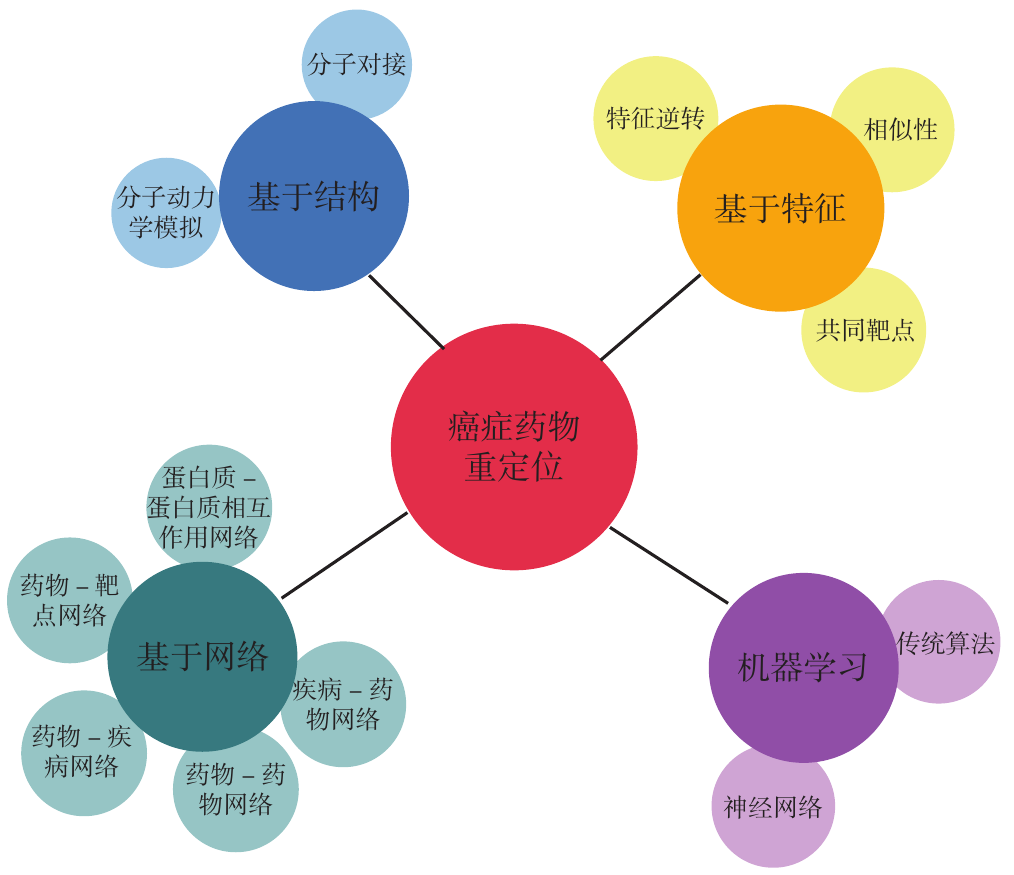
图1 癌症药物重定位计算方法
Figure 1 Computational methods for cancer drug repositioning
| 步骤 | 检索式 |
|---|---|
| #1 | "drug"[All Fields] |
| #2 | "repurposable"[All Fields]O R "repurpose"[All Fields]O R "repurposed"[All Fields]O R "repurposing"[All Fields]O R "reposit"[All Fields]O R "reposited"[All Fields]O R "reposition"[All Fields]O R "repositioned"[All Fields]O R "repositioning"[All Fields]O R "repositionings"[All Fields]O R "repositions"[All Fields] |
| #3 | "cancers"[All Fields]O R "cancerated"[All Fields]O R "canceration"[All Fields]O R "cancerization"[All Fields]O R "cancerized"[All Fields]O R "cancerous"[All Fields]O R "neoplasms"[MeSH Terms]O R "neoplasms"[All Fields]O R "cancer"[All Fields]O R "cancers"[All Fields]O R "neurofibroma"[MeSH Terms]O R "neurofibroma"[All Fields]O R "neurofibromas"[All Fields]O R "tumor s"[All Fields]O R "tumoral"[All Fields]O R "tumorous"[All Fields]O R "tumour"[All Fields]O R "neoplasms"[MeSH Terms]O R "neoplasms"[All Fields]O R "tumor"[All Fields]O R "tumour s"[All Fields]O R "tumoural"[All Fields]O R "tumourous"[All Fields]O R "tumours"[All Fields]O R "tumors"[All Fields]O R "neoplasm s"[All Fields]O R "neoplasms"[MeSH Terms]O R "neoplasms"[All Fields]O R "neoplasm"[All Fields] |
| #4 | "artificial intelligence"[All Fields]O R "machine learning"[All Fields]O R "deep learning"[All Fields]O R "neural network"[All Fields]O R "random forest"[All Fields]O R "support vector machine"[All Fields]O R "bayesian network"[All Fields]O R "algorithm s"[All Fields]O R "algorithmic"[All Fields]O R "algorithmically"[All Fields]O R "algorithmics"[All Fields]O R "algorithmization"[All Fields]O R "algorithms"[MeSH Terms]O R "algorithms"[All Fields]O R "algorithm"[All Fields]O R "data mining"[All Fields]O R "text mining"[All Fields]O R "natural language processing"[All Fields]O R "non-natural language processing"[All Fields] |
| #5 | (#3)AND(#4) |
表1 PubMed检索策略
Table 1 Search strategies of PubMed
| 步骤 | 检索式 |
|---|---|
| #1 | "drug"[All Fields] |
| #2 | "repurposable"[All Fields]O R "repurpose"[All Fields]O R "repurposed"[All Fields]O R "repurposing"[All Fields]O R "reposit"[All Fields]O R "reposited"[All Fields]O R "reposition"[All Fields]O R "repositioned"[All Fields]O R "repositioning"[All Fields]O R "repositionings"[All Fields]O R "repositions"[All Fields] |
| #3 | "cancers"[All Fields]O R "cancerated"[All Fields]O R "canceration"[All Fields]O R "cancerization"[All Fields]O R "cancerized"[All Fields]O R "cancerous"[All Fields]O R "neoplasms"[MeSH Terms]O R "neoplasms"[All Fields]O R "cancer"[All Fields]O R "cancers"[All Fields]O R "neurofibroma"[MeSH Terms]O R "neurofibroma"[All Fields]O R "neurofibromas"[All Fields]O R "tumor s"[All Fields]O R "tumoral"[All Fields]O R "tumorous"[All Fields]O R "tumour"[All Fields]O R "neoplasms"[MeSH Terms]O R "neoplasms"[All Fields]O R "tumor"[All Fields]O R "tumour s"[All Fields]O R "tumoural"[All Fields]O R "tumourous"[All Fields]O R "tumours"[All Fields]O R "tumors"[All Fields]O R "neoplasm s"[All Fields]O R "neoplasms"[MeSH Terms]O R "neoplasms"[All Fields]O R "neoplasm"[All Fields] |
| #4 | "artificial intelligence"[All Fields]O R "machine learning"[All Fields]O R "deep learning"[All Fields]O R "neural network"[All Fields]O R "random forest"[All Fields]O R "support vector machine"[All Fields]O R "bayesian network"[All Fields]O R "algorithm s"[All Fields]O R "algorithmic"[All Fields]O R "algorithmically"[All Fields]O R "algorithmics"[All Fields]O R "algorithmization"[All Fields]O R "algorithms"[MeSH Terms]O R "algorithms"[All Fields]O R "algorithm"[All Fields]O R "data mining"[All Fields]O R "text mining"[All Fields]O R "natural language processing"[All Fields]O R "non-natural language processing"[All Fields] |
| #5 | (#3)AND(#4) |
| [1] |
|
| [2] |
|
| [3] |
|
| [4] |
|
| [5] |
|
| [6] |
|
| [7] |
|
| [8] |
|
| [9] |
|
| [10] |
|
| [11] |
|
| [12] | |
| [13] |
|
| [14] |
|
| [15] |
|
| [16] |
|
| [17] |
|
| [18] |
|
| [19] |
|
| [20] |
|
| [21] |
|
| [22] |
|
| [23] |
|
| [24] |
|
| [25] |
|
| [26] |
|
| [27] |
|
| [28] |
|
| [29] |
|
| [30] |
|
| [31] |
|
| [32] |
|
| [33] |
|
| [34] |
|
| [35] |
|
| [36] |
|
| [37] |
|
| [38] |
|
| [39] |
|
| [40] |
|
| [41] |
|
| [42] |
|
| [43] |
|
| [44] |
|
| [45] |
|
| [46] |
|
| [47] |
|
| [48] |
|
| [49] |
|
| [50] |
|
| [51] |
|
| [52] |
|
| [53] |
|
| [54] |
|
| [55] |
|
| [56] |
|
| [57] |
|
| [58] |
|
| [59] |
|
| [60] |
|
| [1] | 胡健, 刘民, 焦增涛, 景文展, 梁万年. 呼吸道传染病传播风险等级评估研究:以新型冠状病毒感染的公共场所为例[J]. 中国全科医学, 2026, 29(32): 4738-4744. |
| [2] | 黄牧, 张道春, 阳维, 钟丽明, 袁文静, 贾子琪, 谭相良, 段小慧, 刘岘, 陈维翠. 基于融合三维U-Net与Transformer的深度学习网络对腹部CT图像中结直肠癌病灶的自动分割:一项多中心、多设备研究[J]. 中国全科医学, 2026, 29(29): 4281-4287. |
| [3] | 东勇飞, 陈昭燕, 孙培元, 黄璜, 胡卓伦, 刘真岑, 陈海畅, 李学朝, 田韫菏, 李紫君, 刘雅丹, 雷馨逸, 张维, 严天明, 周聪俊, 吴凤仪, 李里诗洛, 张冠群, 闫琪, 吴梦瑶, 付瑞瑛, 林宇冰, 马修齐, 朱彩蓉, 张亚玮. 癌症一级预防核心知识知晓问卷的开发与验证:一项Delphi与网络应答驱动抽样研究[J]. 中国全科医学, 2026, 29(28): 4147-4156. |
| [4] | 刘阳, 冯小洁, 陈洁瑜, 罗仁, 赵晓山, 毕建璐. 基于机器学习揭示生活方式与亚健康之间的关系:一项在中国广东省的横断面研究[J]. 中国全科医学, 2026, 29(26): 3829-3837. |
| [5] | 周以纯, 韩业明, 张鹏飞, 宋雯雯, 万晓钰, 李奇谋, 刘权德, 杨威, 潘继琛, 李昕昊, 李笃民, 于德新, 董梅, 梁永锋, 胡珊珊, 吕立娟, 张梅. 冠状动脉计算机断层扫描衍生的血流储备分数的一致性与诊断性能研究:基于不同深度学习算法[J]. 中国全科医学, 2026, 29(24): 3466-3475. |
| [6] | 欧阳微娜, 王露, 张璇, 唐薇, 范咏梅. 基于动态多尺度特征融合与注意力机制的心房颤动筛查研究[J]. 中国全科医学, 2026, 29(23): 3281-3286. |
| [7] | 张石飞, 顾志娥, 吕亚, 于海龙. 恐惧疾病进展在中青年宫颈癌患者癌症信息超载与参与治疗决策间的中介效应研究[J]. 中国全科医学, 2026, 29(23): 3307-3314. |
| [8] | 周明瑶, 张柳柳, 韩仁强, 陆宁宁, 王丹, 程芳. 社区乳腺癌高危人群筛查实施的障碍和促进因素:对妇女、组织者和提供者的访谈研究[J]. 中国全科医学, 2026, 29(22): 3206-3213. |
| [9] | 房彬彬, 单春方, 刘芬, 田婷, 谢骞, 冀伟, 李艳红, 杨毅宁, 李晓梅. Stanford A型主动脉夹层病变关键基因筛选与免疫浸润研究[J]. 中国全科医学, 2026, 29(18): 2523-2531. |
| [10] | 邱艳丽, 高永银, 卞雪艳, 王雪, 李越. 脉搏波传导速度对癌症患者全因和心血管相关死亡率的预测价值研究[J]. 中国全科医学, 2026, 29(14): 1890-1897. |
| [11] | 许庆洪, 王静, 黄元, 祝辞, 操文兵, 李盈. 基于深度学习的结直肠息肉实时测量系统测量结直肠息肉尺寸的验证研究[J]. 中国全科医学, 2026, 29(14): 1873-1877. |
| [12] | 周荭玫, 何林, 许辉, 王宁. 基于COSMIN指南对癌症患者疲劳评估工具的系统评价[J]. 中国全科医学, 2026, 29(08): 965-973. |
| [13] | 史佳琦, 王玉欣, 罗佳妮, 姜琪, 吴善玉, 金头峰. 胃肠道癌症患者症状群影响因素的范围综述[J]. 中国全科医学, 2026, 29(05): 668-675. |
| [14] | 肖俊杰, 何佳玮, 曾潇, 向红霞, 雷茂, 郑如意, 郑川, 任益锋, 由凤鸣, 付西, 马琼. 昼夜节律紊乱与肺癌发生风险的因果关系及干预中药预测研究[J]. 中国全科医学, 2025, 28(36): 4605-4618. |
| [15] | 宋欣芫, 常文秀, 张文玉, 杨婷婷, 王恺. 基于慢性肾脏病数据集的卷积神经网络对慢性肾脏病进展的预测价值研究[J]. 中国全科医学, 2025, 28(35): 4457-4463. |
| 阅读次数 | ||||||
|
全文 |
|
|||||
|
摘要 |
|
|||||