中国全科医学 ›› 2026, Vol. 29 ›› Issue (09): 1217-1224.DOI: 10.12114/j.issn.1007-9572.2024.0675
• 综述与专论 • 上一篇
杨阳1, 高曦2,*( )
)
收稿日期:2024-12-10
修回日期:2025-04-06
出版日期:2026-03-20
发布日期:2026-01-28
通讯作者:
高曦
作者贡献:
杨阳、高曦进行文章的构思与设计;杨阳进行文献、资料收集及整理,撰写论文;高曦进行文章的可行性分析,论文的修订,负责文章的质量控制及审校,对文章整体负责,监督管理。
基金资助:
YANG Yang1, GAO Xi2,*()
Received:2024-12-10
Revised:2025-04-06
Published:2026-03-20
Online:2026-01-28
Contact:
GAO Xi
摘要: 骨质疏松是一种临床常见的骨骼疾病,由多种因素引发,其主要机制是改变机体炎性微环境,促使破骨细胞生成增多,进而导致骨吸收增加、骨量减少。反常骨形成则是一种通过调控部分成骨细胞凋亡,进而影响巨噬细胞胞葬以促进成骨细胞分化,调节骨形成并增加骨量的过程。成骨细胞主要参与骨形成,破骨细胞参与骨吸收,二者共同介导骨稳态的调节。在正常稳态下,发生骨重塑的成骨细胞中约有50%会发生凋亡。当促成骨细胞部分凋亡引发反常骨形成时,巨噬细胞被募集并发挥胞葬作用。在胞葬作用下,巨噬细胞极化为M2型。M2巨噬细胞通过调节成骨细胞分化并抑制破骨细胞生成,在发挥骨吸收抑制作用的同时,使新鲜成骨细胞迅速占据原陈旧成骨细胞的位置继续参与骨形成。由于新鲜成骨细胞的骨形成量高于陈旧成骨细胞,所以会出现骨量较凋亡前显著增加。对出现骨质疏松的机体促进部分成骨细胞凋亡或许能够反向增加骨量,反常骨形成有望成为治疗骨质疏松的新方向。因此,本文提出通过"反常骨形成"治疗骨质疏松,并分析其相关机制,以期为骨质疏松相关研究及治疗提供新的思路。
中图分类号:
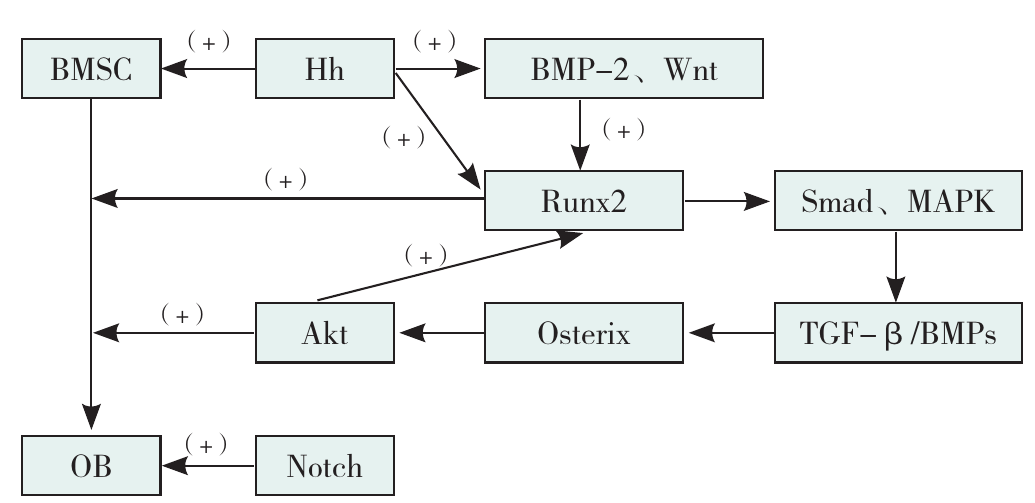
图1 BMSC分化为OB的相关机制注:BMSC=骨髓间充质干细胞,OB=成骨细胞,Hh=Hedgehog信号通路,BMP-2=骨形态发生蛋白2,Akt=蛋白激酶B,Wnt=经典Wnt信号通路,Smad=经典Smad依赖信号通路,MAPK=p38丝裂原活化蛋白激酶通路,TGF-β/BMPs=转化生长因子β/骨形态发生蛋白。
Figure 1 Mechanisms involved in the differentiation of BMSC into OB
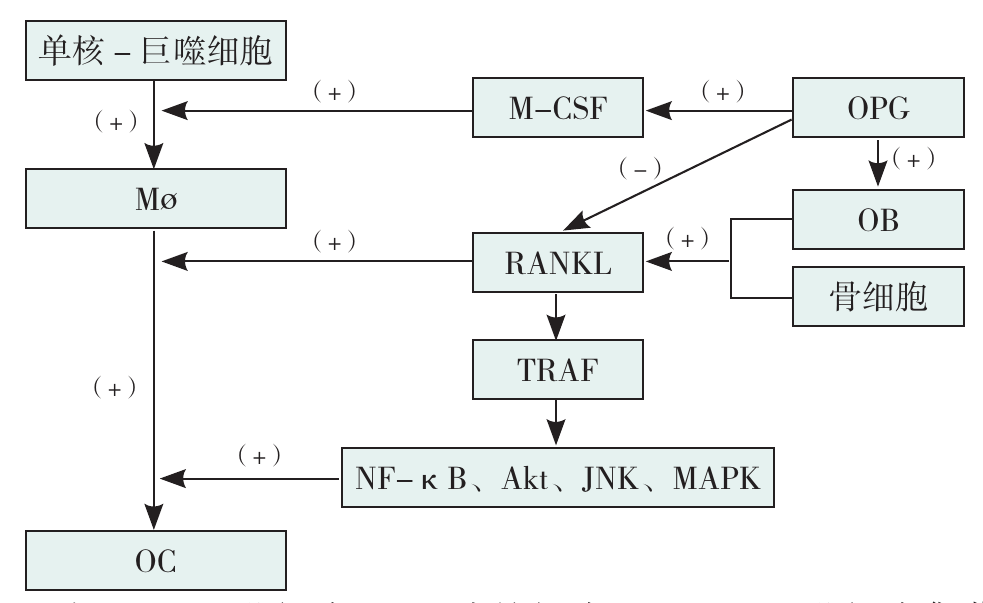
图2 OC分化相关机制注:Mø=巨噬细胞,OC=破骨细胞,M-CSF=巨噬细胞集落刺激因子,OPG=骨保护素,RANKL=核因子受体活化因子配体,TRAF=肿瘤坏死因子受体相关因子,NF-κB=核因子κB,JNK=c-Jun氨基末端激酶。
Figure 2 OC differentiation-related mechanisms
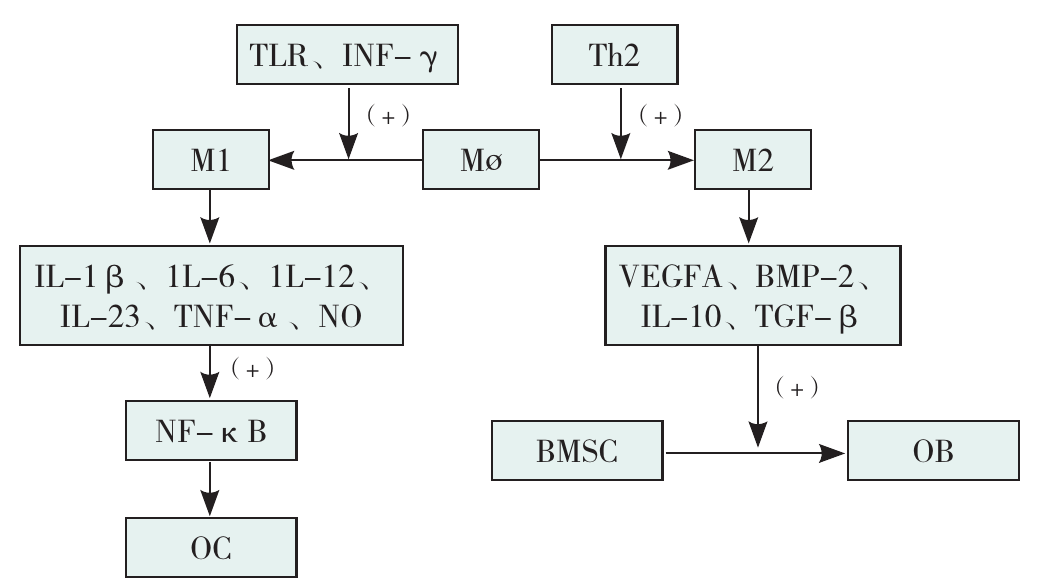
图3 巨噬细胞极化与OB、OC分化的相关机制注:TLR=Toll样受体,IFN-γ=干扰素γ,M1=经典活化的巨噬细胞,M2=选择性活化的巨噬细胞,IL-1α=白介素1α,IL-1β=白介素1β,IL-6=白介素6,IL-12=白介素12,IL-23=白介素23,TNF-α=肿瘤坏死因子α,NO=一氧化氮,VEGFA=血管内皮生长因子A,IL-10=白介素10。
Figure 3 Mechanisms associated with macrophage polarization involvement in OB and OC differentiation
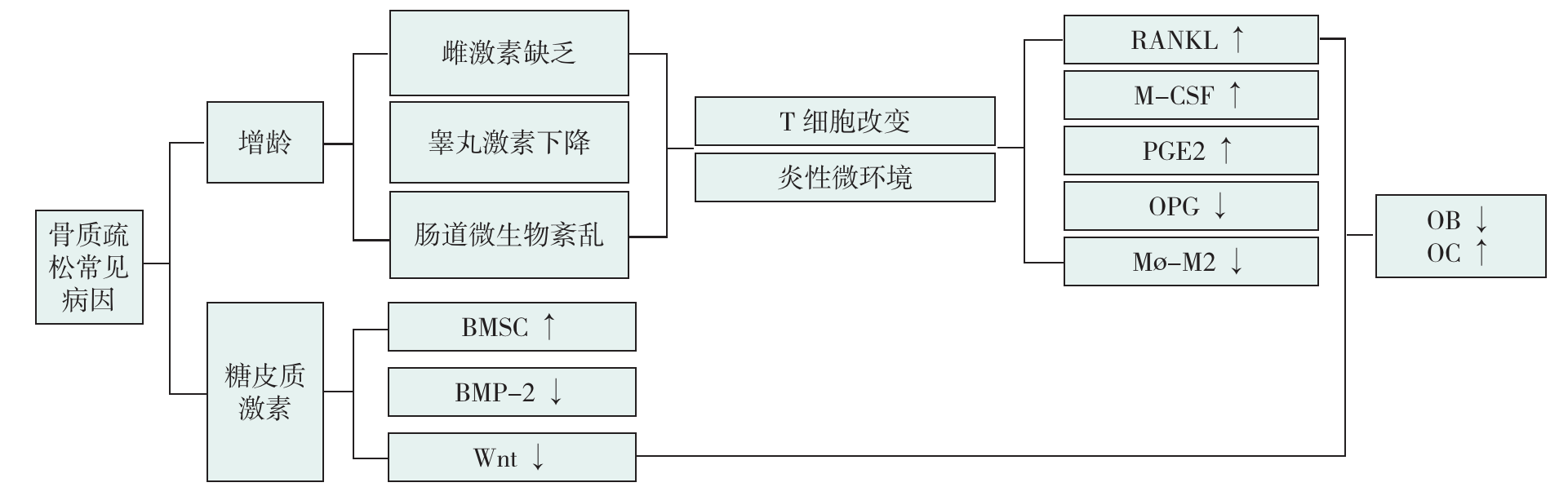
图4 OP相关发生机制注:↑代表表达上调,↓代表表达下调;PGE2=前列腺素E2,OPG=骨保护素,Mø→M2=巨噬细胞选择性活化。
Figure 4 Osteoporosis-related mechanisms of occurrence
| [1] |
中华医学会物理医学与康复学分会. 骨质疏松症康复治疗指南(2024版)[J]. 中国循证医学杂志, 2024, 24(6): 626-636.
|
| [2] |
|
| [3] |
|
| [4] |
|
| [5] |
|
| [6] |
|
| [7] |
中华医学会骨质疏松和骨矿盐疾病分会. 原发性骨质疏松症诊疗指南(2022)[J]. 中华骨质疏松和骨矿盐疾病杂志, 2022, 15(6): 573-611.
|
| [8] |
|
| [9] |
梁松林, 成文翔, 张鹏, 等. 成骨细胞程序性死亡的研究进展[J]. 中国骨质疏松杂志, 2024, 30(3): 385-390.
|
| [10] |
|
| [11] |
童安莉, 陈璐璐, 丁桂芝. 成骨细胞骨形成机制研究进展[J]. 中国骨质疏松杂志, 1999, 5(3): 60-64. DOI: 10.3969/j.issn.1006-7108.1999.03.020.
|
| [12] |
陈永强, 戴尅戎, 裘世静. 骨改建的细胞学基础[J]. 国外医学创伤与外科基本问题分册, 1989, 10(2): 85-89.
|
| [13] |
|
| [14] |
|
| [15] |
|
| [16] |
|
| [17] |
|
| [18] |
|
| [19] |
|
| [20] |
|
| [21] |
|
| [22] |
|
| [23] |
|
| [24] |
|
| [25] |
|
| [26] |
|
| [27] |
|
| [28] |
|
| [29] |
|
| [30] |
|
| [31] |
|
| [32] |
|
| [33] |
|
| [34] |
|
| [35] |
|
| [36] |
|
| [37] |
|
| [38] |
|
| [39] |
汪小敏, 王祥, 曹林忠, 等. RANK/RANKL/OPG信号轴在骨质疏松与炎性肠病相关性中的作用机制[J]. 中华骨质疏松和骨矿盐疾病杂志, 2017, 10(5): 499-504. DOI: 10.3969/j.issn.1674-2591.2017.05.012.
|
| [40] |
|
| [41] |
|
| [42] |
|
| [43] |
|
| [44] |
|
| [45] |
|
| [46] |
|
| [47] |
|
| [48] |
|
| [49] |
|
| [50] |
|
| [51] |
|
| [52] |
|
| [53] |
|
| [54] |
|
| [55] | |
| [56] |
|
| [57] |
|
| [58] |
耿锐, 陆军. 巨噬细胞的胞葬作用与炎症性疾病关系的研究进展[J]. 东南大学学报(医学版), 2023, 42(3): 466-474.
|
| [59] |
|
| [60] |
李敏, 林俊. 细胞凋亡途径及其机制[J]. 国际妇产科学杂志, 2014, 41(2): 103-107.
|
| [61] |
|
| [1] | 林燕平, 黄佳纯, 郭海威, 赵瑞, 杨昊霖, 万雷, 朱根福, 黄宏兴. 原发性骨质疏松症患者中医证型分布规律与肌-骨-脂关系研究[J]. 中国全科医学, 2026, 29(21): 3040-3045. |
| [2] | 李世龙, 王贺, 周晓宇, 付蕾, 赵倬, 华成俊, 司春婴. 心脏巨噬细胞在射血分数保留型心力衰竭中的研究进展[J]. 中国全科医学, 2026, 29(15): 2084-2091. |
| [3] | 何晓铭, 何敏聪, 魏腾飞, 林天烨, 刘文刚, 张庆文, 何伟, 魏秋实. 绝经后膝骨关节炎患者"中医证型-临床特征-分子分型"多维关系研究[J]. 中国全科医学, 2026, 29(12): 1588-1598. |
| [4] | 张含之, 金花, 马乐, 史玲, 陈晨, 宦红梅, 于德华. 上海市社区卫生服务机构骨质疏松症诊疗能力研究[J]. 中国全科医学, 2026, 29(12): 1548-1557. |
| [5] | 张媛, 陈冠华, 吕珊珊, 荆亚莉. 甲状腺功能正常的2型糖尿病患者甲状腺激素敏感性指标与骨质疏松症的关系研究[J]. 中国全科医学, 2025, 28(29): 3653-3659. |
| [6] | 赵玉晴, 王伟, 陈立沅, 油惠娟, 魏莹, 王清路, 杨风英. 肝脏巨噬细胞极化:运动防治非酒精性脂肪性肝病的新靶向[J]. 中国全科医学, 2025, 28(27): 3456-3465. |
| [7] | 熊鑫, 李洋, 石峰, 杨连, 段维, 陈蓓, 李勇, 赵林伟, 付泉水, 范小萍, 杨国庆. 基于人工智能的胸腰椎骨密度测定系统及其校准研究[J]. 中国全科医学, 2025, 28(19): 2398-2406. |
| [8] | 谭文彬, 李佳, 刘明玉, 路永欣, 程雅欣. 神经系统疾病及相关治疗药物对骨质疏松症影响的研究进展[J]. 中国全科医学, 2025, 28(17): 2092-2100. |
| [9] | 贺婷, 李佳, 谭文彬. 循环系统疾病与继发性骨质疏松症的研究新进展[J]. 中国全科医学, 2025, 28(17): 2101-2112. |
| [10] | 陈钡钡, 李佳, 谭文彬. 内分泌代谢系统疾病与继发性骨质疏松症的研究新进展[J]. 中国全科医学, 2025, 28(17): 2082-2091. |
| [11] | 李佳, 谭文彬. 继发性骨质疏松症防治困境与对策探究[J]. 中国全科医学, 2025, 28(17): 2075-2081. |
| [12] | 孙清, 吴玉霄, 崔立敏. 中国2型糖尿病患者肌少-骨质疏松症患病率的Meta分析[J]. 中国全科医学, 2025, 28(12): 1520-1526. |
| [13] | 刘洋晓讴, 孙艳格, 于溯, 杜雪平, 黄凯, 闫岩, 李超. FRAX对北京地区居民骨折风险的预测价值及干预阈值研究[J]. 中国全科医学, 2025, 28(07): 838-843. |
| [14] | 任凌萱, 卢子琪, 齐威, 冯志杰. 基于单细胞转录组学测序的巨噬细胞在肝硬化-肝癌疾病进展中的功能研究[J]. 中国全科医学, 2024, 27(29): 3654-3663. |
| [15] | 杨超富, 谭国庆, 徐展望. 骨质疏松中衰老相关分泌表型调控机制的研究进展[J]. 中国全科医学, 2024, 27(29): 3685-3695. |
| 阅读次数 | ||||||
|
全文 |
|
|||||
|
摘要 |
|
|||||