中国全科医学 ›› 2026, Vol. 29 ›› Issue (35): 5197-5202.DOI: 10.12114/j.issn.1007-9572.2025.0408

• 全科医疗/社区卫生服务工作研究 • 上一篇    下一篇

成都市村(居)民委员会公共卫生委员会人员结构化能力的潜在剖面及其影响因素研究

曾庆秋1,*(), 王红义1, 叶静雪1, 刘丹1, 蒋莉华2   

  1. 1.610041 四川省成都市武侯区玉林社区卫生服务中心
    2.610041 四川省成都市,四川大学华西公共卫生学院
  • 收稿日期:2025-12-16 修回日期:2026-04-23 出版日期:2026-12-15 发布日期:2026-10-26
  • 通讯作者: 曾庆秋

  • 作者贡献:

    曾庆秋负责研究思路的构思和研究方案的设计,对论文整体负责;王红义负责研究过程的实施、问卷制订,并起草论文;叶静雪负责文章的质量控制;刘丹负责数据处理和统计分析;蒋莉华负责问卷和论文的修订与审校。

  • 基金资助:
    中国社区卫生协会"社区卫生科研基金"项目(2021-2-101)

Latent Profiles and Influencing Factors of Structured Competencies among Members of Public Health Committees under Village (Neighborhood) Committees in Chengdu

ZENG Qingqiu1,*(), WANG Hongyi1, YE Jingxue1, LIU Dan1, JIANG Lihua2   

  1. 1. Yulin Community Health Service Center, Wuhou District, Chengdu 610041, China
    2. West China School of Public Health, Sichuan University, Chengdu 610041, China
  • Received:2025-12-16 Revised:2026-04-23 Published:2026-12-15 Online:2026-10-26
  • Contact: ZENG Qingqiu

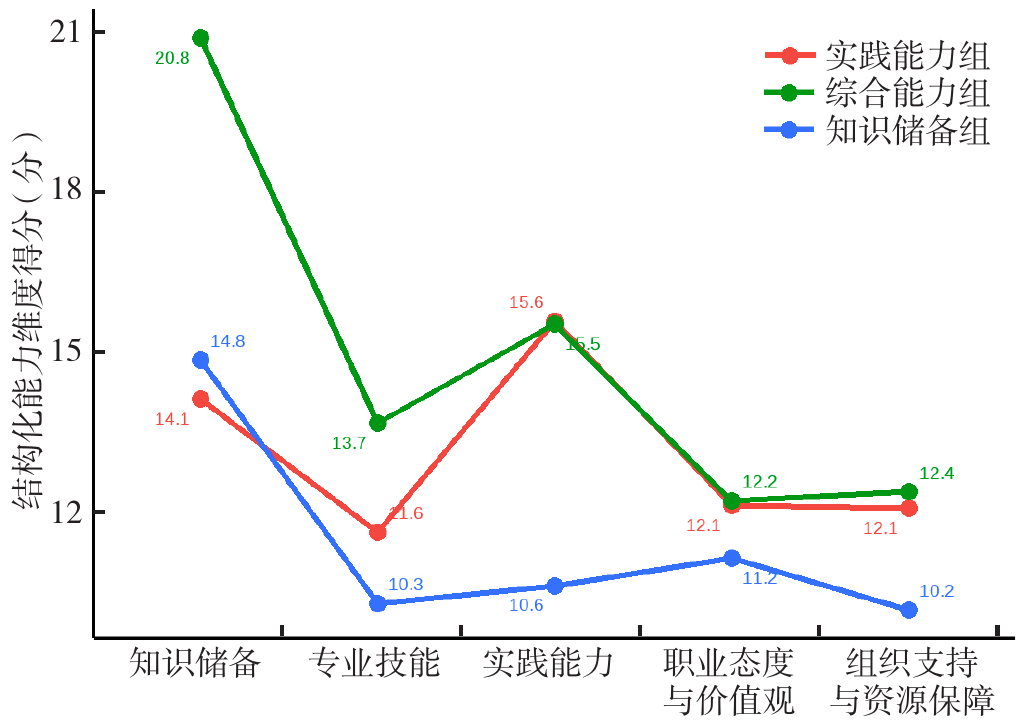
摘要: 背景 自2021年全面推进村(居)民委员会公共卫生委员会(以下简称公共卫生委员会)建设以来,各地已基本实现全覆盖,但仍普遍存在人员配置不足、专业能力薄弱、指令性任务执行效率低等问题,其结构化能力整体水平与差异特征尚不明确。 目的 评估成都市公共卫生委员会人员的结构化能力,识别其潜在类别,并分析其影响因素,为精准提升基层公共卫生服务能力提供依据。 方法 于2025年3—7月,采用方便抽样法选取成都市8个街道办事处76个公共卫生委员会的工作人员作为调查对象。通过问卷调查,从知识储备、专业技能、实践能力、职业态度与价值观、组织支持与资源保障5个维度评估人员的结构化能力。采用潜在剖面分析(LPA)对人员的结构化能力进行分类,采用多因素Logistic回归分析探讨其影响因素。 结果 共发放问卷715份,回收有效问卷689份,问卷有效回收率为96.4%。LPA识别出3类潜在能力剖面:实践能力组(n=206)、综合能力组(n=209)和知识储备组(n=274),各剖面结构化能力得分分别为(65.5±1.7)分、(74.6±3.6)分、(57.2±1.9)分。多因素Logistic回归分析结果显示,以综合能力组为参照,网格员归入实践能力组(OR=1.84,95%CI=1.16~2.94)、知识储备组(OR=1.94,95%CI=1.25~3.01)的概率高于其他职务人员(P<0.05),高中及以下学历者归入知识储备组的概率高于本科及以上学历者(OR=2.24,95%CI=1.23~4.09,P<0.05),工作区域在四圈层者归入实践能力组(OR=0.45,95%CI=0.26~0.79)、知识储备组(OR=0.39,95%CI=0.23~0.66)的概率低于一圈层者(P<0.05)。 结论 成都市公共卫生委员会人员的结构化能力存在明显群体差异,职务、学历、工作区域是主要影响因素。建议实施区域差异化培训策略,并开展职务与学历分层赋能计划,以系统性提升基层公共卫生服务能力。

关键词: 公共卫生委员会, 结构化能力, 潜在剖面分析, Logistic回归, 影响因素分析

Abstract:

Background

Since the comprehensive promotion of the establishment of public health committees in village (neighborhood) committees (hereinafter referred to as the community public health committees) in 2021, full coverage has basically been achieved across various regions. However, issues such as insufficient personnel allocation, weak professional capabilities, and low efficiency in executing directive tasks remain widespread. The overall level and differential characteristics of their structured capacity are still unclear.

Objective

To assess the structed competencies of staff members of public health committees in Chengdu, identify their potential categories, and analyze the main influencing factors, so as to provide a basis for precisely enhancing the capacity of grassroots public health services.

Methods

From March to July 2025, a convenience sampling method was used to select staff members from 76 village (neighborhood) public health committees across 8 subdistrict offices in Chengdu. A questionnaire survey was conducted to evaluate five dimensions: knowledge reserve, professional skills, practical ability, professional attitude and values, and organizational support and resource guarantee. Latent profile analysis (LPA) was used to classify staff members' structured competencies, and multivariable Logistic regression analysis was applied to explore influencing factors.

Results

A total of 715 questionnaires were distributed, and 689 valid questionnaires were recovered, with an effective response rate of 96.4%. LPA identified three potential capacity profiles: the practical ability group (n=206), the comprehensive ability group (n=209), and the knowledge reserve group (n=274). The mean structured competency scores for each profile were (65.5±1.7), (74.6±3.6), and (57.2±1.9), respectively. Multivariate Logistic regression analysis showed that, taking the comprehensive ability group as the reference, grid workers were more likely to be classified into the practical ability group (OR=1.84, 95%CI=1.16-2.94) and knowledge reserve group (OR=1.94, 95%CI=1.25-3.01) than personnel in other positions (P<0.05); participants with senior high school education or below had a higher probability of belonging to the knowledge reserve group compared with those holding a bachelor's degree or above (OR=2.24, 95%CI=1.23-4.09, P<0.05); staff working in the fourth-circle areas were less likely to fall into the practical ability group (OR=0.45, 95%CI=0.26-0.79) and knowledge reserve group (OR=0.39, 95%CI=0.23-0.66) relative to those from the first-circle areas (P<0.05).

Conclusion

There are significant group differences in the structured competencies of staff members of public health committees in Chengdu. Type of position, work area, and education level are the main influencing factors. It is recommended to implement regionally differentiated training strategies and carry out position- and education-level stratified empowerment programs to systematically enhance the capacity of grassroots public health services.

Key words: Public health committee, Structured capacity, Latent profile analysis, Logistic regression, Root cause analysis

中图分类号: