中国全科医学 ›› 2026, Vol. 29 ›› Issue (35): 5203-5211.DOI: 10.12114/j.issn.1007-9572.2026.0030

• 论著 • 上一篇    下一篇

浦东新区40岁及以上人群同型半胱氨酸与脑卒中发病风险的前瞻性纵向研究

王小楠1, 吴抗1, 刘晓琳2, 阮晓楠3, 陈晓丹1, 刘庆平1, 徐倩1, 吴梦瑶1, 邱桦1, 柯居中1, 宋佳慧1, 高娇娇1, 刘杨1, 孟琪琪1, 周弋4,*()   

  1. 1.200136 上海市浦东新区疾病预防控制中心(上海市浦东新区卫生健康监督所)慢性病防治科
    2.200136 上海市浦东新区疾病预防控制中心(上海市浦东新区卫生健康监督所)行政办公室
    3.200136 上海市浦东新区疾病预防控制中心(上海市浦东新区卫生健康监督所)业务管理办公室
    4.200136 上海市浦东新区疾病预防控制中心(上海市浦东新区卫生健康监督所)领导办公室
  • 收稿日期:2026-04-28 修回日期:2026-07-11 出版日期:2026-12-15 发布日期:2026-07-16
  • 通讯作者: 周弋

  • 作者贡献:

    王小楠负责论文撰写、数据分析;吴抗负责论文指导及现场协调;刘晓琳负责研究设计、数据清洗整理、数据处理;阮晓楠负责研究设计、组织协调及论文指导;陈晓丹、刘庆平、徐倩、吴梦瑶、邱桦、柯居中、宋佳慧、高娇娇、刘杨、孟琪琪负责现场调查及质量控制,数据收集;周弋对论文整体负责。

  • 基金资助:
    浦东新区卫生健康委员会研究者发起的临床研究项目(临床研究队列专项)(2024-PWDL-03); 浦东新区卫生系统领先人才培养计划(PWRl2024-10); 浦东新区卫生健康委员会公共卫生学科(PWGw2025-06); 浦东新区疾病预防控制中心业务研发平台慢性病流行病学(DXZB-2024-01)

A Prospective Longitudinal Study on the Association between Homocysteine and Stroke Risk in Adults Aged 40 Years and Older in Pudong New Area

WANG Xiaonan1, WU Kang1, LIU Xiaolin2, RUAN Xiaonan3, CHEN Xiaodan1, LIU Qingping1, XU Qian1, WU Mengyao1, QIU Hua1, KE Juzhong1, SONG Jiahui1, GAO Jiaojiao1, LIU Yang1, MENG Qiqi1, ZHOU Yi4,*()   

  1. 1. Department of Chronic Disease Prevention and Control, Shanghai Pudong New Area Center for Disease Control and Prevention (Shanghai Pudong New Area Health Supervision Institute), Shanghai 200136, China
    2. Office of Administration, Shanghai Pudong New Area Center for Disease Control and Prevention (Shanghai Pudong New Area Health Supervision Institute), Shanghai 200136, China
    3. Office of Business Management, Shanghai Pudong New Area Center for Disease Control and Prevention (Shanghai Pudong New Area Health Supervision Institute), Shanghai 200136, China
    4. Administration Office, Shanghai Pudong New Area Center for Disease Control and Prevention (Shanghai Pudong New Area Health Supervision Institute), Shanghai 200136, China
  • Received:2026-04-28 Revised:2026-07-11 Published:2026-12-15 Online:2026-07-16
  • Contact: ZHOU Yi

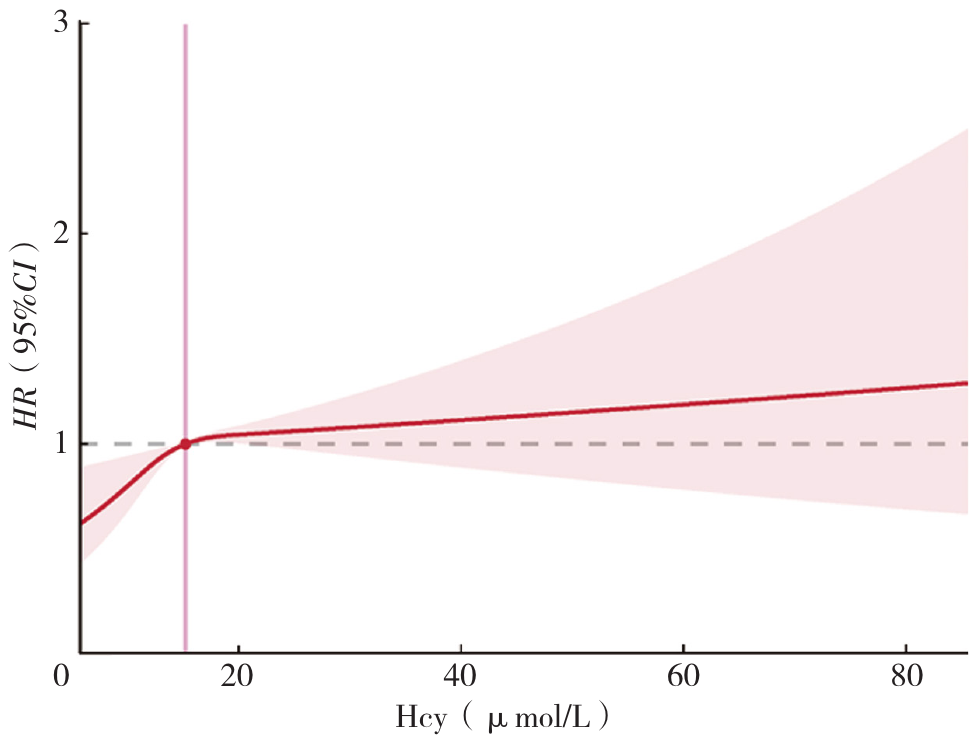
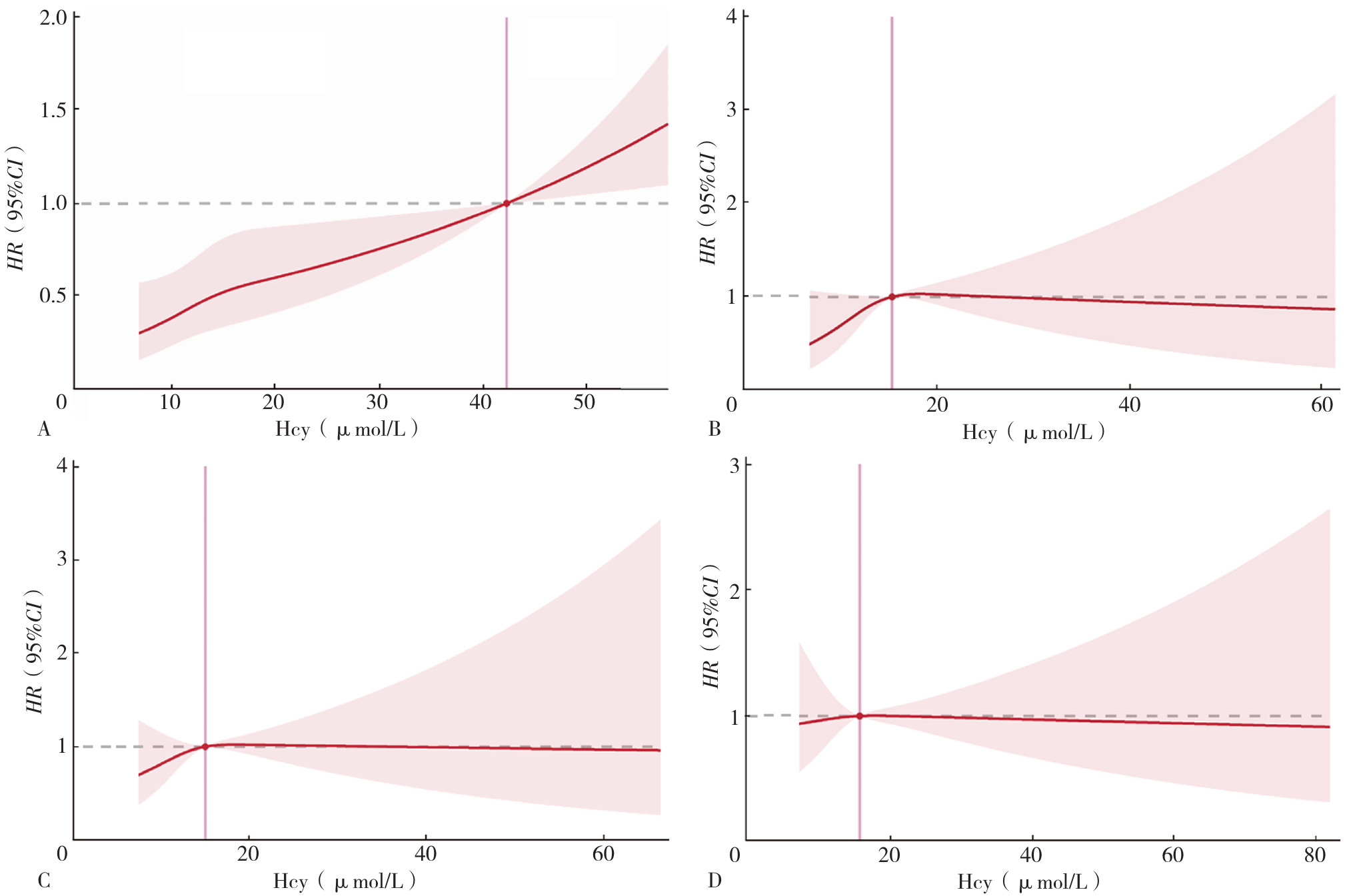
摘要: 背景 脑卒中是我国居民的第一大死因,也是全球重大公共卫生问题,具有高发病率、高死亡率、高残疾率、高复发率等特点。同型半胱氨酸(Hcy)是脑卒中的潜在危险因素,但目前两者关联仍存在争议。因此,探索Hcy作为早期预警生物标志物,对脑卒中防控具有重要意义。 目的 探究浦东新区40岁及以上人群Hcy水平与脑卒中发病风险的关联,为基层慢性病健康管理及脑卒中防控提供证据和指导。 方法 分别于2016年10月和2019年10月,采用多阶段分层整群抽样的方法,选取浦东新区年龄≥40岁的常住居民,纳入浦东新区慢性病及其危险因素监测队列研究项目,最终纳入13 395名(2016年入组6 266名,2019年新入组7 129名),以首次入组时间为随访开始时间,随访结束时间为2023-12-31,结局事件为新发脑卒中病例或脑卒中相关死亡。采用单因素与多因素Cox回归分析探索血清Hcy与脑卒中发病风险的关系,并采用限制性立方样条(RCS)回归模型探索两者间的非线性剂量反应关系。采用亚组分析进一步分析Hcy与不同亚组之间的关联。 结果 13 395名研究对象在随访期内发生脑卒中923例,男性脑卒中累积发病率为7.14%,女性为6.73%。多因素Cox回归分析结果显示,高血压史(HR=1.211,95%CI=1.047~1.400)、糖尿病史(HR=1.282,95%CI=1.103~1.490)、血脂异常(HR=1.178,95%CI=1.016~1.366)、超重/肥胖(HR=1.243,95%CI=1.071~1.443)、Hcy水平升高(HR=1.009,95%CI=1.001~1.016)以及年龄为50~<60岁(HR=2.670,95%CI=1.717~4.152)、60~<70岁(HR=4.508,95%CI=2.947~6.897)、70~79岁(HR=7.478,95%CI=4.834~11.569)是脑卒中发病的危险因素,受教育水平为初中(HR=0.769,95%CI=0.634~0.931)、高中(HR=0.675,95%CI=0.538~0.847)、大专及以上(HR=0.663,95%CI=0.486~0.906)是脑卒中发病的保护因素(P<0.05)。RCS回归分析结果显示,Hcy与脑卒中发病风险存在非线性关联(P总=0.011且P非线性=0.027)。当Hcy>15.218 μmol/L时,随着Hcy水平升高,脑卒中的发病风险升高。亚组分析显示,在不同C反应蛋白(CRP)亚组间存在显著交互效应(P交互效应=0.027),在低CRP组(Q1,0~0.3 mg/L)中,Hcy与脑卒中发生呈线性关联(P总<0.001且P非线性=0.251)。 结论 本研究证实Hcy水平与脑卒中的发病风险存在非线性关联,对CRP水平存在修饰作用。基层慢性病健康管理应重视多因素综合管理,重点关注老年人群、有基础慢性病史及肥胖人群的管理,加强炎症因子筛查,并密切监测血压、血糖、血脂、CRP及Hcy等关键指标。Hcy可作为脑卒中发病风险的预测指标,但需结合CRP等炎症指标进行综合评估。

关键词: 脑卒中, 同型半胱氨酸, 发病率, 纵向研究, 上海

Abstract:

Background

Stroke is the leading cause of death among residents in China and a major global public health issue, characterized by high incidence, high mortality, high disability, and high recurrence rates. Homocysteine (Hcy) is a potential risk factor for stroke; however, the association between the two remains controversial. Therefore, exploring Hcy as an early warning biomarker is of great significance for the prevention and control of stroke.

Objective

To investigate the association between Hcy levels and the risk of incident stroke among residents aged 40 years and older in Pudong New Area, and to provide evidence and guidance for community-based chronic disease health management as well as stroke prevention and control.

Methods

Using multistage stratified cluster sampling, permanent residents aged 40 years and above in Pudong New Area were recruited in October 2016 and October 2019, respectively, and were enrolled in the Pudong New Area Chronic Disease and Risk Factor Surveillance Cohort Study. A total of 13 395 participants were finally included (6 266 enrolled in 2016 and 7 129 newly enrolled in 2019). The date of the first enrollment was used as the start of follow-up, and the follow-up ended on December 31, 2023. The outcome events were newly diagnosed stroke cases or stroke-related deaths. Univariate and multivariate Cox regression analyses were performed to explore the association between serum Hcy and the risk of incident stroke, and the restricted cubic spline (RCS) regression model was used to examine the potential non-linear dose-response relationship between them. Subgroup analyses were conducted to further evaluate the association between Hcy and stroke risk across different subgroups.

Results

During the follow-up period, 923 incident stroke cases occurred among the 13 395 participants, with a cumulative incidence of 7.14% in men and 6.73% in women. Multivariable Cox regression analysis showed that history of hypertension (HR=1.211, 95%CI=1.047-1.400), history of diabetes (HR=1.282, 95%CI=1.103-1.490), dyslipidemia (HR=1.178, 95%CI=1.016-1.366), overweight/obesity (HR=1.243, 95%CI=1.071-1.443), elevated Hcy levels (HR=1.009, 95%CI=1.001-1.016), and age (50-<60 years: HR=2.670, 95%CI=1.717-4.152; 60-<70 years: HR=4.508, 95%CI=2.947-6.897; 70-79 years: HR=7.478, 95%CI=4.834-11.569) were risk factors for incident stroke, whereas education level of junior high school (HR=0.769, 95%CI=0.634-0.931), senior high school (HR=0.675, 95%CI=0.538-0.847), and college diploma or above (HR=0.663, 95%CI=0.486-0.906) were protective factors (all P<0.05). RCS regression analysis revealed a non-linear association between Hcy and the risk of incident stroke (Poverall association =0.011, Pnon-linearity=0.027). When Hcy was greater than 15.218 μmol/L, the risk of stroke increased with rising Hcy levels. Subgroup analysis showed a significant interaction effect between different CRP subgroups (Pinteraction =0.027); in the low CRP group (Q1, 0-0.3 mg/L), the association between Hcy and stroke was linear (Poverall association<0.001, Pnon-linearity=0.251).

Conclusion

This study confirms the non-linear association between Hcy levels and the risk of incident stroke, and that this association is modified by CRP levels. These findings suggest that community-based chronic disease health management should prioritize comprehensive multi-factorial intervention, with special attention to the management of elderly individuals, those with chronic disease histories, and those with obesity. Enhanced screening for inflammatory factors and close monitoring of key indicators, including blood pressure, blood glucose, blood lipids, CRP, and Hcy, are recommended. Hcy can serve as a predictor of stroke risk, but it should be combined with inflammatory markers such as CRP for comprehensive assessment.

Key words: Stroke, Homocysteine, Incidence, Longitudinal studies, Shanghai