中国全科医学 ›› 2026, Vol. 29 ›› Issue (15): 2050-2055.DOI: 10.12114/j.issn.1007-9572.2024.0674

所属专题: 儿科最新文章合辑

• 论著 • 上一篇    

基于改良德尔菲法构建《儿童遗尿症中西医结合诊疗指南》临床问题及结局指标

刘晓羽1,2, 朱荣欣1,2, 张博1,2, 苏杭1,2, 任献青1,2,*()   

  1. 1.450000 河南省郑州市,河南中医药大学第一附属医院儿科
    2.450046 河南省郑州市,河南中医药大学儿科医学院
  • 收稿日期:2025-02-11 修回日期:2025-03-17 出版日期:2026-05-20 发布日期:2026-04-14
  • 通讯作者: 任献青

  • 作者贡献:

    刘晓羽负责研究实施、数据统计,撰写论文;朱荣欣负责方法学设计和文章校审;张博负责环节把控,对文章进行监督管理;苏杭负责环节把控和文章校审;任献青负责最终版本的修订,对论文负责。

  • 基金资助:
    中华中医药学会团体标准(20230902-BZ-CACM); 河南省中医学"双一流"创建科学研究专项(HSRP-DFCTCM-2023-2-13); 河南省中医药科学研究专项课题(2022ZY1027,2023ZY2020)

Defining Clinical Questions and Outcome Indicators in Guidelines for Diagnosis and Treatment of Nocturnal Enuresis in Children with Integrated Traditional Chinese and Western Medicine Based on Modified Delphi Method

LIU Xiaoyu1,2, ZHU Rongxin1,2, ZHANG Bo1,2, SU Hang1,2, REN Xianqing1,2,*()   

  1. 1. Department of Pediatrics, the First Affiliated Hospital of Henan University of Chinese Medicine, Zhengzhou 450000, China
    2. College of Pediatrics, Henan University of Chinese Medicine, Zhengzhou 450046, China
  • Received:2025-02-11 Revised:2025-03-17 Published:2026-05-20 Online:2026-04-14
  • Contact: REN Xianqing

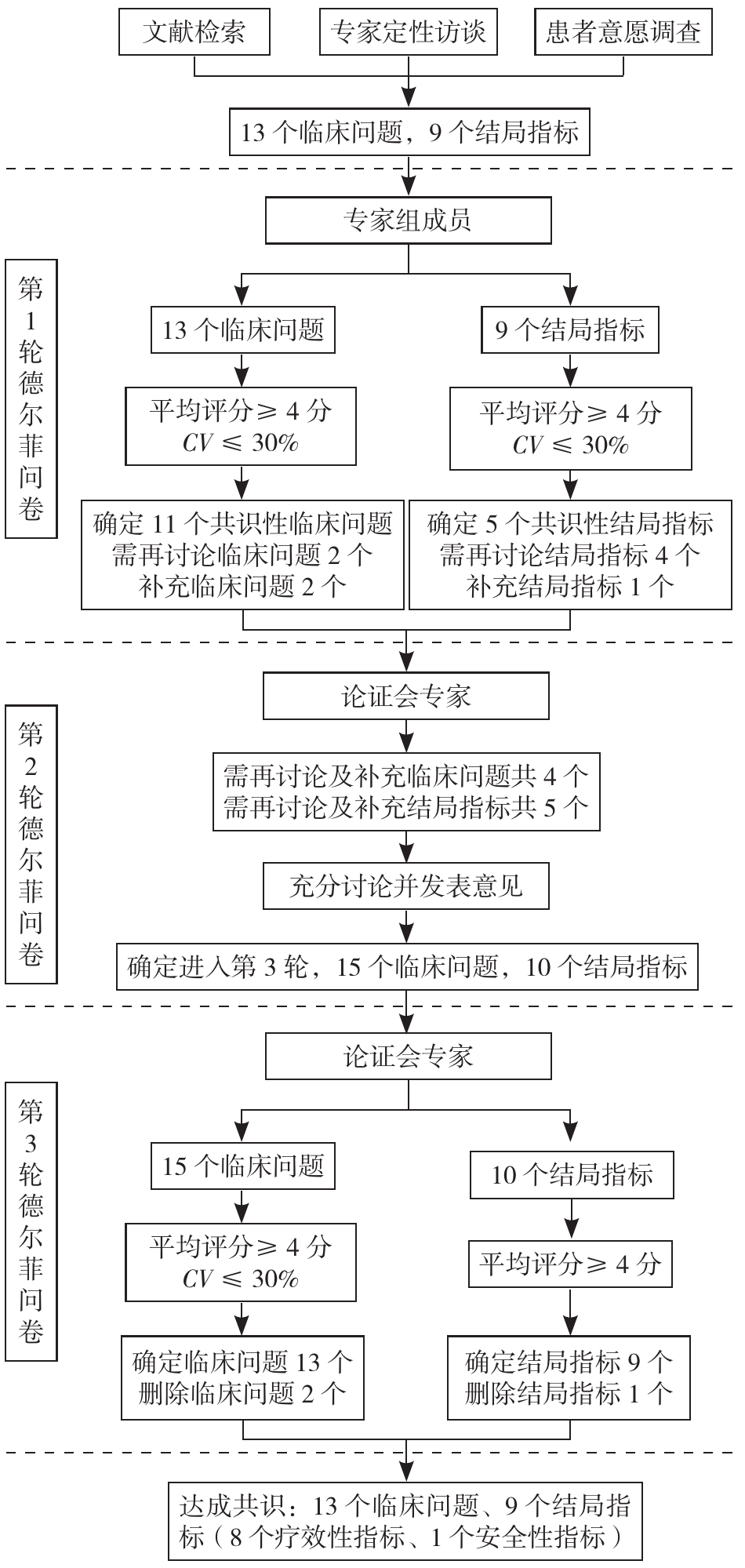
摘要: 背景 儿童遗尿症是临床常见的肾脏疾病之一,本病的西医一线治疗停药后复发率较高且依从性较差,中医治疗起效较慢且治疗方案不统一,因此将中西医进行融合以充分发挥各自治疗优势具有重要意义。 目的 构建《儿童遗尿症中西医结合诊疗指南》的临床问题及结局指标。 方法 通过文献研究、专家访谈及临床调研形成临床问题和结局指标清单,基于改良德尔菲法于2024年7—11月完成2轮专家问卷调研及1轮专家讨论。采用SPSS 26.0统计学软件分析问卷结果,以积极系数、平均评分、标准差、变异系数、Cronbach's α系数作为质量控制评价标准,最终确定指南纳入的临床问题及结局指标。 结果 第1轮问卷共26名专家、医护人员等参与,积极系数为100%,Cronbach's α系数为0.907。7名专家参与第2轮专家论证会及第3轮专家问卷调查,积极系数均为100%,Cronbach's α系数为0.724。最终纳入13个临床问题和9个结局指标(疗效性指标8个、安全性指标1个),临床问题主要涉及中医特征、中医干预方式(汤药、中成药、针刺、艾灸、推拿等)、复发治疗、提前干预、预防调护等;8个疗效性指标为遗尿次数、夜间觉醒程度、负面情绪指标、生活质量、睡眠质量、中医证候积分、复发率、膀胱容量;1个安全性指标为不良反应率。 结论 通过改良德尔菲法确定了临床问题和结局指标,初步形成了指南的结构体系,为指南的后续制订工作奠定了工作基础。

关键词: 遗尿, 儿童遗尿症, 中西医结合, 临床问题, 结局指标, 改良德尔菲法, 指南

Abstract:

Background

Nocturnal enuresis in children is one of the common renal diseases in clinic, the recurrence rate after stopping the first-line treatment of Western medicine is high and the compliance is poor, the effect of Chinese medicine treatment is slow and the treatment plan is not uniform, therefore, it is important to integrate the Chinese and Western medicines in order to give full play to the advantages of their respective treatments.

Objective

This study aims to construct a system of clinical queries and outcome indiators for the Guidelines for Diagnosis and Treatment of Nocturnal Enuresis in Children with Integrated Traditional Chinese and Western Medicine.

Methods

Through literature research, expert interviews, and clinical research, an initial list was formed. The modified Delphi method was then employed to conduct 2 rounds of expert questionnaire surveys and 1 round of expert discussions from July to November 2024. The SPSS 26.0 software was employed in statistical analysis of the results, including positivity coefficient, mean, statistics, coefficient of variation, and Cronbach's α for quality control.

Results

The first round of questionnaires involved 26 experts and professionals, with a positivity coefficient of 100% and a Cronbach's α of 0.907. The second and third rounds involved 7 experts, maintaining a positivity coefficient of 100% and a Cronbach's α of 0.724. Ultimately, 13 clinical questions and 9 outcome indicators were included, covering key areas such as characteristics of traditional Chinese medicine (TCM), intervention methods (decoctions, patent medicines, acupuncture, moxibustion, Chinese massage, etc.), relapse treatment, early intervention, and preventive care; 8 efficacy indicators were number of episodes of enuresis, degree of nocturnal awakening, indicators of negative mood, quality of life, quality of sleep, TCM evidence scores, relapse rate, and bladder capacity; and 1 safety indicator was the rate of adverse reactions.

Conclusion

Clinical questions and outcome indicators were identified through the Modified Delphi method, and the structural system of the guidelines was initially formed, laying a working foundation for the subsequent development of the guidelines.

Key words: Enuresis, Nocturnal enuresis in children, Integrated traditional Chinese medicine & western medicine, Clinical questions, Outcome indicators, Modified Delphi method, Guidebook

中图分类号: