中国全科医学 ›› 2026, Vol. 29 ›› Issue (06): 718-725.DOI: 10.12114/j.issn.1007-9572.2025.0254

• 论著 • 上一篇    下一篇

原发性干燥综合征燥瘀互结证患者临床特点及影响因素研究

雷淳心1, 张曦亚1, 张燕1, 陈嘉琪1, 刘子菡1, 罗静2,*(), 陶庆文2,*()   

  1. 1.100029 北京市,北京中医药大学研究生院
    2.100029 北京市,中日友好医院中医风湿病科 免疫炎性疾病北京市重点实验室
  • 收稿日期:2025-08-18 修回日期:2025-09-20 出版日期:2026-02-20 发布日期:2026-01-05
  • 通讯作者: 罗静, 陶庆文

  • 作者贡献:

    雷淳心、罗静负责研究的构思与设计;张曦亚、张燕、陈嘉琪、刘子菡进行数据的收集与整理,雷淳心、张曦亚、张燕负责统计学处理,表的绘制与展示;雷淳心负责撰写论文;罗静进行论文的修订;罗静、陶庆文负责文章的质量控制与审查,对文章整体负责,监督管理。

  • 基金资助:
    首都卫生发展科研专项(首发2024-1-4065); 中日友好医院"菁英计划"人才培育工程资助(ZRJY2024-GG08); 中华中医药学会风湿病分会青年培英计划(No.202327-007)

Clinical Characteristics and Influencing Factors of Primary Sjögren's Disease with Dryness and Blood-stasis Syndrome

LEI Chunxin1, ZHANG Xiya1, ZHANG Yan1, CHEN Jiaqi1, LIU Zihan1, LUO Jing2,*(), TAO Qingwen2,*()   

  1. 1. Graduate School, Beijing University of Chinese Medicine, Beijing 100029, China
    2. Traditional Chinese Medicine Department of Rheumatism, China-Japan Friendship Hospital/Beijing Key Laboratory of Immune inflammatory Disease, Beijing 100029, China
  • Received:2025-08-18 Revised:2025-09-20 Published:2026-02-20 Online:2026-01-05
  • Contact: LUO Jing, TAO Qingwen

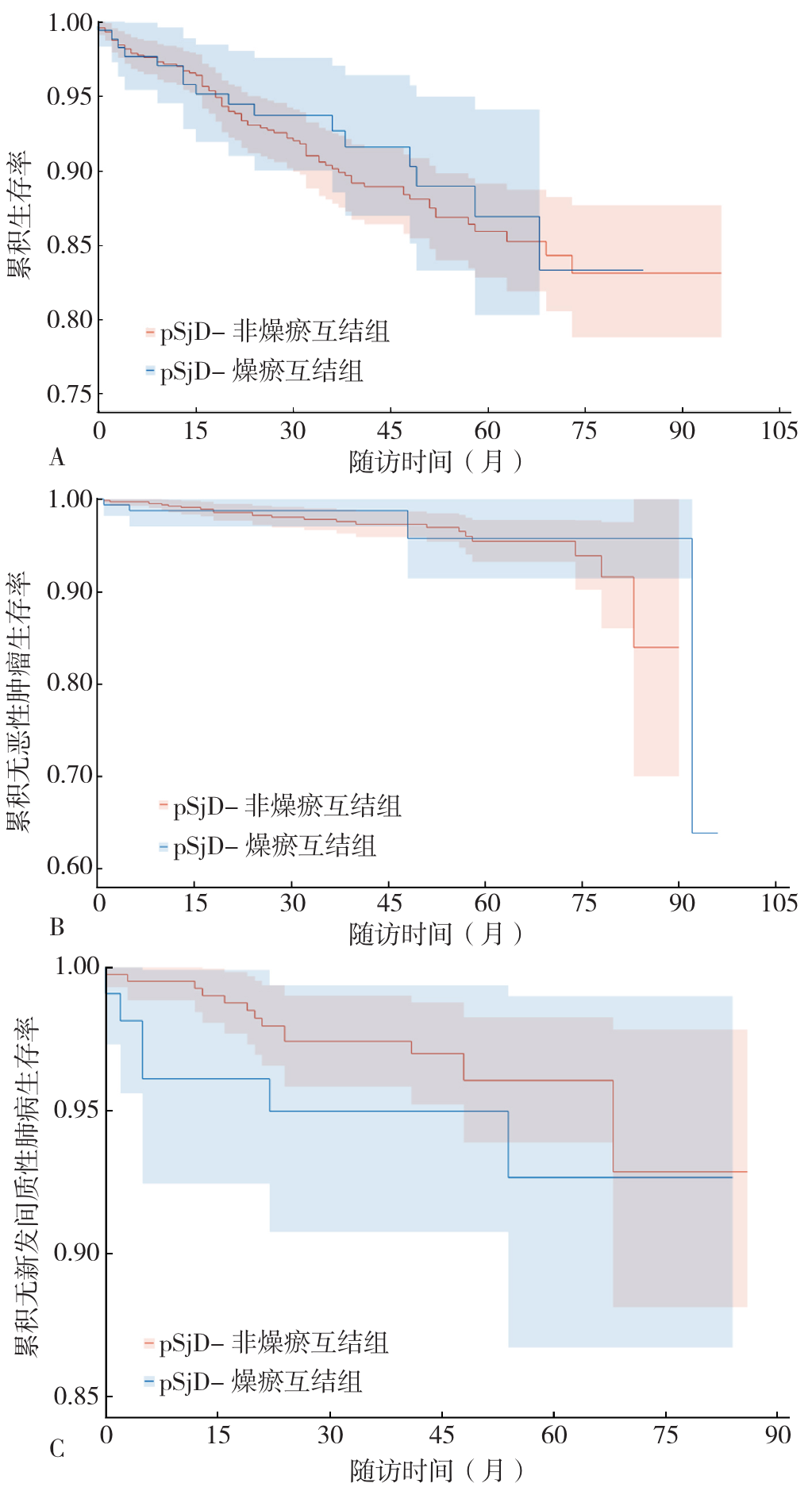
摘要: 背景 原发性干燥综合征(pSjD)是一种以淋巴细胞浸润外分泌腺体为特征的慢性自身免疫病,主要表现为口干、眼干,并可累及多系统。流行病学调查显示其患病率为0.06%~0.08%,且逐年上升。近年来中医专家共识提出燥瘀互结证为常见证型之一,但其临床特征、影响因素及预后情况尚缺乏系统研究。 目的 探索pSjD-燥瘀互结证患者的中西医临床特点、影响因素及预后情况。 方法 纳入2017—2022年就诊于中日友好医院的970例pSjD患者,分为pSjD-燥瘀互结组(185例)和pSjD-非燥瘀互结组(785例)。比较2组患者一般资料、临床症状、实验室指标及疾病活动度(ESSDAI)评分差异,采用多因素Logistic回归分析pSjD-燥瘀互结证的影响因素。生存结局(包括全因死亡、恶性肿瘤及间质性肺疾病)采用Kaplan-Meier生存曲线分析,组间差异使用Log-rank检验评估。 结果 与pSjD-非燥瘀互结组相比,pSjD-燥瘀互结组女性比例更高、病程更长、就诊年龄和发病年龄更小(P<0.05)。pSjD-燥瘀互结组患者中,前五位高频主诉症状依次为口干(75.1%)、眼干(75.1%)、关节痛(54.6%)、乏力(43.2%)、猖獗齿(33.5%)。pSjD-燥瘀互结组患者口干、关节痛、雷诺现象、淋巴结肿大、咳嗽、呼吸困难、腮腺肿大、紫癜样皮疹、关节炎、合并出血发生比例高于pSjD-非燥瘀互结组,咳嗽和呼吸困难发生比例低于pSjD-非燥瘀互结组(P<0.05)。多因素Logistic回归分析结果显示,就诊年龄增大(OR=0.979,95%CI=0.965~0.993,P=0.004)、血小板计数水平升高(OR=0.997,95%CI=0.994~0.999,P=0.007)为pSjD患者发生燥瘀互结证的独立保护因素,抗核糖核蛋白(RNP)抗体阳性(OR=2.352,95%CI=1.305~4.238,P=0.004)、抗着丝点蛋白B(CENP-B)抗体阳性(OR=2.490,95%CI=1.404~4.415,P=0.002)、抗β2-糖蛋白1(β2GP1)抗体阳性(OR=2.269,95%CI=1.057~4.872,P=0.036)以及ESSDAI评分升高(OR=1.037,95%CI=1.011~1.064,P=0.006)为pSjD患者发生燥瘀互结证的独立危险因素。Kaplan-Meier生存曲线分析结果显示,pSjD-燥瘀互结组与pSjD-非燥瘀互结组的总体死亡率、肿瘤及新发间质性肺疾病发生率比较,差异均无统计学意义(P>0.05)。 结论 pSjD-燥瘀互结证患者病情发展缠绵、ESSDAI评分更高、血液系统受累更显著,但合并ILD比例小。就诊年龄增大、血小板计数水平升高可能是pSjD患者发生燥瘀互结证的独立保护因素,抗RNP抗体阳性、抗CENP-B抗体阳性、抗β2GP1抗体阳性以及ESSDAI评分升高可能是pSjD患者发生燥瘀互结证的独立危险因素。pSjD-燥瘀互结组与pSjD-非燥瘀互结组的总体死亡率、肿瘤及新发ILD发生率无明显差异。

关键词: 原发性干燥综合征, 燥瘀互结证, 临床特点, 血液系统受累, 影响因素分析, 预后

Abstract:

Background

Primary Sjögren's disease (pSjD) is a chronic autoimmune disease characterized by lymphocytic infiltration of exocrine glands, presenting mainly with xerostomia and xerophthalmia, and potentially involving multiple systems. Epidemiological studies indicate a prevalence of approximately 0.06%-0.08%, with an increasing trend over time. In recent years, expert consensus in traditional Chinese medicine (TCM) has recognized the dryness and blood-stasis pattern as one of the common syndromes; however, its clinical characteristics, influencing factors, and prognosis have not been systematically investigated.

Objective

To explore the integrative clinical features, influencing factors, and prognostic outcomes of patients with pSjD of dryness and blood-stasis syndrome.

Methods

A total of 970 patients with pSjD treated at the China-Japan Friendship Hospital from 2017 to 2022 were enrolled, including 185 with pSjD of dryness and blood-stasis syndrome and 785 without pSjD of dryness and blood-stasis syndrome. General information, clinical symptoms, laboratory indicators, and disease activity scores (EULAR Sjögren's Syndrome Disease Activity Index, ESSDAI) were compared between groups. Multivariate Logistic regression analysis was used to identify independent factors associated with pSjD of dryness and blood-stasis syndrome. Survival outcomes, including all-cause mortality, malignancy, and incident interstitial lung disease (ILD), were analyzed using Kaplan-Meier survival curves and compared by the Log-rank test.

Results

Compared with the non-dryness and blood-stasis syndrome group, patients with pSjD of dryness and blood-stasis syndrome were more frequently female, had longer disease duration, and were younger at disease onset and enrollment (P<0.05). The top five symptoms in the pSjD of dryness and blood-stasis syndrome group were xerostomia (75.1%), xerophthalmia (75.1%), arthralgia (54.6%), fatigue (43.2%), and rampant caries (33.5%). The proportions of xerostomia, arthralgia, Raynaud's phenomenon, lymphadenopathy, parotid gland enlargement, purpura-like rash, arthritis, and bleeding were significantly higher in the pSjD of dryness and blood-stasis syndrome group, whereas cough and dyspnea were less frequent (P<0.05). Multivariate Logistic regression analysis identified older age at enrollment (OR=0.979, 95%CI=0.965-0.993, P=0.004) and higher platelet counts (OR=0.997, 95%CI=0.994-0.999, P=0.007) as independent protective factors for pSjD of dryness and blood-stasis syndrome, while anti-RNP positivity (OR=2.352, 95%CI=1.305-4.238, P=0.004), anti-CENP-B positivity (OR=2.490, 95%CI=1.404-4.415, P=0.002), anti-β2GP1 positivity (OR=2.269, 95%CI=1.057-4.872, P=0.036), and higher ESSDAI scores (OR=1.037, 95%CI=1.011-1.064, P=0.006) were identified as independent risk factors. Kaplan-Meier survival analysis showed no significant differences between groups in all-cause mortality, malignancy, or incident ILD (P>0.05).

Conclusion

Nearly 20% of pSjD patients had dryness and blood-stasis syndrome, and these patients exhibited a more chronic disease course, higher ESSDAI scores, and more prominent hematological involvement, although with a lower proportion of ILD. Older age at enrollment and higher platelet counts may be the independent protective factors for pSjD of dryness and blood-stasis syndrome, while anti-RNP positivity, anti-CENP-B positivity, anti-β2GP1 positivity, and higher ESSDAI scores may be identified as independent risk factors. No significant differences were observed in all-cause mortality, malignancy, or incident ILD between the two groups.

Key words: Primary Sj?gren's disease, Dryness and blood-stasis syndrome, Clinical characteristics, Haematological involvement, Root cause analysis, Prognosis

中图分类号: