中国全科医学 ›› 2026, Vol. 29 ›› Issue (35): 5180-5186.DOI: 10.12114/j.issn.1007-9572.2024.0714

• 全科医疗/社区卫生服务工作研究 • 上一篇    下一篇

医联体模式下浦东新区联合病房建设实践与优化策略研究

唐馨怡1, 顾桂国2, 胡新雨3, 张宜民4,*(), 刘姗姗3,*()   

  1. 1.261000 山东省潍坊市,山东第二医科大学管理学院
    2.200120 上海市浦东新区宣桥社区卫生服务中心
    3.200120 上海市浦东新区,上海市浦东卫生发展研究院
    4.200120 上海市浦东新区卫生健康委员会
  • 收稿日期:2025-04-02 修回日期:2025-08-01 出版日期:2026-12-15 发布日期:2026-10-26
  • 通讯作者: 张宜民, 刘姗姗

  • 作者贡献:

    唐馨怡负责研究设计与论文初稿撰写;顾桂国、胡新雨负责文献收集与资料整理;张宜民、刘姗姗参与研究思路的设计,负责论文修订与审查,对文章整体负责。

  • 基金资助:
    上海市卫生健康委员会政策研究项目(2024HP20); 浦东新区卫生系统优秀青年医学人才培养计划(PWRq2020-15); 浦东新区卫生系统领先人才培养计划(PWRl2020-05)

The Practice and Optimization Strategy of Joint Ward Construction in Pudong New Area under the Medical Consortium Model

TANG Xinyi1, GU Guiguo2, HU Xinyu3, ZHANG Yimin4,*(), LIU Shanshan3,*()   

  1. 1. School of Management, Shandong Second Medical University, Weifang 261000, China
    2. Xuanqiao Community Health Service Center, Pudong New Area, Shanghai 200120, China
    3. Pudong Institute for Health Development, Shanghai 200120, China
    4. Shanghai Pudong New Area Health Commission, Shanghai 200120, China
  • Received:2025-04-02 Revised:2025-08-01 Published:2026-12-15 Online:2026-10-26
  • Contact: ZHANG Yimin, LIU Shanshan

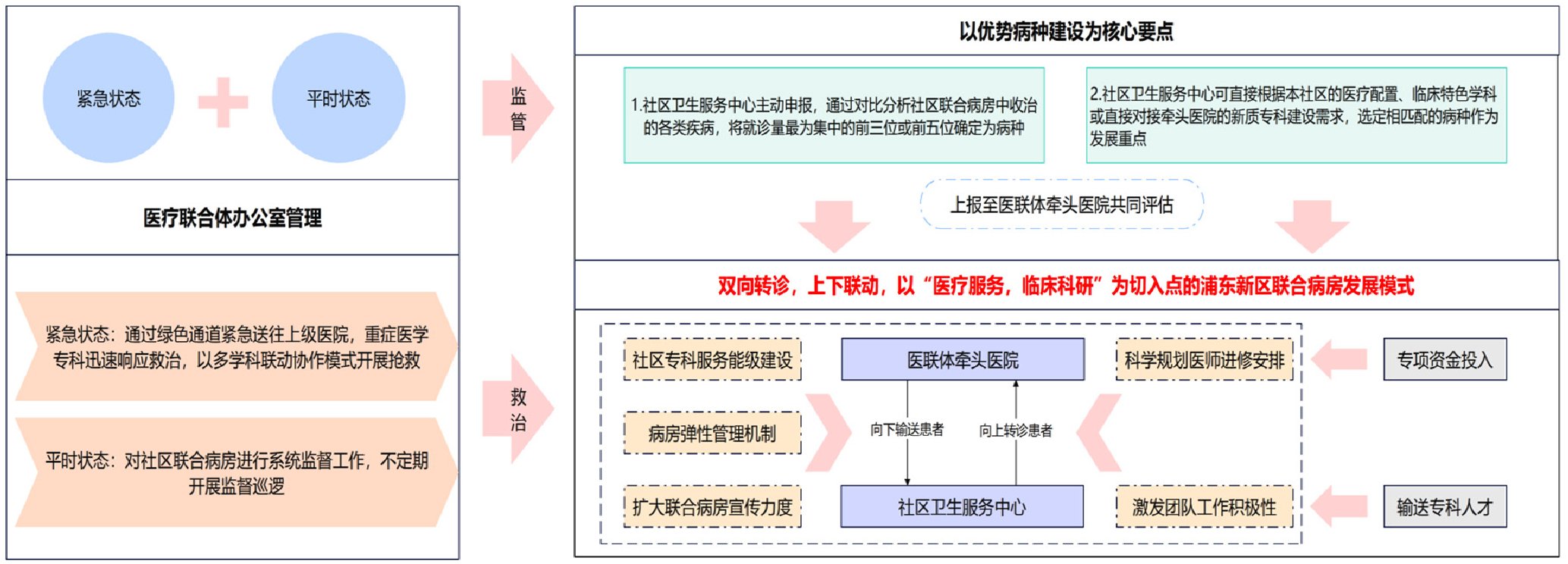
摘要: 背景 在推行分级诊疗制度背景下,为破解医疗资源分配不均和基层卫生资源利用率不高等突出问题,联合病房作为一种创新性的医疗服务协作模式应运而生。联合病房建设对于进一步加快优质医疗资源配置共享具有重要意义。 目的 了解浦东新区联合病房的建设现状,深入剖析其联合病房运行模式和运作过程中的难点,为提高医疗资源利用率和居民获取便利优质医疗资源提供可借鉴的优化策略。 方法 于2024年11月—2025年3月,采用文献研究法,系统检索国内外数据库和各地方卫生健康委员会官网,获取与联合病房建设相关的政策文件和文献,以总结归纳我国联合病房的主要发展模式及优劣势;于2024年8月,采用关键知情人访谈法,对5家医联体牵头医院和7家社区卫生服务中心联合病房的主要负责人进行半结构化访谈,以了解医联体联合病房的学科建设、优势病种匹配度和发展制约问题等。 结果 我国目前的联合病房发展模式主要为"以医联体牵头医院主导,各级医疗机构开展合作",具有5种典型发展模式,其中"医院-社区"一站式病房建设是主要运行模式,为患者提供直接过渡的就医路径。浦东新区联合病房建设当前面临优势病种建设不突出、医师进修安排待完善、下转患者难协调、宣传工作覆盖面不足的问题,基于此,应从规章制度建设、核心要点把握、关键要素抓牢和外部条件构建4个方面入手,进一步优化浦东新区联合病房发展的可视化实施方案。 结论 浦东新区联合病房处于探索发展阶段,建议以提升社区专科能级为关键点,以优势病种建设为核心抓手,加大联合病房的宣传力度,激发联合病房团队的工作积极性,科学合理安排社区医师进修时间及建立联合病房弹性管理机制,让居民实现"近"享优质医疗服务,从而为我国其他区域联合病房建设提供可行的实践范式。

关键词: 医联体, 联合病房, 分级诊疗, 社区卫生服务中心

Abstract:

Background

In the context of implementing the hierarchical diagnosis and treatment system, in order to solve the prominent problems of uneven distribution of medical resources, low utilization of primary health resources and other prominent problems, the joint ward has emerged as an innovative medical service collaboration model, which is of great significance for further accelerating the allocation and sharing of high-quality medical resources.

Objective

To understand the current status of joint ward development in Pudong New Area, analyze in depth the operation mode and difficulties encountered during implementation, and provide optimization strategies for improving the utilization of medical resources and residents' access to convenient, high-quality medical resources.

Methods

From November 2024 to March 2025, the literature research method was adopted to systematically search domestic and foreign databases as well as the official website of local health commissions, aiming to obtain policy documents and literature related to the development of joint wards, so as to summarize the main development models of joint wards in China along with their advantages and disadvantages. In August 2024, the key informant interview method was adopted to conduct semi-structured interviews with the main persons in charge of the joint wards from 5 medical alliance leading hospitals and 7 community health service centers, so as to understand issues such as specially development, matching of advantageous diseases, and development constraints in the joint wards of medical consortia.

Results

Our team found that the main development model of joint wards in China is led by medical consortium leading hospitals and involves cooperation among medical institutions at all levels. There were five typical development models, among which the "hospital community" one-stop ward construction was the main operating model, providing patients with a direct transition to medical care. The research on the exploration and construction of joint wards in Pudong New Area had found that there were currently problems such as the lack of prominent advantageous disease construction, incomplete arrangements for physician training, difficulty in coordinating the transfer of patients, and insufficient coverage of publicity work. Based on this, the study proposed to optimize the visual implementation plan for the development of joint wards in Pudong New Area from four aspects: the construction of rules and regulations, the grasp of core points, the grasp of key elements, and the construction of external conditions.

Conclusion

The joint ward in Pudong New Area is in the stage of exploration and development. In practice, it is recommended to focus on improving the level of community specialties, taking the construction of advantageous diseases as the core focus, increasing the publicity of joint wards, stimulating the work enthusiasm of joint ward teams, scientifically and reasonably arranging the training time of community doctors, and establishing a flexible management mechanism for joint wards, so that residents can enjoy high-quality medical services "nearby", and provide a feasible practical paradigm for the construction of joint wards in other regions of China.

Key words: Medical consortium, Joint ward, Graded diagnosis and treatment, Community health center

中图分类号: