
中国全科医学 ›› 2026, Vol. 29 ›› Issue (05): 583-590.DOI: 10.12114/j.issn.1007-9572.2024.0638
朱辰蕊1, 李娜2, 吴云涛1, 赵海燕1, 黄喆1, 刘妍1, 季春鹏1, 吴寿岭1,*( )
)
收稿日期:2025-01-08
修回日期:2025-10-26
出版日期:2026-02-15
发布日期:2026-01-05
通讯作者:
吴寿岭
作者贡献:
吴云涛、吴寿岭负责提出研究方向及试验设计,对论文进行修改及审查;朱辰蕊、李娜、赵海燕、黄喆、刘妍、季春鹏负责数据收集、数据整理及统计;朱辰蕊负责论文撰写。
ZHU Chenrui1, LI Na2, WU Yuntao1, ZHAO Haiyan1, HUANG Zhe1, LIU Yan1, JI Chunpeng1, WU Shouling1,*()
Received:2025-01-08
Revised:2025-10-26
Published:2026-02-15
Online:2026-01-05
Contact:
WU Shouling
摘要: 背景 既往研究表明血尿酸(SUA)水平与多种心血管疾病相关,比如高血压、心房颤动、心力衰竭和冠心病。但其与房室传导阻滞的关系目前尚不清楚。 目的 探讨SUA水平对新发房室传导阻滞的影响。 方法 本研究为前瞻性队列研究。选取2006—2007年参加开滦集团健康体检且符合纳排标准的人群87 913例作为研究队列,根据基线SUA水平将其分为非高尿酸血症组(SUA≤420 μmol/L)82 418例和高尿酸血症组(SUA>420 μmol/L)5 495例,每2年随访1次。以新发房室传导阻滞为终点事件,研究随访至2019-12-31。采用多因素Cox逐步回归模型分析不同SUA水平分组及SUA每增加1个标准差(SD)对新发房室传导阻滞的影响。 结果 入选的87 913人中男69 101例(78.60%)、女18 812例(21.40%),平均年龄(50.7±12.0)岁。中位随访11.89(9.06~12.83)年,共有1 037人发生房室传导阻滞。校正了年龄、性别等因素后,高尿酸血症组新发房室传导阻滞的风险较非高尿酸血症组增加26%(HR=1.26,95%CI=1.02~1.54,P=0.030),SUA水平每增加1个SD新发房室传导阻滞的风险增加12%(HR=1.12,95%CI=1.05~1.19,P<0.001);高尿酸血症组新发Ⅰ度房室传导阻滞的风险较非高尿酸血症组增加29%(HR=1.29,95%CI=1.05~1.60,P=0.017),SUA水平每增加1个SD新发Ⅰ度房室传导阻滞的风险增加12%(HR=1.12,95%CI=1.05~1.20,P<0.001)。样条函数曲线分析结果显示SUA水平与新发房室传导阻滞存在非线性相关(P<0.001)。 结论 高尿酸血症是新发房室传导阻滞的独立危险因素,且两者呈剂量-反应关系。
中图分类号:
| 组别 | 例数 | 年龄( | 性别(男/女) | 吸烟[例(%)] | 饮酒[例(%)] | 体育锻炼[例(%)] | BMI ( | SBP ( |
|---|---|---|---|---|---|---|---|---|
| 非高尿酸血症组 | 82 418 | 50.5±11.9 | 63 953/18 465 | 32 009(38.80) | 32 886(39.90) | 12 373(15.00) | 25.0±3.4 | 130±20 |
| 高尿酸血症组 | 5 495 | 53.2±13.3 | 5 148/347 | 3 120(56.80) | 3 405(62.00) | 1 190(21.70) | 26.5±3.4 | 135±21 |
| 检验统计量值 | -15.34a | 792.86 | 691.18 | 1 034.61 | 174.26 | -32.07a | -18.79a | |
| P值 | <0.001 | <0.001 | <0.001 | <0.001 | <0.001 | <0.001 | <0.001 | |
| 组别 | DBP ( | FBG ( | TG[M(P25,P75),mmol/L] | TC ( | LDL-C ( | hs-CRP[M(P25,P75),mg/L] | SUA( | |
| 非高尿酸血症组 | 83±11 | 5.45±1.56 | 1.25(0.88,1.88) | 4.93±1.09 | 2.35±0.88 | 0.80(0.30,2.16) | 275.40±67.19 | |
| 高尿酸血症组 | 86±12 | 5.39±1.41 | 1.80(1.20,2.81) | 5.23±1.12 | 2.38±0.89 | 1.29(0.55,3.10) | 473.66±49.27 | |
| 检验统计量值 | -16.39a | 3.00a | 1 553.54b | -19.83a | -2.68a | 573.47b | -281.37a | |
| P值 | <0.001 | 0.003 | <0.001 | <0.001 | 0.007 | <0.001 | <0.001 | |
| 组别 | eGFR[ | 高血压[例(%)] | 糖尿病[例(%)] | 基线心肌梗死[例(%)] | 服用降压药[例(%)] | 服用降糖药[例(%)] | 服用降脂药[例(%)] | 服用利尿剂[例(%)] |
| 非高尿酸血症组 | 82.81±20.72 | 34 543(41.90) | 7 319(8.88) | 834(1.01) | 7 719(9.37) | 1 798(2.18) | 688(0.83) | 726(0.88) |
| 高尿酸血症组 | 77.20±21.12 | 2 982(54.30) | 441(8.03) | 110(2.00) | 1 209(22.00) | 132(2.40) | 74(1.35) | 199(3.62) |
| 检验统计量值 | 19.09a | 321.45 | 4.68 | 47.52 | 901.52 | 1.17 | 15.71 | 371.65 |
| P值 | <0.001 | <0.001 | 0.031 | <0.001 | <0.001 | 0.280 | <0.001 | <0.001 |
表1 非高尿酸血症组与高尿酸血症组基线资料比较
Table 1 Comparison of baseline characteristics between non-hyperuricemia group and hyperuricemia group
| 组别 | 例数 | 年龄( | 性别(男/女) | 吸烟[例(%)] | 饮酒[例(%)] | 体育锻炼[例(%)] | BMI ( | SBP ( |
|---|---|---|---|---|---|---|---|---|
| 非高尿酸血症组 | 82 418 | 50.5±11.9 | 63 953/18 465 | 32 009(38.80) | 32 886(39.90) | 12 373(15.00) | 25.0±3.4 | 130±20 |
| 高尿酸血症组 | 5 495 | 53.2±13.3 | 5 148/347 | 3 120(56.80) | 3 405(62.00) | 1 190(21.70) | 26.5±3.4 | 135±21 |
| 检验统计量值 | -15.34a | 792.86 | 691.18 | 1 034.61 | 174.26 | -32.07a | -18.79a | |
| P值 | <0.001 | <0.001 | <0.001 | <0.001 | <0.001 | <0.001 | <0.001 | |
| 组别 | DBP ( | FBG ( | TG[M(P25,P75),mmol/L] | TC ( | LDL-C ( | hs-CRP[M(P25,P75),mg/L] | SUA( | |
| 非高尿酸血症组 | 83±11 | 5.45±1.56 | 1.25(0.88,1.88) | 4.93±1.09 | 2.35±0.88 | 0.80(0.30,2.16) | 275.40±67.19 | |
| 高尿酸血症组 | 86±12 | 5.39±1.41 | 1.80(1.20,2.81) | 5.23±1.12 | 2.38±0.89 | 1.29(0.55,3.10) | 473.66±49.27 | |
| 检验统计量值 | -16.39a | 3.00a | 1 553.54b | -19.83a | -2.68a | 573.47b | -281.37a | |
| P值 | <0.001 | 0.003 | <0.001 | <0.001 | 0.007 | <0.001 | <0.001 | |
| 组别 | eGFR[ | 高血压[例(%)] | 糖尿病[例(%)] | 基线心肌梗死[例(%)] | 服用降压药[例(%)] | 服用降糖药[例(%)] | 服用降脂药[例(%)] | 服用利尿剂[例(%)] |
| 非高尿酸血症组 | 82.81±20.72 | 34 543(41.90) | 7 319(8.88) | 834(1.01) | 7 719(9.37) | 1 798(2.18) | 688(0.83) | 726(0.88) |
| 高尿酸血症组 | 77.20±21.12 | 2 982(54.30) | 441(8.03) | 110(2.00) | 1 209(22.00) | 132(2.40) | 74(1.35) | 199(3.62) |
| 检验统计量值 | 19.09a | 321.45 | 4.68 | 47.52 | 901.52 | 1.17 | 15.71 | 371.65 |
| P值 | <0.001 | <0.001 | 0.031 | <0.001 | <0.001 | 0.280 | <0.001 | <0.001 |
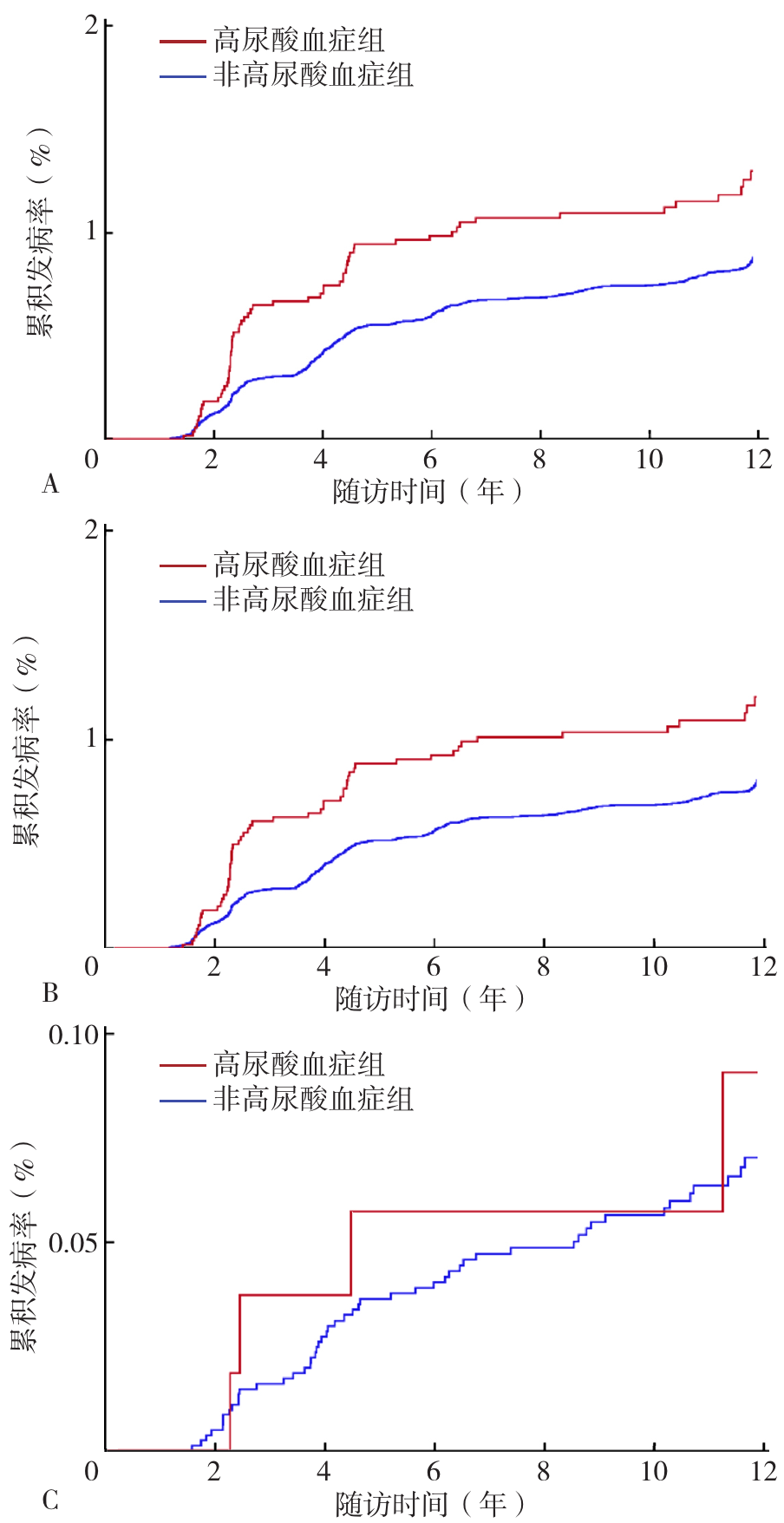
图1 不同SUA水平新发房室传导阻滞的生存曲线分析注:A为新发房室传导阻滞,B为新发Ⅰ度房室传导阻滞,C为新发Ⅱ度及以上房室传导阻滞。
Figure 1 Kaplan-Meier curves analysis of new-onset atrioventricular block at different SUA levels
| 分组 | 模型1 | 模型2 | 模型3 | |||
|---|---|---|---|---|---|---|
| HR(95%CI) | P值 | HR(95%CI) | P值 | HR(95%CI) | P值 | |
| 房室传导阻滞 | ||||||
| 高尿酸血症组(以非高尿酸血症组为参考) | 1.31(1.07~1.60) | 0.010 | 1.31(1.07~1.61) | 0.010 | 1.26(1.02~1.54) | 0.030 |
| SUA每增加1个SD | 1.14(1.07~1.21) | <0.001 | 1.14(1.07~1.21) | <0.001 | 1.12(1.05~1.19) | <0.001 |
| Ⅰ度房室传导阻滞 | ||||||
| 高尿酸血症组(以非高尿酸血症组为参考) | 1.35(1.09~1.66) | 0.006 | 1.35(1.09~1.67) | 0.005 | 1.29(1.05~1.60) | 0.017 |
| SUA每增加1个SD | 1.14(1.07~1.21) | <0.001 | 1.14(1.07~1.21) | <0.001 | 1.12(1.05~1.20) | <0.001 |
| Ⅱ度及以上房室传导阻滞 | ||||||
| 高尿酸血症组(以非高尿酸血症组为参考) | 0.85(0.35~2.12) | 0.721 | 0.84(0.33~2.09) | 0.700 | 0.76(0.30~1.92) | 0.567 |
| SUA每增加1个SD | 1.11(0.88~1.39) | 0.382 | 1.10(0.87~1.38) | 0.437 | 1.06(0.84~1.34) | 0.640 |
表2 不同SUA水平对新发房室传导阻滞影响的多因素Cox回归分析结果
Table 2 Multivariate Cox regression model for the association between different SUA Levels and new-onset atrioventricular block
| 分组 | 模型1 | 模型2 | 模型3 | |||
|---|---|---|---|---|---|---|
| HR(95%CI) | P值 | HR(95%CI) | P值 | HR(95%CI) | P值 | |
| 房室传导阻滞 | ||||||
| 高尿酸血症组(以非高尿酸血症组为参考) | 1.31(1.07~1.60) | 0.010 | 1.31(1.07~1.61) | 0.010 | 1.26(1.02~1.54) | 0.030 |
| SUA每增加1个SD | 1.14(1.07~1.21) | <0.001 | 1.14(1.07~1.21) | <0.001 | 1.12(1.05~1.19) | <0.001 |
| Ⅰ度房室传导阻滞 | ||||||
| 高尿酸血症组(以非高尿酸血症组为参考) | 1.35(1.09~1.66) | 0.006 | 1.35(1.09~1.67) | 0.005 | 1.29(1.05~1.60) | 0.017 |
| SUA每增加1个SD | 1.14(1.07~1.21) | <0.001 | 1.14(1.07~1.21) | <0.001 | 1.12(1.05~1.20) | <0.001 |
| Ⅱ度及以上房室传导阻滞 | ||||||
| 高尿酸血症组(以非高尿酸血症组为参考) | 0.85(0.35~2.12) | 0.721 | 0.84(0.33~2.09) | 0.700 | 0.76(0.30~1.92) | 0.567 |
| SUA每增加1个SD | 1.11(0.88~1.39) | 0.382 | 1.10(0.87~1.38) | 0.437 | 1.06(0.84~1.34) | 0.640 |
| 分组 | 模型1 | 模型2 | 模型3 | |||
|---|---|---|---|---|---|---|
| HR(95%CI) | P值 | HR(95%CI) | P值 | HR(95%CI) | P值 | |
| 房室传导阻滞 | ||||||
| 非高尿酸血症组 | 1.00 | 1.00 | 1.00 | |||
| 高尿酸血症组 | 1.41(1.30~1.53) | <0.001 | 1.42(1.31~1.54) | <0.001 | 1.38(1.27~1.50) | <0.001 |
| Ⅰ度房室传导阻滞 | ||||||
| 非高尿酸血症组 | 1.00 | 1.00 | 1.00 | |||
| 高尿酸血症组 | 1.44(1.32~1.56) | <0.001 | 1.45(1.33~1.57) | <0.001 | 1.41(1.30~1.54) | <0.001 |
| Ⅱ度及以上房室传导阻滞 | ||||||
| 非高尿酸血症组 | 1.00 | 1.00 | 1.00 | |||
| 高尿酸血症组 | 1.05(0.74~1.49) | 0.779 | 1.05(0.74~1.49) | 0.788 | 1.02(0.72~1.45) | 0.894 |
表3 不同SUA水平对新发房室传导阻滞影响的时间依赖多因素Cox回归分析结果
Table 3 Time-dependent multivariate Cox regression model for the risks of atrioventricular block according to SUA levels
| 分组 | 模型1 | 模型2 | 模型3 | |||
|---|---|---|---|---|---|---|
| HR(95%CI) | P值 | HR(95%CI) | P值 | HR(95%CI) | P值 | |
| 房室传导阻滞 | ||||||
| 非高尿酸血症组 | 1.00 | 1.00 | 1.00 | |||
| 高尿酸血症组 | 1.41(1.30~1.53) | <0.001 | 1.42(1.31~1.54) | <0.001 | 1.38(1.27~1.50) | <0.001 |
| Ⅰ度房室传导阻滞 | ||||||
| 非高尿酸血症组 | 1.00 | 1.00 | 1.00 | |||
| 高尿酸血症组 | 1.44(1.32~1.56) | <0.001 | 1.45(1.33~1.57) | <0.001 | 1.41(1.30~1.54) | <0.001 |
| Ⅱ度及以上房室传导阻滞 | ||||||
| 非高尿酸血症组 | 1.00 | 1.00 | 1.00 | |||
| 高尿酸血症组 | 1.05(0.74~1.49) | 0.779 | 1.05(0.74~1.49) | 0.788 | 1.02(0.72~1.45) | 0.894 |
| 分组 | 模型1 | 模型2 | 模型3 | |||
|---|---|---|---|---|---|---|
| HR(95%CI) | P值 | HR(95%CI) | P值 | HR(95%CI) | P值 | |
| 年龄 | ||||||
| <60岁 | ||||||
| 非高尿酸血症组 | 1.00 | 1.00 | 1.00 | |||
| 高尿酸血症组 | 1.27(0.97~1.65) | 0.084 | 1.27(0.97~1.66) | 0.081 | 1.18(0.90~1.54) | 0.238 |
| ≥60岁 | ||||||
| 非高尿酸血症组 | 1.00 | 1.00 | 1.00 | |||
| 高尿酸血症组 | 1.42(1.04~1.95) | 0.029 | 1.41(1.03~1.94) | 0.033 | 1.32(0.96~1.82) | 0.091 |
| 性别 | ||||||
| 男性 | ||||||
| 非高尿酸血症组 | 1.00 | 1.00 | 1.00 | |||
| 高尿酸血症组 | 1.28(1.04~1.59) | 0.020 | 1.29(1.04~1.59) | 0.019 | 1.24(1.00~1.53) | 0.049 |
| 女性 | ||||||
| 非高尿酸血症组 | 1.00 | 1.00 | 1.00 | |||
| 高尿酸血症组 | 1.47(0.59~3.63) | 0.409 | 1.48(0.60~3.66) | 0.399 | 1.28(0.51~3.19) | 0.601 |
表4 按年龄和性别分层后不同SUA水平对新发房室传导阻滞影响的多因素Cox回归分析结果
Table 4 Multivariate Cox regression model for the associations between SUA levels and atrioventricular block incidence stratified by age or sex
| 分组 | 模型1 | 模型2 | 模型3 | |||
|---|---|---|---|---|---|---|
| HR(95%CI) | P值 | HR(95%CI) | P值 | HR(95%CI) | P值 | |
| 年龄 | ||||||
| <60岁 | ||||||
| 非高尿酸血症组 | 1.00 | 1.00 | 1.00 | |||
| 高尿酸血症组 | 1.27(0.97~1.65) | 0.084 | 1.27(0.97~1.66) | 0.081 | 1.18(0.90~1.54) | 0.238 |
| ≥60岁 | ||||||
| 非高尿酸血症组 | 1.00 | 1.00 | 1.00 | |||
| 高尿酸血症组 | 1.42(1.04~1.95) | 0.029 | 1.41(1.03~1.94) | 0.033 | 1.32(0.96~1.82) | 0.091 |
| 性别 | ||||||
| 男性 | ||||||
| 非高尿酸血症组 | 1.00 | 1.00 | 1.00 | |||
| 高尿酸血症组 | 1.28(1.04~1.59) | 0.020 | 1.29(1.04~1.59) | 0.019 | 1.24(1.00~1.53) | 0.049 |
| 女性 | ||||||
| 非高尿酸血症组 | 1.00 | 1.00 | 1.00 | |||
| 高尿酸血症组 | 1.47(0.59~3.63) | 0.409 | 1.48(0.60~3.66) | 0.399 | 1.28(0.51~3.19) | 0.601 |
| 分组 | 模型1 | 模型2 | 模型3 | |||
|---|---|---|---|---|---|---|
| HR(95%CI) | P值 | HR(95%CI) | P值 | HR(95%CI) | P值 | |
| 排除eGFR<45 mL·min-1·(1.73 m2)-1 | ||||||
| 高尿酸血症组(以非高尿酸血症组为参考) | 1.31(1.06~1.61) | 0.012 | 1.31(1.06~1.61) | 0.011 | 1.25(1.02~1.54) | 0.035 |
| SUA每增加1个SD | 1.13(1.07~1.20) | <0.001 | 1.13(1.07~1.21) | <0.001 | 1.12(1.05~1.19) | <0.001 |
| 排除2年内发生终点事件 | ||||||
| 高尿酸血症组(以非高尿酸血症组为参考) | 1.34(1.08~1.66) | 0.008 | 1.34(1.08~1.66) | 0.008 | 1.28(1.03~1.59) | 0.027 |
| SUA每增加1个SD | 1.14(1.07~1.22) | <0.001 | 1.14(1.07~1.22) | <0.001 | 1.12(1.05~1.20) | <0.001 |
| 排除服用利尿剂 | ||||||
| 高尿酸血症组(以非高尿酸血症组为参考) | 1.30(1.06~1.61) | 0.014 | 1.31(1.06~1.61) | 0.013 | 1.26(1.02~1.56) | 0.032 |
| SUA每增加1个SD | 1.13(1.06~1.20) | <0.001 | 1.13(1.06~1.20) | <0.001 | 1.12(1.05~1.19) | <0.001 |
| 排除痛风病史 | ||||||
| 高尿酸血症组(以非高尿酸血症组为参考) | 1.28(1.04~1.58) | 0.021 | 1.28(1.04~1.58) | 0.020 | 1.23(0.99~1.52) | 0.055 |
| SUA每增加1个SD | 1.13(1.06~1.20) | <0.001 | 1.13(1.06~1.20) | <0.001 | 1.11(1.05~1.18) | <0.001 |
| 排除基线及随访心房颤动病史 | ||||||
| 高尿酸血症组(以非高尿酸血症组为参考) | 1.32(1.07~1.62) | 0.009 | 1.32(1.07~1.62) | 0.008 | 1.26(1.03~1.55) | 0.028 |
| SUA每增加1个SD | 1.14(1.07~1.21) | <0.001 | 1.14(1.07~1.21) | <0.001 | 1.12(1.05~1.19) | <0.001 |
| 排除基线及随访心力衰竭病史 | ||||||
| 高尿酸血症组(以非高尿酸血症组为参考) | 1.33(1.09~1.64) | 0.006 | 1.34(1.09~1.64) | 0.006 | 1.27(1.04~1.57) | 0.021 |
| SUA每增加1个SD | 1.14(1.07~1.21) | <0.001 | 1.14(1.07~1.21) | <0.001 | 1.12(1.05~1.19) | <0.001 |
表5 不同SUA水平对新发房室传导阻滞影响的敏感性分析
Table 5 Sensitivity analyses of associations between SUA levels and atrioventricular block
| 分组 | 模型1 | 模型2 | 模型3 | |||
|---|---|---|---|---|---|---|
| HR(95%CI) | P值 | HR(95%CI) | P值 | HR(95%CI) | P值 | |
| 排除eGFR<45 mL·min-1·(1.73 m2)-1 | ||||||
| 高尿酸血症组(以非高尿酸血症组为参考) | 1.31(1.06~1.61) | 0.012 | 1.31(1.06~1.61) | 0.011 | 1.25(1.02~1.54) | 0.035 |
| SUA每增加1个SD | 1.13(1.07~1.20) | <0.001 | 1.13(1.07~1.21) | <0.001 | 1.12(1.05~1.19) | <0.001 |
| 排除2年内发生终点事件 | ||||||
| 高尿酸血症组(以非高尿酸血症组为参考) | 1.34(1.08~1.66) | 0.008 | 1.34(1.08~1.66) | 0.008 | 1.28(1.03~1.59) | 0.027 |
| SUA每增加1个SD | 1.14(1.07~1.22) | <0.001 | 1.14(1.07~1.22) | <0.001 | 1.12(1.05~1.20) | <0.001 |
| 排除服用利尿剂 | ||||||
| 高尿酸血症组(以非高尿酸血症组为参考) | 1.30(1.06~1.61) | 0.014 | 1.31(1.06~1.61) | 0.013 | 1.26(1.02~1.56) | 0.032 |
| SUA每增加1个SD | 1.13(1.06~1.20) | <0.001 | 1.13(1.06~1.20) | <0.001 | 1.12(1.05~1.19) | <0.001 |
| 排除痛风病史 | ||||||
| 高尿酸血症组(以非高尿酸血症组为参考) | 1.28(1.04~1.58) | 0.021 | 1.28(1.04~1.58) | 0.020 | 1.23(0.99~1.52) | 0.055 |
| SUA每增加1个SD | 1.13(1.06~1.20) | <0.001 | 1.13(1.06~1.20) | <0.001 | 1.11(1.05~1.18) | <0.001 |
| 排除基线及随访心房颤动病史 | ||||||
| 高尿酸血症组(以非高尿酸血症组为参考) | 1.32(1.07~1.62) | 0.009 | 1.32(1.07~1.62) | 0.008 | 1.26(1.03~1.55) | 0.028 |
| SUA每增加1个SD | 1.14(1.07~1.21) | <0.001 | 1.14(1.07~1.21) | <0.001 | 1.12(1.05~1.19) | <0.001 |
| 排除基线及随访心力衰竭病史 | ||||||
| 高尿酸血症组(以非高尿酸血症组为参考) | 1.33(1.09~1.64) | 0.006 | 1.34(1.09~1.64) | 0.006 | 1.27(1.04~1.57) | 0.021 |
| SUA每增加1个SD | 1.14(1.07~1.21) | <0.001 | 1.14(1.07~1.21) | <0.001 | 1.12(1.05~1.19) | <0.001 |
| 分组 | 模型1 | 模型2 | 模型3 | |||
|---|---|---|---|---|---|---|
| HR(95%CI) | P值 | HR(95%CI) | P值 | HR(95%CI) | P值 | |
| 非高尿酸血症组 | 1.00 | 1.00 | 1.00 | |||
| 高尿酸血症组 | 1.31(1.07~1.60) | 0.011 | 1.31(1.07~1.61) | 0.010 | 1.25(1.02~1.54) | 0.033 |
表6 不同SUA水平对新发房室传导阻滞影响的死亡竞争风险模型
Table 6 Competing risk model of death for risks of atrioventricular block according to SUA levels
| 分组 | 模型1 | 模型2 | 模型3 | |||
|---|---|---|---|---|---|---|
| HR(95%CI) | P值 | HR(95%CI) | P值 | HR(95%CI) | P值 | |
| 非高尿酸血症组 | 1.00 | 1.00 | 1.00 | |||
| 高尿酸血症组 | 1.31(1.07~1.60) | 0.011 | 1.31(1.07~1.61) | 0.010 | 1.25(1.02~1.54) | 0.033 |
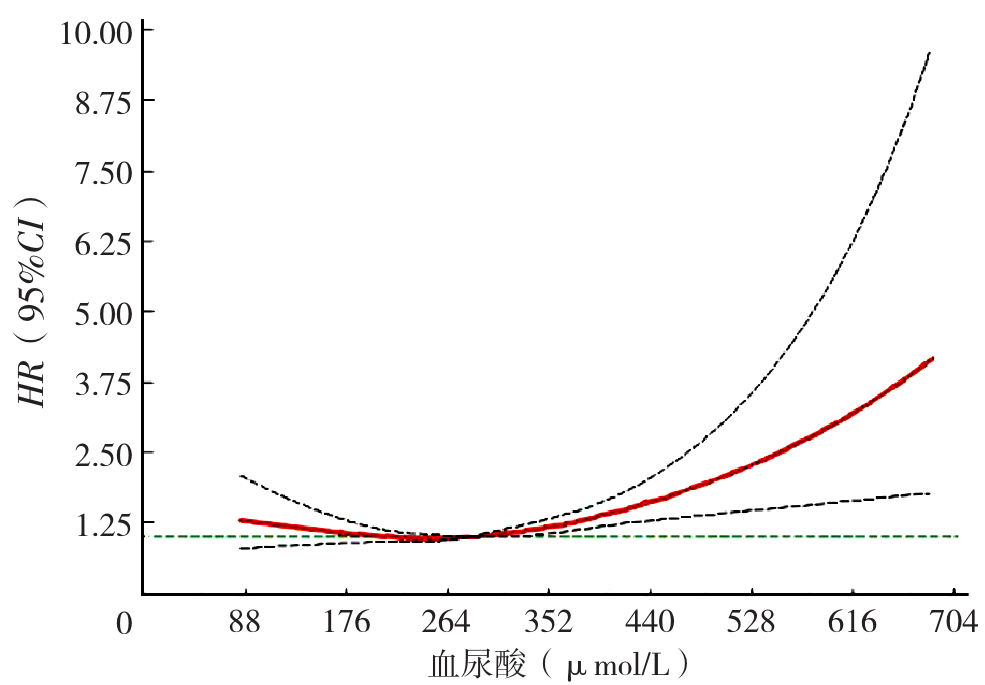
图2 SUA水平与新发房室传导阻滞风险的样条函数曲线
Figure 2 Restricted cubic splines for the associations of SUA levels with the risks of atrioventricular block
| [1] |
|
| [2] |
|
| [3] |
|
| [4] |
|
| [5] |
|
| [6] |
|
| [7] |
|
| [8] |
|
| [9] |
|
| [10] |
|
| [11] |
|
| [12] |
|
| [13] |
|
| [14] |
|
| [15] |
Corrigendum to: 2016 ESC Guidelines for the management of atrial fibrillation developed in collaboration with EACTS[J]. Eur Heart J, 2018, 39(13): 1109. DOI: 10.1093/eurheartj/ehx039.
|
| [16] |
|
| [17] |
|
| [18] |
|
| [19] |
|
| [20] |
|
| [21] |
|
| [22] |
|
| [23] |
|
| [24] |
|
| [25] |
|
| [26] |
|
| [27] |
|
| [28] |
|
| [29] |
|
| [30] |
|
| [31] |
|
| [1] | 柴智浩, 张维森, 罗娇玲, 朱峰, 朱彤, 靳雅丽, 潘静, 卢映君, 江朝强. 中老年人社会经济状况在少儿期父母文化与认知功能间的中介效应:基于广州生物库队列研究[J]. 中国全科医学, 2026, 29(21): 2959-2966. |
| [2] | 韩聪聪, 邱欣雨, 单春方, 宋宁, 陈清杰, 穆拉迪力·阿卜杜热合曼, 李晓梅, 杨毅宁, 赵倩. 代谢肥胖表型对急性冠脉综合征患者经皮冠状动脉介入治疗远期预后的影响研究[J]. 中国全科医学, 2026, 29(21): 2950-2958. |
| [3] | 刘帅, 苑世朝, 刘琰, 贾硕贤, 赵岩, 王紫怡, 周春华, 于静. 两性霉素B治疗侵袭性真菌病的疗效、安全性及经济性评价:一项回顾性队列研究[J]. 中国全科医学, 2026, 29(21): 2967-2974. |
| [4] | 热伊莱·麦麦提, 周燚然, 武云, 刘稹诚, 卢耀勤, 吴海燕. 高血压患者新型肥胖指标与心血管疾病发病风险的关联研究[J]. 中国全科医学, 2026, 29(20): 2836-2845. |
| [5] | 刘阳, 周国平, 李小石, 李萍, 张鑫. 急性呼吸窘迫综合征不同病因对驱动压预后评估价值的影响:一项前瞻性队列研究[J]. 中国全科医学, 2026, 29(19): 2638-2647. |
| [6] | 张馨文, 魏光成, 张解玉, 石金杰, 李晓旭, 马锐, 押玉珑, 彭九程, 曹炜. 睡眠特征与血清尿酸水平的因果效应:一项双向孟德尔随机化研究[J]. 中国全科医学, 2026, 29(17): 2354-2360. |
| [7] | 于超, 宋丽华, 王琳彦, 芦云平, 王林洋, 崔伟. 首发抑郁障碍患者7年后功能结局及影响因素研究[J]. 中国全科医学, 2026, 29(16): 2221-2226. |
| [8] | 邱欣雨, 赵倩, 陈玉斐, 加木勒·买买提依明, 韩聪聪, 爱克丹·艾尔肯, 李晓梅, 杨毅宁. 体重状态及其代谢特征对收缩压纵向轨迹的影响:一项队列研究[J]. 中国全科医学, 2026, 29(15): 2006-2013. |
| [9] | 吴志远, 王传旭, 杨枫, 张栩铭, 周嘉宝, 高建东. 矢志方在高尿酸血症尿酸转运相关蛋白中的作用机制研究[J]. 中国全科医学, 2026, 29(14): 1898-1910. |
| [10] | 邱艳丽, 高永银, 卞雪艳, 王雪, 李越. 脉搏波传导速度对癌症患者全因和心血管相关死亡率的预测价值研究[J]. 中国全科医学, 2026, 29(14): 1890-1897. |
| [11] | 刘翔, 陈红, 崔睿, 郭志超, 李盼盼, 曹子龙, 纪伊晴, 俞文雅. 特大城市儿童早期发展一致性与差异性:一项回顾性队列研究[J]. 中国全科医学, 2026, 29(11): 1411-1421. |
| [12] | 胡嘉琦, 李端, 方昊, 樊兴颖, 杜薇, 周涵妮. 基于体检人群队列的高尿酸血症非遗传因素风险预测模型构建研究[J]. 中国全科医学, 2026, 29(10): 1324-1333. |
| [13] | 李秋春, 苏萍, 逄锦宏, 陈巧巧, 赵颖颖, 何蕊言, 王玥, 陈学禹, 乔俊鹏, 迟蔚蔚. 三酰甘油-葡萄糖指数与心血管-肾脏-代谢综合征0~3期人群心血管疾病的关联性:一项前瞻性队列研究[J]. 中国全科医学, 2026, 29(09): 1129-1136. |
| [14] | 赵倩倩, 张梅, 李艳英, 张艳红, 晏文华, 潘慧, 班博. 生长激素缺乏症的临床特征与重组人生长激素疗效分析:一项十年纵向队列研究[J]. 中国全科医学, 2026, 29(06): 733-740. |
| [15] | 鹿妍秋, 吴云涛, 刘少鹏, 林海颖, 邓惠友, 武英, 黄喆, 杨鹏, 吴寿岭, 李云. 正常高值血压人群血压轨迹对心血管疾病发病风险的影响:基于开滦队列研究[J]. 中国全科医学, 2026, 29(03): 299-310. |
| 阅读次数 | ||||||
|
全文 |
|
|||||
|
摘要 |
|
|||||