
中国全科医学 ›› 2026, Vol. 29 ›› Issue (01): 122-128.DOI: 10.12114/j.issn.1007-9572.2024.0657
所属专题: 心血管最新文章合辑
的机卓玛1, 邹雁秋1, 郑迪心2, 胡梦婕1, 刘小雪1, 姜侠1,3, 樊萌语1,3,*( ), 李佳圆1,3
收稿日期:2025-02-13
修回日期:2025-07-02
出版日期:2026-01-05
发布日期:2025-12-18
通讯作者:
樊萌语
作者贡献:
的机卓玛负责数据整理、数据分析与论文撰写;邹雁秋、郑迪心、胡梦婕、刘小雪负责协助统计分析与结果解释;樊萌语负责研究的构思与设计、研究的实施、论文修订及经费支持,对文章整体负责;姜侠、李佳圆负责确定分析方案、论文修改及经费支持。
基金资助:
DIJI Zhuoma1, ZOU Yanqiu1, ZHENG Dixin2, HU Mengjie1, LIU Xiaoxue1, JIANG Xia1,3, FAN Mengyu1,3,*(), LI Jiayuan1,3
Received:2025-02-13
Revised:2025-07-02
Published:2026-01-05
Online:2025-12-18
Contact:
FAN Mengyu
摘要: 背景 心血管疾病是我国乃至全球居民死亡的主要原因,社交隔离和孤独与心血管健康密切相关。然而,目前的研究聚焦于欧洲人群,且研究结果并不一致。在中国人群中,尚未有充分证据同时探讨社交隔离和孤独感对心血管疾病发病风险的影响。 目的 探讨中国中老年人社交隔离和孤独与心血管疾病发病风险的独立和联合关联。 方法 本研究的开展时间为2024年8月,研究对象来自中国健康与养老追踪调查,剔除基线患有心脏疾病和卒中者,纳入10 668人进行分析。基于基线问卷信息定义社交隔离和孤独感,基于随访问卷的疾病相关数据定义心血管疾病发病,采用Cox比例风险回归模型进行统计分析。 结果 研究人群中位随访8.9年,随访期间新发心血管疾病2 409例(22.58%),心脏疾病1 777例(16.66%),卒中896例(8.40%)。Cox比例风险回归分析结果显示,调整了多种混杂因素后,与非孤独者相比,孤独者发生心血管疾病、心脏疾病、卒中的风险分别增加24%(HR=1.24,95%CI=1.13~1.35)、24%(HR=1.24,95%CI=1.12~1.38)和26%(HR=1.26,95%CI=1.09~1.45);与非社交隔离者相比,社交隔离者发生卒中的风险增加16%(HR=1.16,95%CI=1.01~1.33),社交隔离与心血管疾病、心脏疾病发病风险间未见统计学关联(P>0.05)。社交隔离和孤独与心血管疾病及其亚型的发病风险之间未见交互作用(P>0.05)。社交隔离且孤独者发生心血管疾病的风险最高(HR=1.23,95%CI=1.09~1.39),其中卒中的风险尤为显著(HR=1.49,95%CI=1.23~1.80)。 结论 主观感知的孤独是心血管疾病及其亚型发病的独立危险因素,与客观评估的社交隔离同时存在时心血管疾病发病风险最高。本研究结果提示鼓励中老年人群维持活跃的社交联系、打破孤独感对心血管健康具有重要作用。
| 特征 | 总体 | 社交隔离 | 孤独 | ||||||
|---|---|---|---|---|---|---|---|---|---|
| 非社交隔离(n=6 241) | 社交隔离(n=4 427) | χ2(t)值 | P值 | 非孤独(n=7 723) | 孤独(n=2 945) | χ2(t)值 | P值 | ||
| 年龄( | 59.7±9.3 | 59.1±8.9 | 60.5±9.7 | 7.658a | <0.001 | 59.3±9.2 | 60.7±9.5 | 6.768a | <0.001 |
| 性别[名(%)] | 55.760 | <0.001 | 90.892 | <0.001 | |||||
| 男 | 5 211(48.85) | 3 239(51.90) | 1 972(44.54) | 3 993(51.70) | 1 218(41.36) | ||||
| 女 | 5 457(51.15) | 3 002(48.10) | 2 455(55.46) | 3 730(48.30) | 1 727(58.64) | ||||
| 城乡[名(%)] | 40.832 | <0.001 | 87.030 | <0.001 | |||||
| 农村 | 6 850(64.21) | 3 851(61.70) | 2 999(67.74) | 4 752(61.53) | 2 098(71.24) | ||||
| 城镇 | 3 818(35.79) | 2 390(38.30) | 1 428(32.26) | 2 971(38.47) | 847(28.76) | ||||
| 教育程度[名(%)] | 175.656 | <0.001 | 139.563 | <0.001 | |||||
| 未正式上过学 | 5 122(48.01) | 2 659(42.61) | 2 463(55.64) | 3 435(44.48) | 1 687(57.28) | ||||
| 小学及以上 | 5 546(51.99) | 3 582(57.39) | 1 964(44.36) | 4 288(55.52) | 1 258(42.72) | ||||
| 医保[名(%)] | 17.281 | <0.001 | 4.342 | 0.037 | |||||
| 无 | 657(6.16) | 333(5.34) | 324(7.32) | 452(5.85) | 205(6.96) | ||||
| 有 | 10 011(93.84) | 5 908(94.66) | 4 103(92.68) | 7 271(94.15) | 2 740(93.04) | ||||
| 吸烟状况[名(%)] | 32.168 | <0.001 | 19.962 | <0.001 | |||||
| 吸烟 | 3 415(32.01) | 2 133(34.18) | 1 282(28.96) | 2 569(33.26) | 846(28.73) | ||||
| 戒烟/从不吸烟 | 7 253(67.99) | 4 108(65.82) | 3 145(71.04) | 5 154(66.74) | 2 099(71.27) | ||||
| 饮酒状况[名(%)] | 37.321 | <0.001 | 23.110 | <0.001 | |||||
| 喝酒 | 3 673(34.43) | 2 297(36.80) | 1 376(31.08) | 2 765(35.80) | 908(30.83) | ||||
| 不喝酒 | 6 995(65.57) | 3 944(63.20) | 3 051(68.92) | 4 958(64.20) | 2 037(69.17) | ||||
| BMI( | 23.3 ±3.9 | 23.6±4.0 | 22.9±3.8 | 9.381a | <0.001 | 23.4±3.9 | 23.0±4.0 | 5.225a | <0.001 |
| 高血压[名(%)] | 5.649 | 0.017 | 0.795 | 0.373 | |||||
| 有 | 2 270(21.28) | 1 378(22.08) | 892(20.15) | 1 626(21.05) | 644(21.87) | ||||
| 无 | 8 398(78.72) | 4 863(77.92) | 3 535(79.85) | 6 097(78.95) | 2 301(78.13) | ||||
| 糖尿病[名(%)] | 6.744 | 0.009 | 0.045 | 0.831 | |||||
| 有 | 505(4.73) | 324(5.19) | 181(4.09) | 363(4.70) | 142(4.82) | ||||
| 无 | 10 163(95.27) | 5 917(94.81) | 4 246(95.91) | 7 360(95.30) | 2 803(95.18) | ||||
| 血脂异常[名(%)] | 18.538 | <0.001 | 1.437 | 0.231 | |||||
| 有 | 756(7.09) | 499(8.00) | 257(5.81) | 562(7.28) | 194(6.59) | ||||
| 无 | 9 912(92.91) | 5 742(92.00) | 4 170(94.19) | 7 161(92.72) | 2 751(93.41) | ||||
| 其他慢性病[名(%)]b | 0.997 | 0.318 | 135.845 | <0.001 | |||||
| 有 | 5 603(52.52) | 3 252(52.11) | 2 351(53.11) | 3 787(49.04) | 1 816(61.66) | ||||
| 无 | 5 065(47.48) | 2 989(47.89) | 2 076(46.89) | 3 936(50.96) | 1 129(38.34) | ||||
| 降压治疗[名(%)] | 6.623 | 0.036 | 1.213 | 0.545 | |||||
| 有 | 601(5.63) | 363(5.82) | 238(5.38) | 424(5.49) | 177(6.01) | ||||
| 无 | 1 655(15.51) | 1 010(16.18) | 645(14.57) | 1 194(15.46) | 461(15.65) | ||||
| 不患高血压 | 8 412(78.85) | 4 868(78.00) | 3 544(80.05) | 6 105(79.05) | 2 307(78.34) | ||||
| 降糖治疗[名(%)] | 6.270 | 0.043 | 2.268 | 0.322 | |||||
| 有 | 152(1.42) | 97(1.55) | 55(1.24) | 102(1.32) | 50(1.70) | ||||
| 无 | 344(3.22) | 220(3.53) | 124(2.80) | 252(3.26) | 92(3.12) | ||||
| 不患糖尿病 | 10 172(95.35) | 5 924(94.92) | 4 248(95.96) | 7 369(95.42) | 2 803(95.18) | ||||
| 调脂治疗[名(%)] | 20.356 | <0.001 | 1.840 | 0.398 | |||||
| 有 | 353(3.31) | 238(3.81) | 115(2.60) | 264(3.42) | 89(3.02) | ||||
| 无 | 389(3.65) | 254(4.07) | 135(3.05) | 289(3.74) | 100(3.40) | ||||
| 不患血脂异常 | 9 926(93.04) | 5 749(92.12) | 4 177(94.35) | 7 170(92.84) | 2 756(93.58) | ||||
表1 不同社交隔离和孤独状态人群的基线特征比较
Table 1 Comparison of baseline characteristics of participants according to social isolation and loneliness status
| 特征 | 总体 | 社交隔离 | 孤独 | ||||||
|---|---|---|---|---|---|---|---|---|---|
| 非社交隔离(n=6 241) | 社交隔离(n=4 427) | χ2(t)值 | P值 | 非孤独(n=7 723) | 孤独(n=2 945) | χ2(t)值 | P值 | ||
| 年龄( | 59.7±9.3 | 59.1±8.9 | 60.5±9.7 | 7.658a | <0.001 | 59.3±9.2 | 60.7±9.5 | 6.768a | <0.001 |
| 性别[名(%)] | 55.760 | <0.001 | 90.892 | <0.001 | |||||
| 男 | 5 211(48.85) | 3 239(51.90) | 1 972(44.54) | 3 993(51.70) | 1 218(41.36) | ||||
| 女 | 5 457(51.15) | 3 002(48.10) | 2 455(55.46) | 3 730(48.30) | 1 727(58.64) | ||||
| 城乡[名(%)] | 40.832 | <0.001 | 87.030 | <0.001 | |||||
| 农村 | 6 850(64.21) | 3 851(61.70) | 2 999(67.74) | 4 752(61.53) | 2 098(71.24) | ||||
| 城镇 | 3 818(35.79) | 2 390(38.30) | 1 428(32.26) | 2 971(38.47) | 847(28.76) | ||||
| 教育程度[名(%)] | 175.656 | <0.001 | 139.563 | <0.001 | |||||
| 未正式上过学 | 5 122(48.01) | 2 659(42.61) | 2 463(55.64) | 3 435(44.48) | 1 687(57.28) | ||||
| 小学及以上 | 5 546(51.99) | 3 582(57.39) | 1 964(44.36) | 4 288(55.52) | 1 258(42.72) | ||||
| 医保[名(%)] | 17.281 | <0.001 | 4.342 | 0.037 | |||||
| 无 | 657(6.16) | 333(5.34) | 324(7.32) | 452(5.85) | 205(6.96) | ||||
| 有 | 10 011(93.84) | 5 908(94.66) | 4 103(92.68) | 7 271(94.15) | 2 740(93.04) | ||||
| 吸烟状况[名(%)] | 32.168 | <0.001 | 19.962 | <0.001 | |||||
| 吸烟 | 3 415(32.01) | 2 133(34.18) | 1 282(28.96) | 2 569(33.26) | 846(28.73) | ||||
| 戒烟/从不吸烟 | 7 253(67.99) | 4 108(65.82) | 3 145(71.04) | 5 154(66.74) | 2 099(71.27) | ||||
| 饮酒状况[名(%)] | 37.321 | <0.001 | 23.110 | <0.001 | |||||
| 喝酒 | 3 673(34.43) | 2 297(36.80) | 1 376(31.08) | 2 765(35.80) | 908(30.83) | ||||
| 不喝酒 | 6 995(65.57) | 3 944(63.20) | 3 051(68.92) | 4 958(64.20) | 2 037(69.17) | ||||
| BMI( | 23.3 ±3.9 | 23.6±4.0 | 22.9±3.8 | 9.381a | <0.001 | 23.4±3.9 | 23.0±4.0 | 5.225a | <0.001 |
| 高血压[名(%)] | 5.649 | 0.017 | 0.795 | 0.373 | |||||
| 有 | 2 270(21.28) | 1 378(22.08) | 892(20.15) | 1 626(21.05) | 644(21.87) | ||||
| 无 | 8 398(78.72) | 4 863(77.92) | 3 535(79.85) | 6 097(78.95) | 2 301(78.13) | ||||
| 糖尿病[名(%)] | 6.744 | 0.009 | 0.045 | 0.831 | |||||
| 有 | 505(4.73) | 324(5.19) | 181(4.09) | 363(4.70) | 142(4.82) | ||||
| 无 | 10 163(95.27) | 5 917(94.81) | 4 246(95.91) | 7 360(95.30) | 2 803(95.18) | ||||
| 血脂异常[名(%)] | 18.538 | <0.001 | 1.437 | 0.231 | |||||
| 有 | 756(7.09) | 499(8.00) | 257(5.81) | 562(7.28) | 194(6.59) | ||||
| 无 | 9 912(92.91) | 5 742(92.00) | 4 170(94.19) | 7 161(92.72) | 2 751(93.41) | ||||
| 其他慢性病[名(%)]b | 0.997 | 0.318 | 135.845 | <0.001 | |||||
| 有 | 5 603(52.52) | 3 252(52.11) | 2 351(53.11) | 3 787(49.04) | 1 816(61.66) | ||||
| 无 | 5 065(47.48) | 2 989(47.89) | 2 076(46.89) | 3 936(50.96) | 1 129(38.34) | ||||
| 降压治疗[名(%)] | 6.623 | 0.036 | 1.213 | 0.545 | |||||
| 有 | 601(5.63) | 363(5.82) | 238(5.38) | 424(5.49) | 177(6.01) | ||||
| 无 | 1 655(15.51) | 1 010(16.18) | 645(14.57) | 1 194(15.46) | 461(15.65) | ||||
| 不患高血压 | 8 412(78.85) | 4 868(78.00) | 3 544(80.05) | 6 105(79.05) | 2 307(78.34) | ||||
| 降糖治疗[名(%)] | 6.270 | 0.043 | 2.268 | 0.322 | |||||
| 有 | 152(1.42) | 97(1.55) | 55(1.24) | 102(1.32) | 50(1.70) | ||||
| 无 | 344(3.22) | 220(3.53) | 124(2.80) | 252(3.26) | 92(3.12) | ||||
| 不患糖尿病 | 10 172(95.35) | 5 924(94.92) | 4 248(95.96) | 7 369(95.42) | 2 803(95.18) | ||||
| 调脂治疗[名(%)] | 20.356 | <0.001 | 1.840 | 0.398 | |||||
| 有 | 353(3.31) | 238(3.81) | 115(2.60) | 264(3.42) | 89(3.02) | ||||
| 无 | 389(3.65) | 254(4.07) | 135(3.05) | 289(3.74) | 100(3.40) | ||||
| 不患血脂异常 | 9 926(93.04) | 5 749(92.12) | 4 177(94.35) | 7 170(92.84) | 2 756(93.58) | ||||
| 自变量 | 因变量 | 发病人数 | 发病密度(1/1 000人年) | 模型1 | 模型2 | 模型3 | |||
|---|---|---|---|---|---|---|---|---|---|
| HR(95%CI) | P值 | HR(95%CI) | P值 | HR(95%CI) | P值 | ||||
| 社交隔离 | 心血管疾病 | 986 | 29.6 | 0.94(0.87~1.02) | 0.159 | 0.98(0.90~1.06) | 0.642 | 0.99(0.91~1.09) | 0.772 |
| 心脏疾病 | 711 | 20.9 | 0.90(0.82~0.99) | 0.028 | 0.94(0.85~1.03) | 0.179 | 0.94(0.86~1.04) | 0.241 | |
| 卒中 | 395 | 11.1 | 1.11(0.97~1.27) | 0.125 | 1.16(1.01~1.32) | 0.032 | 1.16(1.01~1.33) | 0.030 | |
| 孤独 | 心血管疾病 | 753 | 34.5 | 1.19(1.09~1.30) | <0.001 | 1.24(1.13~1.35) | <0.001 | 1.24(1.13~1.35) | <0.001 |
| 心脏疾病 | 562 | 25.2 | 1.19(1.08~1.32) | 0.001 | 1.24(1.12~1.38) | <0.001 | 1.24(1.12~1.38) | <0.001 | |
| 卒中 | 287 | 12.2 | 1.25(1.08~1.44) | 0.002 | 1.28(1.11~1.48) | 0.001 | 1.26(1.09~1.45) | 0.002 | |
表2 中老年人群社交隔离和孤独与心血管疾病发病风险的Cox比例风险回归分析
Table 2 Cox regression analysis of the association between social isolation, loneliness and the risk of cardiovascular disease among middle-aged and older adults
| 自变量 | 因变量 | 发病人数 | 发病密度(1/1 000人年) | 模型1 | 模型2 | 模型3 | |||
|---|---|---|---|---|---|---|---|---|---|
| HR(95%CI) | P值 | HR(95%CI) | P值 | HR(95%CI) | P值 | ||||
| 社交隔离 | 心血管疾病 | 986 | 29.6 | 0.94(0.87~1.02) | 0.159 | 0.98(0.90~1.06) | 0.642 | 0.99(0.91~1.09) | 0.772 |
| 心脏疾病 | 711 | 20.9 | 0.90(0.82~0.99) | 0.028 | 0.94(0.85~1.03) | 0.179 | 0.94(0.86~1.04) | 0.241 | |
| 卒中 | 395 | 11.1 | 1.11(0.97~1.27) | 0.125 | 1.16(1.01~1.32) | 0.032 | 1.16(1.01~1.33) | 0.030 | |
| 孤独 | 心血管疾病 | 753 | 34.5 | 1.19(1.09~1.30) | <0.001 | 1.24(1.13~1.35) | <0.001 | 1.24(1.13~1.35) | <0.001 |
| 心脏疾病 | 562 | 25.2 | 1.19(1.08~1.32) | 0.001 | 1.24(1.12~1.38) | <0.001 | 1.24(1.12~1.38) | <0.001 | |
| 卒中 | 287 | 12.2 | 1.25(1.08~1.44) | 0.002 | 1.28(1.11~1.48) | 0.001 | 1.26(1.09~1.45) | 0.002 | |
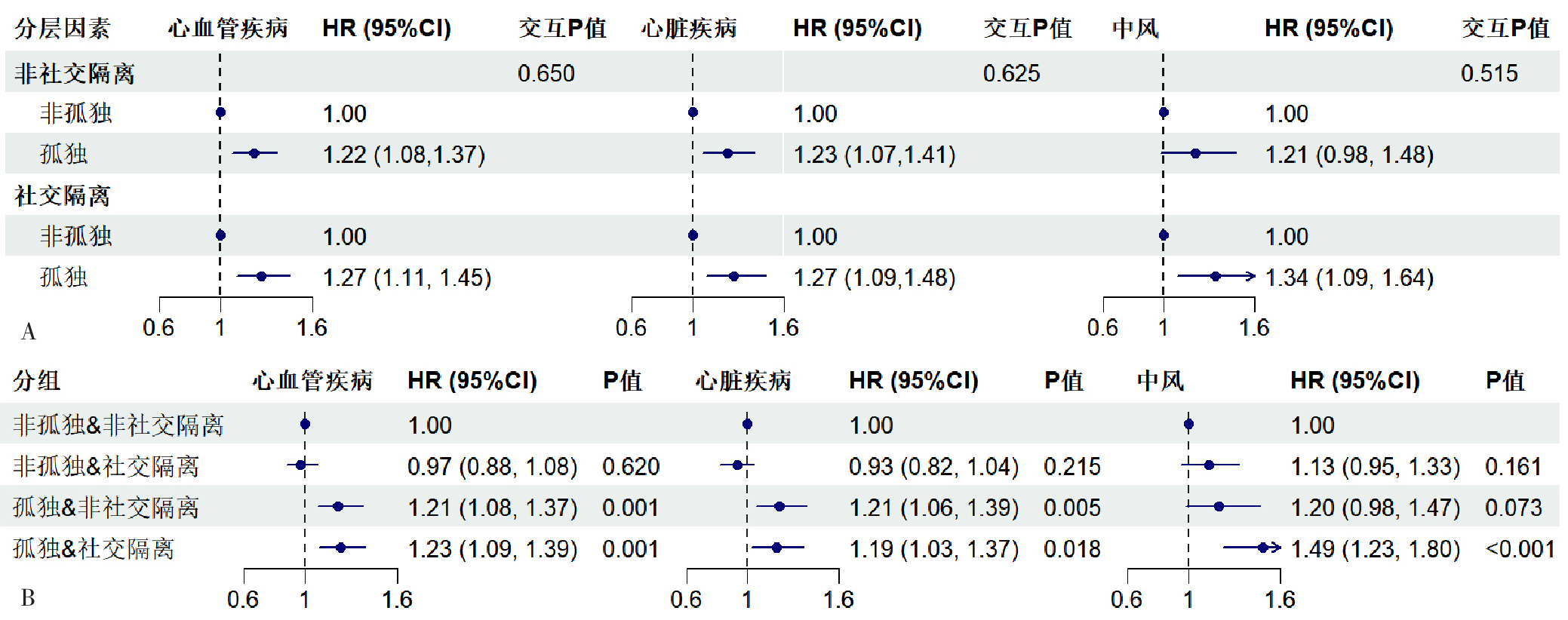
图1 社交隔离和孤独与心血管疾病及亚型发病风险的交互作用和联合作用注:图A为分层分析,图B为联合分析;模型3调整年龄、性别、教育程度、医保、吸烟状况、饮酒状况、BMI、高血压、糖尿病、血脂异常、降压治疗、降糖治疗、调脂治疗。
Figure 1 Interaction and joint effects of social isolation and loneliness on the risk of cardiovascular disease and its subtypes
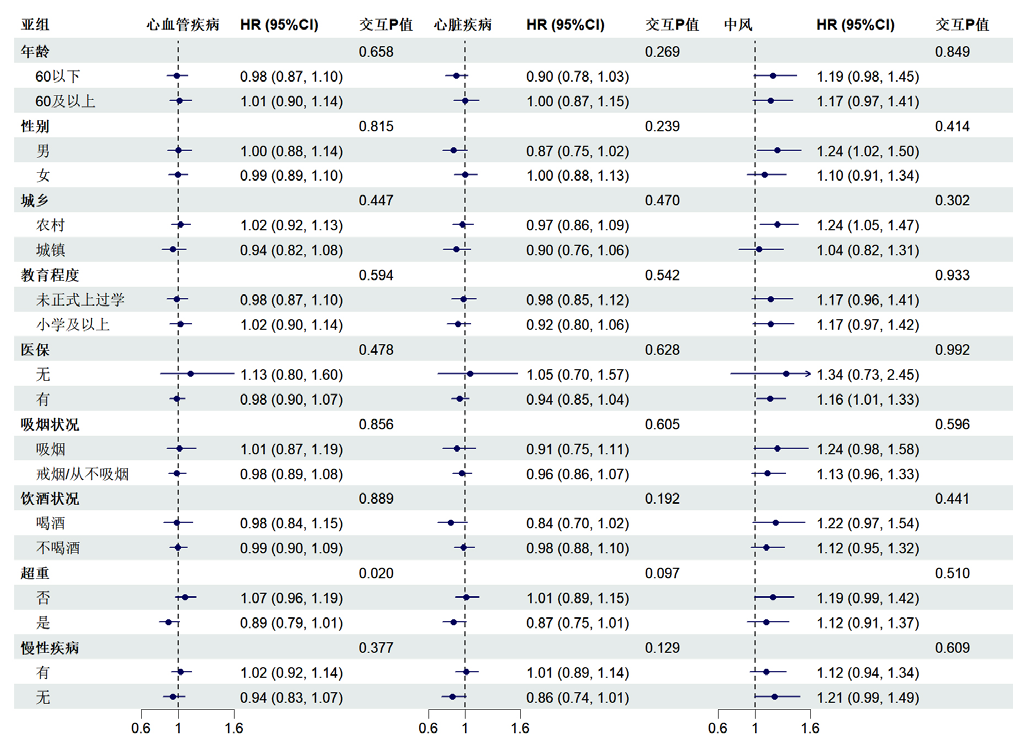
图2 社交隔离与心血管疾病及亚型发病风险关联的亚组分析注:模型3调整年龄、性别、教育程度、医保、吸烟状况、饮酒状况、BMI、高血压、糖尿病、血脂异常、降压治疗、降糖治疗、调脂治疗、孤独。
Figure 2 Subgroup analysis of the association between social isolation and the risk of cardiovascular disease and its subtypes
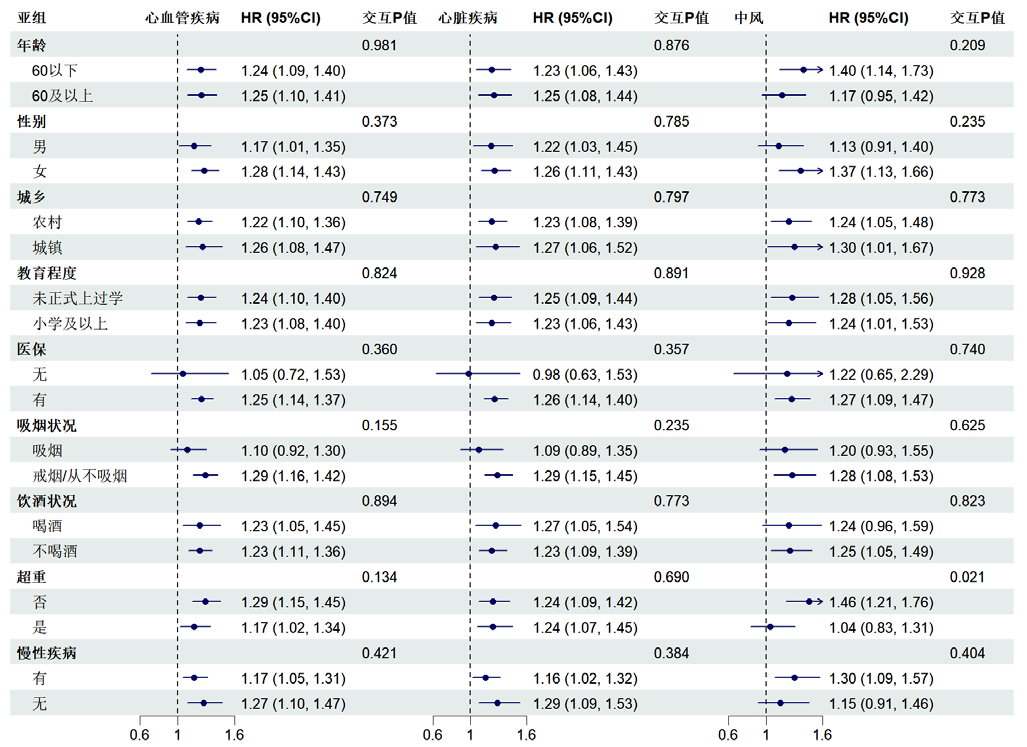
图3 孤独与心血管疾病及亚型发病风险关联的亚组分析注:模型3调整年龄、性别、教育程度、医保、吸烟状况、饮酒状况、BMI、高血压、糖尿病、血脂异常、降压治疗、降糖治疗、调脂治疗、社交隔离。
Figure 3 Subgroup analysis of the association between loneliness and the risk of cardiovascular disease and its subtypes
| [1] |
2021 Causes of Death Collaborators GBD. Global burden of 288 causes of death and life expectancy decomposition in 204 countries and territories and 811 subnational locations, 1990-2021: a systematic analysis for the Global Burden of Disease Study 2021[J]. Lancet, 2024, 403(10440): 2100-2132. DOI: 10.1016/S0140-6736(24)00367-2.
|
| [2] |
|
| [3] |
|
| [4] |
左淑芳,王紫玉,叶翠,等. 中国老年人孤独感流行率的系统评价和Meta分析[J]. 军事护理, 2024, 41(9): 1-7.
|
| [5] |
|
| [6] |
|
| [7] |
|
| [8] |
|
| [9] |
|
| [10] |
|
| [11] |
|
| [12] |
|
| [13] |
|
| [14] |
|
| [15] |
|
| [16] |
|
| [17] |
|
| [18] |
|
| [19] |
|
| [20] |
周鼒,马佳平,郝世超,等. 中老年人社会隔离与脑卒中发病的关系[J]. 中国老年学杂志, 2016, 36(12): 3027-3029. DOI: 10.3969/j.issn.1005-9202.2016.12.096.
|
| [21] |
|
| [22] |
北京大学国家发展研究院. 中国健康与养老追踪调查第五轮(2020)用户手册[EB/OL]. (2023-11-06) [2024-11-23].
|
| [23] |
|
| [24] |
|
| [25] |
|
| [26] |
|
| [27] |
|
| [28] |
|
| [29] |
|
| [30] |
|
| [31] |
|
| [32] |
|
| [33] |
|
| [34] |
|
| [1] | 鹿妍秋, 吴云涛, 刘少鹏, 林海颖, 邓惠友, 武英, 黄喆, 杨鹏, 吴寿岭, 李云. 正常高值血压人群血压轨迹对心血管疾病发病风险的影响:基于开滦队列研究[J]. 中国全科医学, 2026, 29(03): 299-310. |
| [2] | 范转转, 李文婷, 马国亮. 绝经后女性内脏脂肪指数与心血管疾病的关联性分析:前瞻性队列研究[J]. 中国全科医学, 2026, 29(02): 180-187. |
| [3] | 张姝, 程钰, 吴寿岭, 陈朔华, 吴云涛. 非糖尿病人群累积血浆致动脉粥样硬化指数暴露对新发心血管疾病影响的队列研究[J]. 中国全科医学, 2025, 28(36): 4558-4565. |
| [4] | 刘瑞越, 杨雪梅, 赵乃慧, 温薪冉, 蔡汐, 梁雅靖, 马佳佳, 吴寿岭, 崔刘福. 不同年龄段超敏C反应蛋白与白蛋白比值对新发心血管疾病的影响:一项队列研究[J]. 中国全科医学, 2025, 28(36): 4566-4577. |
| [5] | 张颖, 廖晓阳, 杨寒飞, 余泳君, 刘力滴, 贾禹, 沈灿, 李霄, 黄传应, 杨荣. 2024年《国际高血压学会立场文件:血压测量与报告技术创新》解读及对中国的启示[J]. 中国全科医学, 2025, 28(36): 4541-4549. |
| [6] | 曾明慧, 蒯文涛, 陈林, 韩家鑫, 徐连欣, 葛立颖, 代容容, 宓余强, 徐亮. 2型糖尿病对核苷(酸)类似物治疗慢性乙型肝炎效果的影响研究[J]. 中国全科医学, 2025, 28(35): 4414-4420. |
| [7] | 赵倬, 王贺. 缺氧诱导因子2α在心血管系统疾病中的作用机制研究进展[J]. 中国全科医学, 2025, 28(33): 4241-4248. |
| [8] | 王碧优, 高鹰, 尤俊方, 刘莉, 张卿, 苏海燕. 心血管疾病风险人群脂质比值与炎症指标的典型相关性研究[J]. 中国全科医学, 2025, 28(33): 4132-4139. |
| [9] | 顾建辉, 景玉珍, 路军锋, 杨丽娜, 魏清琳, 贾永男. 揿针联合维生素D对孤独症谱系障碍儿童行为及胃肠道症状的临床研究[J]. 中国全科医学, 2025, 28(33): 4180-4186. |
| [10] | 陈慧龙, 廖芸楚, 刘育伟, 孔政辉, 黄兴辉, 徐嘉辉, 漆娜, 王远平, 梁文坚. 相对脂肪量与中老年人群心血管疾病之间的关联:一项基于CHARLS的横断面与纵向研究[J]. 中国全科医学, 2025, 28(32): 4047-4054. |
| [11] | 刘明波, 何新叶, 杨晓红, 王增武. 《中国心血管健康与疾病报告2024》要点解读[J]. 中国全科医学, 2025, 28(32): 3989-4008. |
| [12] | 廖姣姣, 王照宇, 李兆基, 赵威, 詹思延, 王鹏, 陶立元. 非高密度脂蛋白胆固醇动态变化对颈动脉内中膜增厚的预测价值:一项双向性队列研究[J]. 中国全科医学, 2025, 28(31): 3932-3941. |
| [13] | 张骥, 周婕, 李凌, 吴延莉, 吉维, 刘涛. 空腹血糖水平与全因死亡和特定原因死亡风险的前瞻性队列研究[J]. 中国全科医学, 2025, 28(31): 3924-3931. |
| [14] | 苏晴, 徐曜, 李一航, 汪丽燕, 蔡业峰, 倪小佳. 脑卒中及其风险人群中医证候演变规律研究的方法学质量评价[J]. 中国全科医学, 2025, 28(29): 3694-3702. |
| [15] | 邓洁, 齐祺, 吴欣雨, 韩全乐, 李雷, 蒋越, 郁静, 吴若洁, 吴寿岭, 李康博. 血浆致动脉硬化指数与体检人群新发心力衰竭风险的队列研究[J]. 中国全科医学, 2025, 28(29): 3645-3652. |
| 阅读次数 | ||||||
|
全文 |
|
|||||
|
摘要 |
|
|||||