中国全科医学 ›› 2026, Vol. 29 ›› Issue (35): 5259-5265.DOI: 10.12114/j.issn.1007-9572.2024.0393

• 论著 • 上一篇    下一篇

捏脊法通过调节脑源性神经营养因子改善未成年哮喘大鼠学习记忆能力的机制研究

朱延1,2, 熊英2,*()   

  1. 1.223800 江苏省宿迁市,宿迁市中医院
    2.210023 江苏省南京市,南京中医药大学针灸推拿学院·养生康复学院
  • 收稿日期:2024-07-18 修回日期:2025-09-06 出版日期:2026-12-15 发布日期:2026-10-26
  • 通讯作者: 熊英

  • 作者贡献:

    熊英提出主要研究目标,负责研究的构思与设计,论文的修订,对文章整体负责,监督管理。朱延负责研究的实施,撰写论文,数据的收集与整理,统计学处理,图、表的绘制与展示。

  • 基金资助:
    国家自然科学基金资助项目(81973970); 宿迁市科技计划资助项目(K202401); 宿迁市中医院青年托举项目(QNTJ202401)

Mechanisms of Spine-pinching Therapy Improving Learning and Memory in Juvenile Asthmatic Rats via Modulation of Brain-derived Neurotrophic Factor

ZHU Yan1,2, XIONG Ying2,*()   

  1. 1. Suqian Hospital of Traditional Chinese Medicine, Suqian 223800, China
    2. School of Acupuncture-Moxibustion and Tuina, School of Health Preservation and Rehabilitation, Nanjing University of Chinese Medicine, Nanjing 210023, China
  • Received:2024-07-18 Revised:2025-09-06 Published:2026-12-15 Online:2026-10-26
  • Contact: XIONG Ying

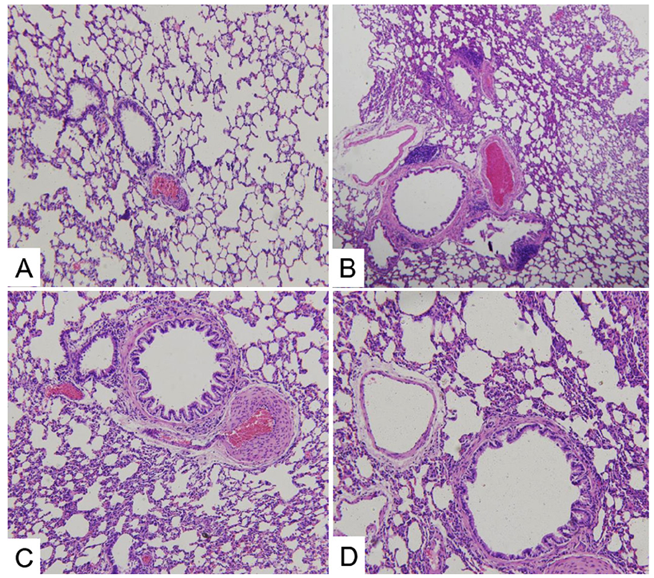
摘要: 背景 哮喘是儿童常见的慢性疾病,不仅可引起反复发作的气道炎症,还可导致认知功能下降和学习记忆能力减退。捏脊法作为一种传统中医疗法,在改善哮喘症状和提高机体免疫功能方面展现出潜在的疗效,但其在调节学习记忆能力方面的机制尚不完全清楚。 目的 探讨捏脊法改善未成年哮喘大鼠气道炎症及调节脑源性神经营养因子(BDNF)改善学习记忆能力的作用机制。 方法 于2020年10—12月选取3~4周龄雄性SPF级SD大鼠40只,将大鼠分为对照组(n=6)、哮喘模型组(n=7)、捏脊干预组(n=7)和甲基泼尼松龙组(n=7)。采用卵清蛋白(OVA)致敏和激发法建立未成年大鼠哮喘模型,分别以捏脊法和甲基泼尼松龙腹腔注射对哮喘造模过程进行干预,通过水迷宫检测大鼠学习记忆能力;全身容积描记法检测增强呼吸间歇(Penh)值评估大鼠气道高反应;采用HE染色观察肺组织病理变化;采用ELISA检测血浆IgE和肺泡灌洗液(BALF)中干扰素γ(IFN-γ)、白介素4(IL-4)、肿瘤坏死因子α(TNF-α)水平;采用免疫组化检测海马组织中BDNF的表达。 结果 哮喘模型组大鼠Penh值、气道炎症评分、IgE、IL-4、TNF-α和IFN-γ水平均高于对照组,海马组织中BDNF水平低于对照组,第4天定位航行潜伏期长于对照组(P<0.05);捏脊干预组和甲基泼尼松龙组大鼠Penh值、气道炎症评分、IL-4、TNF-α水平均低于哮喘模型组(P<0.05);捏脊干预组第1、4天定位航行潜伏期均短于哮喘模型组和甲基泼尼松龙组(P<0.05)。 结论 捏脊疗法可通过减轻炎症反应、提高哮喘大鼠海马区BDNF的表达改善大鼠学习记忆能力,在哮喘的治疗及认知功能恢复方面具有潜在的应用价值。

关键词: 哮喘, 捏脊法, 学习记忆, 脑源性神经营养因子, 气道炎症

Abstract:

Background

Asthma is a common chronic disease in children that can cause recurrent airway inflammation and lead to cognitive dysfunction and memory impairment. Chiropractic therapy, a traditional Chinese medicine treatment, has shown potential therapeutic effects in improving asthma symptoms and enhancing immune function, but its mechanism in regulating learning and memory abilities is not fully understood.

Objective

To explore the mechanism of chiropractic spinal therapy improving airway inflammation in adolescent asthmatic rats and regulates brain-derived neurotrophic factor (BDNF) to improve learning and memory abilities.

Methods

From October to December 2020, 40 male SPF-grade SD rats aged 3-4 weeks were selected as research subjects and randomly divided into control group (n=6), asthma model group (n=7), chiropractic therapy intervention group (n=7), and methylprednisolone group (n=7). An adolescent asthma rat model was established using ovalbumin (OVA) sensitization and challenge, and the asthma modeling process was intervened with chiropractic therapy and methylprednisolone intraperitoneal injection. Learning and memory abilities of the rats were assessed using the water maze test; Airway hyperresponsivenesse was evaluated by measuring enhanced pause (Penh) values via whole-body plethysmography; Pathological changes in lung tissue were observed with HE staining; Levels of plasma IgE and interferon-γ (IFN-γ), interleukin-4 (IL-4), and tumor necrosis factor-α (TNF-α) in bronchoalveolar lavage fluid (BALF) were detected by enzyme-linked immunosorbent assay (ELISA); Immunohistochemistry was used to detect BDNF expression in the hippocampal tissue.

Results

The asthma model group rats had higher Penh values, airway inflammation scores, IgE, IL-4, TNF-α levels, lower hippocampal BDNF expression and a longer escape latency on day 4 than the control group (P<0.05); The chiropractic therapy intervention group and the methylprednisolone group rats had lower Penh values, airway inflammation scores, IL-4, and TNF-α levels compared to the asthma model group (P<0.05); On day 1 and 4, escape latency was shorter in the chiropractic therapy intervention group than in the asthma model and methylprednisolone groups (P<0.05).

Conclusion

Chiropractic spinal therapy can improve learning and memory abilities in asthmatic rats by reducing inflammatory responses and increasing the expression of BDNF in the hippocampus, showing potential application value in the treatment of asthma and the recovery of cognitive functions.

Key words: Asthma, Chiropractic spinal therapy, Learning and memory, Brain-derived neurotrophic factor, Airway inflammation

中图分类号: