
中国全科医学 ›› 2027, Vol. 30 ›› Issue (03): 462-472.DOI: 10.12114/j.issn.1007-9572.2025.0494
• 综述与专论 • 上一篇
贾沛霖1, 姚兆旭1, 李亚1, 王龙雨1, 张海龙1,2,*( )
收稿日期:2025-11-15
修回日期:2026-03-14
出版日期:2027-01-20
发布日期:2026-11-26
通讯作者:
张海龙
作者贡献:
贾沛霖负责文章的构思与设计、研究资料的收集与整理、论文撰写;姚兆旭、李亚、王龙雨负责文章的构思与设计、论文修订;张海龙负责文章的构思与设计、论文修订、文章的质量控制及审校。
基金资助:
JIA Peilin1, YAO Zhaoxu1, LI Ya1, WANG Longyu1, ZHANG Hailong1,2,*()
Received:2025-11-15
Revised:2026-03-14
Published:2027-01-20
Online:2026-11-26
Contact:
ZHANG Hailong
摘要: 慢性阻塞性肺疾病(简称慢阻肺病)是一种常见的慢性呼吸系统疾病,主要表现为持续的气流受限和慢性气道炎症。慢阻肺病的发病机制复杂,炎症反应是其发生、进展及急性加重的核心因素。传统药物治疗(如支气管舒张剂和吸入性糖皮质激素)可缓解部分症状,但无法有效控制部分患者的病情进展与急性加重,亟需新的治疗策略。本文系统介绍了慢阻肺病的炎症机制,并总结了靶向治疗的研究进展,重点评述了针对特定炎症通路的生物制剂在慢阻肺病治疗中的临床应用与挑战。以度普利尤单抗为代表的生物制剂在2型炎症表型中获益显著,但对于非2型炎症的治疗仍面临挑战。未来研究应聚焦炎症亚型的精准识别与分型,开发新型靶向药物及联合治疗策略,以推动慢阻肺病的个体化精准防治。
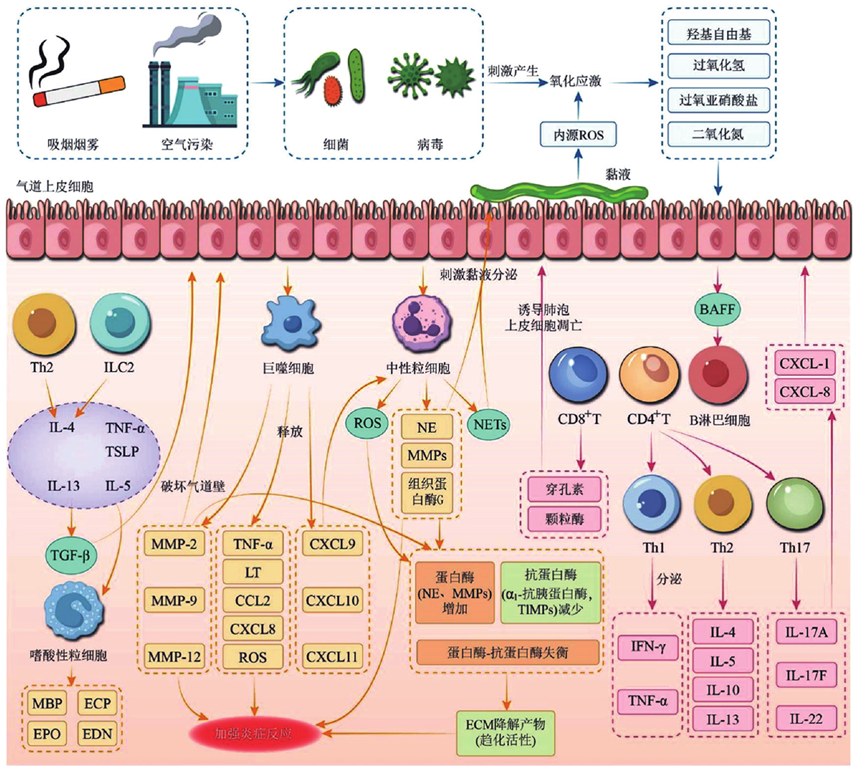
图1 慢性阻塞性肺疾病炎症机制注:Th=辅助性T淋巴细胞,ILC2=2型固有淋巴细胞,IL=白介素,TSLP=胸腺基质淋巴细胞生成素,TNF-α=肿瘤坏死因子α,TGF-β=转化生长因子β,MMPs=基质金属蛋白酶,LT=白三烯,CCL2=单核细胞趋化蛋白-1,CXCL=CXC基序趋化因子配体,ROS=活性氧,NE=中性粒细胞弹性蛋白酶,NETs=中性粒细胞细胞外陷阱,IFN-γ=干扰素-γ,CD8+T=细胞毒性T淋巴细胞,CD4+T=辅助性T淋巴细胞,BAFF=B淋巴细胞活化因子,TIMPs=金属蛋白酶组织抑制剂,MBP=主要碱性蛋白,ECP=嗜酸性粒细胞阳离子蛋白,EPO=嗜酸性粒细胞过氧化物酶,EDN=嗜酸性粒细胞源性神经毒素,ECM=细胞外基质。
Figure 1 Inflammatory mechanisms of chronic obstructive pulmonary disease
| 靶点 | 药物 | 研究设计 | 研究人群 | 结局 | 临床试验注册号 |
|---|---|---|---|---|---|
| IL-4R | 度普利尤单抗 | Ⅲ期、多中心、随机、双盲、安慰剂对照试验(样本量:939) | 吸烟或有吸烟史;慢性支气管炎,中度至重度COPD;血EOS≥300/μL;MRC ≥2;≥2次中度或≥1次重度急性加重;使用三联治疗 | 显著降低中/重度COPD急性加重年发生率;显著改善FEV1、SGRQ评分 | BO R EAS(NCT03930732) |
| Ⅲ期、多中心、随机、双盲、安慰剂对照试验(样本量:935) | 吸烟或有吸烟史;慢性支气管炎,中度至重度COPD;血EOS≥300/μL;MRC ≥2;≥2次中度或≥1次重度急性加重;使用三联治疗 | 显著降低中/重度COPD急性加重年发生率;FEV1显著改善 | NOTUS (NCT04456673) | ||
| IL-5 | 美泊利珠单抗 | Ⅲ期、多中心、随机、双盲、安慰剂对照、平行组试验(样本量:836) | FEV1:20%~80%;≥2次中度或1次重度急性加重;EOS≥150/μL或前1年≥300/μL;使用三联治疗 | 仅EOS表型患者急性加重年发生率显著降低,总体人群急性加重年发生率无显著差异 | METREX(NCT02105948) |
| Ⅲ期、多中心、随机、双盲、安慰剂对照、平行组试验(样本量:674) | FEV1:20%~80%;1年内≥2次中度或1次重度急性加重;EOS≥150/μL或前1年≥300/μL;使用三联治疗 | 急性加重年发生率无显著差异 | METREO(NCT02105961) | ||
| Ⅲ期、多中心、随机、双盲、安慰剂对照、平行组试验(样本量:806) | 吸烟或有吸烟史;FEV1:20%~80%;≥2次中度或1次重度急性加重;EOS≥300/μL;使用三联治疗 | 显著降低中度/重度急性加重年发生率;其他临床结果无显著差异 | MATINEE(NCT04133909) | ||
| Ⅱb期、单中心、随机、双盲、安慰剂对照试验(样本量:238) | MRC≥2;吸烟或有吸烟史;急性加重需住院治疗;EOS≥300/μL;入院前使用皮质类固醇 | 未显著降低再入院或死亡风险 | COPD-HELP(NCT04075331) | ||
| IL-5R | 本瑞利珠单抗 | Ⅱa期、多中心、随机、双盲、安慰剂对照试验(样本量:101) | 吸烟或有吸烟史;≥1次中度或重度急性加重;前一年内痰EOS≥3% | 未显著降低急性加重年发生率 | NCT01227278 |
| Ⅲ期、多中心、随机、双盲、安慰剂对照、平行组试验(样本量:1 656) | 吸烟或有吸烟史;mMRC≥1;FEV1:20%~65%;中度至极重度COPD;≥2次中度或≥1次重度急性加重;使用二联或三联治疗;EOS>220 /μL | 未显著降低急性加重年发生率 | GALATHEA(NCT02138916) | ||
| Ⅲ期、多中心、随机、双盲、安慰剂对照、平行组试验(样本量:2 254) | 吸烟或有吸烟史;mMRC≥1;FEV1:20%~65%;中度至极重度COPD;≥2次中度或≥1次重度急性加重;使用二联或三联治疗;EOS>220/μL | 未显著降低急性加重年发生率 | TERRANOVA(NCT02155660) | ||
| Ⅲ期、多中心、随机、双盲、安慰剂对照、平行组试验(样本量:689) | 吸烟或有吸烟史;中度至极重度COPD;FEV1≤65%;≥2次需全身性皮质类固醇治疗和/或住院治疗的急性加重史;使用三联疗法;血EOS≥300/μL;CAT总分≥15分 | 未显著降低中重度急性加重年发生率 | RESOLUTE(NCT04053634) | ||
| IL-13 | 来瑞组单抗 | Ⅱ期、多中心、随机、双盲、安慰剂对照试验(样本量:309) | 吸烟或有吸烟史;≥1次需全身性皮质类固醇治疗和/或抗生素治疗和/或住院治疗的急性加重史;使用皮质类固醇和支气管扩张药物 | 未显著改善FEV1 | NCT02546700 |
| TSLP | 特泽利尤单抗 | Ⅱa期、多中心、随机、双盲、安慰剂对照试验(样本量:337) | 吸烟或有吸烟史;FEV1:20%~80%;≥2次中度或重度急性加重;CAT总分≥15分;使用三联治疗 | 未显著降低急性加重年发生率 | COURSE(NCT04039113) |
| IL-33 | 依特吉单抗 | Ⅱa期、多中心、随机、双盲、安慰剂对照试验(样本量:343) | 吸烟或有吸烟史;CAT总分≥10分;FEV1:30%~70%;≥2次中度或1次重度急性加重 | 未显著降低总体人群及吸烟者亚组急性加重年发生率;显著降低戒烟者亚组中中度或重度急性加重年发生率并显著改善FEV1 | NCT03546907 |
| Ⅲ期、多中心、随机、双盲、安慰剂对照、平行组试验(样本量:1 127) | 既往吸烟者;中度至重度COPD;≥2次中度或≥1次重度急性加重;使用二联或三联治疗 | 显著降低既往吸烟者急性加重年发生率 | AERIFY-1(NCT04701983) | ||
| Ⅲ期、多中心、随机、双盲、安慰剂对照、平行组试验(样本量:1 239) | 既往吸烟者或当前吸烟者;中度至重度COPD;≥2次中度或≥1次重度急性加重;使用二联或三联治疗 | 未显著降低急性加重年发生率 | AERIFY-2(NCT04751487) | ||
| 托雷奇单抗 | Ⅰ期、随机、双盲、安慰剂对照试验(样本量:88) | 第一组:轻度特应性病史;健康参与者;第二组:COPD病史;FEV1≥50%;8周内没有急性加重;第三组:健康参与者 | 安全性与耐受性总体良好;药代动力学特征呈线性且可控 | NCT03096795 | |
| Ⅱ期、多中心、随机、双盲、安慰剂对照、平行组试验(样本量:135) | 吸烟或有吸烟史;FEV1:20%~80%;慢性支气管炎病史;咳嗽和痰液BCSS评分≥2分;≥1次中度或重度急性加重;使用二联或三联治疗 | 未显著改善FEV1,未显著降低急性加重风险 | FRONTIER-4(NCT04631016) | ||
| ST-2 | 艾特利单抗 | Ⅱa期、单中心、随机、双盲、安慰剂对照、平行组试验(样本量:81) | 吸烟或有吸烟史;mMRC≥2;FEV1< 70%;过去1年内≥2次中度至重度COPD急性加重 | 未显著降低急性加重年发生率,改善生活质量 | COPD-ST2OP(NCT03615040) |
| Ⅱb期、多中心、随机、双盲、安慰剂对照试验(样本量:1 334) | 吸烟或有吸烟史;FEV1:20%~80%;12个月内≥2次中度或重度急性加重;mMRC≥2;使用二联或三联治疗 | 显著降低年化急性加重率 | ALIENTO(NCT05037929) | ||
| Ⅲ期、多中心、随机、双盲、安慰剂对照试验(样本量:预计1290) | 吸烟或有吸烟史;FEV1:20%~80%;12个月内≥2次中度或重度急性加重;mMRC≥2;使用二联或三联治疗 | 未显著降低年化急性加重率(顶线结果) | ARNASA(NCT05595642) | ||
| TNF-α | 英夫利昔单抗 | Ⅱ期、单中心、随机、双盲、安慰剂对照、平行组、剂量探索试验(样本量:22) | 吸烟;轻至中度COPD;过去1个月内无中度或重度急性加重 | 未显著改善肺功能、静息能量消耗和生活质量 | |
| Ⅱ期、多中心、随机、双盲、安慰剂对照、平行组、剂量探索试验(样本量:234) | 中度或重度COPD;过去1个月内无中度或重度急性加重 | 未显著改善慢性呼吸问卷总分、肺功能、6分钟步行距离、SF-36评分、呼吸困难指数和中度至重度COPD急性加重率 | NCT00056264 | ||
| 依那西普 | Ⅱ/Ⅲ期、随机、双盲、安慰剂对照试验(样本量:81) | 吸烟或有吸烟史;处于COPD急性加重期 | 未显著改善肺功能、呼吸困难症状和生活质量 | NCT00789997 | |
| IL-17 | CNTO6785 | Ⅱ期、多中心、随机、双盲、安慰剂对照试验(样本量:187) | 吸烟或有吸烟史;中度至重度COPD伴慢性支气管炎;过去2年内≥2次急性加重或筛查期间有咳痰症状 | 未显著改善肺功能 | NCT01966549 |
| IL-1R1 | MEDI8968 | Ⅱ期、多中心、随机、双盲、安慰剂对照试验(样本量:464) | 吸烟或有吸烟史;筛选时处于GOLD Ⅱ、Ⅲ或Ⅳ期;12月内有COPD急性加重史;筛选前8周内无COPD急性加重 | 未显著改善急性加重发生率、肺功能和生活质量 | NCT01448850 |
| IL-1β | 卡那单抗(ACZ885) | Ⅰ/Ⅱ期、多中心、随机、双盲、安慰剂对照试验(样本量:147) | 吸烟或有吸烟史;FEV1≤50%;筛选前24个月内≥1次急性加重史或C反应蛋白≥3.47 mg/L | 未显著改善肺功能 | NCT00581945 |
| IL-8 | ABX-IL-8 | Ⅱ期、多中心、随机、双盲、安慰剂对照、平行组试验(样本量:109) | 吸烟或有吸烟史;COPD稳定期;慢性支气管炎 | 部分时间点呼吸困难评分改善 | NCT00035828 |
| CXCR2 | MK-7123 | Ⅱ期、随机、双盲、安慰剂对照、平行组试验(样本量:616) | 吸烟或有吸烟史;COPD病史≥2年;6周内没有急性加重或呼吸道感染 | 仅50 mg组显著改善肺功能 | NCT01006616 |
| AZD5069 | Ⅱa期、多中心、随机、双盲、安慰剂对照、平行组试验(样本量:87) | 吸烟或有吸烟史;COPD病史≥1年;6周内没有急性加重或呼吸道感染;FEV1:30%~80% | 短期耐受性和安全性良好 | NCT01233232 |
表1 慢阻肺病靶向生物制剂相关试验
Table 1 Clinical trials of targeted drugs for COPD
| 靶点 | 药物 | 研究设计 | 研究人群 | 结局 | 临床试验注册号 |
|---|---|---|---|---|---|
| IL-4R | 度普利尤单抗 | Ⅲ期、多中心、随机、双盲、安慰剂对照试验(样本量:939) | 吸烟或有吸烟史;慢性支气管炎,中度至重度COPD;血EOS≥300/μL;MRC ≥2;≥2次中度或≥1次重度急性加重;使用三联治疗 | 显著降低中/重度COPD急性加重年发生率;显著改善FEV1、SGRQ评分 | BO R EAS(NCT03930732) |
| Ⅲ期、多中心、随机、双盲、安慰剂对照试验(样本量:935) | 吸烟或有吸烟史;慢性支气管炎,中度至重度COPD;血EOS≥300/μL;MRC ≥2;≥2次中度或≥1次重度急性加重;使用三联治疗 | 显著降低中/重度COPD急性加重年发生率;FEV1显著改善 | NOTUS (NCT04456673) | ||
| IL-5 | 美泊利珠单抗 | Ⅲ期、多中心、随机、双盲、安慰剂对照、平行组试验(样本量:836) | FEV1:20%~80%;≥2次中度或1次重度急性加重;EOS≥150/μL或前1年≥300/μL;使用三联治疗 | 仅EOS表型患者急性加重年发生率显著降低,总体人群急性加重年发生率无显著差异 | METREX(NCT02105948) |
| Ⅲ期、多中心、随机、双盲、安慰剂对照、平行组试验(样本量:674) | FEV1:20%~80%;1年内≥2次中度或1次重度急性加重;EOS≥150/μL或前1年≥300/μL;使用三联治疗 | 急性加重年发生率无显著差异 | METREO(NCT02105961) | ||
| Ⅲ期、多中心、随机、双盲、安慰剂对照、平行组试验(样本量:806) | 吸烟或有吸烟史;FEV1:20%~80%;≥2次中度或1次重度急性加重;EOS≥300/μL;使用三联治疗 | 显著降低中度/重度急性加重年发生率;其他临床结果无显著差异 | MATINEE(NCT04133909) | ||
| Ⅱb期、单中心、随机、双盲、安慰剂对照试验(样本量:238) | MRC≥2;吸烟或有吸烟史;急性加重需住院治疗;EOS≥300/μL;入院前使用皮质类固醇 | 未显著降低再入院或死亡风险 | COPD-HELP(NCT04075331) | ||
| IL-5R | 本瑞利珠单抗 | Ⅱa期、多中心、随机、双盲、安慰剂对照试验(样本量:101) | 吸烟或有吸烟史;≥1次中度或重度急性加重;前一年内痰EOS≥3% | 未显著降低急性加重年发生率 | NCT01227278 |
| Ⅲ期、多中心、随机、双盲、安慰剂对照、平行组试验(样本量:1 656) | 吸烟或有吸烟史;mMRC≥1;FEV1:20%~65%;中度至极重度COPD;≥2次中度或≥1次重度急性加重;使用二联或三联治疗;EOS>220 /μL | 未显著降低急性加重年发生率 | GALATHEA(NCT02138916) | ||
| Ⅲ期、多中心、随机、双盲、安慰剂对照、平行组试验(样本量:2 254) | 吸烟或有吸烟史;mMRC≥1;FEV1:20%~65%;中度至极重度COPD;≥2次中度或≥1次重度急性加重;使用二联或三联治疗;EOS>220/μL | 未显著降低急性加重年发生率 | TERRANOVA(NCT02155660) | ||
| Ⅲ期、多中心、随机、双盲、安慰剂对照、平行组试验(样本量:689) | 吸烟或有吸烟史;中度至极重度COPD;FEV1≤65%;≥2次需全身性皮质类固醇治疗和/或住院治疗的急性加重史;使用三联疗法;血EOS≥300/μL;CAT总分≥15分 | 未显著降低中重度急性加重年发生率 | RESOLUTE(NCT04053634) | ||
| IL-13 | 来瑞组单抗 | Ⅱ期、多中心、随机、双盲、安慰剂对照试验(样本量:309) | 吸烟或有吸烟史;≥1次需全身性皮质类固醇治疗和/或抗生素治疗和/或住院治疗的急性加重史;使用皮质类固醇和支气管扩张药物 | 未显著改善FEV1 | NCT02546700 |
| TSLP | 特泽利尤单抗 | Ⅱa期、多中心、随机、双盲、安慰剂对照试验(样本量:337) | 吸烟或有吸烟史;FEV1:20%~80%;≥2次中度或重度急性加重;CAT总分≥15分;使用三联治疗 | 未显著降低急性加重年发生率 | COURSE(NCT04039113) |
| IL-33 | 依特吉单抗 | Ⅱa期、多中心、随机、双盲、安慰剂对照试验(样本量:343) | 吸烟或有吸烟史;CAT总分≥10分;FEV1:30%~70%;≥2次中度或1次重度急性加重 | 未显著降低总体人群及吸烟者亚组急性加重年发生率;显著降低戒烟者亚组中中度或重度急性加重年发生率并显著改善FEV1 | NCT03546907 |
| Ⅲ期、多中心、随机、双盲、安慰剂对照、平行组试验(样本量:1 127) | 既往吸烟者;中度至重度COPD;≥2次中度或≥1次重度急性加重;使用二联或三联治疗 | 显著降低既往吸烟者急性加重年发生率 | AERIFY-1(NCT04701983) | ||
| Ⅲ期、多中心、随机、双盲、安慰剂对照、平行组试验(样本量:1 239) | 既往吸烟者或当前吸烟者;中度至重度COPD;≥2次中度或≥1次重度急性加重;使用二联或三联治疗 | 未显著降低急性加重年发生率 | AERIFY-2(NCT04751487) | ||
| 托雷奇单抗 | Ⅰ期、随机、双盲、安慰剂对照试验(样本量:88) | 第一组:轻度特应性病史;健康参与者;第二组:COPD病史;FEV1≥50%;8周内没有急性加重;第三组:健康参与者 | 安全性与耐受性总体良好;药代动力学特征呈线性且可控 | NCT03096795 | |
| Ⅱ期、多中心、随机、双盲、安慰剂对照、平行组试验(样本量:135) | 吸烟或有吸烟史;FEV1:20%~80%;慢性支气管炎病史;咳嗽和痰液BCSS评分≥2分;≥1次中度或重度急性加重;使用二联或三联治疗 | 未显著改善FEV1,未显著降低急性加重风险 | FRONTIER-4(NCT04631016) | ||
| ST-2 | 艾特利单抗 | Ⅱa期、单中心、随机、双盲、安慰剂对照、平行组试验(样本量:81) | 吸烟或有吸烟史;mMRC≥2;FEV1< 70%;过去1年内≥2次中度至重度COPD急性加重 | 未显著降低急性加重年发生率,改善生活质量 | COPD-ST2OP(NCT03615040) |
| Ⅱb期、多中心、随机、双盲、安慰剂对照试验(样本量:1 334) | 吸烟或有吸烟史;FEV1:20%~80%;12个月内≥2次中度或重度急性加重;mMRC≥2;使用二联或三联治疗 | 显著降低年化急性加重率 | ALIENTO(NCT05037929) | ||
| Ⅲ期、多中心、随机、双盲、安慰剂对照试验(样本量:预计1290) | 吸烟或有吸烟史;FEV1:20%~80%;12个月内≥2次中度或重度急性加重;mMRC≥2;使用二联或三联治疗 | 未显著降低年化急性加重率(顶线结果) | ARNASA(NCT05595642) | ||
| TNF-α | 英夫利昔单抗 | Ⅱ期、单中心、随机、双盲、安慰剂对照、平行组、剂量探索试验(样本量:22) | 吸烟;轻至中度COPD;过去1个月内无中度或重度急性加重 | 未显著改善肺功能、静息能量消耗和生活质量 | |
| Ⅱ期、多中心、随机、双盲、安慰剂对照、平行组、剂量探索试验(样本量:234) | 中度或重度COPD;过去1个月内无中度或重度急性加重 | 未显著改善慢性呼吸问卷总分、肺功能、6分钟步行距离、SF-36评分、呼吸困难指数和中度至重度COPD急性加重率 | NCT00056264 | ||
| 依那西普 | Ⅱ/Ⅲ期、随机、双盲、安慰剂对照试验(样本量:81) | 吸烟或有吸烟史;处于COPD急性加重期 | 未显著改善肺功能、呼吸困难症状和生活质量 | NCT00789997 | |
| IL-17 | CNTO6785 | Ⅱ期、多中心、随机、双盲、安慰剂对照试验(样本量:187) | 吸烟或有吸烟史;中度至重度COPD伴慢性支气管炎;过去2年内≥2次急性加重或筛查期间有咳痰症状 | 未显著改善肺功能 | NCT01966549 |
| IL-1R1 | MEDI8968 | Ⅱ期、多中心、随机、双盲、安慰剂对照试验(样本量:464) | 吸烟或有吸烟史;筛选时处于GOLD Ⅱ、Ⅲ或Ⅳ期;12月内有COPD急性加重史;筛选前8周内无COPD急性加重 | 未显著改善急性加重发生率、肺功能和生活质量 | NCT01448850 |
| IL-1β | 卡那单抗(ACZ885) | Ⅰ/Ⅱ期、多中心、随机、双盲、安慰剂对照试验(样本量:147) | 吸烟或有吸烟史;FEV1≤50%;筛选前24个月内≥1次急性加重史或C反应蛋白≥3.47 mg/L | 未显著改善肺功能 | NCT00581945 |
| IL-8 | ABX-IL-8 | Ⅱ期、多中心、随机、双盲、安慰剂对照、平行组试验(样本量:109) | 吸烟或有吸烟史;COPD稳定期;慢性支气管炎 | 部分时间点呼吸困难评分改善 | NCT00035828 |
| CXCR2 | MK-7123 | Ⅱ期、随机、双盲、安慰剂对照、平行组试验(样本量:616) | 吸烟或有吸烟史;COPD病史≥2年;6周内没有急性加重或呼吸道感染 | 仅50 mg组显著改善肺功能 | NCT01006616 |
| AZD5069 | Ⅱa期、多中心、随机、双盲、安慰剂对照、平行组试验(样本量:87) | 吸烟或有吸烟史;COPD病史≥1年;6周内没有急性加重或呼吸道感染;FEV1:30%~80% | 短期耐受性和安全性良好 | NCT01233232 |
| [1] |
Global Initiative for Chronic Obstructive Lung Disease. Global strategy for prevention, diagnosis and management of COPD: 2026 report [EB/OL]. [2025-09-11].
|
| [2] |
|
| [3] |
|
| [4] |
|
| [5] |
|
| [6] |
|
| [7] |
|
| [8] |
|
| [9] |
|
| [10] |
|
| [11] |
|
| [12] |
|
| [13] |
|
| [14] |
|
| [15] |
|
| [16] |
|
| [17] |
|
| [18] |
|
| [19] |
|
| [20] |
|
| [21] |
|
| [22] |
|
| [23] |
|
| [24] |
|
| [25] |
|
| [26] |
|
| [27] |
|
| [28] |
|
| [29] |
|
| [30] |
|
| [31] |
|
| [32] |
|
| [33] |
|
| [34] |
|
| [35] |
|
| [36] |
|
| [37] |
|
| [38] |
|
| [39] |
|
| [40] |
|
| [41] |
|
| [42] |
|
| [43] |
|
| [44] |
|
| [45] |
|
| [46] |
|
| [47] |
|
| [48] |
|
| [49] |
|
| [50] |
|
| [51] |
|
| [52] |
|
| [53] |
|
| [54] |
|
| [55] |
|
| [56] |
|
| [57] |
|
| [58] |
|
| [59] |
|
| [60] |
|
| [61] |
|
| [62] |
|
| [63] |
|
| [64] |
|
| [65] |
|
| [66] |
|
| [67] |
|
| [68] |
|
| [69] |
|
| [70] |
|
| [71] |
AstraZeneca. Update on the RESOLUTE phaseⅢ trial for fasenra in chronic obstructive pulmonary disease[EB/OL]. (2025-09-17)[2025-10-19].
|
| [72] |
ClinicalTrials.gov. A study to evaluate safety and efficacy of Lebrikizumab in participants with chronic obstructive pulmonary disease (COPD)[EB/OL]. (2025-03-15)[2025-10-19].
|
| [73] |
|
| [74] |
|
| [75] |
|
| [76] |
|
| [77] |
SANOFI. Press release: itepekimab met the primary endpoint in one of two COPD phase 3 studies[EB/OL]. (2025-05-30)[2025-10-19].
|
| [78] |
|
| [79] |
|
| [80] |
|
| [81] |
|
| [82] |
Roche. Roche provides update on astegolimab in chronic obstructive pulmonary disease[EB/OL]. (2025-07-21)[2026-03-19].
|
| [83] |
|
| [84] |
|
| [85] |
|
| [86] |
|
| [87] |
|
| [88] |
|
| [89] |
|
| [90] |
|
| [91] |
ClinicalTrials.gov. Safety and efficacy of multiple doses of canakinumab (ACZ885) in chronic obstructive pulmonary disease (COPD) patients[EB/OL]. (2011-06-30)[2025-10-19].
|
| [92] |
|
| [93] |
|
| [94] |
|
| [95] |
|
| [96] |
|
| [97] |
|
| [1] | 唐霞, 彭梦凡, 任海丽, 高晨雪, 季明辉, 沈洁淼. 细胞衰老在慢性肺疾病中的作用机制研究进展[J]. 中国全科医学, 2027, 30(02): 312-320. |
| [2] | 萧鲲, 梁振宇, 梁匡迪, 李美怡, 梁兰芳, 许浦生. 县域住院患者慢性阻塞性肺疾病主动筛查风险分层及优先级方案构建研究[J]. 中国全科医学, 2027, 30(01): 60-65. |
| [3] | 李璐, 徐诗涵, 蓝叶秀, 刘慧, 石磊. 数智医疗对基层医生诊疗行为影响的范围综述:应用形式、影响维度与证据特征[J]. 中国全科医学, 2027, 30(01): 29-37. |
| [4] | 刘文静, 刘婷, 董林培, 杨梦洁, 张梦繁. 时限性自我调节理论视角下炎症性肠病患者饮食管理行为影响因素的混合方法研究[J]. 中国全科医学, 2026, 29(36): 5376-5384. |
| [5] | 李艳, 伊丽米努尔·阿卜杜吾甫尔, 迪丽达尔·希力甫. 瑞舒伐他汀钙对高尿酸血症大鼠炎症因子及动脉损伤的影响及其代谢组学研究[J]. 中国全科医学, 2026, 29(36): 5393-5400. |
| [6] | 朱延, 熊英. 捏脊法通过调节脑源性神经营养因子改善未成年哮喘大鼠学习记忆能力的机制研究[J]. 中国全科医学, 2026, 29(35): 5259-5265. |
| [7] | 韩琳, 侯振彦, 李军, 王妍, 李慧博. 免疫介导的炎症性疾病妊娠期和哺乳期生物制剂治疗:疗效、安全性和挑战[J]. 中国全科医学, 2026, 29(35): 5161-5168. |
| [8] | 谢芳, 毛靖伟. 药物联合方案在炎症性肠病治疗中的现状[J]. 中国全科医学, 2026, 29(35): 5274-5280. |
| [9] | 杨泊娇, 师伟. 保护女性生育能力的子宫内膜异位症最新药物治疗进展[J]. 中国全科医学, 2026, 29(35): 5281-5289. |
| [10] | 臧丹阳, 杨曙光, 徐莉莉, 余学庆. 国内临床实践指南适用性评价工具的研制现状与思考[J]. 中国全科医学, 2026, 29(34): 5045-5050. |
| [11] | 彭杨杨, 刘怀磊, 张含之, 于德华. 基于心身医学的疾病诊治管理策略系统评价[J]. 中国全科医学, 2026, 29(34): 5085-5093. |
| [12] | 旷湘楠, 刘星冉, 赵欣瑶, 刘时乔, 李丽. 沙参麦冬汤通过调节肺肠轴对慢性阻塞性肺疾病老年小鼠肺部炎症与肠道菌群紊乱的作用研究[J]. 中国全科医学, 2026, 29(34): 5101-5112. |
| [13] | 马慧琳, 王瑶瑶, 李赞, 杨晨, 于新娟, 韩伟. 甘油三酯-总胆固醇-体重指数与老年人筛查定义慢性阻塞性肺疾病和肺功能的关联:一项基于青岛市老年人的横断面调查[J]. 中国全科医学, 2026, 29(34): 5051-5060. |
| [14] | 王国军, 银河, 刘宁, 冯天笑, 孙凯, 解化龙, 王谦, 魏戌. 青少年特发性脊柱侧弯可穿戴设备研发及应用进展[J]. 中国全科医学, 2026, 29(34): 5132-5136. |
| [15] | 冯天笑, 王旭, 孙凯, 李玲慧, 刘勇国, 王艳国, 朱立国, 魏戌. 中医导引功法对青少年特发性脊柱侧弯的影响:范围综述[J]. 中国全科医学, 2026, 29(34): 5137-5144. |
| 阅读次数 | ||||||
|
全文 |
|
|||||
|
摘要 |
|
|||||