中国全科医学 ›› 2026, Vol. 29 ›› Issue (36): 5409-5419.DOI: 10.12114/j.issn.1007-9572.2023.0702
• 论著·中医·中西医结合研究 • 上一篇
杨开燕, 李淑玲*( ), 魏惠平, 甄小龙, 寇宗莉, 王新强, 王洁, 徐鑫
收稿日期:2025-05-20
修回日期:2026-03-26
出版日期:2026-12-20
发布日期:2026-10-30
通讯作者:
李淑玲
作者贡献:
李淑玲提出研究思路、命题,负责设计与优化研究方案;杨开燕负责数据收集、清洗及统计学分析,进行图表绘制等;杨开燕、李淑玲负责论文的最终修订,对论文整体负责;杨开燕、魏惠平、甑小龙负责论文撰写;寇宗莉、王新强、王洁、徐鑫负责论文修订。
基金资助:
YANG Kaiyan, LI Shuling*(), WEI Huiping, ZHEN Xiaolong, KOU Zongli, WANG Xinqiang, WANG Jie, XU Xin
Received:2025-05-20
Revised:2026-03-26
Published:2026-12-20
Online:2026-10-30
Contact:
LI Shuling
摘要: 背景 经典药对当归-红芪具有一定抗心肌纤维化作用,但其作用机制尚不明确。 目的 探讨当归-红芪药对抗心肌纤维化的作用机制。 方法 检索Web of Science核心合集(WoSCC),分析以心肌纤维化为主题的文献发表情况;通过中药系统药理学数据库与分析平台(TCMSP)检索当归-红芪药对的主要生物活性化合物,通过基因卡数据库筛选药物-疾病交集靶标基因,并进行GO富集分析、KEGG富集分析。利用分子对接技术将核心蛋白与当归-红芪药对主要生物活性化合物进行分子对接。 结果 1992—2022年WoSCC中以心肌纤维化为主题的文献发表数量呈逐年升高趋势。共获得13种当归-红芪药对的主要生物活性化合物、148个药物-疾病交集靶标基因。GO富集分析结果显示,当归-红芪药对抗心肌纤维化作用涉及对活性氧的反应、对药物的反应、脂多糖反应、氧化应激反应等生物学过程;KEGG富集分析结果显示,当归-红芪药对抗心肌纤维化作用主要与白介素17信号通路、肿瘤坏死因子信号通路、缺氧诱导因子1信号通路等炎症相关信号通路有关。分子对接技术结果显示,度值排在前三的主要生物活性化合物(槲皮素、β-谷甾醇、豆甾醇)与度值排在前三的核心蛋白(丝裂原活化蛋白激酶3、JUN原癌基因、丝裂原活化蛋白激酶1)之间的结合能均<0 kcal/mol。 结论 心肌纤维化是未来研究热点和方向之一,当归-红芪药对通过多种生物学过程、多种途径发挥抗心肌纤维化作用,其主要生物活性化合物槲皮素、β-谷甾醇、豆甾醇属于候选药物分子。
中图分类号:
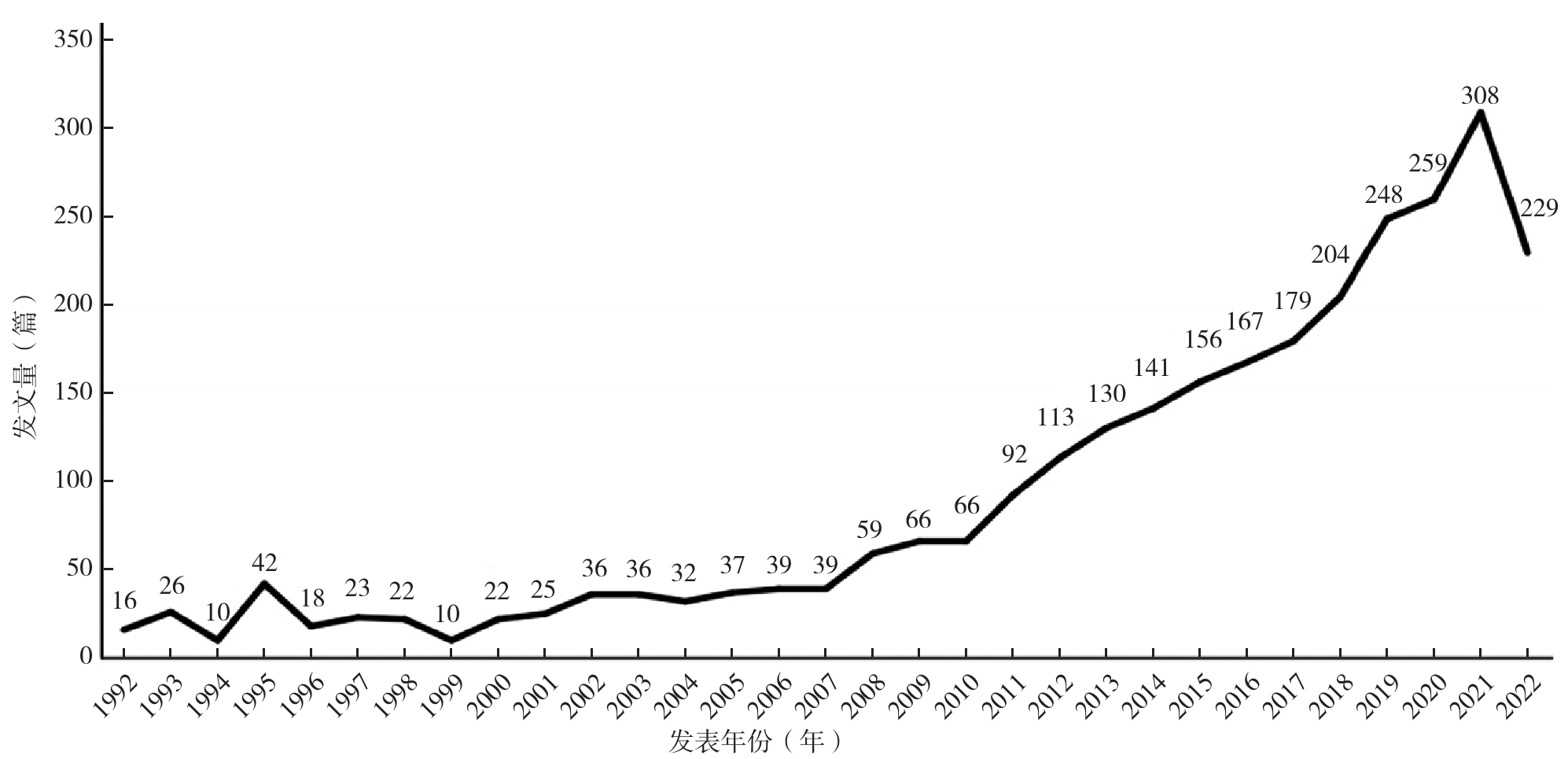
图1 1992—2022年WoSCC中以心肌纤维化为主题的文献发表数量
Figure 1 The number of publications on myocardial fibrosis in the WoSCC from 1992 to 2022
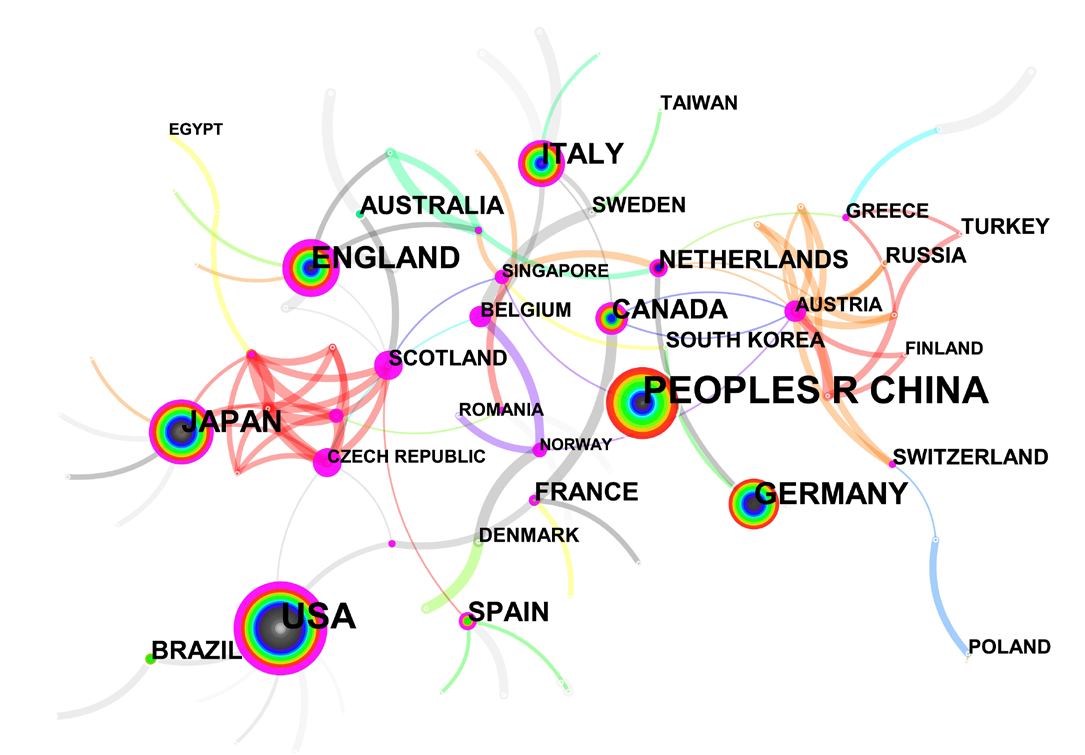
图2 1992—2022年WoSCC中以心肌纤维化为主题的文献地域分布注:每一个节点代表一个国家/地区,节点大小反映发文数量多少。
Figure 2 Geographical distribution of literature on myocardial fibrosis in the WoSCC from 1992 to 2022
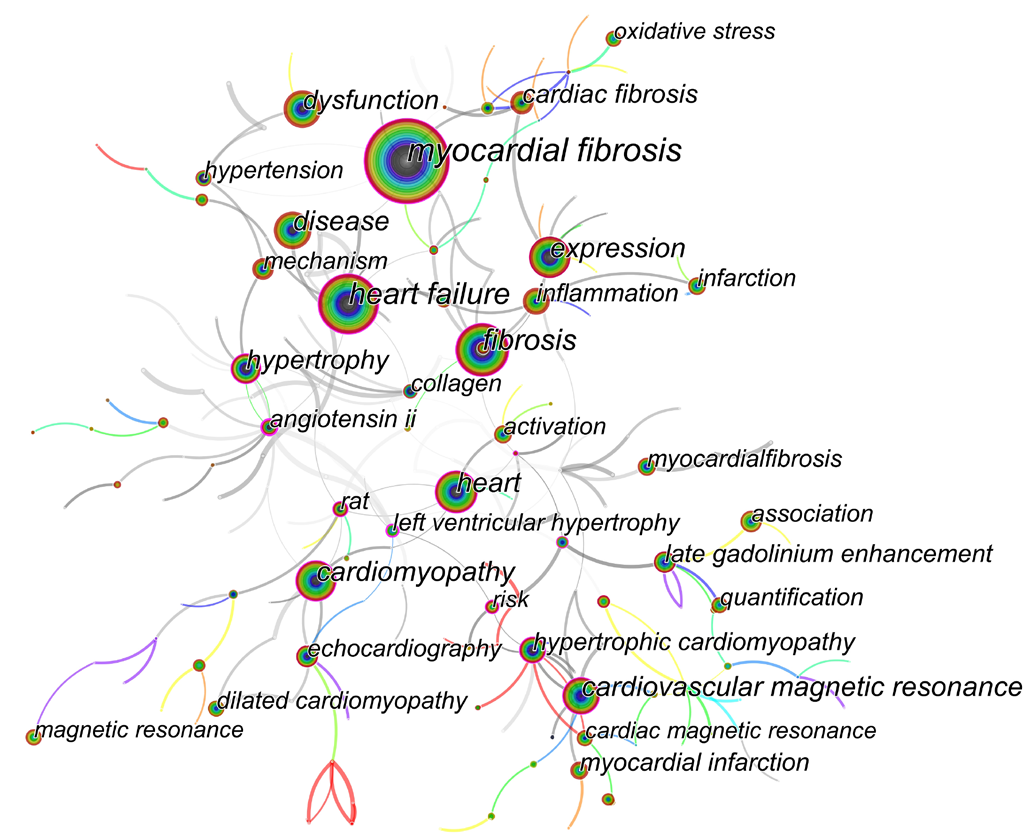
图3 1992—2022年WoSCC中以心肌纤维化为主题的文献关键词共现分析注:每一个节点代表一个关键词,节点大小反映关键词出现频次高低。
Figure 3 Co-occurrence analysis of keywords in literature on myocardial fibrosis in the WoSCC from 1992 to 2022
| 药物 | MOL ID | 主要生物活性化合物 | OB(%) | DL |
|---|---|---|---|---|
| 当归 | MOL000358 | β-谷甾醇 | 36.91 | 0.75 |
| 当归 | MOL000449 | 豆甾醇 | 43.83 | 0.76 |
| 红芪 | MOL011076 | 美迪紫檀素 | 60.46 | 0.34 |
| 红芪 | MOL011078 | 3',7-二羟基-4'-甲氧基-异黄酮 | 50.70 | 0.24 |
| 红芪 | MOL001792 | 甘草素 | 32.76 | 0.18 |
| 红芪 | MOL000358 | β-谷甾醇 | 36.91 | 0.75 |
| 红芪 | MOL000392 | 芒柄花素 | 69.67 | 0.21 |
| 红芪 | MOL000417 | 毛蕊异黄酮 | 47.75 | 0.24 |
| 红芪 | MOL004328 | 柚皮素 | 59.29 | 0.21 |
| 红芪 | MOL000449 | 豆甾醇 | 43.83 | 0.76 |
| 红芪 | MOL004941 | (2R)-7-羟基-2-(4-羟基苯基)色-4-酮 | 71.12 | 0.18 |
| 红芪 | MOL000500 | 维斯体素 | 74.66 | 0.21 |
| 红芪 | MOL005575 | 龙胆山酮酚 | 72.82 | 0.27 |
| 红芪 | MOL008173 | 胡萝卜苷 | 36.91 | 0.75 |
| 红芪 | MOL000098 | 槲皮素 | 46.43 | 0.28 |
表1 当归-红芪药对的主要生物活性化合物
Table 1 The major bioactive compounds in Chinese herbal pair of Danggui-Hongqi
| 药物 | MOL ID | 主要生物活性化合物 | OB(%) | DL |
|---|---|---|---|---|
| 当归 | MOL000358 | β-谷甾醇 | 36.91 | 0.75 |
| 当归 | MOL000449 | 豆甾醇 | 43.83 | 0.76 |
| 红芪 | MOL011076 | 美迪紫檀素 | 60.46 | 0.34 |
| 红芪 | MOL011078 | 3',7-二羟基-4'-甲氧基-异黄酮 | 50.70 | 0.24 |
| 红芪 | MOL001792 | 甘草素 | 32.76 | 0.18 |
| 红芪 | MOL000358 | β-谷甾醇 | 36.91 | 0.75 |
| 红芪 | MOL000392 | 芒柄花素 | 69.67 | 0.21 |
| 红芪 | MOL000417 | 毛蕊异黄酮 | 47.75 | 0.24 |
| 红芪 | MOL004328 | 柚皮素 | 59.29 | 0.21 |
| 红芪 | MOL000449 | 豆甾醇 | 43.83 | 0.76 |
| 红芪 | MOL004941 | (2R)-7-羟基-2-(4-羟基苯基)色-4-酮 | 71.12 | 0.18 |
| 红芪 | MOL000500 | 维斯体素 | 74.66 | 0.21 |
| 红芪 | MOL005575 | 龙胆山酮酚 | 72.82 | 0.27 |
| 红芪 | MOL008173 | 胡萝卜苷 | 36.91 | 0.75 |
| 红芪 | MOL000098 | 槲皮素 | 46.43 | 0.28 |
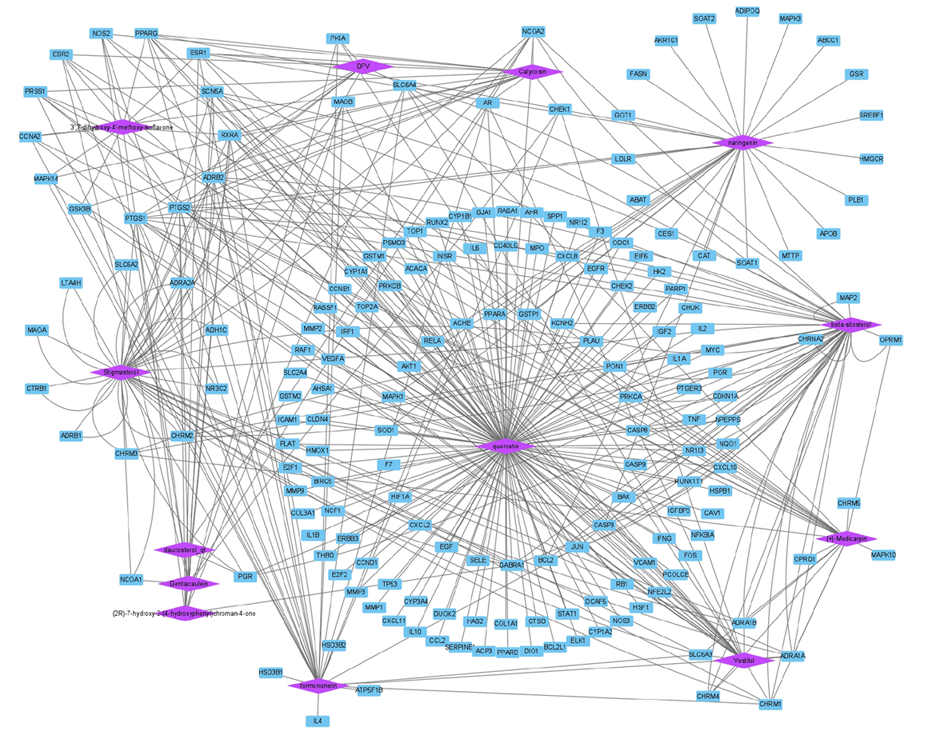
图4 当归-红芪药对主要生物活性化合物及其靶标基因的小分子网络注:紫色菱形代表主要生物活性化合物,蓝色方形代表靶标基因,共有196个节点、388条线。
Figure 4 Small-molecule network of major bioactive compounds and their target genes in Chinese herbal pair of Danggui-Hongqi
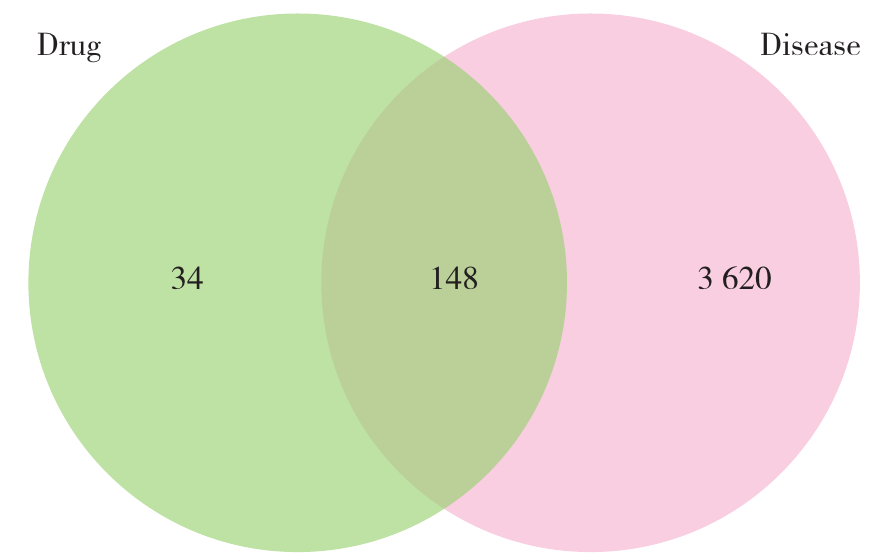
图5 当归-红芪药对抗心肌纤维化作用的靶标基因分布注:Drug=药物,Disease=疾病;图中绿色圆形代表当归-红芪药对主要生物活性化合物靶标基因数量,粉色圆形代表疾病靶标基因数量。
Figure 5 Distribution of target genes in anti-myocardial fibrosis of Chinese herbal pair of Danggui-Hongqi
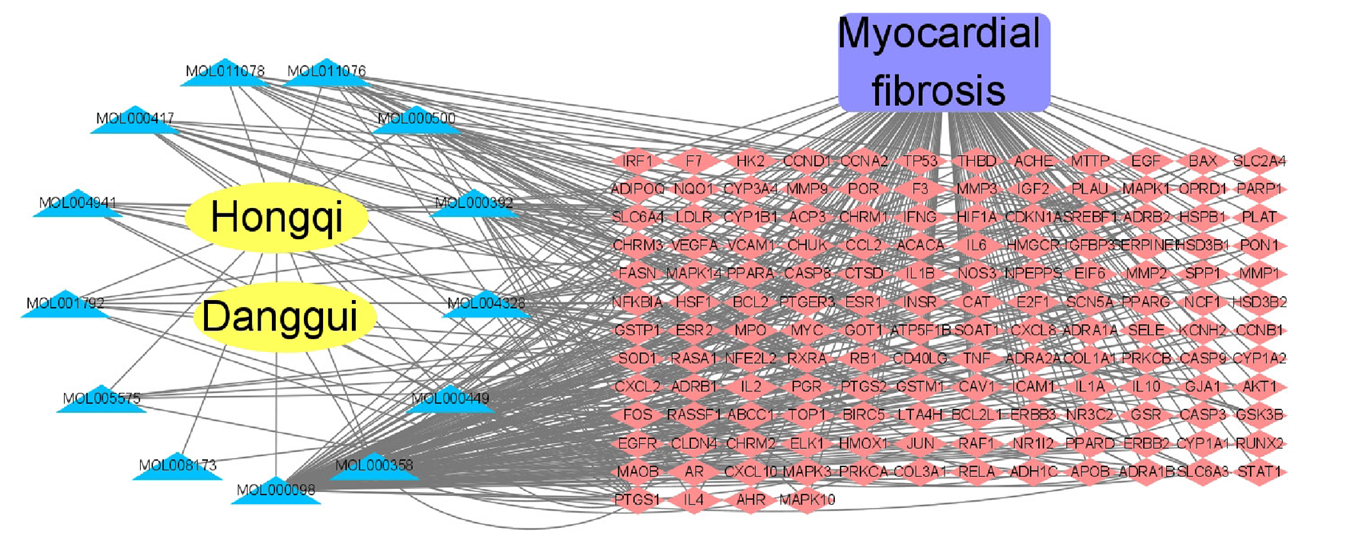
图6 当归-红芪药对抗心肌纤维化作用的"药物-成分-靶标-疾病"网络注:Hongqi=红芪,Danggui=当归,Myocardial fibrosis=心肌梗死;黄色圆形代表药物,蓝色三角形代表主要生物活性化合物,紫色长方形代表疾病,红色菱形代表药物-疾病交集靶标基因;共有164个节点、472条线。
Figure 6 "Drug-Component-Target-Disease" network in anti-myocardial fibrosis of Chinese herbal pair of Danggui-Hongqi
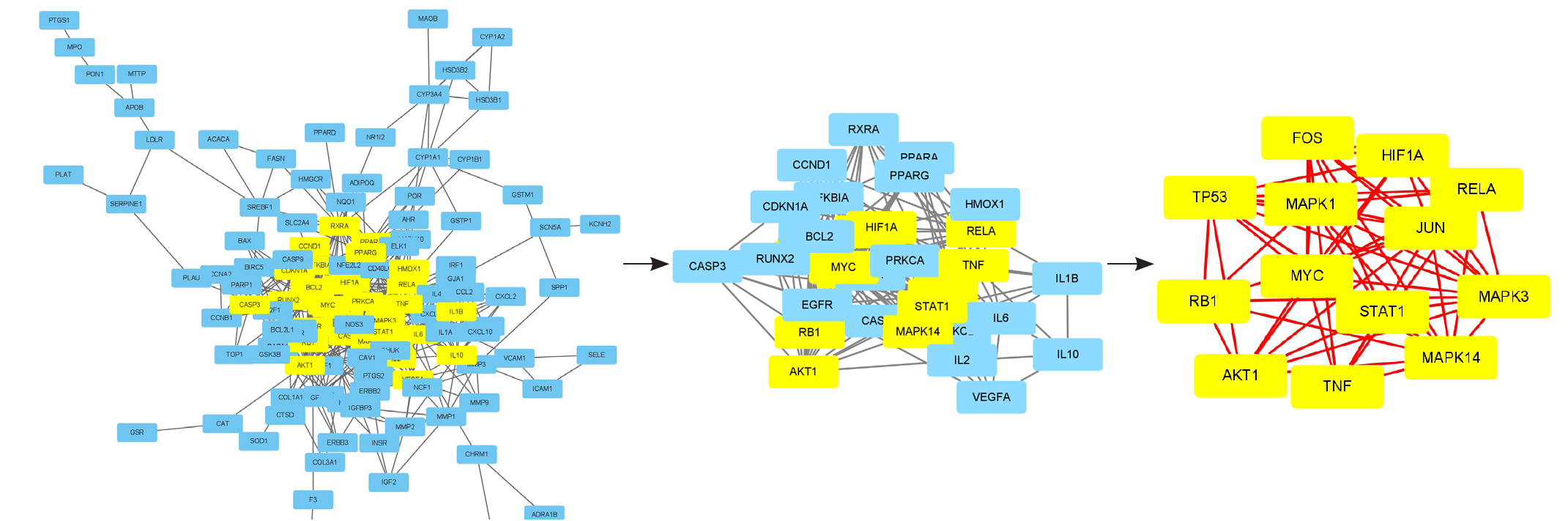
图7 当归-红芪药对抗心肌纤维化作用的蛋白-蛋白相互作用网络
Figure 7 Protein-protein interaction network in anti-myocardial fibrosis of Chinese herbal pair of Danggui-Hongqi
| 蛋白 | PDB ID | 蛋白名称 | 度值 |
|---|---|---|---|
| MAPK3 | Q16644 | 丝裂原活化蛋白激酶3 | 24 |
| JUN | P05412 | Jun原癌基因 | 23 |
| MAPK1 | P28482 | 丝裂原活化蛋白激酶1 | 23 |
| RELA | Q04206 | V-rel网状内皮细胞病毒癌基因同源物A | 20 |
| MAPK14 | Q16539 | 丝裂原活化蛋白激酶14 | 19 |
| TP53 | P04637 | 肿瘤蛋白p53 | 19 |
| AKT1 | P31749 | 丝氨酸/苏氨酸激酶1 | 16 |
| MYC | P01106 | 骨髓细胞瘤癌基因 | 16 |
| FOS | P01100 | Fos原癌基因 | 16 |
| TNF | P01375 | 肿瘤坏死因子 | 15 |
| RB1 | P06400 | 视网膜母细胞瘤基因 | 13 |
| HIF1A | Q16665 | 缺氧诱导因子1亚基α | 13 |
| STAT1 | P42224 | 信号转导与转录激活因子1 | 12 |
表2 当归-红芪药对抗心肌纤维化作用的核心蛋白
Table 2 Core proteins in anti-myocardial fibrosis of Chinese herbal pair of Danggui-Hongqi
| 蛋白 | PDB ID | 蛋白名称 | 度值 |
|---|---|---|---|
| MAPK3 | Q16644 | 丝裂原活化蛋白激酶3 | 24 |
| JUN | P05412 | Jun原癌基因 | 23 |
| MAPK1 | P28482 | 丝裂原活化蛋白激酶1 | 23 |
| RELA | Q04206 | V-rel网状内皮细胞病毒癌基因同源物A | 20 |
| MAPK14 | Q16539 | 丝裂原活化蛋白激酶14 | 19 |
| TP53 | P04637 | 肿瘤蛋白p53 | 19 |
| AKT1 | P31749 | 丝氨酸/苏氨酸激酶1 | 16 |
| MYC | P01106 | 骨髓细胞瘤癌基因 | 16 |
| FOS | P01100 | Fos原癌基因 | 16 |
| TNF | P01375 | 肿瘤坏死因子 | 15 |
| RB1 | P06400 | 视网膜母细胞瘤基因 | 13 |
| HIF1A | Q16665 | 缺氧诱导因子1亚基α | 13 |
| STAT1 | P42224 | 信号转导与转录激活因子1 | 12 |
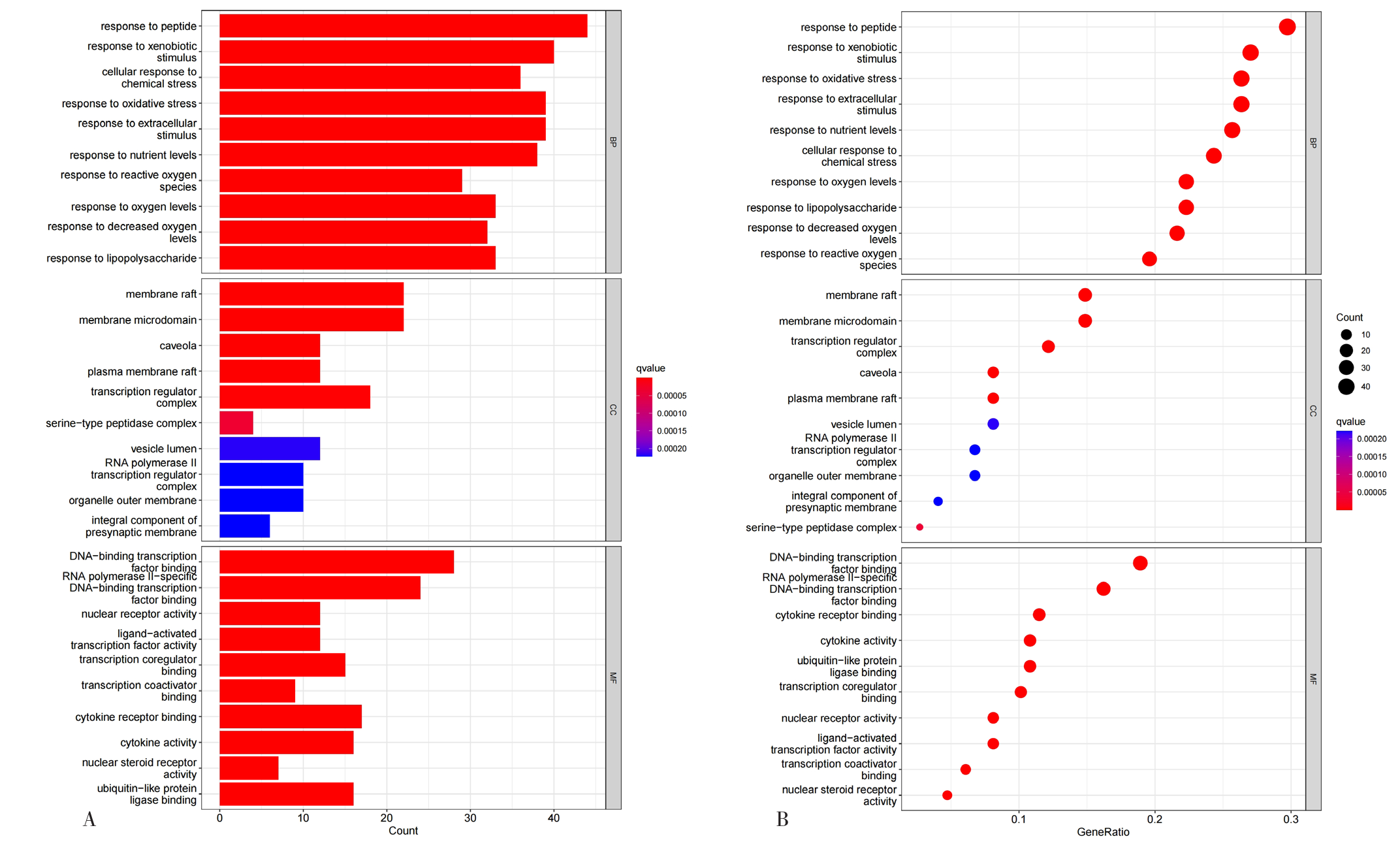
图8 当归-红芪药对抗心肌纤维化作用的GO富集分析结果注:A为GO富集分析中生物过程类别术语的柱状图,B为GO富集分析中生物过程类别术语的气泡图。
Figure 8 GO enrichment analysis results in anti-myocardial fibrosis of Chinese herbal pair of Danggui-Hongqi
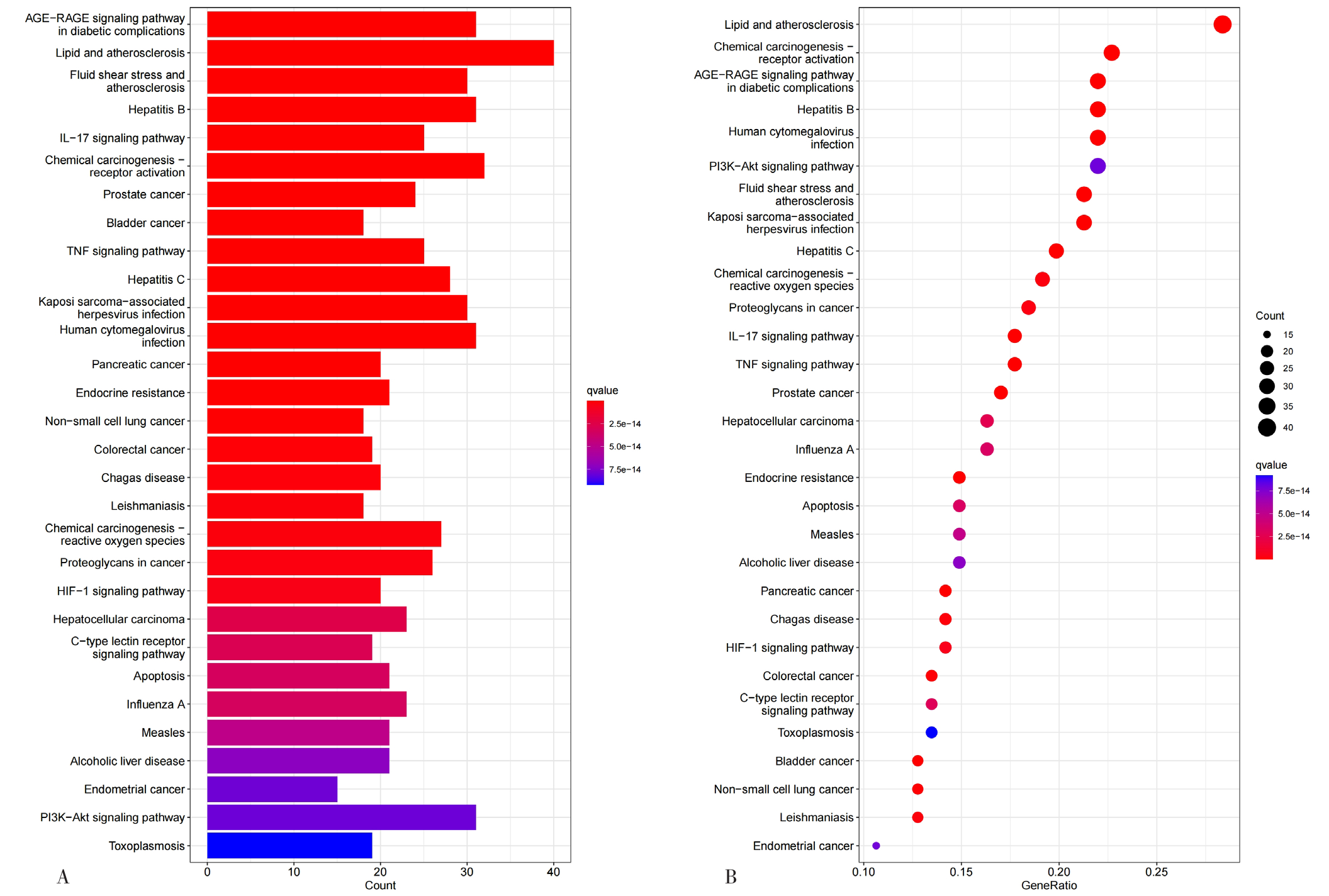
图9 当归-红芪药对抗心肌纤维化作用的KEGG富集分析结果注:A为前20条高浓缩信号通路的柱状图,B为前20条高浓缩信号通路的气泡图。
Figure 9 KEGG enrichment analysis results in anti-myocardial fibrosis of Chinese herbal pair of Danggui-Hongqi
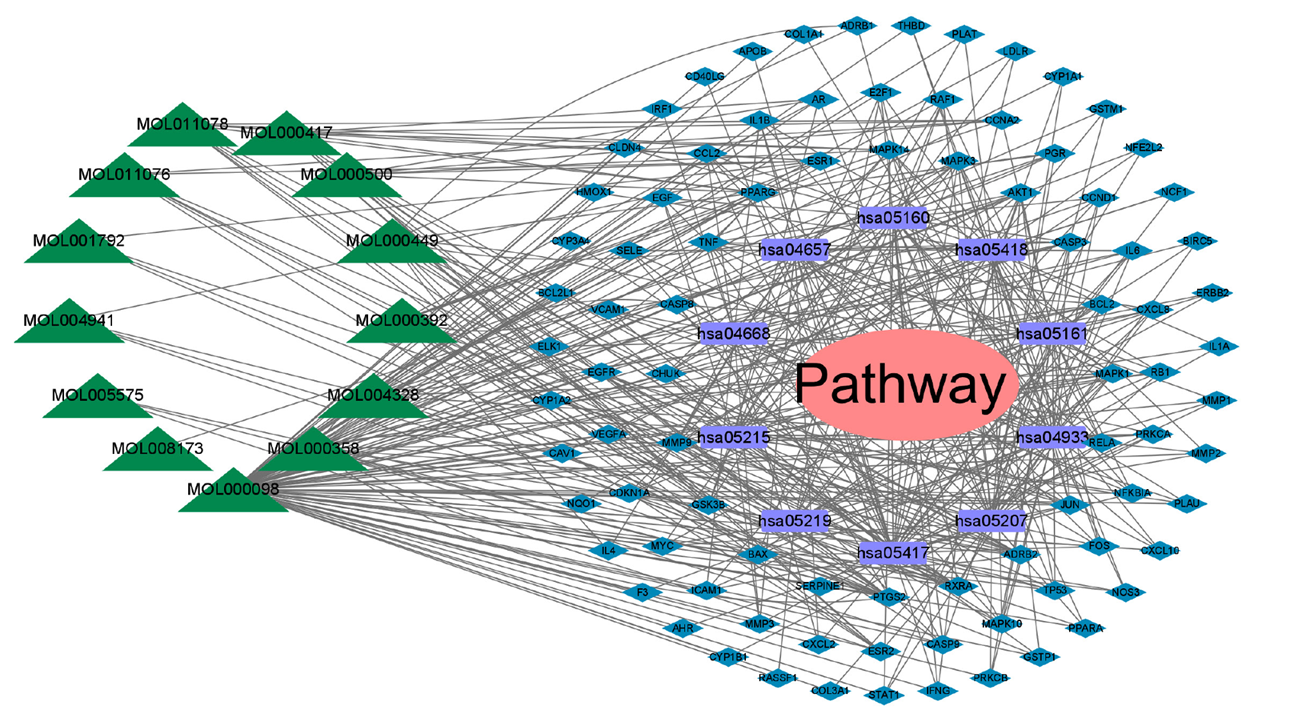
图10 当归-红芪药对抗心肌纤维化作用的主要生物活性化合物-核心蛋白-信号通路网络注:绿色三角形代表主要生物活性化合物,蓝色菱形代表核心蛋白,紫色长方形代表信号通路。
Figure 10 Network of major bioactive compound-core protein-signaling pathway in anti-myocardial fibrosis of Chinese herbal pair of Danggui-Hongqi
| 信号通路ID | 信号通路 | 基因ID | 基因计数 |
|---|---|---|---|
| hsa04933 | 高级糖基化终末产物-受体(AGE-RAGE)信号通路 | MAPK10/MAPK14/BCL2/BAX/JUN/CASP3/PRKCA/RELA/AKT1/MAPK3/MAPK1/VEGFA/CCND1/MMP2/TNF/IL6/STAT1/F3/ICAM1/IL1B/CCL2/SELE/VCAM1/CXCL8/PRKCB/NOS3/THBD/SERPINE1/COL1A1/IL1A/COL3A1 | 31 |
| hsa05417 | 脂质和动脉粥样硬化信号通路 | RXRA/MAPK10/PPARG/MAPK14/GSK3B/BCL2/BAX/CASP9/JUN/CASP3/CASP8/PRKCA/RELA/AKT1/MAPK3/MAPK1/LDLR/APOB/MMP3/BCL2L1/FOS/MMP9/TNF/IL6/TP53/NFKBIA/MMP1/CYP1A1/ICAM1/IL1B/CCL2/SELE/VCAM1/CXCL8/NOS3/NCF1/NFE2L2/CXCL2/CHUK/CD40LG | 40 |
| hsa05418 | 流体剪切应力和动脉粥样硬化信号通路 | MAPK10/MAPK14/BCL2/JUN/RELA/AKT1/GSTP1/VEGFA/FOS/MMP2/MMP9/TNF/TP53/HMOX1/CAV1/ICAM1/IL1B/CCL2/SELE/VCAM1/NOS3/PLAT/THBD/IFNG/IL1A/NCF1/NFE2L2/NQO1/CHUK/GSTM1 | 30 |
| hsa05161 | 肝炎B途径 | MAPK10/CCNA2/MAPK14/BCL2/BAX/CASP9/JUN/CASP3/CASP8/PRKCA/RELA/AKT1/MAPK3/MAPK1/FOS/CDKN1A/MMP9/RB1/TNF/IL6/TP53/ELK1/NFKBIA/RAF1/STAT1/MYC/CXCL8/PRKCB/BIRC5/CHUK/E2F1 | 31 |
| hsa04657 | IL-17信号通路 | PTGS2/MAPK10/MAPK14/GSK3B/JUN/CASP3/CASP8/IL4/RELA/MAPK3/MAPK1/MMP3/FOS/MMP9/TNF/IL6/NFKBIA/MMP1/IL1B/CCL2/CXCL8/IFNG/CXCL2/CXCL10/CHUK | 25 |
| hsa05207 | 化学致癌作用-受体激活途径 | ESR1/RXRA/ADRB2/ESR2/PGR/BCL2/JUN/PRKCA/AR/RELA/AKT1/MAPK3/MAPK1/PPARA/ADRB1/EGFR/VEGFA/CCND1/FOS/EGF/RB1/RAF1/CYP3A4/CYP1A2/MYC/CYP1A1/PRKCB/BIRC5/CYP1B1/AHR/E2F1/GSTM1 | 32 |
| hsa05215 | 前列腺癌途径 | GSK3B/BCL2/CASP9/AR/RELA/AKT1/MAPK3/MAPK1/GSTP1/PLAU/MMP3/EGFR/CCND1/CDKN1A/MMP9/EGF/RB1/TP53/NFKBIA/RAF1/ERBB2/PLAT/CHUK/E2F1 | 24 |
| hsa05219 | 膀胱癌途径 | MAPK3/MAPK1/EGFR/VEGFA/CCND1/CDKN1A/MMP2/MMP9/EGF/RB1/TP53/RAF1/MMP1/ERBB2/MYC/CXCL8/RASSF1/E2F1 | 18 |
| hsa04668 | TNF信号通路 | PTGS2/MAPK10/MAPK14/JUN/CASP3/CASP8/RELA/AKT1/MAPK3/MAPK1/MMP3/FOS/MMP9/TNF/IL6/NFKBIA/ICAM1/IL1B/CCL2/SELE/VCAM1/CXCL2/CXCL10/CHUK/IRF1 | 25 |
| hsa05160 | 肝炎C途径 | RXRA/GSK3B/BAX/CASP9/CASP3/CASP8/RELA/AKT1/MAPK3/MAPK1/LDLR/PPARA/EGFR/CCND1/CDKN1A/EGF/RB1/TNF/TP53/NFKBIA/RAF1/STAT1/MYC/IFNG/CLDN4/CXCL10/CHUK/E2F1 | 28 |
| hsa05167 | 卡波西肉瘤相关疱疹病毒感染途径 | PTGS2/MAPK10/MAPK14/GSK3B/BAX/CASP9/JUN/CASP3/CASP8/RELA/AKT1/MAPK3/MAPK1/VEGFA/CCND1/FOS/CDKN1A/RB1/IL6/TP53/NFKBIA/RAF1/HIF1A/STAT1/MYC/ICAM1/CXCL8/CXCL2/CHUK/E2F1 | 30 |
| hsa05163 | 人类巨细胞病毒感染途径 | PTGS2/MAPK14/GSK3B/BAX/CASP9/CASP3/CASP8/PRKCA/RELA/AKT1/MAPK3/MAPK1/EGFR/VEGFA/CCND1/CDKN1A/RB1/TNF/IL6/TP53/ELK1/NFKBIA/RAF1/MYC/IL1B/CCL2/PTGER3/CXCL8/PRKCB/CHUK/E2F1 | 31 |
| hsa05212 | 胰腺癌途径 | MAPK10/BAX/CASP9/RELA/AKT1/MAPK3/MAPK1/EGFR/VEGFA/CCND1/BCL2L1/CDKN1A/EGF/RB1/TP53/RAF1/STAT1/ERBB2/CHUK/E2F1 | 20 |
| hsa01522 | 内分泌抵抗途径 | ESR1/ESR2/MAPK10/MAPK14/BCL2/BAX/JUN/AKT1/MAPK3/MAPK1/EGFR/CCND1/FOS/CDKN1A/MMP2/MMP9/RB1/TP53/RAF1/ERBB2/E2F1 | 21 |
| hsa05223 | 非小细胞肺癌途径 | RXRA/BAX/CASP9/PRKCA/AKT1/MAPK3/MAPK1/EGFR/CCND1/CDKN1A/EGF/RB1/TP53/RAF1/ERBB2/PRKCB/RASSF1/E2F1 | 18 |
| hsa05210 | 结直肠癌途径 | MAPK10/GSK3B/BCL2/BAX/CASP9/JUN/CASP3/AKT1/MAPK3/MAPK1/EGFR/CCND1/FOS/CDKN1A/EGF/TP53/RAF1/MYC/BIRC5 | 19 |
| hsa05142 | 美洲锥虫病途径 | MAPK10/MAPK14/JUN/CASP8/RELA/AKT1/MAPK3/MAPK1/FOS/IL10/TNF/IL6/NFKBIA/IL1B/CCL2/CXCL8/IL2/SERPINE1/IFNG/CHUK | 20 |
| hsa05140 | 利什曼病途径 | PTGS2/MAPK14/JUN/IL4/RELA/MAPK3/MAPK1/FOS/IL10/TNF/ELK1/NFKBIA/STAT1/IL1B/PRKCB/IFNG/IL1A/NCF1 | 18 |
| hsa05208 | 化学致癌作用-活性氧途径 | MAPK10/MAPK14/JUN/ATP5F1B/RELA/AKT1/MAPK3/MAPK1/SOD1/CAT/EGFR/VEGFA/FOS/EGF/NFKBIA/RAF1/HIF1A/HMOX1/CYP1A2/CYP1A1/CYP1B1/NCF1/NFE2L2/NQO1/AHR/CHUK/GSTM1 | 27 |
| hsa05205 | 癌症中的蛋白聚糖途径 | ESR1/MAPK14/CASP3/PRKCA/AKT1/MAPK3/MAPK1/PLAU/EGFR/VEGFA/CCND1/CDKN1A/MMP2/MMP9/TNF/TP53/ELK1/RAF1/HIF1A/ERBB2/CAV1/MYC/PRKCB/COL1A1/IGF2/ERBB3 | 26 |
表3 当归-红芪药对抗心肌纤维化作用的KEGG富集分析结果
Table 3 KEGG enrichment analysis results in anti-myocardial fibrosis of Chinese herbal pair of Danggui-Hongqi
| 信号通路ID | 信号通路 | 基因ID | 基因计数 |
|---|---|---|---|
| hsa04933 | 高级糖基化终末产物-受体(AGE-RAGE)信号通路 | MAPK10/MAPK14/BCL2/BAX/JUN/CASP3/PRKCA/RELA/AKT1/MAPK3/MAPK1/VEGFA/CCND1/MMP2/TNF/IL6/STAT1/F3/ICAM1/IL1B/CCL2/SELE/VCAM1/CXCL8/PRKCB/NOS3/THBD/SERPINE1/COL1A1/IL1A/COL3A1 | 31 |
| hsa05417 | 脂质和动脉粥样硬化信号通路 | RXRA/MAPK10/PPARG/MAPK14/GSK3B/BCL2/BAX/CASP9/JUN/CASP3/CASP8/PRKCA/RELA/AKT1/MAPK3/MAPK1/LDLR/APOB/MMP3/BCL2L1/FOS/MMP9/TNF/IL6/TP53/NFKBIA/MMP1/CYP1A1/ICAM1/IL1B/CCL2/SELE/VCAM1/CXCL8/NOS3/NCF1/NFE2L2/CXCL2/CHUK/CD40LG | 40 |
| hsa05418 | 流体剪切应力和动脉粥样硬化信号通路 | MAPK10/MAPK14/BCL2/JUN/RELA/AKT1/GSTP1/VEGFA/FOS/MMP2/MMP9/TNF/TP53/HMOX1/CAV1/ICAM1/IL1B/CCL2/SELE/VCAM1/NOS3/PLAT/THBD/IFNG/IL1A/NCF1/NFE2L2/NQO1/CHUK/GSTM1 | 30 |
| hsa05161 | 肝炎B途径 | MAPK10/CCNA2/MAPK14/BCL2/BAX/CASP9/JUN/CASP3/CASP8/PRKCA/RELA/AKT1/MAPK3/MAPK1/FOS/CDKN1A/MMP9/RB1/TNF/IL6/TP53/ELK1/NFKBIA/RAF1/STAT1/MYC/CXCL8/PRKCB/BIRC5/CHUK/E2F1 | 31 |
| hsa04657 | IL-17信号通路 | PTGS2/MAPK10/MAPK14/GSK3B/JUN/CASP3/CASP8/IL4/RELA/MAPK3/MAPK1/MMP3/FOS/MMP9/TNF/IL6/NFKBIA/MMP1/IL1B/CCL2/CXCL8/IFNG/CXCL2/CXCL10/CHUK | 25 |
| hsa05207 | 化学致癌作用-受体激活途径 | ESR1/RXRA/ADRB2/ESR2/PGR/BCL2/JUN/PRKCA/AR/RELA/AKT1/MAPK3/MAPK1/PPARA/ADRB1/EGFR/VEGFA/CCND1/FOS/EGF/RB1/RAF1/CYP3A4/CYP1A2/MYC/CYP1A1/PRKCB/BIRC5/CYP1B1/AHR/E2F1/GSTM1 | 32 |
| hsa05215 | 前列腺癌途径 | GSK3B/BCL2/CASP9/AR/RELA/AKT1/MAPK3/MAPK1/GSTP1/PLAU/MMP3/EGFR/CCND1/CDKN1A/MMP9/EGF/RB1/TP53/NFKBIA/RAF1/ERBB2/PLAT/CHUK/E2F1 | 24 |
| hsa05219 | 膀胱癌途径 | MAPK3/MAPK1/EGFR/VEGFA/CCND1/CDKN1A/MMP2/MMP9/EGF/RB1/TP53/RAF1/MMP1/ERBB2/MYC/CXCL8/RASSF1/E2F1 | 18 |
| hsa04668 | TNF信号通路 | PTGS2/MAPK10/MAPK14/JUN/CASP3/CASP8/RELA/AKT1/MAPK3/MAPK1/MMP3/FOS/MMP9/TNF/IL6/NFKBIA/ICAM1/IL1B/CCL2/SELE/VCAM1/CXCL2/CXCL10/CHUK/IRF1 | 25 |
| hsa05160 | 肝炎C途径 | RXRA/GSK3B/BAX/CASP9/CASP3/CASP8/RELA/AKT1/MAPK3/MAPK1/LDLR/PPARA/EGFR/CCND1/CDKN1A/EGF/RB1/TNF/TP53/NFKBIA/RAF1/STAT1/MYC/IFNG/CLDN4/CXCL10/CHUK/E2F1 | 28 |
| hsa05167 | 卡波西肉瘤相关疱疹病毒感染途径 | PTGS2/MAPK10/MAPK14/GSK3B/BAX/CASP9/JUN/CASP3/CASP8/RELA/AKT1/MAPK3/MAPK1/VEGFA/CCND1/FOS/CDKN1A/RB1/IL6/TP53/NFKBIA/RAF1/HIF1A/STAT1/MYC/ICAM1/CXCL8/CXCL2/CHUK/E2F1 | 30 |
| hsa05163 | 人类巨细胞病毒感染途径 | PTGS2/MAPK14/GSK3B/BAX/CASP9/CASP3/CASP8/PRKCA/RELA/AKT1/MAPK3/MAPK1/EGFR/VEGFA/CCND1/CDKN1A/RB1/TNF/IL6/TP53/ELK1/NFKBIA/RAF1/MYC/IL1B/CCL2/PTGER3/CXCL8/PRKCB/CHUK/E2F1 | 31 |
| hsa05212 | 胰腺癌途径 | MAPK10/BAX/CASP9/RELA/AKT1/MAPK3/MAPK1/EGFR/VEGFA/CCND1/BCL2L1/CDKN1A/EGF/RB1/TP53/RAF1/STAT1/ERBB2/CHUK/E2F1 | 20 |
| hsa01522 | 内分泌抵抗途径 | ESR1/ESR2/MAPK10/MAPK14/BCL2/BAX/JUN/AKT1/MAPK3/MAPK1/EGFR/CCND1/FOS/CDKN1A/MMP2/MMP9/RB1/TP53/RAF1/ERBB2/E2F1 | 21 |
| hsa05223 | 非小细胞肺癌途径 | RXRA/BAX/CASP9/PRKCA/AKT1/MAPK3/MAPK1/EGFR/CCND1/CDKN1A/EGF/RB1/TP53/RAF1/ERBB2/PRKCB/RASSF1/E2F1 | 18 |
| hsa05210 | 结直肠癌途径 | MAPK10/GSK3B/BCL2/BAX/CASP9/JUN/CASP3/AKT1/MAPK3/MAPK1/EGFR/CCND1/FOS/CDKN1A/EGF/TP53/RAF1/MYC/BIRC5 | 19 |
| hsa05142 | 美洲锥虫病途径 | MAPK10/MAPK14/JUN/CASP8/RELA/AKT1/MAPK3/MAPK1/FOS/IL10/TNF/IL6/NFKBIA/IL1B/CCL2/CXCL8/IL2/SERPINE1/IFNG/CHUK | 20 |
| hsa05140 | 利什曼病途径 | PTGS2/MAPK14/JUN/IL4/RELA/MAPK3/MAPK1/FOS/IL10/TNF/ELK1/NFKBIA/STAT1/IL1B/PRKCB/IFNG/IL1A/NCF1 | 18 |
| hsa05208 | 化学致癌作用-活性氧途径 | MAPK10/MAPK14/JUN/ATP5F1B/RELA/AKT1/MAPK3/MAPK1/SOD1/CAT/EGFR/VEGFA/FOS/EGF/NFKBIA/RAF1/HIF1A/HMOX1/CYP1A2/CYP1A1/CYP1B1/NCF1/NFE2L2/NQO1/AHR/CHUK/GSTM1 | 27 |
| hsa05205 | 癌症中的蛋白聚糖途径 | ESR1/MAPK14/CASP3/PRKCA/AKT1/MAPK3/MAPK1/PLAU/EGFR/VEGFA/CCND1/CDKN1A/MMP2/MMP9/TNF/TP53/ELK1/RAF1/HIF1A/ERBB2/CAV1/MYC/PRKCB/COL1A1/IGF2/ERBB3 | 26 |
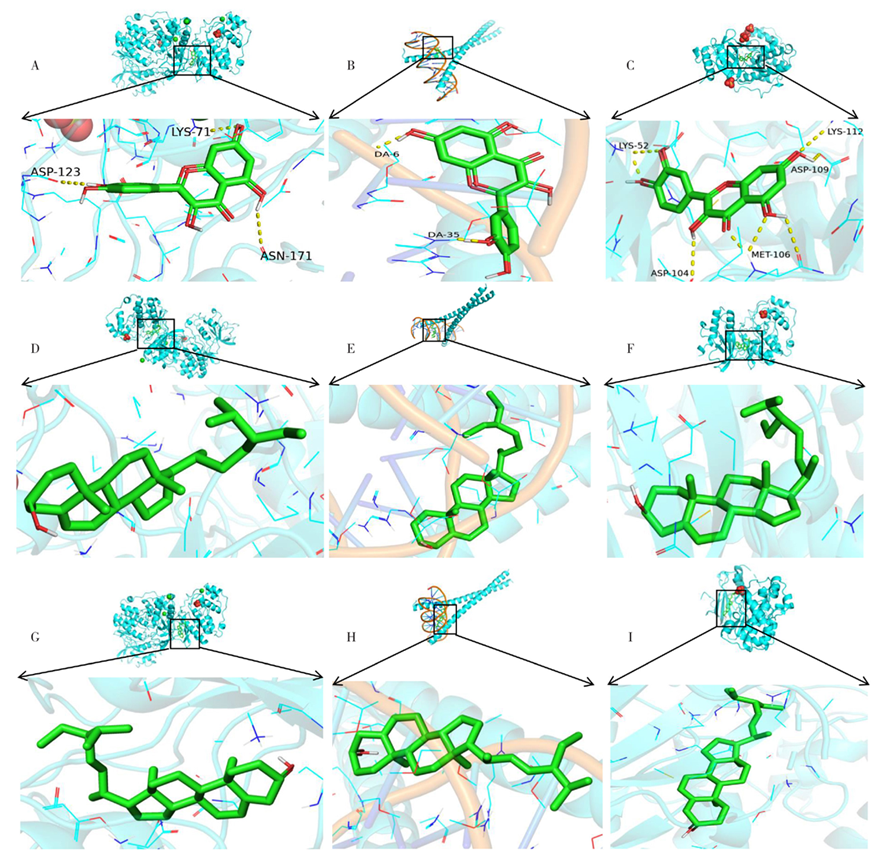
图11 当归-红芪药对抗心肌纤维化作用的主要生物活性化合物与核心蛋白对接结果的3D图注:A为槲皮素与MAPK3对接,B为槲皮素与JUN对接,C为槲皮素与MAPK1对接,D为β-谷甾醇与MAPK3对接,E为β-谷甾醇与JUN对接,F为β-谷甾醇与MAPK1对接,G为豆甾醇与MAPK3对接,H为豆甾醇与JUN对接,I为豆甾醇与MAPK1对接。
Figure 11 3D diagram of the docking results of the major bioactive compounds and core proteins in anti-myocardial fibrosis of Chinese herbal pair of Danggui-Hongqi
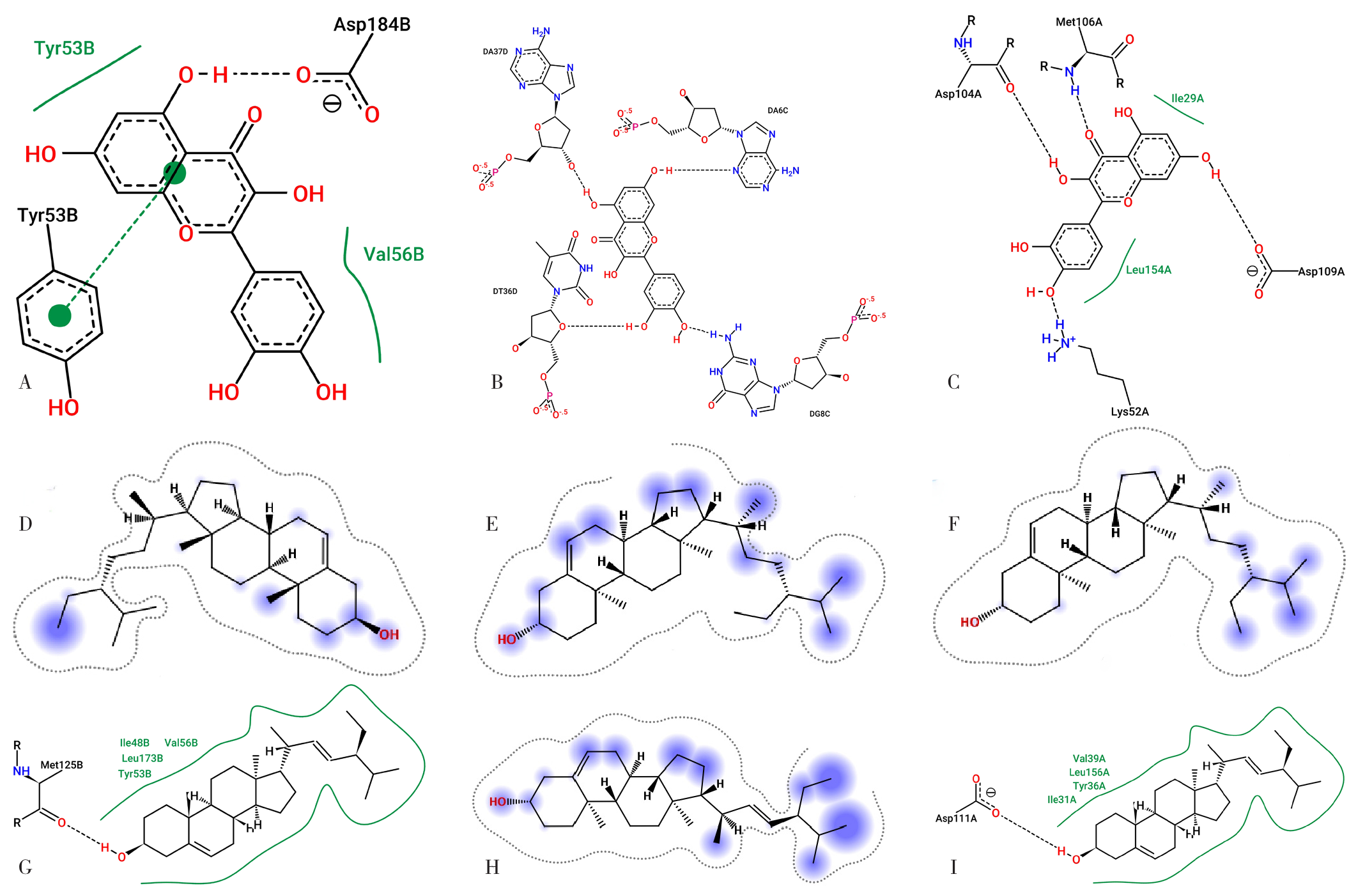
图12 当归-红芪药对抗心肌纤维化作用的主要生物活性化合物与核心蛋白对接结果的2D图注:A为槲皮素与MAPK3对接,B为槲皮素与JUN对接,C为槲皮素与MAPK1对接,D为β-谷甾醇与MAPK3对接,E为β-谷甾醇与JUN对接,F为β-谷甾醇与MAPK1对接,G为豆甾醇与MAPK3对接,H为豆甾醇与JUN对接,I为豆甾醇与MAPK1对接
Figure 12 2D diagram of the docking results of the major bioactive compounds and core proteins in anti-myocardial fibrosis of Chinese herbal pair of Danggui-Hongqi
| 化合物 | 化学式 | 分子量(g/mol) | 结合能(kcal/mol) | ||
|---|---|---|---|---|---|
| MAPK3 | JUN | MAPK1 | |||
| 槲皮素 | C15H10O7 | 302.23 | -9.3 | -8.6 | -8.9 |
| β-谷甾醇 | C29H50O | 414.7 | -9.7 | -6.8 | -8.2 |
| 豆甾醇 | C29H48O | 412.7 | -9.6 | -7.3 | -8.6 |
表4 当归-红芪药对抗心肌纤维化作用的主要生物活性化合物与核心蛋白的结合能力
Table 4 Binding ability of the major bioactive compounds and core proteins in anti-myocardial fibrosis of Chinese herbal pair of Danggui-Hongqi
| 化合物 | 化学式 | 分子量(g/mol) | 结合能(kcal/mol) | ||
|---|---|---|---|---|---|
| MAPK3 | JUN | MAPK1 | |||
| 槲皮素 | C15H10O7 | 302.23 | -9.3 | -8.6 | -8.9 |
| β-谷甾醇 | C29H50O | 414.7 | -9.7 | -6.8 | -8.2 |
| 豆甾醇 | C29H48O | 412.7 | -9.6 | -7.3 | -8.6 |
| [1] |
|
| [2] |
|
| [3] |
|
| [4] |
马承旭. 当归红芪超滤物防治实验性大鼠放射性心肌纤维化的作用及分子机制研究[D]. 兰州: 甘肃中医药大学, 2020.
|
| [5] |
|
| [6] |
|
| [7] |
|
| [8] |
|
| [9] |
|
| [10] |
|
| [11] |
|
| [12] |
|
| [13] |
|
| [14] |
王海洋, 刘琳, 柴志勇, 等. 基于GSK-3β/Fyn/Nrf2信号通路探讨槲皮素对自发性高血压大鼠心肌纤维化的影响及内在机制[J]. 新中医, 2023, 55(11): 1-7. DOI: 10.13457/j.cnki.jncm.2023.11.001.
|
| [15] |
|
| [16] |
|
| [17] |
|
| [18] |
|
| [19] |
|
| [20] |
|
| [1] | 张可兴, 张博, 吴琼, 朱珊珊, 王迪, 张春男. 基于代谢组学四妙勇安汤治疗糖尿病足的作用机制研究[J]. 中国全科医学, 2025, 28(30): 3796-3805. |
| [2] | 李珊珊, 沈珑慧. 坤泰胶囊治疗子宫内膜异位症的机制研究:网络药理学、分子对接及分子动力学模拟方法[J]. 中国全科医学, 2025, 28(28): 3573-3582. |
| [3] | 韩冰, 杜淑珍, 孟晓雪, 张璐, 陈梓娴, 滕凤玲. 心力衰竭患者血浆骨膜蛋白水平与心肌纤维化的相关性研究[J]. 中国全科医学, 2025, 28(24): 2979-2984. |
| [4] | 朱子一, 何贵新, 秦伟彬, 宋惠, 张利文, 唐伟智, 杨斐斐, 刘凌云, 欧阳彬. 线粒体自噬改善心肌梗死后心肌纤维化及其中医药干预的研究进展[J]. 中国全科医学, 2025, 28(18): 2294-2300. |
| [5] | 沈明妹, 吕俞娇, 张尚博, 周鑫辰, 董姝含, 张卓, 刘永超. 钙敏感受体在心肌损伤中介导的信号通路研究进展[J]. 中国全科医学, 2025, 28(18): 2301-2306. |
| [6] | 杨安银, 刘红丽, 陈妙洋, 郑玉凤, 徐志远, 杨永峰. 基于网络药理学方法探析汉黄芩素治疗肝细胞癌作用机制和体外实验研究[J]. 中国全科医学, 2024, 27(32): 4040-4049. |
| [7] | 李勇, 李占虎, 靳博伟, 李原, 张宏博, 苏亚坤, 闫小菊. 急性冠脉综合征患者血清补体C1q/肿瘤坏死因子相关蛋白5水平与冠状动脉病变程度及心肌纤维化蛋白指标的相关性研究[J]. 中国全科医学, 2024, 27(27): 3365-3371. |
| [8] | 张林, 高锦, 吴明华, 王广梅. 通脑饮治疗急性脑梗死的临床疗效及作用机制研究:基于网络药理学和分子对接技术[J]. 中国全科医学, 2024, 27(23): 2904-2912. |
| [9] | 刁翯, 白文佩, 赵立东. 左慈丸的化学成分及治疗围绝经期听力损失的作用机制研究:基于网络药理学与分子对接技术[J]. 中国全科医学, 2024, 27(12): 1493-1503. |
| [10] | 张帅, 李娜, 沈江立, 柳越冬, 吴宪树, 王磊, 盛天骄, 徐红俊, 安胜军. 优化溃结方对溃疡性结肠炎气滞血瘀模型大鼠的影响及其作用机制研究[J]. 中国全科医学, 2024, 27(11): 1356-1362. |
| [11] | 张康, 赵婷婷, 张波, 高梦琦, 李昱熹, 王邵鹏, 赵文景. 基于网络药理学探究布地奈德治疗IgA肾病的作用机制[J]. 中国全科医学, 2023, 26(35): 4453-4458. |
| [12] | 于妍, 王春爱, 秦晓宇, 李玉兰, 梁曦, 温晓辉, 刘敏. 穴位注射葛根素对布比卡因中毒大鼠心肌线粒体能量代谢的影响及其机制研究[J]. 中国全科医学, 2022, 25(18): 2280-2285. |
| [13] | 叶坤, 雷敏, 谢欣, 郑晖, 陈敏, 余曙光. 基于网络药理学与分子对接技术探讨黄芪建中汤治疗腹泻型肠易激综合征的作用机制研究[J]. 中国全科医学, 2022, 25(15): 1814-1824. |
| [14] | 孙凯,朱立国,魏戌,银河,李秋月,秦晓宽,杨博文. 基于UPLC-Q-TOF-MS/MS结合网络药理学的壮腰通络方延缓腰椎间盘退行性病变的化学成分及作用机制研究[J]. 中国全科医学, 2021, 24(35): 4437-4446. |
| [15] | 程丽颖,王梦玺,张翥,邵凤民. 当归补血汤辅助治疗糖尿病肾病临床疗效的Meta分析[J]. 中国全科医学, 2021, 24(27): 3477-3483. |
| 阅读次数 | ||||||
|
全文 |
|
|||||
|
摘要 |
|
|||||