中国全科医学 ›› 2026, Vol. 29 ›› Issue (36): 5348-5353.DOI: 10.12114/j.issn.1007-9572.2025.0322

• 临床热点研究·体重管理 • 上一篇    

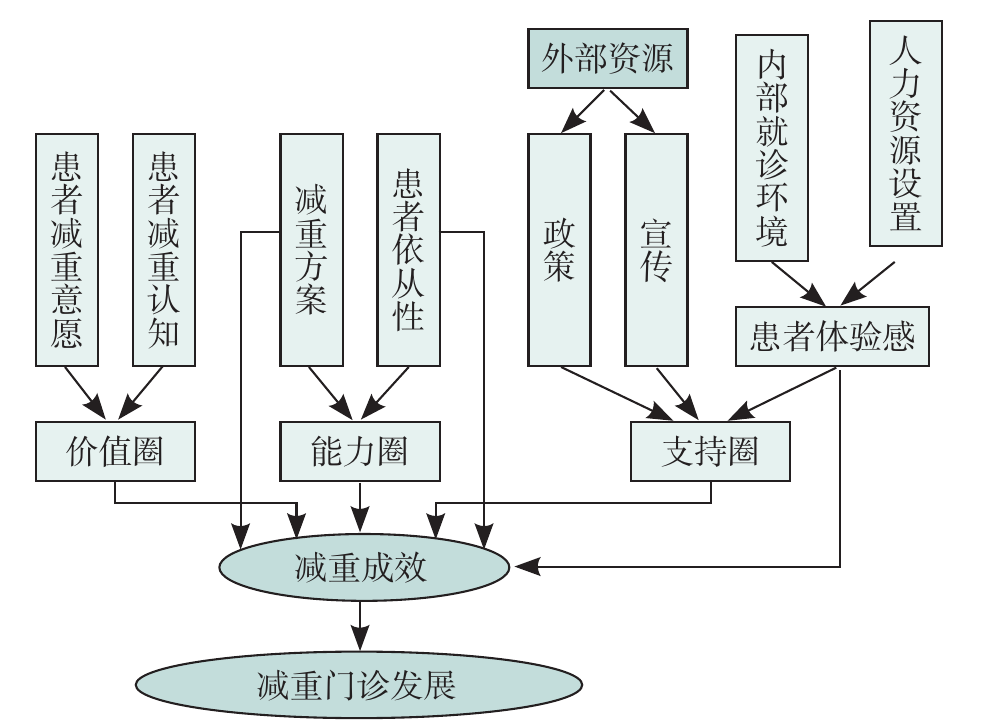
三圈理论视角下医学营养减重门诊的效果及发展策略分析

吴利霞1, 陈红洁2, 杨义1,*()   

  1. 1.611130 四川省成都市,成都中医药大学管理学院
    2.614000 四川省乐山市人民医院临床营养科
  • 收稿日期:2025-07-10 修回日期:2026-03-20 出版日期:2026-12-20 发布日期:2026-10-30
  • 通讯作者: 杨义

  • 作者贡献:

    吴利霞提出主要研究目标,负责研究的构思与设计,研究的实施,撰写论文;吴利霞、陈红洁进行数据的收集与整理,统计学处理,图、表的绘制与展示;吴利霞、杨义进行论文的修订;杨义负责文章的质量控制与审查,对文章整体监督管理。

  • 基金资助:
    四川省基层卫生事业发展研究中心重点项目(SWFZ23-Z-12)

Effectiveness and Development Strategies of a Medical Nutrition Weight-loss Clinic from the Perspective of the Three-Circle Theory

WU Lixia1, CHEN Hongjie2, YANG Yi1,*()   

  1. 1. School of Management, Chengdu University of Traditional Chinese Medicine, Chengdu 611130, China
    2. Department of Clinical Nutrition, the People's Hospital of Leshan, Leshan 614000, China
  • Received:2025-07-10 Revised:2026-03-20 Published:2026-12-20 Online:2026-10-30
  • Contact: YANG Yi

摘要: 背景 肥胖已成为重大公共卫生问题,医学营养减重门诊契合国家健康政策导向,但面临服务供需矛盾等困境。以三圈理论视角研究医学营养减重门诊的优化路径,对其长效良性发展有重要现实意义。 目的 基于三圈理论(价值圈、能力圈、支持圈)分析乐山市人民医院医学营养减重门诊的服务现状与问题,旨在提出优化策略,提升门诊服务质量和患者长期减重效果。 方法 选取2024年8月—2025年4月乐山市人民医院医学营养减重门诊就诊的342例患者为研究对象,在观察期间均接受高蛋白饮食、运动与行为干预。干预1、3、6个月时统计复诊率和脱落率。采用混合线性模型分析患者身体成分指标随时间(初诊及干预1、3、6个月)的变化趋势,采用问卷调查(n=251)评估患者满意度,并结合三圈理论框架进行分析。 结果 342例患者年龄18~62岁,平均年龄(35.4±8.7)岁。男59例(17.25%)、女283例(82.75%)。其中BMI≥24 kg/m2者285例(83.33%),BMI≥28 kg/m2者156例(45.61%)。随着干预时间的延长,复诊率下降,脱落率升高(χ2 趋势=65.93,P<0.01)。混合线性模型分析显示,初诊及干预1、3、6个月复诊时BMI、肌肉量、体脂肪、体脂率、内脏脂肪面积及基础代谢比较,差异均有统计学意义(P<0.05)。肌肉量在干预1个月与3个月、3个月与6个月复诊时比较,差异均无统计学意义(P>0.05);基础代谢在干预3个月复诊和干预6个月复诊时比较,差异无统计学意义(P>0.05);其他身体成分指标在初诊及干预1、3、6个月复诊时,各时间点两两比较,差异均有统计学意义(P<0.05)。满意度调查中,价值圈3个条目得分由高到低依次为:向他人推荐该门诊的意愿(4.77±0.46)分、门诊整体满意度(4.63±0.53)分、减重效果满意度(4.46±0.71)分。能力圈得分前3个条目分别为:日常随访能力(4.89±0.34)分、减重方案的可行性(4.87±0.40)分、个性化(4.86±0.38)分。支持圈得分前3个条目分别为:服务态度(4.89±0.37)分、检查时间的合理性(4.82±0.46)分、就诊环境(4.78±0.53)分。 结论 医学营养减重门诊通过针对性的干预措施,帮助患者取得了较好的减重成效,患者的满意度较高,能力圈、价值圈和支持圈效果显著。基于三圈理论,致力于建设积极的愿景导向文化、推动专业能力优化迭代以及打造优质高效的支持环境等可持续发展策略,实现医学营养减重门诊的服务质效不断提升。

关键词: 肥胖管理, 三圈理论, 减重门诊, 门诊医疗, 身体成分, 患者满意度, 发展策略

Abstract:

Background

Obesity has become a major public health issue. Medical nutrition weight-loss clinics align with the national health policy orientation, yet they face challenges such as mismatches between service supply and demand. Exploring optimization pathways for medical nutrition weight-loss clinics from the perspective of the Three-Circle Theory is of great practical significance for their sustainable and positive development.

Objective

Based on the Three-Circle Theory (value circle, capability circle, and support circle), this study analyzed the service status and existing problems of the medical nutrition weight-loss clinic at the People's Hospital of Leshan, with the aim of proposing optimization strategies to improve service quality and long-term weight-loss outcomes.

Methods

A total of 342 patients who visited the medical nutrition weight-loss clinic at the People's Hospital of Leshan from August 2024 to April 2025 were enrolled. During the observation period, all patients received a high-protein diet, exercise intervention, and behavioral intervention. The revisit rate and dropout rate at 1, 3, and 6 months after intervention were analyzed. A mixed-effects linear model was used to examine changes in body composition indicators over time (at baseline and at 1, 3, and 6 months after intervention). Patient satisfaction was assessed through a questionnaire survey (n=251), and the results were interpreted within the framework of the Three-Circle Theory.

Results

The 342 patients were aged 18 to 62 years, with a mean age of (35.4±8.7) years. There were 59 men (17.25%) and 283 women (82.75%). Among them, 285 patients (83.33%) had a BMI ≥24 kg/m2, and 156 patients (45.61%) had a BMI ≥28 kg/m2. As the intervention period lengthened, the revisit rate decreased and the dropout rate increased (χ2 trend=65.93, P<0.01). Mixed-effects linear model analysis showed that BMI, muscle mass, body fat, body fat percentage, visceral fat area, and basal metabolic rate differed significantly among baseline and the 1-, 3-, and 6-month post-intervention assessments (P<0.05). Except for muscle mass, which showed no statistically singnificant differences between 1 and 3 months, and 3 and 6 months, and basal metabolic rate, which showed no statistically significant difference between the 3-month and 6-month follow-up visits after intervention (P>0.05), pairwise comparisons among all time points for body composition indicators at baseline and at 1, 3, and 6 months after intervention showed statistically significant differences (P<0.05). In the satisfaction survey, the top three items in the value circle were, in descending order: willingness to recommend the clinic to others (4.77±0.46), overall satisfaction with the clinic (4.63±0.53), and satisfaction with the weight-loss effect (4.46±0.71). The top three items in the capability circle were daily follow-up ability (4.89±0.34), feasibility of the weight-loss plan (4.87±0.40), and individualization (4.86±0.38). The top three items in the support circle were service attitude (4.89±0.37), appropriateness of examination time (4.82±0.46), and clinical environment (4.78±0.53).

Conclusion

Through targeted interventions, the medical nutrition weight-loss clinic achieved favorable weight-loss outcomes, and patient satisfaction was high, with notable effects in the capability circle, value circle, and support circle. Based on the Three-Circle Theory, sustainable development strategies such as building a positive vision-oriented culture, promoting iterative optimization of professional capabilities, and creating a high-quality and efficient support environment can continuously improve the service quality and effectiveness of medical nutrition weight-loss clinics.

Key words: Obesity management, Three-Circle Theory, Medical nutrition weight loss clinic, Ambulatory care, Body composition, Patient satisfaction, Development strategy

中图分类号: