中国全科医学 ›› 2026, Vol. 29 ›› Issue (15): 1992-1997.DOI: 10.12114/j.issn.1007-9572.2025.0120

• 论著 • 上一篇    下一篇

探究第1秒用力呼气容积、用力肺活量及一秒率正常但小气道功能下降患儿行支气管舒张试验的必要性研究

熊晓曼, 李爱军, 郑月红, 杨秋雁, 张艳丽*()   

  1. 450052 河南省郑州市,郑州大学第三附属医院小儿呼吸内科
  • 收稿日期:2025-05-14 修回日期:2025-07-14 出版日期:2026-05-20 发布日期:2026-04-14
  • 通讯作者: 张艳丽

  • 作者贡献:

    熊晓曼负责采集数据、分析及解释数据、起草文章;李爱军、郑月红负责采集数据;张艳丽、杨秋雁负责对文章的知识性内容做批评性审阅、指导。

  • 基金资助:
    河南省重点研发与推广专项(科技攻关)项目(222102310689)

To Explore the Necessity of Bronchodilation Test in Children with Normal FEV1, FVC and FEV1/FVC but Decreased Small Airway Function

XIONG Xiaoman, LI Aijun, ZHENG Yuehong, YANG Qiuyan, ZHANG Yanli*()   

  1. Department of Pediatric Respiratory Medicine, the Third Affiliated Hospital of Zhengzhou University, Zhengzhou 450052, China
  • Received:2025-05-14 Revised:2025-07-14 Published:2026-05-20 Online:2026-04-14
  • Contact: ZHANG Yanli

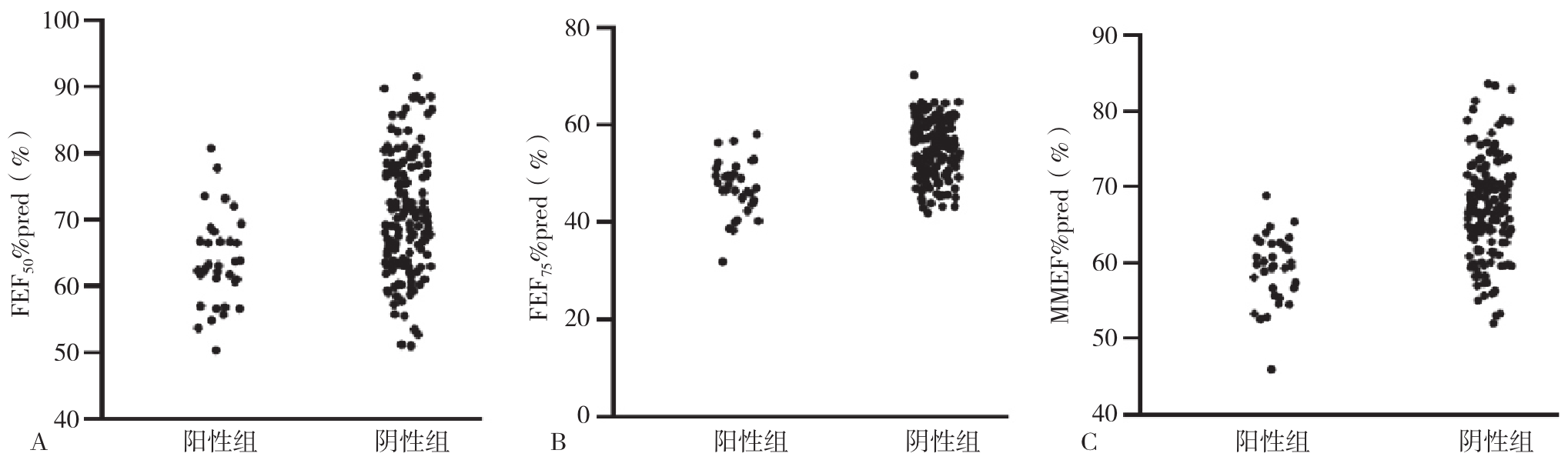
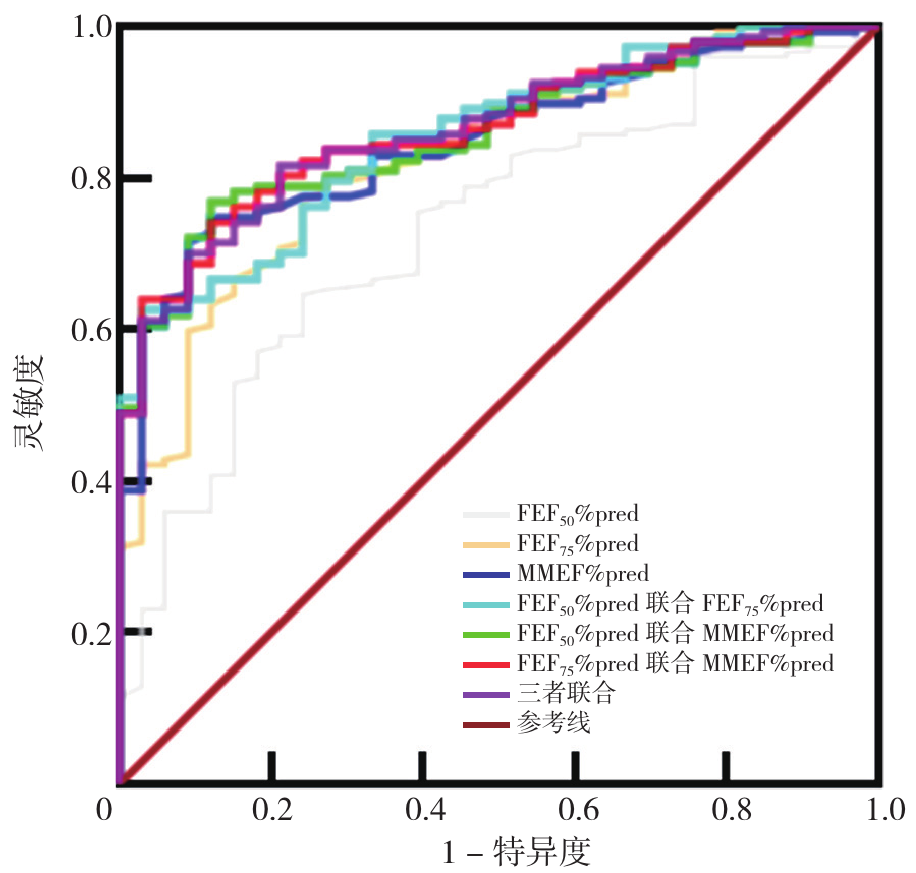
摘要: 背景 临床中对于有喘息、咳嗽、胸闷等哮喘相关症状患儿首先行肺通气功能检查,当第1秒用力呼气容积(FEV1)<70%提示存在明显的气流受限或呼吸道阻塞,应行支气管舒张试验,但部分患儿FEV1正常但小气道功能下降,提示可能存在轻度气流受限或呼吸道阻塞,且进行支气管激发试验较复杂、费用较高、具有一定的危险性、较多基层医院不具备开展的设备和人员条件,但这部分儿童进行支气管舒张试验也可以为阳性,对于哮喘诊断有一定意义。 目的 探讨FEV1、用力肺活量(FVC)及一秒率(FEV1/FVC)正常但小气道功能下降患儿行支气管舒张试验的必要性。 方法 选取2019-05-29—2024-09-20就诊于郑州大学第三附属医院门诊的180例5~14岁有喘息、咳嗽、胸闷等症状的哮喘患儿进行病例对照研究。研究对象已行常规肺通气功能检查及支气管舒张试验,且其常规肺通气功能检查结果显示FEV1、FVC及FEV1/FVC均正常、但小气道功能下降。以FEV1改善率≥12%作为支气管舒张试验阳性判断标准分为阳性组(n=33)及阴性组(n=147),比较两组基本资料及肺通气功能指标。采用Pearson相关性分析探讨小气道功能指标与支气管舒张试验结果的相关性。采用受试者工作特征(ROC)曲线分析小气道功能指标预测支气管舒张试验阳性结果的效能。 结果 支气管舒张试验阳性组患儿用力呼出50%肺活量时的瞬间流量占预测值百分比(FEF50%pred)、用力呼出75%肺活量时的瞬间流量占预测值百分比(FEF75%pred)及最大呼气中期流量占预测值百分比(MMEF%pred)均低于阴性组(P<0.05)。FEF50%pred、FEF75%pred、MMEF%pred与支气管舒张试验结果均具有相关性(P<0.001)。FEF50%pred、FEF75%pred、MMEF%pred预测支气管舒张试验阳性结果的曲线下面积(AUC)分别是0.733(95%CI=0.644~0.822)、0.827(95%CI=0.756~0.898)、0.849(95%CI=0.789~0.909),最佳截断值分别为66.85%、50.00%、63.35%;FEF50%pred联合FEF75%pred、FEF50%pred联合MMEF%pred、FEF75%pred联合MMEF%pred及三指标联合预测支气管舒张试验阳性结果的AUC分别为0.859、0.855、0.865、0.865;三指标联合预测支气管舒张试验阳性结果的AUC值大于FEF50%pred、FEF75%pred指标单独预测(Z=-2.801、-1.994,P=0.005、0.046)。 结论 对于存在喘息、胸闷、咳嗽等哮喘相关症状的患儿,即使FEV1、FVC及FEV1/FVC正常,仍需关注小气道功能指标,当FEF50%pred≤66.85%或FEF75%pred≤50.00%或MMEF%pred≤63.35%时可预测支气管舒张试验阳性结果,应积极行支气管舒张试验以辅助哮喘诊断。

关键词: 哮喘, 支气管哮喘, 儿童, 支气管舒张试验, 小气道功能下降, 第1秒用力呼气容积, 用力肺活量, 一秒率

Abstract:

Background

In clinical practice, children with asthmatic-related symptoms such as wheezing, cough, and chest tightness should first undergo pulmonary ventilation function examination. When forced expiratory volume in one second (FEV1) <70%, which indicates obvious airflow restriction or airway obstruction, and bronchodilation test should be performed. However, some children with normal FEV1 but decreased small airway function may have mild airflow restriction or airway obstruction. In addition, the bronchial stimulation test is complicated, expensive, risky, and more primary hospitals do not have the equipment and personnel conditions to carry out, but the bronchial diastole test for these children can also be positive, which has certain significance for the diagnosis of asthma.

Objective

To investigate the necessity of bronchial diastole test in children with normal FEV1, forced vital capacity (FVC) and FEV1/FVC but decreased small airway function.

Methods

A case-control study was conducted on 180 children with asthma aged 5 to 14 years who had symptoms such as wheezing, coughing and chest tightness and visited the outpatient department of the Third Affiliated Hospital of Zhengzhou University from May 29, 2019 to September 20, 2024. All subjects underwent routine pulmonary ventilation function examination and bronchodilation test, and the results of routine pulmonary ventilation function examination showed that FEV1, FVC and FEV1/FVC were normal, but the small airway function was decreased. Subjects were divided into positive group (n=33) and negative group (n=147) with FEV1 improvement rate≥12% as the positive criterion of bronchodilation test, and the basic data and pulmonary ventilation function indexes of the two groups were compared. The correlation between small airway function index and bronchodilation test was analyzed by Pearson. Receiver operating characteristic (ROC) curve was used to analyze the efficacy of small airway function indicators in predicting positive results of bronchodilation tests.

Results

The forced expiratory flow 50% of vital capacity as a percentage of the predicted value (FEF50%pred), forced expiratory flow 75% of vital capacity as a percentage of the predicted value (FEF75%pred) and maximum mid-expiratory flow as a percentage of the predicted value (MMEF%pred) in positive group were significantly lower than those in negative group (P<0.05). FEF50%pred, FEF75%pred and MMEF%pred were correlated with the results of bronchodilation test (P<0.001). The area under curve (AUC) of FEF50%pred, FEF75%pred and MMEF%pred in predicting positive results of bronchial diastolic tests were 0.733 (95%CI=0.644-0.822) 、0.827 (95%CI=0.756-0.898) 、0.849 (95%CI=0.789-0.909), respectively, and the cut-off values were 66.85%, 50.00% and 63.35%, respectively. The AUC of FEF50%pred combined with FEF75%pred, FEF50%pred combined with MMEF%pred, FEF75%pred combined with MMEF%pred and the combination of the three indexes were 0.859, 0.855, 0.865, 0.865, respectively. The AUC value of positive bronchial diastole test predicted by the combination of the three factors was greater than that predicted by FEF50%pred and FEF75%pred alone (Z=-2.801, -1.994; P=0.005, 0.046).

Conclusion

For children with asthma-related symptoms such as wheezing, chest tightness, and cough, small airway function indicators should be paid attention to even if FEV1, FVC, and FEV1/FVC are normal. When FEF50%pred≤66.85% or FEF75%pred≤50.00% or MMEF%pred≤63.35%, the positive result of bronchial diastole test can be predicted to a certain extent, and bronchial diastole test should be actively performed to assist the diagnosis of asthma.

Key words: Asthma, Bronchial asthma, Child, Bronchodilation test, Decreased small airway function, Forced expiratory volume in one second, Forced vital capacity, Forced expiratory volume in 1 s to forced vital capacity

中图分类号: