中国全科医学 ›› 2026, Vol. 29 ›› Issue (13): 1660-1665.DOI: 10.12114/j.issn.1007-9572.2024.0688

• 论著 • 上一篇    下一篇

高血压患者8年就医行为轨迹及影响因素分析

吴春香1,*(), 田婕2, 郭毅3, 邓波3, 于杰1, 蔡宁1, 沈莉1   

  1. 1.200333 上海市普陀区疾病预防控制中心慢性病防制科
    2.200032 上海市重大传染病和生物安全研究院
    3.200032 上海市,复旦大学公共卫生学院流行病学教研室
  • 收稿日期:2025-10-15 修回日期:2025-12-21 出版日期:2026-05-05 发布日期:2026-04-14
  • 通讯作者: 吴春香

  • 作者贡献:

    吴春香负责提出主要研究目标,负责研究的构思与设计,研究的实施,撰写论文,负责最终版本修订,对论文负责;田婕负责研究指标设计、分析思路和质量控制;郭毅、邓波负责统计学处理,图、表的绘制与展示;于杰、蔡宁负责数据采集和整理;沈莉负责研究实施过程质量控制和指导。

  • 基金资助:
    上海市普陀区卫生健康系统科技创新项目(ptkwws202226)

Analysis of the 8-year Trajectories and Influencing Factors of Medical-help-seeking Behavior of Hypertensive Patients

WU Chunxiang1,*(), TIAN Jie2, GUO Yi3, DENG Bo3, YU Jie1, CAI Ning1, SHEN Li1   

  1. 1. Department of Chronic Disease Prevention and Control, Putuo District Center of Disease Control and Prevention, Shanghai 200333, China
    2. Shanghai Institute of Infectious Disease and Biosecurity, Shanghai 200032, China
    3. Department of Epidemiology, School of Public Health, Fudan University, Shanghai 200032, China
  • Received:2025-10-15 Revised:2025-12-21 Published:2026-05-05 Online:2026-04-14
  • Contact: WU Chunxiang

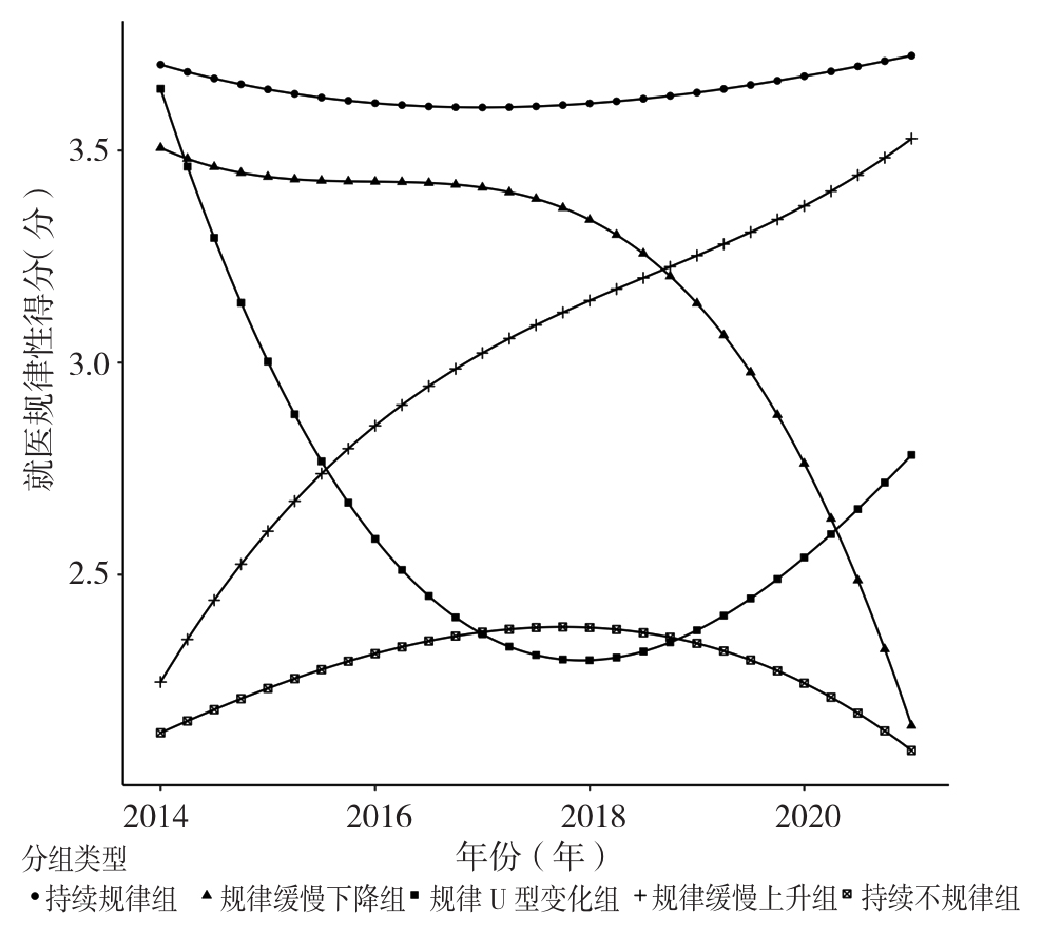
摘要: 背景 高血压已逐渐成为危害人民健康、影响人们生活质量的主要疾病,由于高血压具有病程长、并发症多、基本不可治愈等特点,患者需要长期就医。掌握高血压患者就医行为长期变化趋势及其影响因素情况,对于制订高血压精准防控策略和开展健康服务具有重要意义。 目的 通过对社区管理的高血压患者长期就医行为进行群组轨迹拟合,掌握人群的就医行为轨迹,分析其特征和行为转变因素,为高血压防治政策提供依据。 方法 选取自2014年开始在社区健康档案中有连续记录的8 922例高血压患者为研究对象,通过居民个人电子健康档案系统收集2014—2021年的就诊信息和随访管理信息,采用群组轨迹模型(GBTM)分析患者就医行为改变模式,模拟不同分组行为的转变,匹配出最佳行为轨迹模型;采用方差分析和χ2检验比较不同行为轨迹之间的患者特征;以持续不规律就医组为对照组,采用多因素Logistic回归分析各轨迹组之间的影响因素。 结果 共收集8 922例高血压患者的门诊就诊信息共计444 126条,GBTM拟合结果显示,将就医行为轨迹拟合为5组的模型为最佳,分别为持续规律组(39.84%)、规律缓慢下降组(25.36%)、规律U型变化组(11.43%)、规律缓慢上升组(11.86%)和持续不规律组(14.86%);5组患者性别、年龄、高血压病程、糖尿病史、脑缺血短暂发作史和高血压家族史、规律运动情况比较,差异有统计学意义(P<0.05);以持续不规律就医组为参考,性别、年龄、高血压病程、家族史、糖尿病史和短暂性脑缺血发作史都是就医规律性模式转变的影响因素(P<0.05)。女性和年龄≥75岁患者容易从持续不规律的就医行为转变为持续规律就医或者早期规律就医行为,糖尿病和短暂性脑缺血发作的患者表现为持续不规律就医行为的比值比更低;高血压病程的延长和家族史不利于就医行为模式的转变。 结论 高血压患者的规律就医行为还需长期关注,坚持长期规律就医行为的患者低于40%;对于女性、≥75岁以上、伴有糖尿病或者短暂性脑缺血发作的患者,适当的管理措施容易促使规律就医行为的转变和维持;对于其他类型患者需继续开展分析研究,寻找行为转变的关键因素,促使行为转变的发生。

关键词: 高血压, 就医行为, 行为轨迹, 规律就医, 行为转变, 影响因素分析

Abstract:

Background

Hypertension has become a major health issue, impacting both health and quality of life. Due to its long course of illness, multiple and complex complications, and lack of a cure or correcting deviation, patients require lengthy and continuous support and medical management. Understanding the long-term journey and influencing factors of medical-help-seeking behaviour in hypertensive patients is crucial for developing targeted and patient-centred prevention and control strategies.

Objective

The study aimed to identify and analyze the long-term trajectories of medical-help-seeking behaviour among hypertensive patients who were managed by community health centres of Putuo District in Shanghai City. Using trajectory modeling to determine key behavioral patterns and the influencing factors, the study will inform hypertension prevention and treatment policies.

Methods

Continuous clinical records of 8 922 hypertensive patients were retrieved from Resident Electronic Health Record System of Putuo District in Shanghai from 2014 to 2021. The data include histories, encounters, diagnostic, management and follow-up information. The Group-Based Trajectory Model (GBTM) was applied to analyze the patterns of the medical-help-seeking behaviour change, simulate behavioural transitions, and identify the best fitting model. Analysis of variance and chi square test were employed to examine patient characteristics across diflerent behavioural trajectories. The persistently irregular medical-help-seeking behaviour' group served as the reference group for comparing influencing factors among medical-help-seeking behaviour trajectory groups.

Results

A total of 444 126 outpatient records were retrieved. The GBTM analysis revealed flve distinct medicalhelp-seeking behaviour trajectories: sustained regular (39.84%), regular with a slow decline (25.36%), U-shaped (11.43%), regular with slow increase (11.86%), and persistently irregular (14.86%). Statistical diverences were observed between these groups, including gender, age, illness duration, diabetes history, transient ischemic attack (TIA) history, and family history of high blood pressure, regular exercise habits (P<0.05). Female patients and those aged 75 years or older were more likely to transition from irregular to regular medical-help-seeking behaviour. Patients with diabetes or a history of TIA were less likely to follow irregular medical-help-seeking behaviour. Longer duration of hypertensive history and a family history were associated with a less favorable shift in behaviour.

Conclusion

Less than 40% of hypertensive patients consistently follow a regular medical-help-seeking behaviour. However, appropriate management strategies can promote regular medical-help-seeking behaviour, particularly in females, patients aged 75 years or above, and those with diabetes or a history of TIA. Further research is suggested identifying factors that can encourage medical help-behavioral changes in other medicalhelp-seeking behaviour trajectory groups.

Key words: Hypertension, Medical-help-seeking behavioural, Behavioral trajectories, Regular medical-care- seeking, Behavioral change, Root cause analysis

中图分类号: