
中国全科医学 ›› 2026, Vol. 29 ›› Issue (20): 2836-2845.DOI: 10.12114/j.issn.1007-9572.2025.0414
热伊莱·麦麦提1, 周燚然1, 武云2, 刘稹诚1, 卢耀勤1,3,*( ), 吴海燕3,*()
收稿日期:2025-10-31
修回日期:2025-12-26
出版日期:2026-07-15
发布日期:2026-06-05
通讯作者:
卢耀勤, 吴海燕
作者贡献:
热伊莱·麦麦提负责文章的构思与设计、筛选整理数据、统计学处理、论文撰写;周燚然、武云、刘稹诚提出修改建议;卢耀勤、吴海燕负责文章的质量控制及审校。
基金资助:
REYILAI· Maimaiti1, ZHOU Yiran1, WU Yun2, LIU Zhencheng1, LU Yaoqin1,3,*(), WU Haiyan3,*()
Received:2025-10-31
Revised:2025-12-26
Published:2026-07-15
Online:2026-06-05
Contact:
LU Yaoqin, WU Haiyan
摘要: 背景 高血压是心血管疾病(CVD)的重要危险因素,传统肥胖评估指标BMI在识别高危患者时存在不足,而新型肥胖指标在高血压人群中的预测价值尚待明确。 目的 探讨中国人内脏脂肪指数(CVAI)、身体圆度指数(BRI)、相对脂肪质量指数(RFM)、体质量调整腰围指数(WWI)、甘油三酯-葡萄糖指数(TyG)及其相关指数TyG-BMI、TyG-腰围(TyG-WC)、TyG-腰高比(TyG-WHtR)等新型肥胖指标与高血压患者CVD发病风险的关联,并比较其预测性能,为高血压人群的CVD防治提供依据。 方法 采用回顾性队列研究设计,纳入2016—2022年新疆维吾尔自治区乌鲁木齐市公共卫生监测数据库中69 627名高血压患者为研究对象。收集患者基本信息、一般体格检查指标和实验室检查指标,并计算CVAI、BRI、RFM、WWI、TyG、TyG-BMI、TyG-WC、TyG-WHtR。随访终点为患者首次确诊CVD或研究截止。构建Cox比例风险回归模型和限制性立方样条模型评估不同指标与CVD的发病风险。采用时间依赖性C指数和受试者工作特征(ROC)曲线下面积(AUC)比较不同指标的预测性能。 结果 截至随访终点,共2 466例(3.54%)患者发生CVD。多因素Cox回归分析显示,在调整混杂因素后,CVAI(HR=1.122,95%CI=1.072~1.175)、BRI(HR=1.104,95%CI=1.061~1.149)、RFM(HR=1.236,95%CI=1.141~1.338)、WWI(HR=1.073,95%CI=1.029~1.118)、TyG-BMI(HR=1.099,95%CI=1.054~1.146)、TyG-WC(HR=1.105,95%CI=1.058~1.154)、TyG-WHtR(HR=1.113,95%CI=1.066~1.161)均与CVD风险升高相关(P<0.05)。限制性立方样条分析显示,RFM与CVD风险之间存在显著的非线性剂量-反应关系(Pnonlinear<0.05)。时间依赖性C指数分析显示,各指标判别能力随访时间总体稳定。ROC曲线分析显示,TyG、CVAI、BRI、WWI、TyG-BMI、TyG-WC和TyG-WHtR预测CVD发生风险的AUC分别为0.512、0.568、0.558、0.566、0.518、0.531和0.553。亚组分析结果显示,BRI、RFM、WWI和TyG-WHtR表现出明显的性别交互作用(Pinteraction<0.05)。 结论 在高血压人群中,CVAI、BRI和WWI等新型肥胖指标均与CVD发生风险相关,对CVD的风险评估有一定的参考价值,但其独立预测效能有限。
中图分类号:
| 组别 | 例数 | 年龄[例(%)] | 性别[例(%)] | 居住地[例(%)] | 受教育水平[例(%)] | |||||
|---|---|---|---|---|---|---|---|---|---|---|
| <45岁 | ≥45岁 | 男 | 女 | 农村 | 城市 | 小学及以下 | 初中 | 高中及以上 | ||
| 非CVD组 | 67 161 | 7 907(11.77) | 59 254(88.23) | 32 194(47.94) | 34 967(52.06) | 25 636(38.17) | 41 525(61.83) | 25 814(38.44) | 29 040(43.24) | 12 307(18.32) |
| CVD组 | 2 466 | 76(3.08) | 2 390(96.92) | 1 123(45.54) | 1 343(54.46) | 1 166(47.28) | 1 300(52.72) | 1 259(51.05) | 922(37.39) | 285(11.56) |
| χ2(Z)值 | 176.16a | 5.38a | 83.03a | 176.56a | ||||||
| P值 | <0.001 | 0.020 | <0.001 | <0.001 | ||||||
| 组别 | 婚姻[例(%)] | 锻炼[例(%)] | 吸烟[例(%)] | 饮酒[例(%)] | ||||||
| 未婚 | 已婚 | 离婚 | 丧偶 | 是 | 否 | 是 | 否 | 是 | 否 | |
| 非CVD组 | 1 666(2.48) | 58 391(86.94) | 1 262(1.88) | 5 842(8.70) | 29 538(43.98) | 37 623(56.02) | 10 546(15.70) | 56 615(84.30) | 8 280(12.33) | 58 881(87.67) |
| CVD组 | 18(0.73) | 2 108(85.48) | 35(1.42) | 305(12.37) | 1 179(47.81) | 1 287(52.19) | 349(14.15) | 2 117(85.85) | 244(9.89) | 2 222(90.11) |
| χ2(Z)值 | 69.71a | 13.99a | 4.21a | 12.89a | ||||||
| P值 | <0.001 | <0.001 | 0.040 | <0.001 | ||||||
| 组别 | BMI[例(%)] | 糖尿病[例(%)] | 血脂异常[例(%)] | SBP[M(P25,P75),mmHg] | ||||||
| 正常 | 超重 | 肥胖 | 是 | 否 | 是 | 否 | ||||
| 非CVD组 | 18 811(28.01) | 30 270(45.07) | 18 080(26.92) | 14 681(21.86) | 52 480(78.14) | 26 375(39.27) | 40 786(60.73) | 138(128,147) | ||
| CVD组 | 651(26.40) | 1 098(44.53) | 717(29.08) | 734(29.76) | 1 732(70.24) | 951(38.56) | 1 515(61.44) | 138(129,148) | ||
| χ2(Z)值 | 6.45a | 85.78a | 0.47a | -2.99 | ||||||
| P值 | 0.040 | <0.001 | 0.493 | 0.003 | ||||||
| 组别 | DBP[M(P25,P75),mmHg] | TC[M(P25,P75),mmol/L] | TG[M(P25,P75),mmol/L] | FPG[M(P25,P75),mmol/L] | LDL-C[M(P25,P75),mmol/L] | HDL-C[M(P25,P75),mmol/L] | TyG[M(P25,P75)] | CVAI [M(P25,P75)] | ||
| 非CVD组 | 83(76,90) | 4.90(4.28,5.58) | 1.48(1.07,2.07) | 5.37(4.82,6.06) | 2.57(2.05,3.12) | 1.30(1.10,1.54) | 8.77(8.41,9.16) | 127.87(99.86,155.62) | ||
| CVD组 | 80(75,87) | 4.88(4.22,5.60) | 1.49(1.06,2.01) | 5.52(4.91,6.38) | 2.51(2.00,3.07) | 1.31(1.10,1.55) | 8.79(8.43,9.20) | 137.74(111.69,162.19) | ||
| χ2(Z)值 | 8.23 | 0.87 | 0.86 | -7.40 | 3.00 | -1.00 | -2.00 | -11.52 | ||
| P值 | <0.001 | 0.382 | 0.388 | <0.001 | 0.003 | 0.318 | 0.046 | <0.001 | ||
| 组别 | BRI[M(P25,P75)] | RFM[M(P25,P75)] | WWI[M(P25,P75)] | TyG-BMI[M(P25,P75)] | TyG-WC[M(P25,P75)] | TyG-WHtR[M(P25,P75)] | ||||
| 非CVD组 | 4.32(3.53,5.24) | 33.30(27.26,40.30) | 10.79(10.24,11.36) | 227.51(204.60,252.89) | 788.06(716.52,864.80) | 4.83(4.39,5.30) | ||||
| CVD组 | 4.60(3.76,5.54) | 35.00(28.42,41.06) | 11.00(10.43,11.55) | 230.55(206.09,255.50) | 802.80(729.90,873.18) | 4.96(4.51,5.44) | ||||
| χ2(Z)值 | -9.73 | -7.12 | -11.17 | -3.00 | -5.27 | -8.89 | ||||
| P值 | <0.001 | <0.001 | <0.001 | 0.003 | <0.001 | <0.001 | ||||
表1 非CVD组与CVD组基本情况比较
Table 1 Comparison of basic characteristics between the non-CVD group and the CVD group
| 组别 | 例数 | 年龄[例(%)] | 性别[例(%)] | 居住地[例(%)] | 受教育水平[例(%)] | |||||
|---|---|---|---|---|---|---|---|---|---|---|
| <45岁 | ≥45岁 | 男 | 女 | 农村 | 城市 | 小学及以下 | 初中 | 高中及以上 | ||
| 非CVD组 | 67 161 | 7 907(11.77) | 59 254(88.23) | 32 194(47.94) | 34 967(52.06) | 25 636(38.17) | 41 525(61.83) | 25 814(38.44) | 29 040(43.24) | 12 307(18.32) |
| CVD组 | 2 466 | 76(3.08) | 2 390(96.92) | 1 123(45.54) | 1 343(54.46) | 1 166(47.28) | 1 300(52.72) | 1 259(51.05) | 922(37.39) | 285(11.56) |
| χ2(Z)值 | 176.16a | 5.38a | 83.03a | 176.56a | ||||||
| P值 | <0.001 | 0.020 | <0.001 | <0.001 | ||||||
| 组别 | 婚姻[例(%)] | 锻炼[例(%)] | 吸烟[例(%)] | 饮酒[例(%)] | ||||||
| 未婚 | 已婚 | 离婚 | 丧偶 | 是 | 否 | 是 | 否 | 是 | 否 | |
| 非CVD组 | 1 666(2.48) | 58 391(86.94) | 1 262(1.88) | 5 842(8.70) | 29 538(43.98) | 37 623(56.02) | 10 546(15.70) | 56 615(84.30) | 8 280(12.33) | 58 881(87.67) |
| CVD组 | 18(0.73) | 2 108(85.48) | 35(1.42) | 305(12.37) | 1 179(47.81) | 1 287(52.19) | 349(14.15) | 2 117(85.85) | 244(9.89) | 2 222(90.11) |
| χ2(Z)值 | 69.71a | 13.99a | 4.21a | 12.89a | ||||||
| P值 | <0.001 | <0.001 | 0.040 | <0.001 | ||||||
| 组别 | BMI[例(%)] | 糖尿病[例(%)] | 血脂异常[例(%)] | SBP[M(P25,P75),mmHg] | ||||||
| 正常 | 超重 | 肥胖 | 是 | 否 | 是 | 否 | ||||
| 非CVD组 | 18 811(28.01) | 30 270(45.07) | 18 080(26.92) | 14 681(21.86) | 52 480(78.14) | 26 375(39.27) | 40 786(60.73) | 138(128,147) | ||
| CVD组 | 651(26.40) | 1 098(44.53) | 717(29.08) | 734(29.76) | 1 732(70.24) | 951(38.56) | 1 515(61.44) | 138(129,148) | ||
| χ2(Z)值 | 6.45a | 85.78a | 0.47a | -2.99 | ||||||
| P值 | 0.040 | <0.001 | 0.493 | 0.003 | ||||||
| 组别 | DBP[M(P25,P75),mmHg] | TC[M(P25,P75),mmol/L] | TG[M(P25,P75),mmol/L] | FPG[M(P25,P75),mmol/L] | LDL-C[M(P25,P75),mmol/L] | HDL-C[M(P25,P75),mmol/L] | TyG[M(P25,P75)] | CVAI [M(P25,P75)] | ||
| 非CVD组 | 83(76,90) | 4.90(4.28,5.58) | 1.48(1.07,2.07) | 5.37(4.82,6.06) | 2.57(2.05,3.12) | 1.30(1.10,1.54) | 8.77(8.41,9.16) | 127.87(99.86,155.62) | ||
| CVD组 | 80(75,87) | 4.88(4.22,5.60) | 1.49(1.06,2.01) | 5.52(4.91,6.38) | 2.51(2.00,3.07) | 1.31(1.10,1.55) | 8.79(8.43,9.20) | 137.74(111.69,162.19) | ||
| χ2(Z)值 | 8.23 | 0.87 | 0.86 | -7.40 | 3.00 | -1.00 | -2.00 | -11.52 | ||
| P值 | <0.001 | 0.382 | 0.388 | <0.001 | 0.003 | 0.318 | 0.046 | <0.001 | ||
| 组别 | BRI[M(P25,P75)] | RFM[M(P25,P75)] | WWI[M(P25,P75)] | TyG-BMI[M(P25,P75)] | TyG-WC[M(P25,P75)] | TyG-WHtR[M(P25,P75)] | ||||
| 非CVD组 | 4.32(3.53,5.24) | 33.30(27.26,40.30) | 10.79(10.24,11.36) | 227.51(204.60,252.89) | 788.06(716.52,864.80) | 4.83(4.39,5.30) | ||||
| CVD组 | 4.60(3.76,5.54) | 35.00(28.42,41.06) | 11.00(10.43,11.55) | 230.55(206.09,255.50) | 802.80(729.90,873.18) | 4.96(4.51,5.44) | ||||
| χ2(Z)值 | -9.73 | -7.12 | -11.17 | -3.00 | -5.27 | -8.89 | ||||
| P值 | <0.001 | <0.001 | <0.001 | 0.003 | <0.001 | <0.001 | ||||
| 变量 | 赋值 |
|---|---|
| 心血管疾病 | 否=0,是=1 |
| 性别 | 男=0,女=1 |
| 居住地 | 城市=0,农村=1 |
| 受教育水平 | 小学及以下=0,初中=1,高中及以上=2 |
| 吸烟 | 否=0,是=1 |
| 饮酒 | 否=0,是=1 |
| 锻炼 | 否=0,是=1 |
| 婚姻 | 未婚=0,已婚=1,离婚=2,丧偶=3 |
| 糖尿病 | 否=0,是=1 |
| 血脂异常 | 否=0,是=1 |
表2 变量赋值
Table 2 Variable assignment
| 变量 | 赋值 |
|---|---|
| 心血管疾病 | 否=0,是=1 |
| 性别 | 男=0,女=1 |
| 居住地 | 城市=0,农村=1 |
| 受教育水平 | 小学及以下=0,初中=1,高中及以上=2 |
| 吸烟 | 否=0,是=1 |
| 饮酒 | 否=0,是=1 |
| 锻炼 | 否=0,是=1 |
| 婚姻 | 未婚=0,已婚=1,离婚=2,丧偶=3 |
| 糖尿病 | 否=0,是=1 |
| 血脂异常 | 否=0,是=1 |
| 变量 | 模型1 | 模型2 | 模型3 | |||
|---|---|---|---|---|---|---|
| HR(95%CI) | P值 | HR(95%CI) | P值 | HR(95%CI) | P值 | |
| TyG | 1.045(1.005~1.087) | 0.029 | 1.041(1.000~1.083) | 0.048 | 1.028(0.980~1.079) | 0.252 |
| CVAI | 1.251(1.202~1.302) | <0.001 | 1.117(1.070~1.166) | <0.001 | 1.122(1.072~1.175) | <0.001 |
| BRI | 1.172(1.128~1.217) | <0.001 | 1.120(1.077~1.164) | <0.001 | 1.104(1.061~1.149) | <0.001 |
| RFM | 1.122(1.078~1.167) | <0.001 | 1.268(1.172~1.372) | <0.001 | 1.236(1.141~1.338) | <0.001 |
| WWI | 1.215(1.169~1.263) | <0.001 | 1.088(1.044~1.133) | <0.001 | 1.073(1.029~1.118) | <0.001 |
| TyG-BMI | 1.053(1.013~1.095) | 0.009 | 1.109(1.066~1.154) | <0.001 | 1.099(1.054~1.146) | <0.001 |
| TyG-WC | 1.099(1.057~1.143) | <0.001 | 1.109(1.065~1.154) | <0.001 | 1.105(1.058~1.154) | <0.001 |
| TyG-WHtR | 1.170(1.125~1.216) | <0.001 | 1.124(1.080~1.169) | <0.001 | 1.113(1.066~1.161) | <0.001 |
表3 新型肥胖指标和CVD发病风险的关系
Table 3 Relationship between novel obesity indicators and the risk of CVD across different models
| 变量 | 模型1 | 模型2 | 模型3 | |||
|---|---|---|---|---|---|---|
| HR(95%CI) | P值 | HR(95%CI) | P值 | HR(95%CI) | P值 | |
| TyG | 1.045(1.005~1.087) | 0.029 | 1.041(1.000~1.083) | 0.048 | 1.028(0.980~1.079) | 0.252 |
| CVAI | 1.251(1.202~1.302) | <0.001 | 1.117(1.070~1.166) | <0.001 | 1.122(1.072~1.175) | <0.001 |
| BRI | 1.172(1.128~1.217) | <0.001 | 1.120(1.077~1.164) | <0.001 | 1.104(1.061~1.149) | <0.001 |
| RFM | 1.122(1.078~1.167) | <0.001 | 1.268(1.172~1.372) | <0.001 | 1.236(1.141~1.338) | <0.001 |
| WWI | 1.215(1.169~1.263) | <0.001 | 1.088(1.044~1.133) | <0.001 | 1.073(1.029~1.118) | <0.001 |
| TyG-BMI | 1.053(1.013~1.095) | 0.009 | 1.109(1.066~1.154) | <0.001 | 1.099(1.054~1.146) | <0.001 |
| TyG-WC | 1.099(1.057~1.143) | <0.001 | 1.109(1.065~1.154) | <0.001 | 1.105(1.058~1.154) | <0.001 |
| TyG-WHtR | 1.170(1.125~1.216) | <0.001 | 1.124(1.080~1.169) | <0.001 | 1.113(1.066~1.161) | <0.001 |
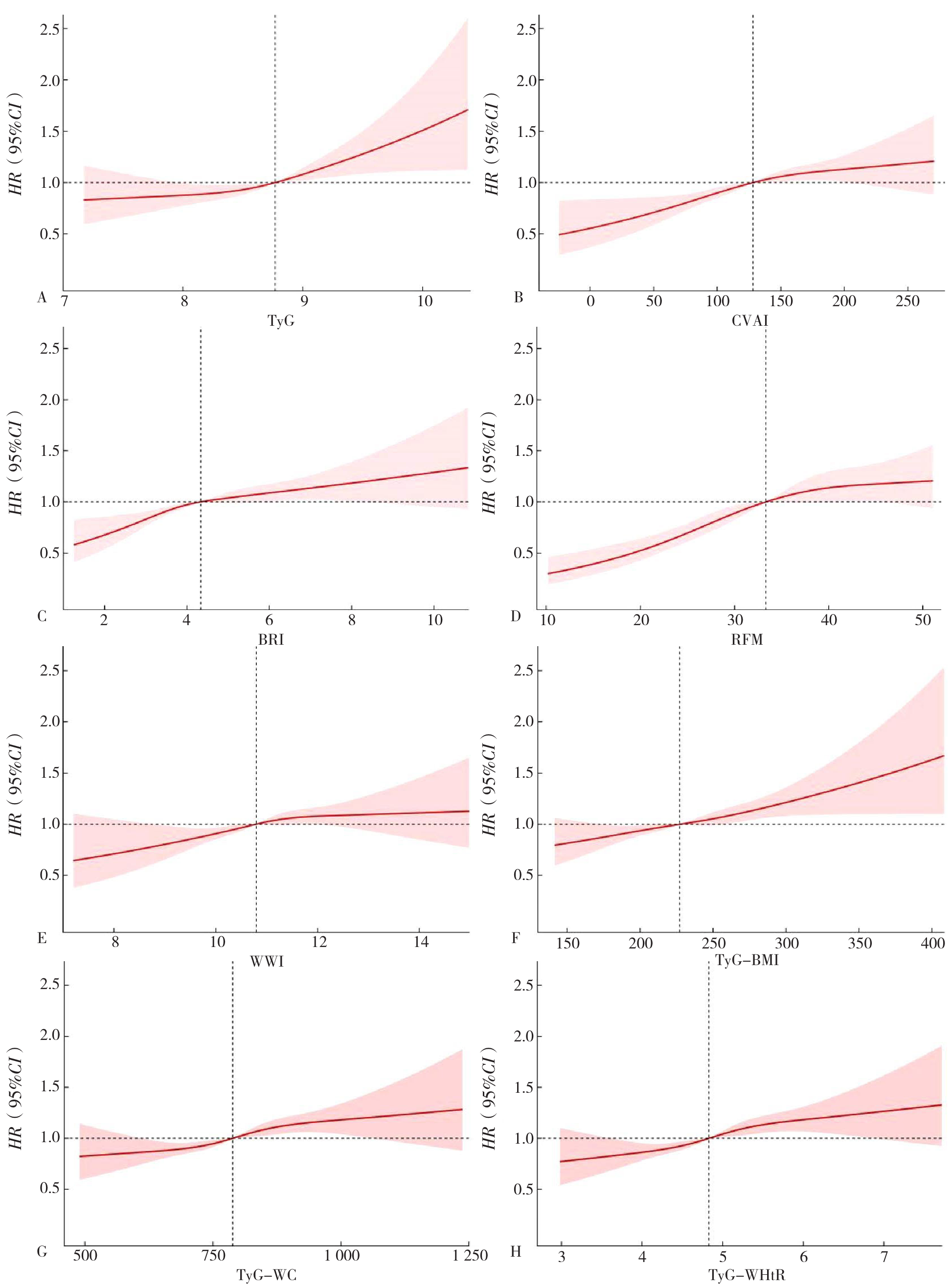
图1 CVD发病风险和新型肥胖指标的RCS曲线注:TyG=甘油三酯-葡萄糖指数,CVAI=中国人内脏脂肪指数,BRI=身体圆度指数,RFM=相对脂肪质量指数,WWI=体质量调整腰围指数,WC=腰围,WHtR=腰高比;A为CVD发病风险和TyG的RCS曲线,B为CVD发病风险和CVAI的RCS曲线,C为CVD发病风险和BRI的RCS曲线,D为CVD发病风险和RFM的RCS曲线,E为CVD发病风险和WWI的RCS曲线,F为CVD发病风险和TyG-BMI的RCS曲线,G为CVD发病风险和TyG-WC的RCS曲线,H为CVD发病风险和TyG-WHtR的RCS曲线。
Figure 1 Restricted cubic spline curve of the relationship between CVD incidence risk and novel obesity indicators
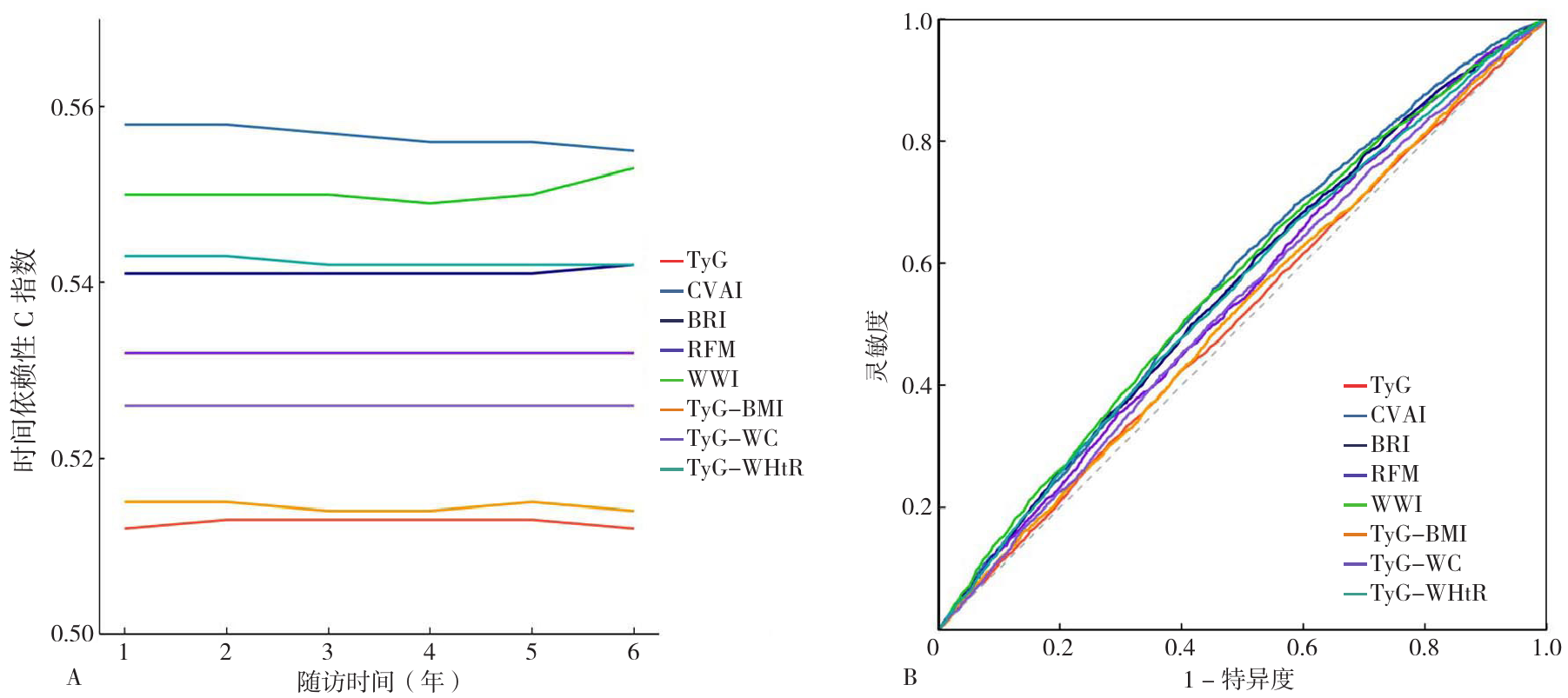
图2 新型肥胖指标C指数和ROC曲线分析注:A为新型肥胖指标时间依赖性C指数图,B为新型肥胖指标ROC曲线。
Figure 2 Predictive performance of novel obesity indices assessed by time-dependent C-index and ROC curves
| 模型 | AUC(95%CI) | P值 | 灵敏度 | 特异度 | 最佳截断值 |
|---|---|---|---|---|---|
| TyG | 0.512(0.500~0.523) | <0.001 | 0.423 | 0.601 | 8.915 |
| CVAI | 0.568(0.557~0.579) | <0.001 | 0.622 | 0.489 | 126.735 |
| BRI | 0.558(0.546~0.569) | <0.001 | 0.608 | 0.481 | 4.255 |
| RFM | 0.542(0.531~0.553) | <0.001 | 0.690 | 0.374 | 29.655 |
| WWI | 0.566(0.555~0.578) | <0.001 | 0.526 | 0.577 | 10.955 |
| TyG-BMI | 0.518(0.506~0.529) | <0.001 | 0.553 | 0.482 | 225.965 |
| TyG-WC | 0.531(0.520~0.543) | <0.001 | 0.498 | 0.557 | 804.040 |
| TyG-WHtR | 0.553(0.541~0.564) | <0.001 | 0.638 | 0.443 | 4.735 |
表4 新型肥胖指标对CVD发病风险的预测价值
Table 4 Predictive value of ovel obesity indices for the risk of incident CVD
| 模型 | AUC(95%CI) | P值 | 灵敏度 | 特异度 | 最佳截断值 |
|---|---|---|---|---|---|
| TyG | 0.512(0.500~0.523) | <0.001 | 0.423 | 0.601 | 8.915 |
| CVAI | 0.568(0.557~0.579) | <0.001 | 0.622 | 0.489 | 126.735 |
| BRI | 0.558(0.546~0.569) | <0.001 | 0.608 | 0.481 | 4.255 |
| RFM | 0.542(0.531~0.553) | <0.001 | 0.690 | 0.374 | 29.655 |
| WWI | 0.566(0.555~0.578) | <0.001 | 0.526 | 0.577 | 10.955 |
| TyG-BMI | 0.518(0.506~0.529) | <0.001 | 0.553 | 0.482 | 225.965 |
| TyG-WC | 0.531(0.520~0.543) | <0.001 | 0.498 | 0.557 | 804.040 |
| TyG-WHtR | 0.553(0.541~0.564) | <0.001 | 0.638 | 0.443 | 4.735 |
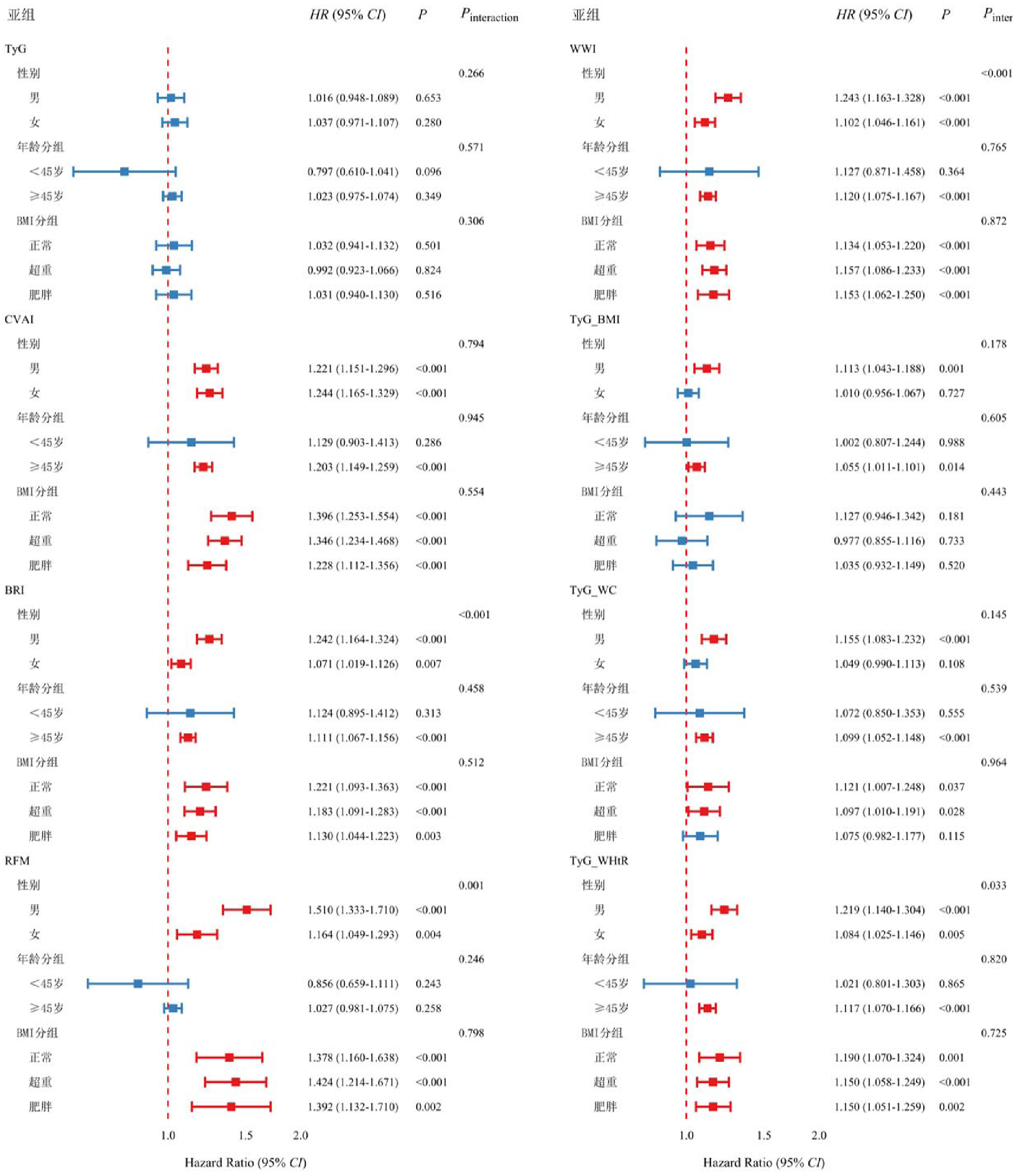
图3 新型肥胖指标与CVD发病风险关联的亚组分析
Figure 3 Subgroup analysis of the association between novel obesity indicesand the risk of incident CVD
| [1] |
|
| [2] |
|
| [3] |
刘明波, 何新叶, 杨晓红, 等. 《中国心血管健康与疾病报告2023》要点解读[J]. 中国心血管杂志, 2024, 29(4): 305-324.DOI: 10.3969/J.ISSN.1006-5725.2025.14.001.
|
| [4] |
|
| [5] |
|
| [6] |
|
| [7] |
|
| [8] |
|
| [9] |
|
| [10] |
|
| [11] |
|
| [12] |
|
| [13] |
|
| [14] |
|
| [15] |
陈红艳, 方奎, 张洁. 甘油三酯-葡萄糖指数与中老年高血压人群脑卒中风险的队列研究[J]. 上海预防医学, 2025, 37(5): 436-440. DOI: 10.19428/j.cnki.sjpm.2025.24453.
|
| [16] |
|
| [17] |
|
| [18] |
阳静,朱晨燕,袁璐,等. TyG指数及TyG-肥胖联合指数与缺血性心脏病发生风险的关联研究[J].四川大学学报(医学版), 2024, 55(5): 1123-1132. DOI: 10.12182/20240960103.
|
| [19] |
中国高血压防治指南修订委员会, 高血压联盟, 中国医疗保健国际交流促进会高血压病学分会, 等. 中国高血压防治指南(2024年修订版)[J]. 中华高血压杂志(中英文), 2024, 32(7): 603-700.DOI: 10.16439/j.issn.1673-7245.2024.07.002.
|
| [20] | |
| [21] |
中国营养学会肥胖防控分会,中国营养学会临床营养分会,中华预防医学会行为健康分会,等. 中国居民肥胖防治专家共识[J]. 中国预防医学杂志, 2022, 23(5): 321-339.DOI: 10.16506/j.1009-6639.2022.05.001.
|
| [22] |
王增武, 刘静, 李建军, 等. 中国血脂管理指南(2023年)[J]. 中国循环杂志, 2023, 38(3): 237-271
|
| [23] |
刘炜达, 刘玉霞, 冷志伟. 不同腹型肥胖指标对老年人群心血管疾病的预测价值比较研究[J]. 实用预防医学, 2024, 31(10): 1168-1171, 1199. DOI: 10.3969/j.issn.1006-3110.2024.10.004.
|
| [24] |
|
| [25] |
|
| [26] |
|
| [27] |
|
| [28] |
|
| [29] |
|
| [30] |
|
| [31] |
|
| [32] |
|
| [33] |
|
| [34] |
|
| [35] |
奎银美, 胡阳, 高桂英, 等. 胰岛素抵抗与高血压及其靶器官损害的研究进展[J]. 西南医科大学学报, 2026, 49(1): 113-119
|
| [36] |
|
| [37] |
|
| [38] |
|
| [39] |
杨文艳, 李靓, 田晶, 等. 中老年女性高血压患者相对脂肪质量指数与全因死亡风险的因果关联研究[J]. 中华疾病控制杂志, 2024, 28(10): 1149-1155. DOI: 10.16462/j.cnki.zhjbkz.2024.10.006.
|
| [40] |
|
| [41] |
陈婉兰, 何佳林, 杨嘉璐, 等. 华南体重正常人群相对脂肪质量指数升高与代谢疾病关联研究[J]. 华南预防医学, 2025, 51(10): 1076-1080, 1086. DOI: 10.12183/J.SCJPM.2025.1076.
|
| [42] |
陈慧龙, 廖芸楚, 刘育伟, 等. 相对脂肪量与中老年人群心血管疾病之间的关联:一项基于CHARLS的横断面与纵向研究[J]. 中国全科医学, 2025, 28(32): 4047-4054. DOI: 10.12114/j.issn.1007-9572.2025.0070.
|
| [43] |
|
| [44] |
|
| [45] |
邵苗苗, 陈争珍. 中国人内脏脂肪指数与中老年人群脑卒中发病风险的前瞻性关联[J]. 协和医学杂志, 2025, 16(4): 922-929. DOI: 10.12290/xhyxzz.2024-0540.
|
| [46] |
|
| [47] |
|
| [48] |
|
| [49] |
|
| [50] |
|
| [51] |
|
| [52] |
|
| [53] |
|
| [54] |
|
| [1] | 周小娅, 王卫凯, 刘倩, 李建华, 孙波, 王燕侠. 孕期睡眠质量与褪黑素受体1B基因多态性交互作用对妊娠期高血压的影响研究[J]. 中国全科医学, 2026, 29(21): 2975-2981. |
| [2] | 柴智浩, 张维森, 罗娇玲, 朱峰, 朱彤, 靳雅丽, 潘静, 卢映君, 江朝强. 中老年人社会经济状况在少儿期父母文化与认知功能间的中介效应:基于广州生物库队列研究[J]. 中国全科医学, 2026, 29(21): 2959-2966. |
| [3] | 韩聪聪, 邱欣雨, 单春方, 宋宁, 陈清杰, 穆拉迪力·阿卜杜热合曼, 李晓梅, 杨毅宁, 赵倩. 代谢肥胖表型对急性冠脉综合征患者经皮冠状动脉介入治疗远期预后的影响研究[J]. 中国全科医学, 2026, 29(21): 2950-2958. |
| [4] | 刘帅, 苑世朝, 刘琰, 贾硕贤, 赵岩, 王紫怡, 周春华, 于静. 两性霉素B治疗侵袭性真菌病的疗效、安全性及经济性评价:一项回顾性队列研究[J]. 中国全科医学, 2026, 29(21): 2967-2974. |
| [5] | 张小娟, 刘阳, 彭博, 叶媛, 朱坤. 基层医疗卫生机构高血压和糖尿病防治现状研究[J]. 中国全科医学, 2026, 29(19): 2614-2620. |
| [6] | 胡敏, 吕向东. 远程心电人工智能诊断的准确性研究[J]. 中国全科医学, 2026, 29(18): 2498-2503. |
| [7] | 苗境杰, 张晋雯, 吴千豪, 韩佩佩. 间歇性禁食对心血管代谢疾病影响的研究进展[J]. 中国全科医学, 2026, 29(18): 2538-2545. |
| [8] | 徐萍, 马艳, 黄莉, 何梅亮, 侯云凤, 王德旺, 孙盼盼, 刘峥, 郭艳芳, 徐英. 社区成年人体重调整腰围指数与高血压、糖尿病和血脂异常共病的关联研究[J]. 中国全科医学, 2026, 29(16): 2198-2204. |
| [9] | 邱欣雨, 赵倩, 陈玉斐, 加木勒·买买提依明, 韩聪聪, 爱克丹·艾尔肯, 李晓梅, 杨毅宁. 体重状态及其代谢特征对收缩压纵向轨迹的影响:一项队列研究[J]. 中国全科医学, 2026, 29(15): 2006-2013. |
| [10] | 刘帆, 陈秋雨, 李婧. 亚临床高风险人群夜间高血压筛查模型的构建与验证:一项单中心队列研究[J]. 中国全科医学, 2026, 29(15): 1998-2005. |
| [11] | 甄锐, 谷旭放, 高晟玮, 张博文, 任真娟, 杨睿璇. 1990—2021年中国归因于代谢风险因素的心血管疾病负担及2022—2035年趋势预测研究[J]. 中国全科医学, 2026, 29(15): 2077-2083. |
| [12] | 刘天缘, 桑婉玥, 彭继平, 程思怡, 黄伊伊, 李欧文, 江洪, 周晓亚. 神经丝轻链蛋白与夜间高血压患者左心室肥厚发生风险的相关性研究[J]. 中国全科医学, 2026, 29(15): 2014-2021. |
| [13] | 邱艳丽, 高永银, 卞雪艳, 王雪, 李越. 脉搏波传导速度对癌症患者全因和心血管相关死亡率的预测价值研究[J]. 中国全科医学, 2026, 29(14): 1890-1897. |
| [14] | 王斯曼, 张梦楚, 李文, 许艾, 徐璡, 郭睿, 燕海霞. 基于中医证候及脉图参数构建原发性高血压伴左心室肥厚风险预测模型研究[J]. 中国全科医学, 2026, 29(14): 1840-1848. |
| [15] | 吴春香, 田婕, 郭毅, 邓波, 于杰, 蔡宁, 沈莉. 高血压患者8年就医行为轨迹及影响因素分析[J]. 中国全科医学, 2026, 29(13): 1660-1665. |
| 阅读次数 | ||||||
|
全文 |
|
|||||
|
摘要 |
|
|||||