
中国全科医学 ›› 2026, Vol. 29 ›› Issue (23): 3294-3306.DOI: 10.12114/j.issn.1007-9572.2025.0358
袁杭滔1, 洪妍2, 袁沛宏3, 林博1, 崔晓云4, 李伟炜5,*( )
)
收稿日期:2025-08-12
修回日期:2025-12-30
出版日期:2026-08-15
发布日期:2026-07-03
通讯作者:
李伟炜
作者贡献:
袁杭滔负责研究的思路构思、数据分析、绘制图表与文章撰写;洪妍进行数据的整理与协助撰写;袁沛宏负责文章撰写及语言润色;林博负责统计学计算及提出修改建议;崔晓云负责文章的思路指导与文章修改;李伟炜负责文章的思路指导,质量控制与审查,对文章整体负责,监督管理。
基金资助:
YUAN Hangtao1, HONG Yan2, YUAN Peihong3, LIN Bo1, CUI Xiaoyun4, LI Weiwei5,*()
Received:2025-08-12
Revised:2025-12-30
Published:2026-08-15
Online:2026-07-03
Contact:
LI Weiwei
摘要: 背景 心血管疾病是我国人群的常见疾病,心脏代谢性共病(CMM)是其中常见的共病类型,绝经后女性是心血管疾病的高发人群,但针对该人群CMM风险的预测模型尚缺少。 目的 基于中国健康与养老追踪调查(CHARLS)队列,开发可解释机器学习(ML)模型预测中国绝经后女性CMM风险。 方法 本研究纳入2011年参与CHARLS队列且未患有CMM的年龄≥45岁的绝经后女性,收集人口学特征、家庭特征、健康状况及实验室检查指标等特征资料,并于2013年、2015年、2018年、2020年进行随访和数据收集,观察CMM发生情况。通过最小绝对收缩和选择运算符(LASSO)算法方法进行特征选择,构建7种ML算法进行风险预测,对最优模型的测试集采用"class_weight='balanced’动态平衡权重+最优阈值筛选"优化模型并应用Shapley加法解释(SHAP)进行可视化分析;以受试者工作特征曲线下面积(AUC)、灵敏度、特异度、准确率和F1分数评估模型性能。 结果 共有5 575名参与者完成4轮随访并纳入此项研究,其中非CMM者4 363例,CMM者1 212例;中位随访9年,CMM累积发病率为21.74%。LASSO回归确定了22个关键特征作为CMM的重要预测因子:健康自评、精神疾病、关节炎、血脂异常、肾脏疾病、是否退休、收缩压(SBP)、舒张压(DBP)、平均脉搏、腰围、BMI、头痛、腰痛、血肌酐(Scr)、甘油三酯(TG)、C反应蛋白(CRP)、糖化血红蛋白(HbA1c)、尿酸(UA)、年龄、流调中心抑郁量表(CES-D)、吸烟、所属地区。各模型中,逻辑回归(LR)模型预测性能最优(测试集AUC=0.758,准确率为79.2%)。SHAP平均值条形图显示核心预测因子为:SBP、HbA1c、所属地区、腰围、CES-D、BMI、DBP、年龄。SHAP汇总图显示,SBP、HbA1c、腰围等与较高的CMM风险预测值相关。 结论 本研究针对中国绝经后女性的CMM风险开发了一个临床可视化预测模型,LR算法在其中表现出良好性能;SBP、HbA1c、腰围等特征是关键风险因素;该模型可为高危人群筛查和个体化干预提供循证依据。
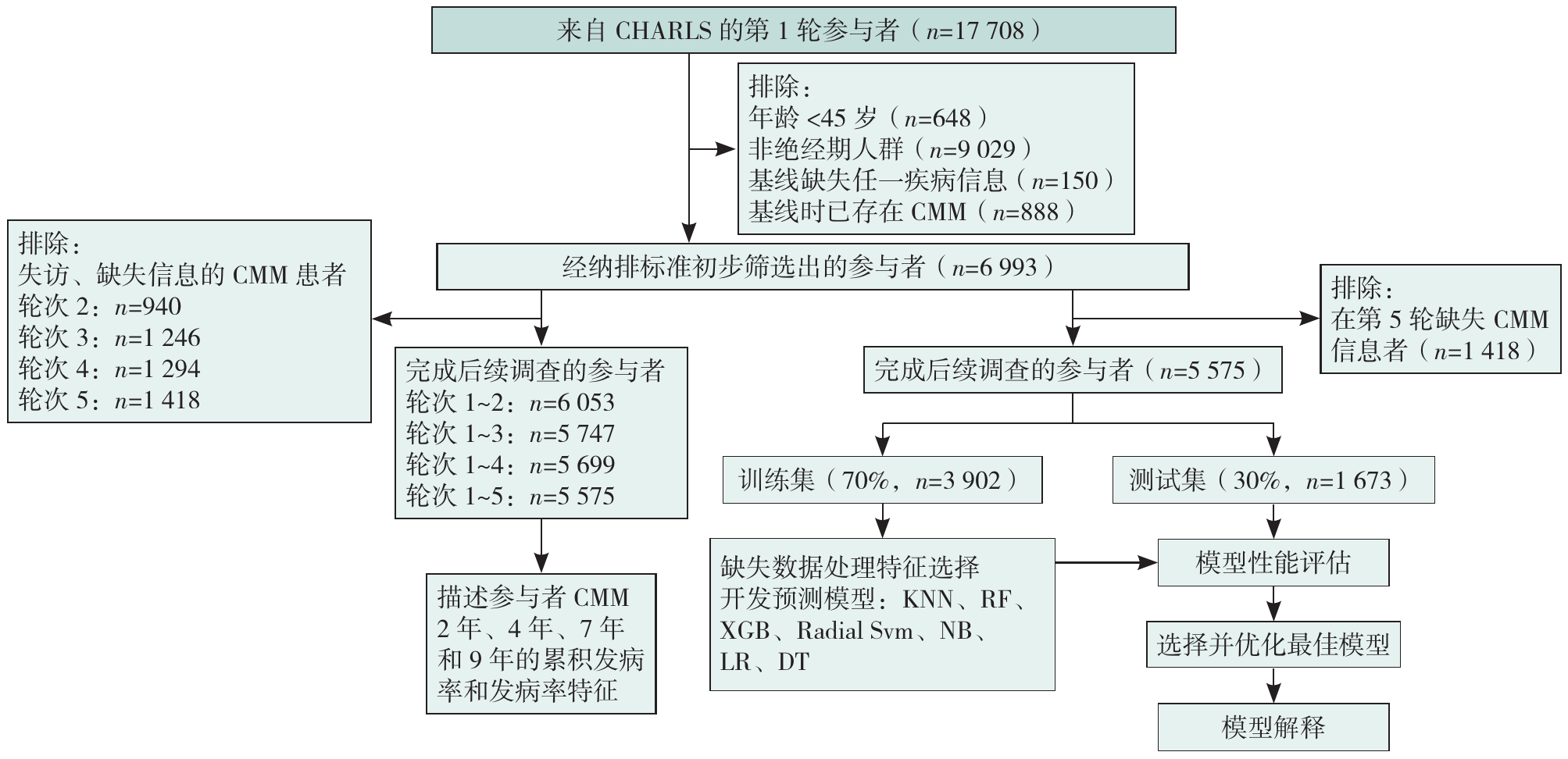
图1 参与者筛选流程图注:CHARLS=中国健康与养老追踪调查,CMM=心脏代谢性共病,KNN=K最近邻,RF=随机森林,XGB=极限梯度提升,Radial Svm=径向基支持向量机,NB=朴素贝叶斯,LR=逻辑回归,DT=决策树。
Figure 1 Participants screening flow chart
| 组别 | 例数 | 年龄[M(P25,P75),岁] | 婚姻状况[例(%)] | 居住地[例(%)] | 血脂异常[例(%)] | ||||
|---|---|---|---|---|---|---|---|---|---|
| 其他 | 已婚/同居 | 城市 | 农村 | 无 | 有 | ||||
| 非CMM者 | 4 363 | 56.0(49.0,62.0) | 492(11.28) | 3 871(88.72) | 1 552(35.57) | 2 811(64.43) | 4 100(93.97) | 263(6.03) | |
| CMM者 | 1 212 | 59.0(53.0,65.0) | 182(15.02) | 1 030(84.98) | 455(37.54) | 757(62.46) | 1 052(86.80) | 160(13.20) | |
| χ2(Z)值 | -10.54a | 12.48 | 1.60 | 69.61 | |||||
| P值 | <0.001 | <0.001 | 0.206 | <0.001 | |||||
| 组别 | 肾脏疾病[例(%)] | 受教育水平[例(%)] | 饮酒史[例(%)] | ||||||
| 无 | 有 | 小学以下 | 小学 | 中学 | 大学及以上 | 无 | 有 | ||
| 非CMM者 | 4 187(95.97) | 176(4.03) | 2 529(57.96) | 749(17.17) | 712(16.32) | 373(8.55) | 3 717(85.19) | 646(14.81) | |
| CMM者 | 1 131(93.32) | 81(6.68) | 736(60.73) | 207(17.08) | 184(15.18) | 85(7.01) | 1 022(84.32) | 190(15.68) | |
| χ2(Z)值 | 15.14 | 4.73 | 0.56 | ||||||
| P值 | <0.001 | 0.193 | 0.453 | ||||||
| 组别 | 吸烟史[例(%)] | 所属地区[例(%)] | |||||||
| 无 | 有 | 东北地区 | 华北地区 | 华中地区 | 东南沿海地区 | 华东地区 | 西北地区 | 西南地区 | |
| 非CMM者 | 4 124(94.52) | 239(5.48) | 242(5.55) | 445(10.20) | 702(16.09) | 570(13.06) | 1 262(28.93) | 289(6.62) | 853(19.55) |
| CMM者 | 1 146(94.55) | 66(5.45) | 90(7.43) | 201(16.58) | 226(18.65) | 100(8.25) | 330(27.23) | 95(7.84) | 170(14.03) |
| χ2(Z)值 | <0.01 | 79.77 | |||||||
| P值 | 0.965 | <0.001 | |||||||
表1 研究对象的基线特征比较
Table 1 Comparison of baseline characteristics of the study population
| 组别 | 例数 | 年龄[M(P25,P75),岁] | 婚姻状况[例(%)] | 居住地[例(%)] | 血脂异常[例(%)] | ||||
|---|---|---|---|---|---|---|---|---|---|
| 其他 | 已婚/同居 | 城市 | 农村 | 无 | 有 | ||||
| 非CMM者 | 4 363 | 56.0(49.0,62.0) | 492(11.28) | 3 871(88.72) | 1 552(35.57) | 2 811(64.43) | 4 100(93.97) | 263(6.03) | |
| CMM者 | 1 212 | 59.0(53.0,65.0) | 182(15.02) | 1 030(84.98) | 455(37.54) | 757(62.46) | 1 052(86.80) | 160(13.20) | |
| χ2(Z)值 | -10.54a | 12.48 | 1.60 | 69.61 | |||||
| P值 | <0.001 | <0.001 | 0.206 | <0.001 | |||||
| 组别 | 肾脏疾病[例(%)] | 受教育水平[例(%)] | 饮酒史[例(%)] | ||||||
| 无 | 有 | 小学以下 | 小学 | 中学 | 大学及以上 | 无 | 有 | ||
| 非CMM者 | 4 187(95.97) | 176(4.03) | 2 529(57.96) | 749(17.17) | 712(16.32) | 373(8.55) | 3 717(85.19) | 646(14.81) | |
| CMM者 | 1 131(93.32) | 81(6.68) | 736(60.73) | 207(17.08) | 184(15.18) | 85(7.01) | 1 022(84.32) | 190(15.68) | |
| χ2(Z)值 | 15.14 | 4.73 | 0.56 | ||||||
| P值 | <0.001 | 0.193 | 0.453 | ||||||
| 组别 | 吸烟史[例(%)] | 所属地区[例(%)] | |||||||
| 无 | 有 | 东北地区 | 华北地区 | 华中地区 | 东南沿海地区 | 华东地区 | 西北地区 | 西南地区 | |
| 非CMM者 | 4 124(94.52) | 239(5.48) | 242(5.55) | 445(10.20) | 702(16.09) | 570(13.06) | 1 262(28.93) | 289(6.62) | 853(19.55) |
| CMM者 | 1 146(94.55) | 66(5.45) | 90(7.43) | 201(16.58) | 226(18.65) | 100(8.25) | 330(27.23) | 95(7.84) | 170(14.03) |
| χ2(Z)值 | <0.01 | 79.77 | |||||||
| P值 | 0.965 | <0.001 | |||||||
| 变量 | 2013年 | 2015年 | 2018年 | 2020年 | ||||
|---|---|---|---|---|---|---|---|---|
| 例数 | CMM | 例数 | CMM | 例数 | CMM | 例数 | CMM | |
| 年龄 | ||||||||
| 45~60岁 | 3 842 | 93(2.42) | 3 707 | 261(7.04) | 3 765 | 575(15.27) | 3 760 | 701(18.64) |
| >60岁 | 2 211 | 91(4.12) | 2 040 | 227(11.13) | 1 934 | 469(24.25) | 1 815 | 511(28.15) |
| χ2值 | 13.68 | 28.28 | 68.83 | 65.08 | ||||
| P值 | <0.001 | <0.001 | <0.001 | <0.001 | ||||
| 婚姻状况 | ||||||||
| 已婚/同居 | 5 172 | 145(2.80) | 4 947 | 392(7.92) | 4 957 | 866(16.74) | 4 901 | 1 030(21.02) |
| 其他 | 881 | 39(4.43) | 800 | 96(12.00) | 742 | 178(23.99) | 674 | 182(27.00) |
| χ2值 | 6.73 | 14.72 | 18.33 | 12.48 | ||||
| P值 | 0.013 | <0.001 | <0.001 | <0.001 | ||||
| 受教育水平 | ||||||||
| 小学以下 | 3 612 | 113(3.13) | 3 465 | 315(9.09) | 3 371 | 645(19.13) | 3 265 | 738(22.60) |
| 小学 | 1 011 | 26(2.57) | 954 | 73(7.65) | 968 | 175(18.08) | 958 | 207(21.61) |
| 中学 | 934 | 24(2.57) | 901 | 69(7.66) | 885 | 149(16.84) | 894 | 182(20.36) |
| 大学及以上 | 496 | 21(4.23) | 427 | 31(7.26) | 475 | 75(15.79) | 458 | 85(18.56) |
| χ2值 | 3.95 | 4.11 | 4.86 | 5.17 | ||||
| P值 | 0.267 | 0.250 | 0.182 | 0.160 | ||||
| 饮酒史 | ||||||||
| 无 | 5 294 | 165(3.12) | 5 038 | 447(8.87) | 4 978 | 918(18.44) | 4 872 | 1 069(21.94) |
| 有 | 759 | 19(2.50) | 709 | 41(5.78) | 721 | 126(17.48) | 703 | 143(20.34) |
| χ2值 | 0.85 | 7.64 | 0.39 | 0.92 | ||||
| P值 | 0.419 | 0.007 | 0.565 | 0.361 | ||||
| 吸烟史 | ||||||||
| 无 | 5 688 | 171(3.01) | 5 408 | 465(8.60) | 5 375 | 982(18.27) | 5 270 | 1 146(21.75) |
| 有 | 365 | 13(3.56) | 339 | 23(6.78) | 324 | 62(19.14) | 305 | 66(21.64) |
| χ2值 | 0.36 | 1.35 | 0.15 | <0.01 | ||||
| P值 | 0.659 | 0.288 | 0.751 | 1.000 | ||||
| 所属地区 | ||||||||
| 东北地区 | 419 | 22(5.25) | 386 | 50(12.95) | 378 | 92(24.34) | 342 | 94(27.49) |
| 华北地区 | 714 | 39(5.46) | 662 | 102(15.41) | 684 | 185(27.05) | 651 | 195(29.95) |
| 华中地区 | 997 | 31(3.11) | 922 | 74(8.03) | 938 | 185(19.72) | 930 | 225(24.19) |
| 东南沿海地区 | 723 | 14(1.94) | 705 | 29(4.11) | 667 | 73(10.94) | 679 | 101(14.87) |
| 华东地区 | 1 678 | 43(2.56) | 1 592 | 118(7.41) | 1 583 | 280(17.69) | 1 579 | 333(21.09) |
| 西北地区 | 436 | 19(4.36) | 418 | 52(12.44) | 405 | 83(20.49) | 379 | 95(25.07) |
| 西南地区 | 1 086 | 16(1.47) | 1 062 | 63(5.93) | 1 044 | 146(13.98) | 1 015 | 169(16.65) |
| χ2值 | 37.07 | 88.02 | 84.26 | 72.86 | ||||
| P值 | <0.001 | <0.001 | <0.001 | <0.001 | ||||
表2 不同基线特征者2013年、2015年、2018年和2020年CMM累积发病率比较[例(%)]
Table 2 Comparison of cumulative incidence of CMM in 2013, 2015, 2018 and 2020 among individuals with different baseline characteristics
| 变量 | 2013年 | 2015年 | 2018年 | 2020年 | ||||
|---|---|---|---|---|---|---|---|---|
| 例数 | CMM | 例数 | CMM | 例数 | CMM | 例数 | CMM | |
| 年龄 | ||||||||
| 45~60岁 | 3 842 | 93(2.42) | 3 707 | 261(7.04) | 3 765 | 575(15.27) | 3 760 | 701(18.64) |
| >60岁 | 2 211 | 91(4.12) | 2 040 | 227(11.13) | 1 934 | 469(24.25) | 1 815 | 511(28.15) |
| χ2值 | 13.68 | 28.28 | 68.83 | 65.08 | ||||
| P值 | <0.001 | <0.001 | <0.001 | <0.001 | ||||
| 婚姻状况 | ||||||||
| 已婚/同居 | 5 172 | 145(2.80) | 4 947 | 392(7.92) | 4 957 | 866(16.74) | 4 901 | 1 030(21.02) |
| 其他 | 881 | 39(4.43) | 800 | 96(12.00) | 742 | 178(23.99) | 674 | 182(27.00) |
| χ2值 | 6.73 | 14.72 | 18.33 | 12.48 | ||||
| P值 | 0.013 | <0.001 | <0.001 | <0.001 | ||||
| 受教育水平 | ||||||||
| 小学以下 | 3 612 | 113(3.13) | 3 465 | 315(9.09) | 3 371 | 645(19.13) | 3 265 | 738(22.60) |
| 小学 | 1 011 | 26(2.57) | 954 | 73(7.65) | 968 | 175(18.08) | 958 | 207(21.61) |
| 中学 | 934 | 24(2.57) | 901 | 69(7.66) | 885 | 149(16.84) | 894 | 182(20.36) |
| 大学及以上 | 496 | 21(4.23) | 427 | 31(7.26) | 475 | 75(15.79) | 458 | 85(18.56) |
| χ2值 | 3.95 | 4.11 | 4.86 | 5.17 | ||||
| P值 | 0.267 | 0.250 | 0.182 | 0.160 | ||||
| 饮酒史 | ||||||||
| 无 | 5 294 | 165(3.12) | 5 038 | 447(8.87) | 4 978 | 918(18.44) | 4 872 | 1 069(21.94) |
| 有 | 759 | 19(2.50) | 709 | 41(5.78) | 721 | 126(17.48) | 703 | 143(20.34) |
| χ2值 | 0.85 | 7.64 | 0.39 | 0.92 | ||||
| P值 | 0.419 | 0.007 | 0.565 | 0.361 | ||||
| 吸烟史 | ||||||||
| 无 | 5 688 | 171(3.01) | 5 408 | 465(8.60) | 5 375 | 982(18.27) | 5 270 | 1 146(21.75) |
| 有 | 365 | 13(3.56) | 339 | 23(6.78) | 324 | 62(19.14) | 305 | 66(21.64) |
| χ2值 | 0.36 | 1.35 | 0.15 | <0.01 | ||||
| P值 | 0.659 | 0.288 | 0.751 | 1.000 | ||||
| 所属地区 | ||||||||
| 东北地区 | 419 | 22(5.25) | 386 | 50(12.95) | 378 | 92(24.34) | 342 | 94(27.49) |
| 华北地区 | 714 | 39(5.46) | 662 | 102(15.41) | 684 | 185(27.05) | 651 | 195(29.95) |
| 华中地区 | 997 | 31(3.11) | 922 | 74(8.03) | 938 | 185(19.72) | 930 | 225(24.19) |
| 东南沿海地区 | 723 | 14(1.94) | 705 | 29(4.11) | 667 | 73(10.94) | 679 | 101(14.87) |
| 华东地区 | 1 678 | 43(2.56) | 1 592 | 118(7.41) | 1 583 | 280(17.69) | 1 579 | 333(21.09) |
| 西北地区 | 436 | 19(4.36) | 418 | 52(12.44) | 405 | 83(20.49) | 379 | 95(25.07) |
| 西南地区 | 1 086 | 16(1.47) | 1 062 | 63(5.93) | 1 044 | 146(13.98) | 1 015 | 169(16.65) |
| χ2值 | 37.07 | 88.02 | 84.26 | 72.86 | ||||
| P值 | <0.001 | <0.001 | <0.001 | <0.001 | ||||
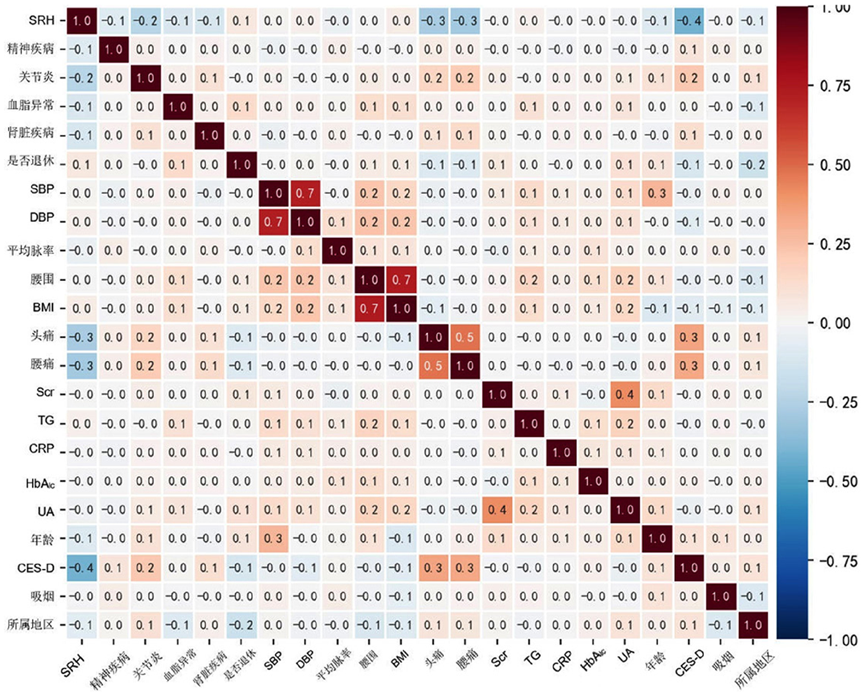
图2 特征相关性热力图注:SRH=健康自评,SBP=收缩压,DBP=舒张压,Scr=血肌酐,TG=甘油三酯,CRP=C反应蛋白,HbA1c=糖化血红蛋白,UA=尿酸,CES-D=流调中心抑郁量表。
Figure 2 Feature correlation heatmap
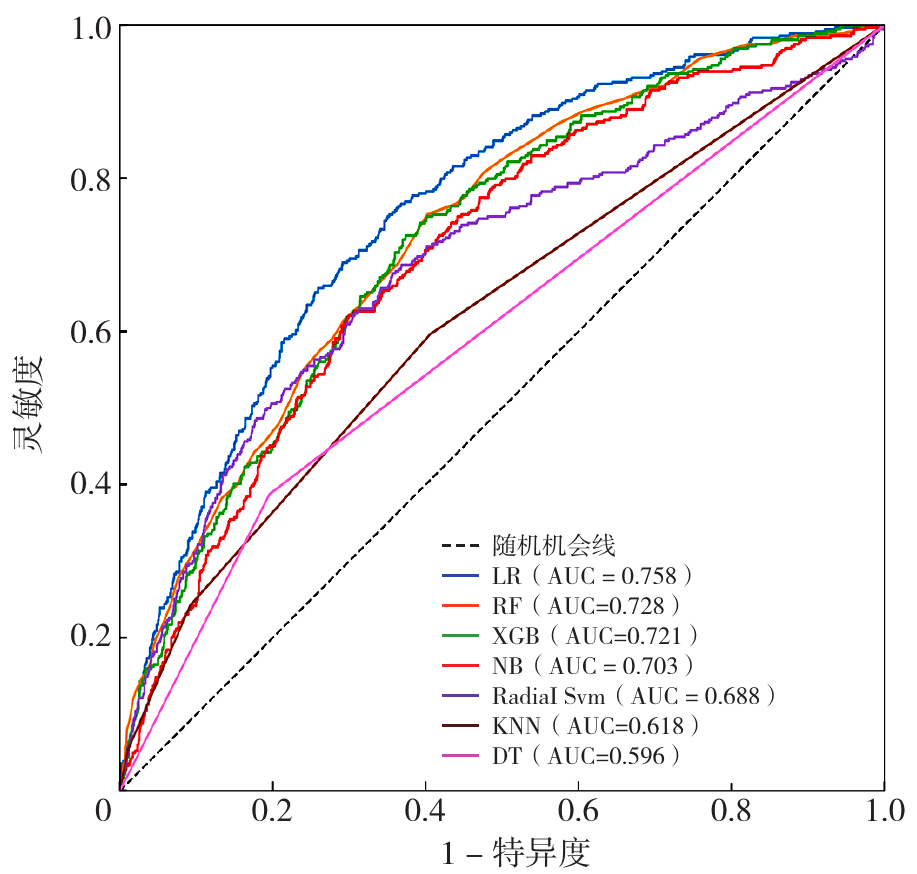
图3 7种ML模型基于测试集的ROC曲线注:AUC=受试者工作特征曲线下面积。
Figure 3 Receiver operating characteristic curves for seven ML models based on the testing set
| 模型 | 准确率(%) | 灵敏度(%) | 特异度(%) | F1分数 | AUC |
|---|---|---|---|---|---|
| LR | 79.2 | 22.5 | 95.0 | 0.320 | 0.758 |
| RF | 79.1 | 15.1 | 96.9 | 0.240 | 0.728 |
| XGB | 77.3 | 26.4 | 91.5 | 0.336 | 0.721 |
| NB | 74.1 | 36.5 | 84.6 | 0.381 | 0.703 |
| Radial Svm | 78.7 | 8.5 | 98.2 | 0.148 | 0.688 |
| KNN | 76.3 | 24.2 | 90.8 | 0.308 | 0.618 |
| DT | 71.4 | 38.7 | 80.4 | 0.371 | 0.596 |
表3 基于测试集7种机器学习模型的预测性能指标
Table 3 The predictive performance metrics for seven ML models based on testing set
| 模型 | 准确率(%) | 灵敏度(%) | 特异度(%) | F1分数 | AUC |
|---|---|---|---|---|---|
| LR | 79.2 | 22.5 | 95.0 | 0.320 | 0.758 |
| RF | 79.1 | 15.1 | 96.9 | 0.240 | 0.728 |
| XGB | 77.3 | 26.4 | 91.5 | 0.336 | 0.721 |
| NB | 74.1 | 36.5 | 84.6 | 0.381 | 0.703 |
| Radial Svm | 78.7 | 8.5 | 98.2 | 0.148 | 0.688 |
| KNN | 76.3 | 24.2 | 90.8 | 0.308 | 0.618 |
| DT | 71.4 | 38.7 | 80.4 | 0.371 | 0.596 |
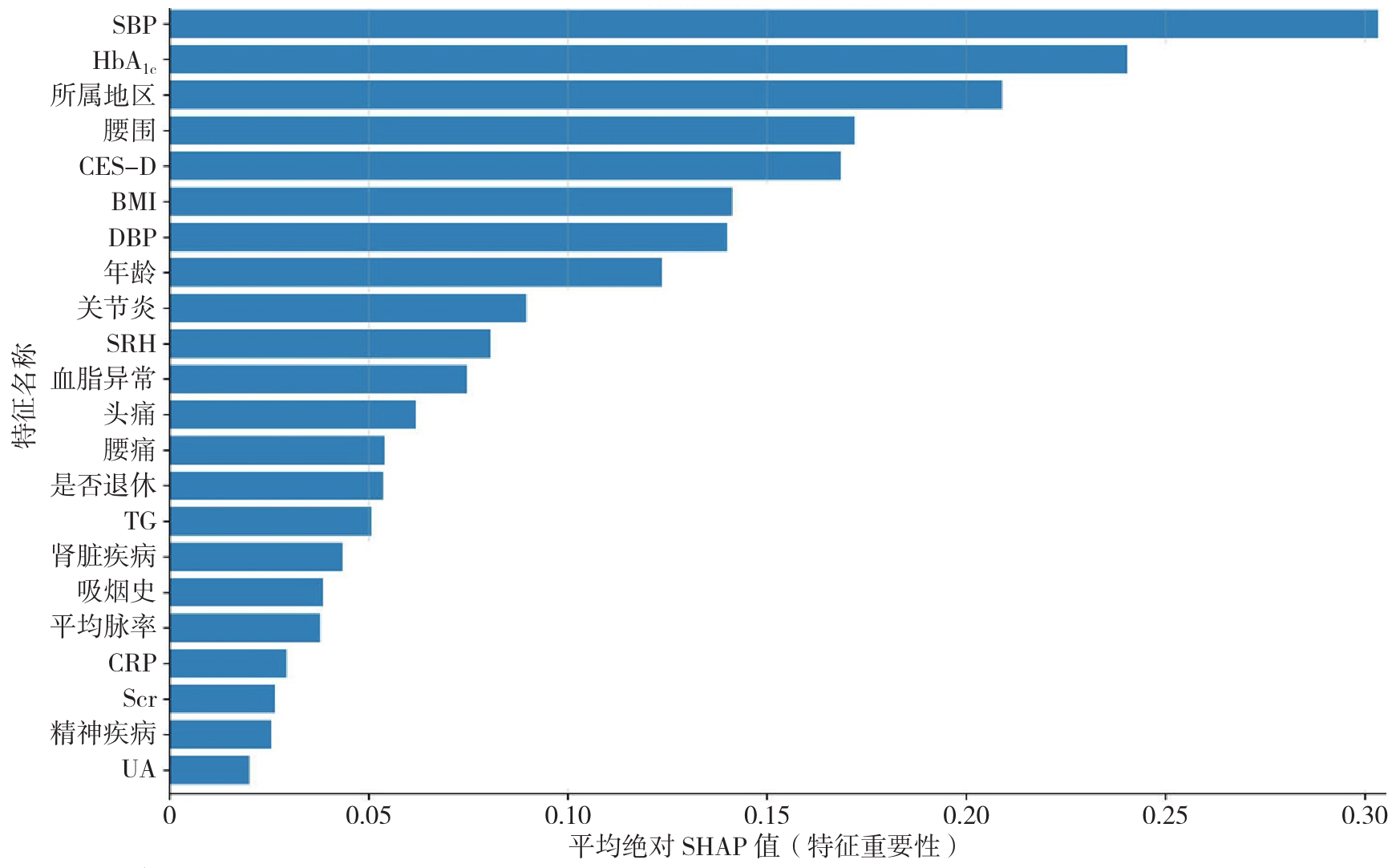
图4 基于LR算法模型的SHAP平均值条形图注:SHAP=Shapley加法解释。
Figure 4 The mean SHAP value bar chart based on LR algorithmic models
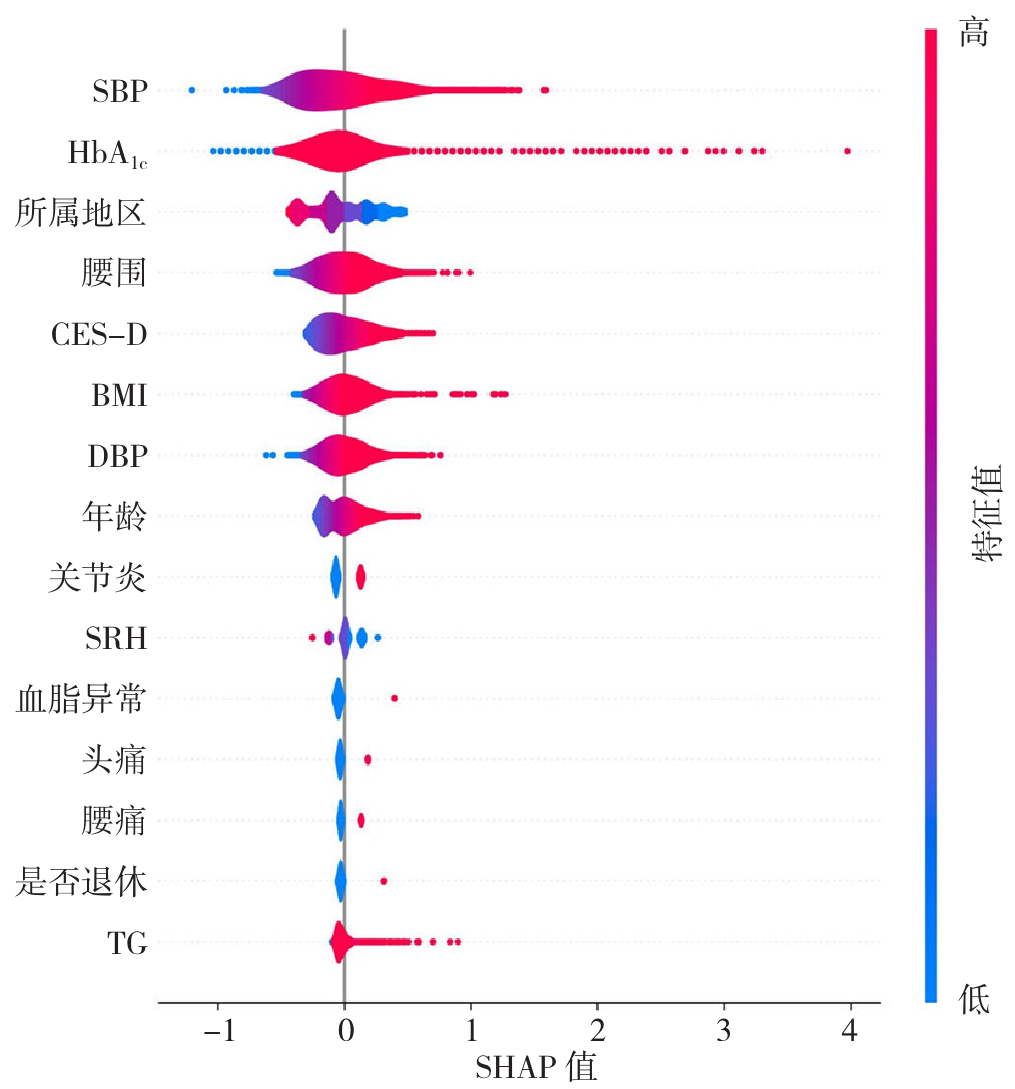
图5 基于LR算法模型的SHAP汇总图注:每个点代表1例患者,点的颜色越趋近红色表示特征值越大,SHAP值为正表示该特征增加CMM风险。
Figure 5 The SHAP summary plot based on LR algorithmic models
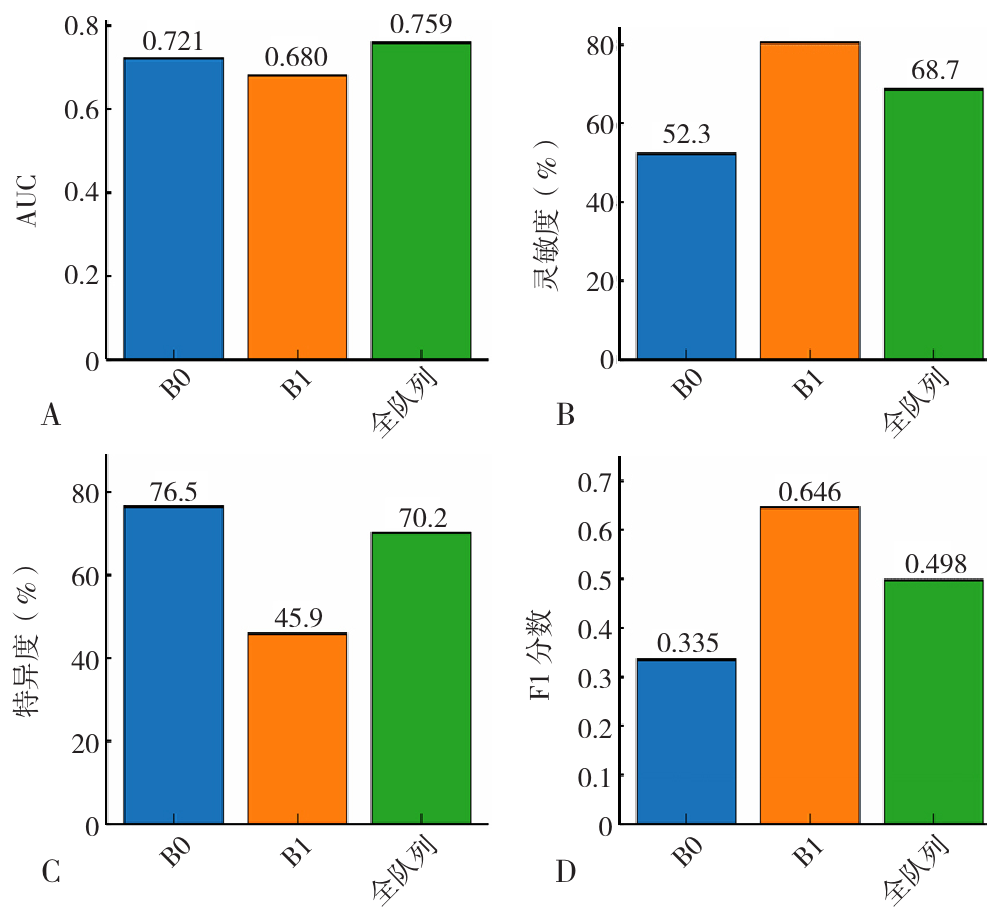
图6 基于亚组的模型性能对比注:图A为AUC对比,图B为灵敏度对比,图C为特异度对比,图D为F1分数对比;B0代表基线0种疾病,B1代表基线1种疾病。
Figure 6 Performance comparison of subgroup-based models
| [1] |
Emerging Risk Factors Collaboration. Association of cardiometabolic multimorbidity with mortality[J]. JAMA, 2015, 314(1): 52-60. DOI: 10.1001/jama.2015.7008.
|
| [2] |
|
| [3] |
|
| [4] |
|
| [5] |
|
| [6] |
|
| [7] |
|
| [8] |
|
| [9] |
|
| [10] |
|
| [11] |
|
| [12] |
|
| [13] |
|
| [14] |
|
| [15] |
|
| [16] |
|
| [17] |
|
| [18] |
|
| [19] |
|
| [20] |
|
| [21] |
|
| [22] |
|
| [23] |
|
| [24] |
|
| [25] |
中国成人血脂异常防治指南修订联合委员会. 中国成人血脂异常防治指南(2016年修订版)[J]. 中国循环杂志, 2016, 31(10): 937-950. DOI: 10.3969/j.issn.1000-3614.2016.10.001.
|
| [26] |
|
| [27] |
American Diabetes Association Professional Practice Committee. 2. Diagnosis and classification of diabetes: standards of care in diabetes-2024[J]. Diabetes Care, 2024, 47(Suppl 1): S20-S42. DOI: 10.2337/dc24-S002.
|
| [28] |
|
| [29] |
|
| [30] |
|
| [31] |
|
| [32] |
|
| [33] |
|
| [34] |
|
| [35] |
|
| [36] |
|
| [37] |
|
| [38] |
|
| [39] |
|
| [40] |
|
| [41] |
|
| [42] |
|
| [43] |
|
| [44] |
|
| [45] |
|
| [46] |
|
| [47] |
|
| [48] |
|
| [49] |
|
| [50] |
|
| [51] |
|
| [52] |
|
| [53] |
|
| [54] |
|
| [55] |
|
| [56] |
|
| [57] |
|
| [58] |
|
| [59] |
|
| [60] |
|
| [61] |
|
| [62] |
|
| [63] |
|
| [64] |
|
| [65] |
|
| [66] |
|
| [67] |
|
| [68] |
|
| [69] |
|
| [70] |
|
| [71] |
|
| [72] |
|
| [73] |
|
| [74] |
|
| [75] |
|
| [1] | 张文政, 张红灵. 心脏代谢指数与社区人群老年代谢相关脂肪性肝病患者发生高血压的相关性:一项前瞻性队列研究[J]. 中国全科医学, 2026, 29(23): 3261-3267. |
| [2] | 柴智浩, 张维森, 罗娇玲, 朱峰, 朱彤, 靳雅丽, 潘静, 卢映君, 江朝强. 中老年人社会经济状况在少儿期父母文化与认知功能间的中介效应:基于广州生物库队列研究[J]. 中国全科医学, 2026, 29(21): 2959-2966. |
| [3] | 李文萍, 陈建华, 许家培, 金雪, 潘子涵, 迟春花. 数智化健康管理平台赋能社区老年人健康服务的范围综述[J]. 中国全科医学, 2026, 29(21): 2938-2949. |
| [4] | 安艳红, 王世东, 李潇然, 郭家扬, 王哲, 沙培林, 孟怡珺, 李小萱, 石雪, 于泽兴, 肖永华. 糖尿病肾病影响因素及列线图预测模型研究:基于超声造影技术[J]. 中国全科医学, 2026, 29(21): 2995-3003. |
| [5] | 李凤, 胡昌好, 罗旭. 老年慢性病共病患者心理健康的影响因素及干预策略研究进展[J]. 中国全科医学, 2026, 29(20): 2816-2828. |
| [6] | 程玉, 韩士尧, 孙平, 向娟, 杨辉, 李东泽, 郑莉, 廖晓阳. 慢性病管理中的社会经济与人口学挑战分析[J]. 中国全科医学, 2026, 29(20): 2800-2807. |
| [7] | 刘影, 刘世炜, 张驰, 沈姞, 张玉珊, 张洁, 桑莹宸, 王友娇, 王蕾, 周厚广, 施红. 中国老年脑卒中患者主观认知功能下降流行特征及影响因素研究[J]. 中国全科医学, 2026, 29(20): 2829-2835. |
| [8] | 鲍若林, 鲁潮, 冯昕, 叶春梅, 来芬华, 倪作为, 杨东波, 郑永韬. 基于巢式病例对照研究老年人流感疫苗突破病例的风险预测模型[J]. 中国全科医学, 2026, 29(19): 2671-2677. |
| [9] | 庞姝, 孙颖, 姜春燕. Fried衰弱表型量表与FRAIL量表在社区体检老年人衰弱前期评估中的效能比较[J]. 中国全科医学, 2026, 29(19): 2664-2670. |
| [10] | 李思旻, 张婷婷, 王鲲博, 杨建洲, 平卫伟. 运动剂量对老年肌肉减少性肥胖患者的影响:一项Meta分析[J]. 中国全科医学, 2026, 29(17): 2400-2409. |
| [11] | 陈燕, 沈德权, 盛仁磊, 常玉洁, 杨佳琦, 丁洁, 孙志芳, 王大辉. 老年人基层中医预防保健服务利用的影响因素及重要性排序[J]. 中国全科医学, 2026, 29(16): 2182-2189. |
| [12] | 于珊, 车雅洁, 苏比伊努尔·麦麦提, 郭楷扬, 冯星星, 颜萍. 新疆地区城乡老年人主观认知下降现状及影响因素的对比研究[J]. 中国全科医学, 2026, 29(16): 2227-2233. |
| [13] | 杨婷婷, 郑利, 梁大强, 吴凡, 袁娴娴, 魏来, 胡瑾, 汪俊华, 王子云. 40~65岁人群睡眠碎片化与动脉硬化的关联性研究[J]. 中国全科医学, 2026, 29(16): 2190-2197. |
| [14] | 李嘉丽, 刘璠, 柯立鑫, 李慧娟, 王海博, 赵晓晓, 赵信科, 卢存存. 1990—2021年全球与中国60岁及以上人群肥胖的疾病负担:趋势分析与模型预测[J]. 中国全科医学, 2026, 29(15): 2067-2076. |
| [15] | 刘帆, 陈秋雨, 李婧. 亚临床高风险人群夜间高血压筛查模型的构建与验证:一项单中心队列研究[J]. 中国全科医学, 2026, 29(15): 1998-2005. |
| 阅读次数 | ||||||
|
全文 |
|
|||||
|
摘要 |
|
|||||