中国全科医学 ›› 2026, Vol. 29 ›› Issue (22): 3131-3137.DOI: 10.12114/j.issn.1007-9572.2024.0690

所属专题: 社区卫生服务最新研究合辑

• 全科医疗/社区卫生服务工作研究·社区卫生人力管理 • 上一篇    下一篇

社区卫生服务人员工作动机量表的开发

刘迪1,2, 李承璐3, 于丹丹4,*(), 石磊3,5,6,7,*()   

  1. 1.150086 黑龙江省哈尔滨市,哈尔滨医科大学马克思主义学院
    2.150001 黑龙江省哈尔滨市,哈尔滨工程大学经济管理学院
    3.511436 广东省广州市,广州医科大学卫生管理学院
    4.150086 黑龙江省哈尔滨市,黑龙江省医学科学院
    5.510515 广东省广州市,广东省高校健康管理政策与精准健康服务协同创新研究哲学社会科学重点实验室
    6.511436 广东省广州市,广东省高校基于大数据利用的卫生健康治理哲学社会科学重点实验室
    7.511436 广东省广州市,粤港澳大湾区医药健康产(行)业高质量发展法治保障研究中心
  • 收稿日期:2025-04-10 修回日期:2025-12-05 出版日期:2026-08-05 发布日期:2026-07-08
  • 通讯作者: 于丹丹, 石磊

  • 作者贡献:

    刘迪提出研究思路,设计研究方案,并负责数据收集、采集、清洗和统计学分析、图表绘制等;李承璐负责论文起草;于丹丹、石磊负责最终版本修订,对论文负责。作者均对最终稿件进行了审阅,并同意发表。

  • 基金资助:
    黑龙江省哲学社会科学研究规划项目(22GLE375)

Development of a Work Motivation Scale for Community Health Service Providers

LIU Di1,2, LI Chenglu3, YU Dandan4,*(), SHI Lei3,5,6,7,*()   

  1. 1. School of Marxism, Harbin Medical University, Harbin 150086, China
    2. School of Economics and Management, Harbin Engineering University, Harbin 150001, China
    3. School of Health Management, Guangzhou Medical University, Guangzhou 511436, China
    4. Heilongjiang Academy of Medical Sciences, Harbin 150086, China
    5. Social Science Key Laboratory of Guangdong Higher Education Institutes for Health Management Policy and Precision Health Services, Guangzhou 510515, China
    6. Social Science Key Laboratory of Guangdong Higher Education Institutes for Health Governance Based on Big Data Utilization, Guangzhou 511436, China
    7. Guangdong-Hong Kong-Macao Greater Bay Area Medical and Health Industry High Quality Development Rule of Law Guarantee Research Center, Guangzhou 511436, China
  • Received:2025-04-10 Revised:2025-12-05 Published:2026-08-05 Online:2026-07-08
  • Contact: YU Dandan, SHI Lei

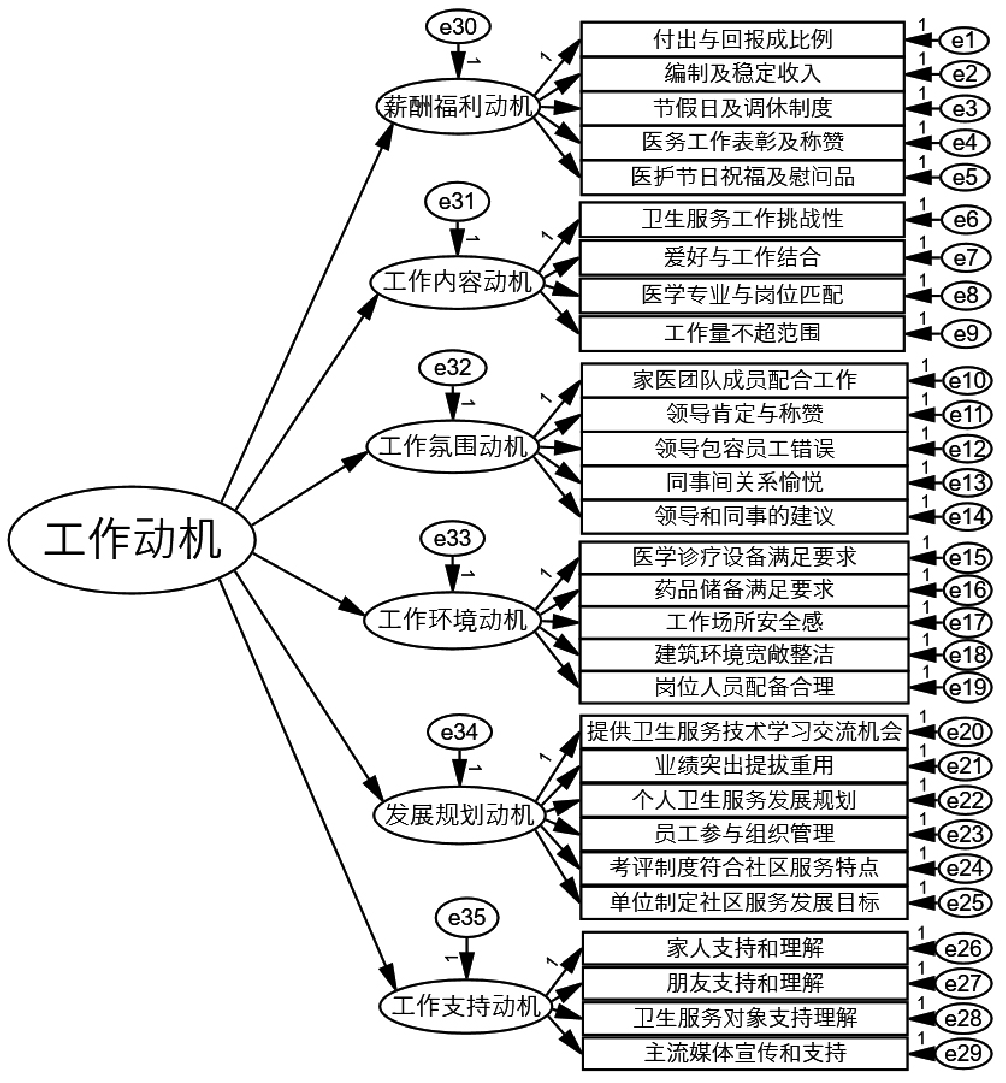
摘要: 背景 社区卫生服务人员的工作动机评估对提升服务质量至关重要,但目前仍缺乏评价社区卫生服务人员工作动机的工具,亟须研制相应的量表工具。 目的 编制社区卫生服务人员的工作动机评估工具,激发社区卫生服务人员的工作热情和积极性。 方法 基于扎根理论,以文献综述为基础构建访谈提纲,并于2022年2—7月在黑龙江省、湖北省、甘肃省和广东省四省采用理论性抽样方法选取社区卫生服务中心人员(n=40)开展深度访谈,采用扎根理论提炼概念和范畴形成初始量表并经专家审定得到42个条目。2022年8—12月分两次在线发放问卷,形成用于探索性因子分析(n=314)和验证性因子分析(n=327)的两个独立样本。采用SPSS 25.0和AMOS 17.0进行信效度检验,评估量表的一致性、结构效度及模型拟合度。 结果 共发放问卷800份,回收有效问卷641份,总体有效率为80.1%。最终的社区卫生服务人员工作动机量表包括6个维度(薪酬福利、工作内容、工作氛围、工作环境、发展规划、工作支持)共计29个条目。总量表的Cronbach'sα系数为0.966,薪酬福利、工作内容、工作氛围、工作环境、发展规划、工作支持6个维度的Cronbach'sα系数分别为0.864、0.878、0.937、0.934、0.940、0.902。 结论 本研究开发的社区卫生服务人员工作动机量表在测量社区卫生服务人员工作动机方面具有可靠性和有效性,为深入探究社区卫生服务人员的工作动机提供了测量工具,并为组织评估和改进员工激励策略提供了参考依据。

关键词: 社区卫生服务, 社区卫生服务人员, 工作动机, 量表开发

Abstract:

Background

The assessment of work motivation among community health service providers is crucial for improving service quality. However, there is still a lack of tools to evaluate their work motivation, and a corresponding scale urgently needs to be developed.

Objective

To develop an assessment tool for the work motivation of community health service providers in order to boost their enthusiasm and proactivity at work.

Methods

Based on grounded theory, an interview outline was constructed using a literature review. From February to July 2022, in-depth interviews were conducted with personnel from community health service centers (n=40) in Heilongjiang, Hubei, Gansu, and Guangdong provinces, selected through theoretical sampling. Grounded theory was used to extract concepts and categories to form an initial scale, which, after expert review, resulted in 42 items. From August to December 2022, questionnaires were distributed online in two phases, yielding two independent samples for exploratory factor analysis (n=314) and confirmatory factor analysis (n=327). SPSS 25.0 and AMOS 17.0 were used for reliability and validity testing, assessing the scale's internal consistency, structural validity, and model fit.

Results

A total of 800 questionnaires were distributed, and 641 valid responses were collected, with an overall effective response rate of 80.1%. The final work motivation scale for community health service providers consisted of six dimensions, including compensation and benefits, job content, work climate, working environment, career development, and work support, with a total of 29 items. The Cronbach's α coefficient for the total scale was 0.966, and the Cronbach's α coefficients for the six dimensions were 0.864, 0.878, 0.937, 0.934, 0.940, and 0.902, respectively.

Conclusion

The work motivation scale for community health service providers developed in this study demonstrates good reliability and validity in measuring their work motivation. It provides a measurement tool for in-depth investigation of work motivation among community health service providers and offers a reference for organizations to assess and improve employee incentive strategies.

Key words: Community health services, Community health service providers, Work motivation, Scale development