中国全科医学 ›› 2026, Vol. 29 ›› Issue (09): 1187-1193.DOI: 10.12114/j.issn.1007-9572.2024.0503

所属专题: 家庭医生签约最新文章合辑

• 论著·医疗卫生服务研究 • 上一篇    

基于卡诺模型的功能楼宇人群家庭医生签约服务需求特征研究

蔡丞俊1, 徐昕1, 邵洁1, 周路路1, 张胜冰1, 黄蛟灵2, 石建伟2, 密一恺3, 黄倩1,*()   

  1. 1.200122 上海市浦东新区潍坊社区卫生服务中心
    2.200025 上海市,上海交通大学医学院公共卫生学院
    3.200335 上海市,上海交通大学中国医院发展研究院社区医疗研究所
  • 收稿日期:2024-11-07 修回日期:2025-03-05 出版日期:2026-03-20 发布日期:2026-01-28
  • 通讯作者: 黄倩

  • 作者贡献:

    蔡丞俊主要进行论文的撰写和修订;徐昕、邵洁、周路路进行数据采集和整理;张胜冰进行调查组织协调;黄蛟灵、石建伟、密一恺进行数据统计分析支持;黄倩对研究设计、执行和结果解释总体负责。

  • 基金资助:
    上海市浦东新区优秀青年医学人才培养项目(PWRq2021-17); 国家自然科学基金资助项目(71904145); 上海市浦东新区卫健委学科带头人培养计划项目(PWRd2021-08); 上海市"医苑新星"青年医学人才培养资助计划项目(沪卫人事[2022]65号); 上海市科委科技创新行动计划软科学项目(22692107200); 上海市加强公共卫生体系建设三年行动计划优青项目(GWVI-11.2-YQ54)

The Characteristics of Family Doctor Service Demand for Functional Building Population Based on KANO Model

CAI Chengjun1, XU Xin1, SHAO Jie1, ZHOU Lulu1, ZHANG Shengbing1, HUANG Jiaoling2, SHI Jianwei2, MI Yikai3, HUANG Qian1,*()   

  1. 1. General Practice, Pudong District Weifang Community Health Center, Shanghai 200122, China
    2. School of Public Health, Shanghai Jiao Tong University School of Medicine, Shanghai 200025, China
    3. Institute of Community Health, China Hospital Development Institute, Shanghai Jiao Tong University, Shanghai 200335, China
  • Received:2024-11-07 Revised:2025-03-05 Published:2026-03-20 Online:2026-01-28
  • Contact: HUANG Qian

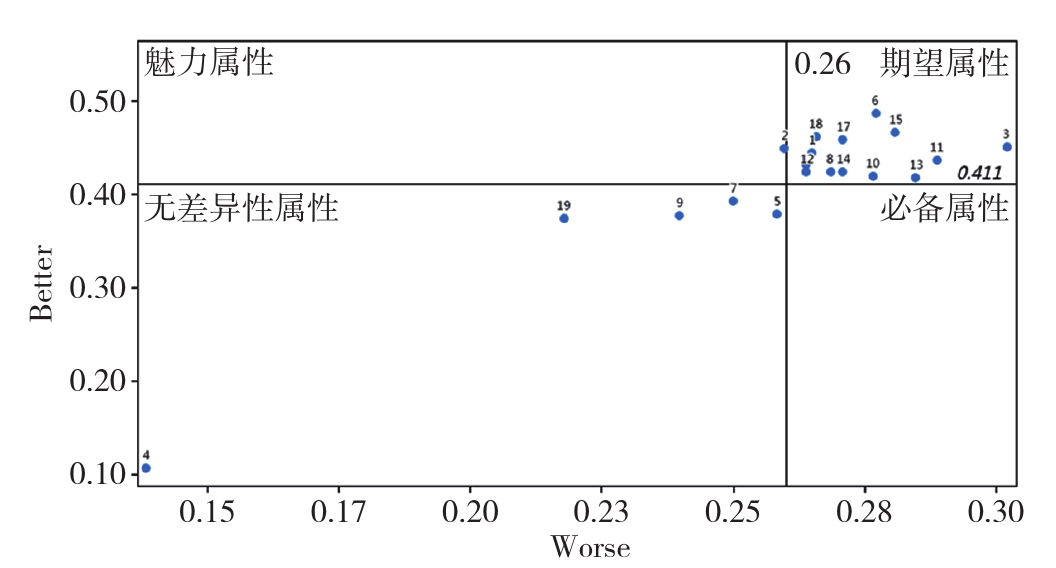
摘要: 背景 随着家庭医生签约服务制度持续深入,如何将有效的家庭医生签约服务覆盖到功能楼宇人群成为关注焦点之一,切实了解该类人群的需求特征是制订有效策略的重要手段。 目的 了解功能楼宇人群的家庭医生签约服务需求,为完善和优化功能楼宇的家庭医生签约服务提供参考。 方法 于2024年3—4月,采用典型抽样法在课题组所在辖区选取功能楼宇3个,采用整群随机抽样法在功能社区抽取中青年396名进行问卷调查。问卷内容包括一般人口学信息、对家庭医生签约服务需求的KANO问卷、过去6个月接受家庭医生签约服务最多的时间段及支付意愿等。对家庭医生签约服务需求的KANO问卷进行信效度分析,构建Better-Worse矩阵对19个服务条目进行KANO需求特征分析,根据不同服务时段和支付意愿进行敏感性分析。 结果 共回收396份有效问卷,19个签约服务条目形成的量表Cronbach's α系数为0.991。按KANO模型对条目进行初步归类,19个条目均属于无差异属性项目,构建Better-Worse矩阵对需求属性进行进一步划分,诊疗服务中的"代配药服务""专家坐诊服务"2个条目,健康管理服务中的"体检报告解读和健康咨询""眼症防治""颈椎病防治"等9个条目归属为"期望属性"项目,诊疗服务中的"延伸处方"服务归属为魅力属性项目,其余为无差异属性项目。敏感性分析显示:"长处方"服务在上班前1 h、周末时段的SR值最高,"中医体质辨识/推拿/艾灸/拔罐/刮痧/针灸"服务在午间1 h服务的SR值最高;支付意愿在0~50元·人-1·年-1和≥201元·人-1·年-1时"专家坐诊"服务的SR值最高,支付意愿在151~200元·人-1·年-1时"中医体质辨识/推拿/艾灸/拔罐/刮痧/针灸"服务的SR值最高。 结论 功能楼宇人群对家庭医生签约下的专项化健康管理服务需求度较高,需求内容多元化,家庭医生提供的长处方、代配药、专家坐诊等签约诊疗服务是满足中青年人群服务需求的基石,应进一步优化和完善针对此类人群的服务内容设计。

关键词: 家庭医生签约服务, 功能楼宇, 卫生服务需求, KANO模型

Abstract:

Background

With the continuous deepening of the family doctor contract service system, how to effectively cover the functional building population with family doctor contract services has become one of the focuses of attention. Effectively understanding the demand characteristics of this group of people is an important means to establish effective strategies.

Objective

To understand the demand for family doctor contract services among functional building populations, and provide reference for improving and optimizing family doctor contract services in functional buildings.

Methods

In March April 2024, a typical sampling method was used to select 3 functional buildings in the jurisdiction of the research group, and a cluster random sampling method was used to select 396 middle-aged and young people from functional communities for a questionnaire survey. The questionnaire includes general demographic information, KANO questionnaire on the demand for family doctor contract services, the time period of receiving the most family doctor contract services in the past 6 months, and willingness to pay. Conduct reliability and validity analysis of the KANO questionnaire on the demand for family doctor contract services, construct a Better-Worse matrix to analyze the KANO demand characteristics of 19 service items, and conduct sensitivity analysis based on different service periods and payment intentions.

Results

A total of 396 valid survey questionnaires were collected, and the Cronbach's α of the scale formed by 19 signed service items was 0.991. According to the KANO model, a preliminary classification of the items showed that 19 items belonged to the category of undifferentiated attributes. A better worse matrix was constructed to further divide the demand attributes. In the diagnosis and treatment service, 2 items were classified, including "medication dispensing service" and "expert consultation service". In the health management service, 9 items, including "interpretation of physical examination reports and health consultation", "prevention and treatment of eye diseases", and "prevention and treatment of cervical spondylosis", belonged to the category of "expected attributes". In the diagnosis and treatment service, the "extended prescription" service belonged to the category of attractive attributes, while the rest belonged to the category of undifferentiated attributes. Sensitivity analysis shows that the "long prescription" service has the highest SR value one hour before work and on weekends. The service of "TCM constitution identification/massage/moxibustion/cupping/scraping/acupuncture and moxibustion" has the highest SR value in one hour at noon. The SR value of "expert consultation" services is highest when the willingness to pay is between 0-50 yuan/person/year and≥201 yuan/person/year. The SR value of "TCM constitution identification/massage/moxibustion/cupping/scraping/acupuncture and moxibustion" service is the highest when the willingness to pay is 151-200 yuan/person/year.

Conclusion

The functional building population has high expectations for specialized health management services under the contract of family doctors, and the demand content is diversified. At the same time, the contracted diagnosis and treatment services provided by family doctors, such as long prescriptions, drug dispensing, and expert consultations, are the cornerstone of meeting the service needs of middle-aged and young people. Further optimization and improvement of service content design for this type of population should be carried out.

Key words: Contracted family doctor services, Functional buildings, Health services demand, KANO model

中图分类号: