中国全科医学 ›› 2026, Vol. 29 ›› Issue (13): 1739-1744.DOI: 10.12114/j.issn.1007-9572.2024.0216

所属专题: 社区卫生服务最新研究合辑

• 论著·全科医学教育研究 • 上一篇    下一篇

北京市社区医生参与科普现状及培训需求的调查研究

付铭源, 刘新颖, 于潇漪, 孔慜, 葛彩英*()   

  1. 100079 北京市,首都医科大学全科医学与继续教育学院第一临床医学院方庄社区卫生服务中心
  • 收稿日期:2025-05-27 修回日期:2025-09-05 出版日期:2026-05-05 发布日期:2026-04-14
  • 通讯作者: 葛彩英

  • 作者贡献:

    付铭源、于潇漪负责数据收集、整理、录入及结果的分析解释;葛彩英、刘新颖、孔慜负责文章构思与整体框架设计、论文的修订;葛彩英负责文章的质量控制和审校,对文章整体负责。

  • 基金资助:
    首都卫生发展科研专项(首发2023-2S-001)

Investigation on the Current Situation and Training Demand of Community Doctors Participating in Science Popularization in Beijing

FU Mingyuan, LIU Xinying, YU Xiaoyi, KONG Min, GE Caiying*()   

  1. Fangzhuang Community Health Service Center, the First Clinical Medical School, College of General Practice and Continuing Education, Capital Medical University, Beijing 100079, China
  • Received:2025-05-27 Revised:2025-09-05 Published:2026-05-05 Online:2026-04-14
  • Contact: GE Caiying

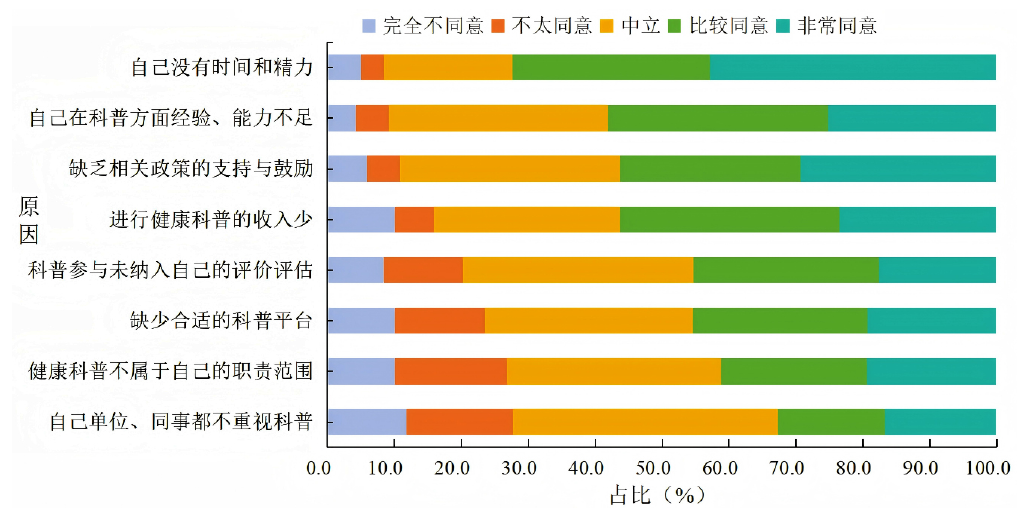
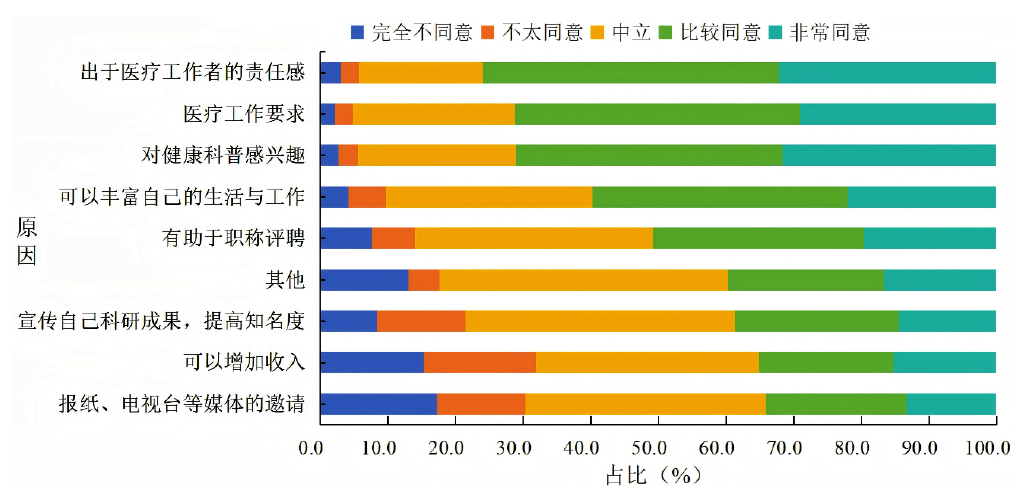
摘要: 背景 随着中国人口老龄化和慢性病患者数量的增加,健康科普在提升公众健康意识和改善生活质量方面变得尤为关键,而社区医生作为提升公众健康知识水平的重要力量,其科普能力的提升对于实现健康中国战略具有重要意义。 目的 了解北京市城郊社区医生参与科普的现状及培训需求,并探讨提升社区医生科普能力的有效策略。 方法 2024年4—5月,采用自制线上问卷对北京市城郊社区医生进行调查。问卷内容涵盖社区医生的基本特征、科普行为阶段、参与动因与障碍、媒介偏好及培训需求等内容。运用描述性统计和组间比较等方法,对社区医生的科普实践现状进行分析,并基于数据分析结果,明确培训需求。 结果 本次调查共发放问卷744份,回收有效问卷668份,回收问卷有效率89.78%。科普行为阶段分布显示,244例(36.53%)处于意向阶段、153例(22.90%)处于准备阶段、152例(22.75%)处于维持阶段。157例(23.50%)社区医生表示比较了解健康科普创作,324例(48.50%)认为社区医生的科普工作对患者的就医体验和健康管理有较大影响。社区医生不愿意投入科普活动的主要原因是缺乏时间和精力(72.27%,86/119)、科普经验和能力不足(57.98%,69/119)、缺乏政策支持与鼓励(56.30%,67/119)以及健康科普收入低(56.30%,67/119);而愿意参与的主要原因是出于医疗工作者的责任感(75.96%,417/549)、医疗工作要求(71.22%,391/549)、对科普感兴趣(71.04%,390/549)以及可以丰富个人生活与工作(59.74%,328/549)。544例(81.44%)受访者表示希望提高自己的科普能力,但仅291例(43.56%)参加过相关培训,主要培训需求包括科普文案脚本写作技巧(70.51%,471/668)、科普选题与精准对接受众需求(67.66%,452/668)、科研成果转化为科普作品的方法(63.47%,424/668)等。 结论 社区医生在科普活动中面临诸多挑战,包括缺乏政策支持感、资源配置不足等。为提升社区医生的科普能力,建议加强政策宣传,建立稳定的资金和资源投入机制,开展定期的科普能力提升培训,并提供新媒体工具使用的专门培训,使社区医生在健康科普实践中进一步发挥出社区诊疗的优势。

关键词: 全科医生, 社区医生, 健康科普, 培训需求, 科普能力提升

Abstract:

Background

With the aging population and the increasing number of patients with chronic diseases in China, health popularization has become crucial in enhancing public health awareness and improving quality of life. As an important force to improve public health knowledge, community doctors' popularization ability is of great significance for realizing the strategy of healthy China.

Objective

This study aims to investigate the current status and training needs of community doctors in urban and suburban areas of Beijing regarding their participation in science popularization, and to explore effective strategies for improving their science communication skills.

Methods

From April to May 2024, a self-designed online questionnaire was administered to community doctors in suburban Beijing. The questionnaire covers basic demographic characteristics, stages of science popularization behavior, motivations and barriers to participation, media preferences, and training needs. Descriptive statistics and intergroup comparisons were used to analyze the current state of science popularization practices among community doctors. Based on the data analysis, training needs were identified.

Results

A total of 744 questionnaires were distributed, and 668 valid responses were collected, yielding an effective response rate of 89.78%. Analysis of the stages of science popularization behavior revealed that 244 respondents (36.53%) were in the intention stage, 153 (22.90%) in the preparation stage, and 152 (22.75%) in the maintenance stage. Furthermore, 157 respondents (23.50%) reported being relatively familiar with the creation of health science popularization content, while 324 (48.50%) believed that community doctors' science popularization efforts have a considerable impact on patients' healthcare experience and health management. The primary reasons cited by community physicians for their reluctance to engage in science popularization activities were lack of time and energy (72.27%, 86/119), insufficient experience and competence in science communication (57.98%, 69/119), lack of policy support and incentives (56.30%, 67/119) and low financial compensation (56.30%, 67/119). In contrast, the main motivations for participation included a sense of responsibility as healthcare professionals (75.96%, 417/549), job requirements (71.22%, 391/549), personal interest in science popularization (71.04%, 390/549), and the desire to enrich both personal and professional life (59.74%, 328/549). Among the respondents, 544 (81.44%) expressed a desire to improve their science communication skills, yet only 291 (43.56%) had participated in relevant training. The major training needs identified included: techniques for writing popular science scripts (70.51%, 471/668) ; selecting relevant topics and accurately targeting audience needs (67.66%, 452/668) ; methods for translating scientific research findings into popular science content (63.47%, 424/668) .

Conclusion

Community doctors face multiple challenges in science popularization activities, including perceived lack of policy support and insufficient resource allocation. To enhance their science communication capabilities, it is recommended to strengthen policy advocacy, establish stable funding and resource investment mechanisms, conduct regular training programs for capacity building, and provide specialized training on the use of new media tools. These measures will help community doctors better leverage their advantages in community healthcare practice through effective health popularization.

Key words: General practitioners, Community doctors, Health popularization, Training needs, Enhance science popularization ability