
中国全科医学 ›› 2027, Vol. 30 ›› Issue (01): 137-145.DOI: 10.12114/j.issn.1007-9572.2025.0586
• 论著·社会·行为·心理研究 • 上一篇
王伟梁*( ), 李秋, 刘雪莹, 闫文靖
收稿日期:2026-05-15
修回日期:2026-10-06
出版日期:2027-01-05
发布日期:2026-11-17
通讯作者:
王伟梁
作者贡献:
王伟梁负责设计研究方案,构思主题,撰写论文,对论文负责;李秋负责数据收集、分析和结果整理;刘雪莹负责数据收集;闫文靖负责论文初稿修改。
基金资助:
WANG Weiliang*(), LI Qiu, LIU Xueying, YAN Wenjing
Received:2026-05-15
Revised:2026-10-06
Published:2027-01-05
Online:2026-11-17
Contact:
WANG Weiliang
摘要: 背景 中国农村处境不利青少年受社会资源匮乏、家庭结构缺失等因素影响,抑郁发生风险较高。现有研究多关注不良童年经历(ACEs)对该群体的负面作用,针对积极童年经历(PCEs)保护效应的研究尚存在局限。 目的 本研究关注中国农村处境不利青少年的高抑郁风险问题,旨在通过数据驱动的方法,探索PCE与处境不利青少年抑郁的关联。 方法 研究采用便利抽样法,于2023年10月在江苏省北部某乡镇中学进行数据收集。根据社会人口学背景评估是否为处境不利青少年,采用儿童抑郁量表(CDI)测量抑郁症状,采用童年积极经历量表(BCEs)评估青少年在成长期所经历的积极经历水平。采用局部加权散点平滑法(LOWESS)和线性回归分析探究PCE与抑郁的关系,并分析PCE的横截面网络结构;采用相对重要性分析进一步探讨各项PCE与抑郁的差异性关联。 结果 研究纳入了来自中国农村一所中学的3 846名参与者,其中处境不利青少年1 594名(41.45%),处境不利青少年的抑郁检出率为41.72%(665/1 594),发生率较低的PCE为"对学校的归属感"和"规律的家庭作息"。LOWESS结果显示,PCE与抑郁之间存在显著负相关。在全样本、非处境不利青少年、处境不利青少年中,"积极自我感觉"对抑郁的方差解释占较大比重,分别为0.29、0.32和0.27;但PCE的中心性与抑郁的共有方差仅在全样本和非处境不利青少年中呈正相关(P<0.05)。在处境不利青少年中,PCE网络中最中心的节点是"他人支持"(Strength=2.62),这一节点不同于对抑郁解释力最强的节点("积极自我感觉")。 结论 PCE对农村青少年抑郁具有保护作用,但其作用机制因群体而异,对处境不利青少年,特定支持路径(尤其是"他人支持")的作用更为突出。研究结果强调提升青少年自我意识在预防抑郁中的重要性,并提示多样化的社区支持对农村处境不利青少年尤为重要。
中图分类号:
| 变量 | 全样本(n=3 846) | 处境不利青少年(n=1 594) | 非处境不利青少年(n=2 252) | χ2(t)值 | P值 |
|---|---|---|---|---|---|
| 年龄[M(QR),岁] | 16.48(1.01) | 16.50(0.99) | 16.46(1.01) | -1.29 | 0.198 |
| 性别[名(%)] | 2.41 | 0.124 | |||
| 男 | 1 918(49.99) | 819(51.48) | 1 099(48.93) | ||
| 女 | 1 919(50.01) | 772(48.52) | 1 147(51.07) | ||
| CDI量表得分[M(QR),分] | 17.43(7.23) | 18.60(7.54) | 16.60(6.88) | -8.38 | <0.001 |
| BCEs总分[M(QR),分] | 7.53(2.22) | 7.19(2.08) | 7.77(2.36) | 7.86 | <0.001 |
| BCEs1[名(%)] | 3 654(95.01) | 1 417(92.47) | 2 180(96.80) | 36.91 | <0.001 |
| BCEs2[名(%)] | 3 711(96.49) | 1 513(94.92) | 2 198(97.60) | 19.85 | <0.001 |
| BCEs3[名(%)] | 2 810(73.06) | 1 109(69.57) | 1 701(75.53) | 16.84 | <0.001 |
| BCEs4[名(%)] | 2 122(55.17) | 842(52.82) | 1 280(56.84) | 6.09 | 0.015 |
| BCEs5[名(%)] | 2 519(65.50) | 1 017(63.80) | 1 502(66.70) | 3.46 | 0.063 |
| BCEs6[名(%)] | 2 509(65.24) | 948(59.47) | 1 561(69.32) | 39.88 | <0.001 |
| BCEs7[名(%)] | 3 285(85.14) | 1 322(82.94) | 1 963(87.17) | 13.41 | <0.001 |
| BCEs8[名(%)] | 3 154(82.10) | 1 258(78.92) | 1 896(84.19) | 17.54 | <0.001 |
| BCEs9[名(%)] | 2 973(77.30) | 1 168(73.27) | 1 805(80.15) | 25.15 | <0.001 |
| BCEs10[名(%)] | 2 230(57.98) | 828(51.94) | 1 402(62.26) | 40.73 | <0.001 |
表1 是否为处境不利青少年的特征比较
Table 1 Comparison of characteristics between disadvantaged and non-disadvantaged adolescents
| 变量 | 全样本(n=3 846) | 处境不利青少年(n=1 594) | 非处境不利青少年(n=2 252) | χ2(t)值 | P值 |
|---|---|---|---|---|---|
| 年龄[M(QR),岁] | 16.48(1.01) | 16.50(0.99) | 16.46(1.01) | -1.29 | 0.198 |
| 性别[名(%)] | 2.41 | 0.124 | |||
| 男 | 1 918(49.99) | 819(51.48) | 1 099(48.93) | ||
| 女 | 1 919(50.01) | 772(48.52) | 1 147(51.07) | ||
| CDI量表得分[M(QR),分] | 17.43(7.23) | 18.60(7.54) | 16.60(6.88) | -8.38 | <0.001 |
| BCEs总分[M(QR),分] | 7.53(2.22) | 7.19(2.08) | 7.77(2.36) | 7.86 | <0.001 |
| BCEs1[名(%)] | 3 654(95.01) | 1 417(92.47) | 2 180(96.80) | 36.91 | <0.001 |
| BCEs2[名(%)] | 3 711(96.49) | 1 513(94.92) | 2 198(97.60) | 19.85 | <0.001 |
| BCEs3[名(%)] | 2 810(73.06) | 1 109(69.57) | 1 701(75.53) | 16.84 | <0.001 |
| BCEs4[名(%)] | 2 122(55.17) | 842(52.82) | 1 280(56.84) | 6.09 | 0.015 |
| BCEs5[名(%)] | 2 519(65.50) | 1 017(63.80) | 1 502(66.70) | 3.46 | 0.063 |
| BCEs6[名(%)] | 2 509(65.24) | 948(59.47) | 1 561(69.32) | 39.88 | <0.001 |
| BCEs7[名(%)] | 3 285(85.14) | 1 322(82.94) | 1 963(87.17) | 13.41 | <0.001 |
| BCEs8[名(%)] | 3 154(82.10) | 1 258(78.92) | 1 896(84.19) | 17.54 | <0.001 |
| BCEs9[名(%)] | 2 973(77.30) | 1 168(73.27) | 1 805(80.15) | 25.15 | <0.001 |
| BCEs10[名(%)] | 2 230(57.98) | 828(51.94) | 1 402(62.26) | 40.73 | <0.001 |
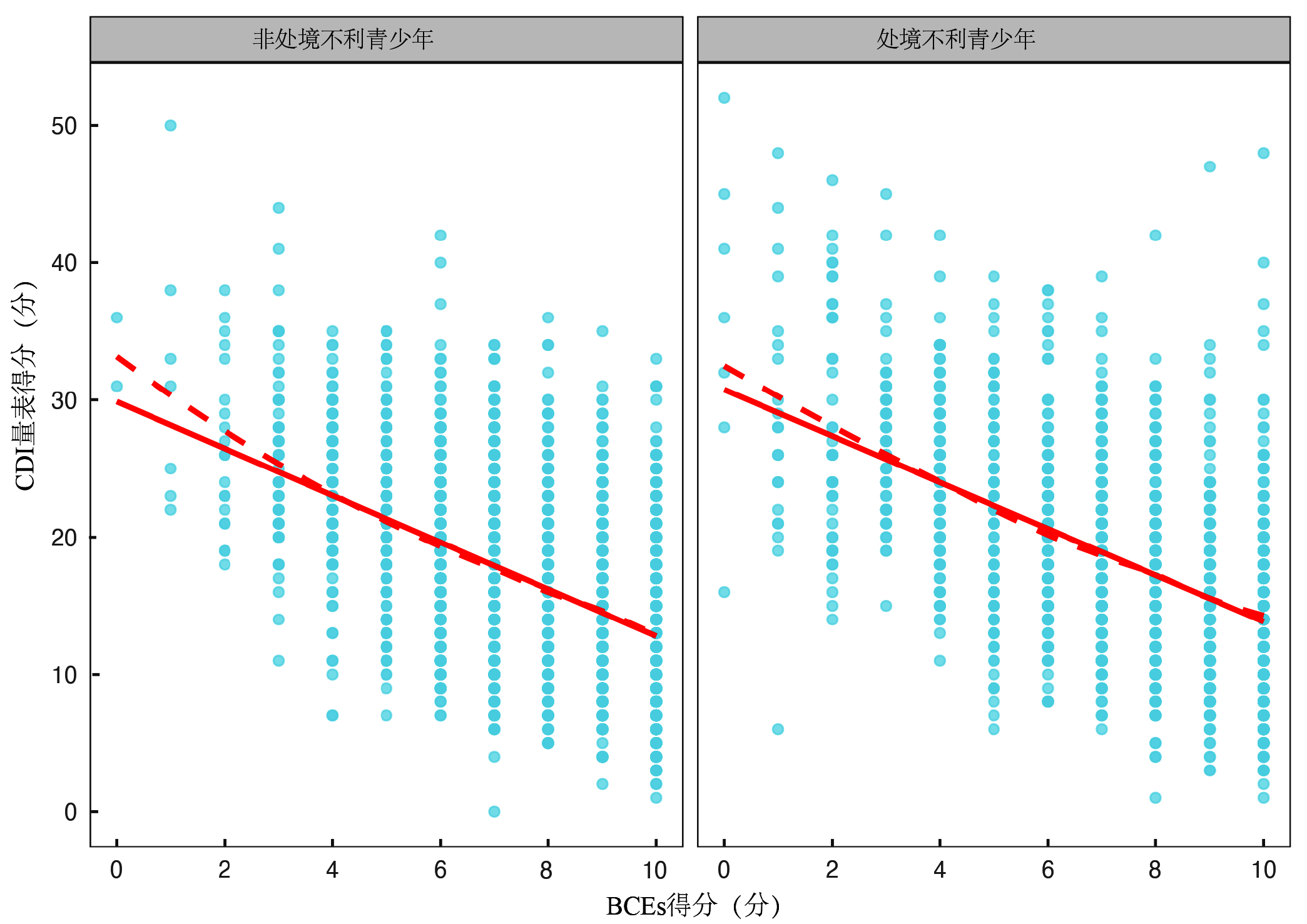
图1 农村青少年PCE与抑郁关系的LOWESS分析注:CDI量表=青少年抑郁症状自评量表,BCEs=童年期积极经历量表,LOWESS=局部加权散点平滑法,PCE=积极童年经历;红色虚线表示LOWESS的拟合结果,红色实线表示线性回归的拟合结果。非处境不利青少年组回归方程:y=29.87-1.71x,R2=0.27,P<0.001;处境不利青少年组回归方程:y=30.75-1.69x,R2=0.28,P<0.001。
Figure 1 LOWESS analysis of the relationship between PCE and depression among rural adolescents
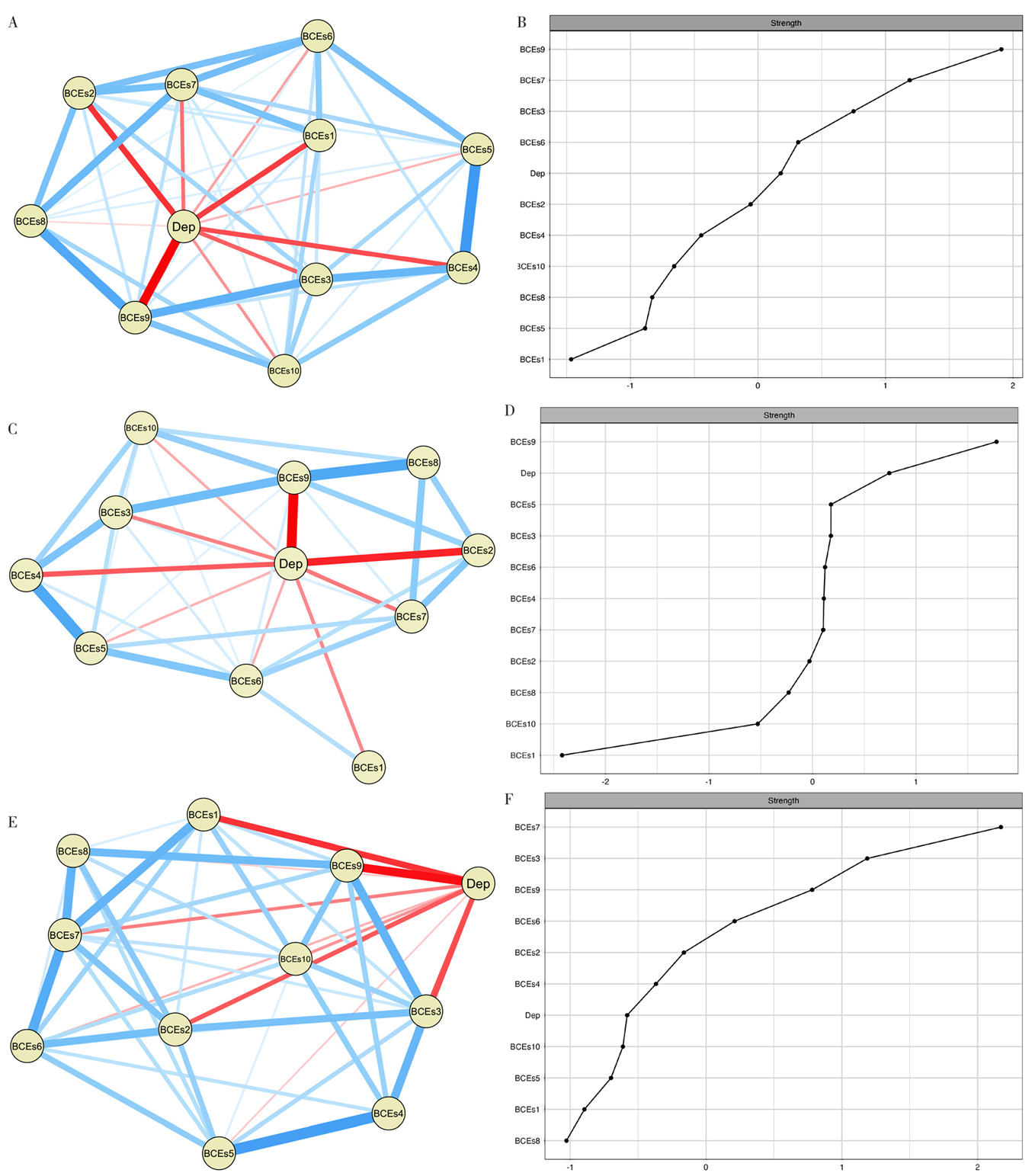
图2 全样本、非处境不利青少年和处境不利青少年的PCE网络注:图A为全样本网络结构图,图B为全样本网络强度图,图C为非处境不利组网络结构图,图D为非处境不利组网络强度图,图E为处境不利组网络结构图,图F为处境不利组网络强度图;BCEs1=安全的监护人,BCEs2=好朋友,BCEs3=坚定信念,BCEs4=对学校的归属感,BCEs5=关心的老师,BCEs6=亲近的邻居,BCEs7=其他成年人的支持,BCEs8=游玩的机会,BCEs9=积极自我感觉,BCEs10=规律的家庭作息;节点间的相关性以边表示,边越粗表示相关性越强,绿色边表示正相关,红色边表示负相关。
Figure 2 PCE network among the whole sample, non-disadvantaged children, and disadvantaged children
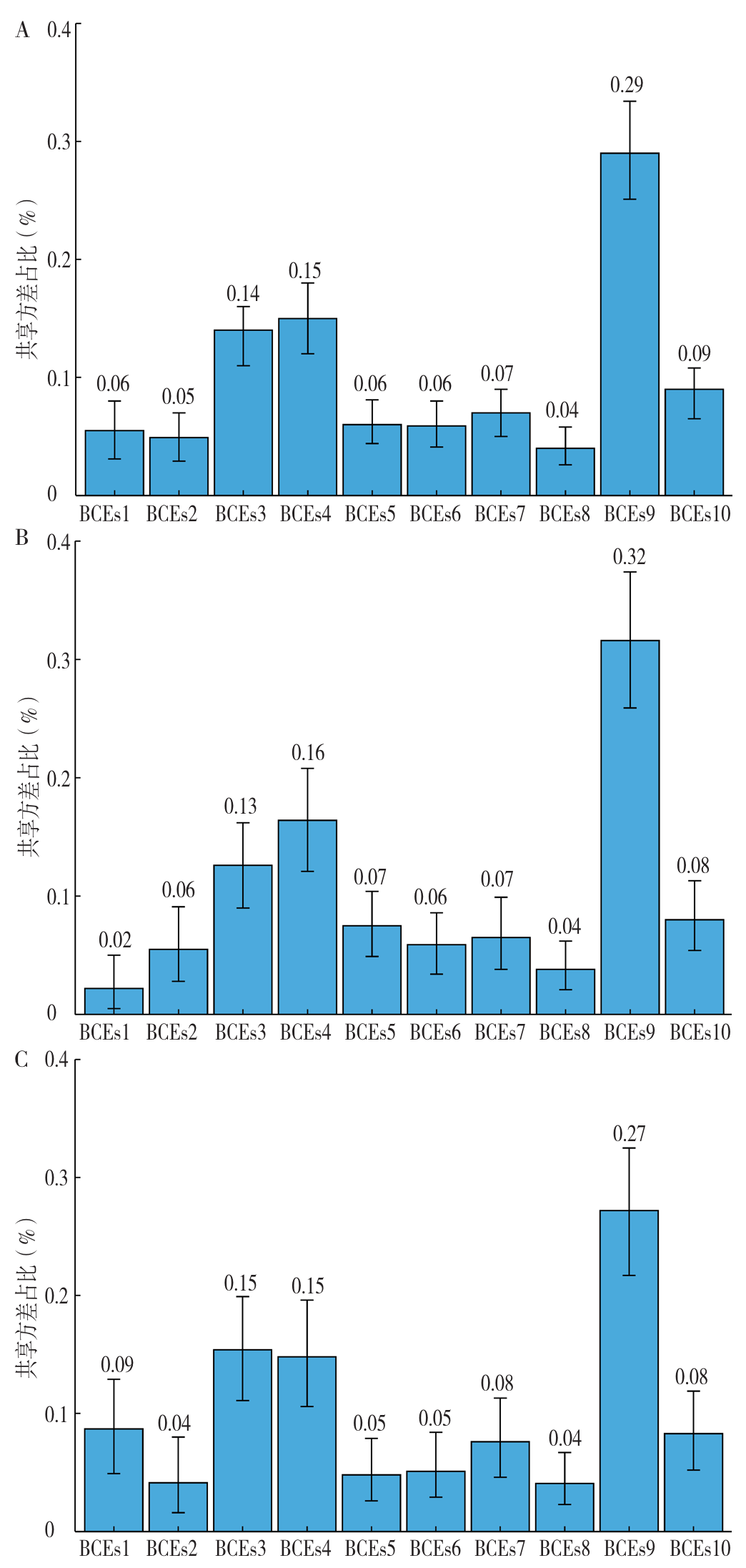
图3 全样本、非处境不利青少年和处境不利青少年中PCE与抑郁共享的相对方差量注:图A为全样本共享方差图,图B为非处境不利组共享方差图,图C为处境不利组共享方差图。
Figure 3 The relative variance in depression shared with PCE in the full sample, non-disadvantaged adolescents, and disadvantaged adolescents
| [1] |
|
| [2] |
|
| [3] |
|
| [4] |
常娜,曹辉. 当前中国农村处境不利儿童的发展困境与抉择[J]. 教育探索, 2016(1): 47-49.
|
| [5] |
|
| [6] |
|
| [7] |
|
| [8] |
|
| [9] |
|
| [10] |
|
| [11] |
范兴华,方晓义,赵纤,等. 留守儿童家庭处境不利累积风险与社会适应:压力的中介作用与心理社会资源的调节作用[J]. 心理学报, 2023, 55(8): 1270-1284.
|
| [12] |
|
| [13] |
宋锐,刘爱书. 儿童期积极经历量表中文版的效度和信度[J]. 中国心理卫生杂志, 2021, 35(9): 733-738.
|
| [14] |
|
| [15] |
|
| [16] |
|
| [17] |
|
| [18] |
|
| [19] |
|
| [20] |
|
| [21] |
|
| [22] |
|
| [23] |
|
| [24] |
|
| [25] |
|
| [26] |
|
| [27] |
|
| [28] |
|
| [29] |
|
| [30] | |
| [31] |
|
| [32] |
吴文峰,卢永彪,谭芙蓉,等. 儿童抑郁量表中文版在中小学生中的信效度[J]. 中国心理卫生杂志, 2010, 24(10): 775-779.
|
| [33] |
温忠麟,侯杰泰,马什赫伯特. 结构方程模型检验:拟合指数与卡方准则[J]. 心理学报, 2004, 36(2): 186-194.
|
| [34] |
|
| [35] |
|
| [36] |
|
| [37] |
|
| [38] |
|
| [39] |
|
| [40] |
|
| [41] |
|
| [42] |
|
| [43] |
|
| [44] |
|
| [45] |
|
| [46] |
|
| [47] |
|
| [48] |
|
| [49] |
|
| [50] |
|
| [51] |
|
| [1] | 池廖婧, 李娜, 李雅方. 体育锻炼对抑郁症患者工作记忆干预效果及影响因素的Meta分析[J]. 中国全科医学, 2026, 29(36): 5428-5441. |
| [2] | 李金婷, 高爱菊. 中国中老年人群体质量调整腰围指数与抑郁发生风险的关联研究[J]. 中国全科医学, 2026, 29(34): 5071-5077. |
| [3] | 王延赏, 何平. 整合服务对糖尿病和抑郁共病人群的影响研究[J]. 中国全科医学, 2026, 29(32): 4783-4785. |
| [4] | 付梦茹, 薛梅启旸, 蒋雨桐, 陈鸣声, 钱东福, 李忠. 农村心房颤动患者自我管理能力影响因素研究[J]. 中国全科医学, 2026, 29(27): 3947-3955. |
| [5] | 徐西良, 刘明矾, 程果, 杨立昊. 大学生负性注意偏向、解释偏向与抑郁的关系研究[J]. 中国全科医学, 2026, 29(24): 3486-3492. |
| [6] | 李凤, 胡昌好, 罗旭. 老年慢性病共病患者心理健康的影响因素及干预策略研究进展[J]. 中国全科医学, 2026, 29(20): 2816-2828. |
| [7] | 颜文, 张含之, 金花, 钱洁, 于德华. 上海市社区卫生服务机构抑郁障碍诊疗能力研究[J]. 中国全科医学, 2026, 29(20): 2790-2799. |
| [8] | 聂佳慧, 李国娟, 郝卓群, 杜巧荣, 刘鹏鸿, 刘志芬, 刘莎, 张爱霞, 王彦芳. 重性抑郁障碍患者认知功能损害的异质性及影响因素研究[J]. 中国全科医学, 2026, 29(17): 2340-2346. |
| [9] | 于超, 宋丽华, 王琳彦, 芦云平, 王林洋, 崔伟. 首发抑郁障碍患者7年后功能结局及影响因素研究[J]. 中国全科医学, 2026, 29(16): 2221-2226. |
| [10] | 王睿, 罗丹, 杨翠翠, 翁欣怡, 王玉冰, 徐晶晶. 基于多源病耻感的青少年1型糖尿病患者心理韧性复杂网络研究[J]. 中国全科医学, 2026, 29(16): 2264-2272. |
| [11] | 姚丁烨, 罗桂平, 孙俊生, 李慧. 初级保健视角下双相Ⅱ型情感障碍与抑郁障碍的鉴别诊断研究进展[J]. 中国全科医学, 2026, 29(15): 2092-2099. |
| [12] | 廖秋红, 陶红, 杨晓辉, 袁勇贵, 林珊珊, 徐微, 李玉秀, 裴育. 2型糖尿病患者抑郁现状及危险因素:一项全国多中心横断面研究[J]. 中国全科医学, 2026, 29(12): 1558-1565. |
| [13] | 李鲤, 徐天朝, 董晓梅, 黄鸿飞, 崔刚, 李冬冬, 张欧, 范琳, 王奇. 补肾健脑针刺疗法联合舍曲林治疗老年抑郁症的效果:一项随机对照试验[J]. 中国全科医学, 2026, 29(11): 1399-1404. |
| [14] | 余新艳, 马忠, 曹凡, 苏鹏, 林颖, 张海澄. 基于单导联可穿戴心电设备预测基层老年心血管代谢疾病患者抑郁发生风险的研究[J]. 中国全科医学, 2026, 29(10): 1300-1310. |
| [15] | 黎珏希, 李立圆, 郭雨璇, 肖小嫱, 唐佩琪, 蒲婷, 左海汐, 杨婷, 樊小夏, 周波. 童年创伤与青少年网络成瘾:抑郁症状和学业倦怠的链式中介作用及性别的调节作用[J]. 中国全科医学, 2026, 29(07): 900-906. |
| 阅读次数 | ||||||
|
全文 |
|
|||||
|
摘要 |
|
|||||