
中国全科医学 ›› 2027, Vol. 30 ›› Issue (03): 407-414.DOI: 10.12114/j.issn.1007-9572.2024.0532
• 论著 • 上一篇
张亚访, 闻萱, 邓春燕, 杜兴梅, 夏修, 黄睿, 邓睿, 黄源*( )
收稿日期:2024-11-27
修回日期:2025-08-03
出版日期:2027-01-20
发布日期:2026-11-26
通讯作者:
黄源
作者贡献:
张亚访、黄源负责研究设计、实施、结果分析与解释、论文撰写与修订,对文章负责;闻萱、邓春燕、杜兴梅、夏修、黄睿、邓睿负责数据收集与整理、统计学处理。
基金资助:
ZHANG Yafang, WEN Xuan, DENG Chunyan, DU Xingmei, XIA Xiu, HUANG Rui, DENG Rui, HUANG Yuan*()
Received:2024-11-27
Revised:2025-08-03
Published:2027-01-20
Online:2026-11-26
Contact:
HUANG Yuan
摘要: 背景 "直过民族"因其独特的社会历史发展轨迹,在健康方面可能表现出不同于其他少数民族的特征,但其健康效用值及影响因素尚未明确。 目的 了解云南省六个"直过民族"的健康效用值和影响因素,为"直过民族"健康促进和健康公平措施制订提供依据。 方法 于2022年7—12月在云南省3个州市,采用多阶段随机整群抽样方法选取佤族、傈僳族、怒族、基诺族、拉祜族、布朗族六个"直过民族"15岁及以上人群进行调查。采用欧洲五维五水平健康量表(EQ-5D-5L)和中国人群健康效用积分体系测量健康效用值,基于Andersen模型和多因素Tobit回归模型分析六个"直过民族"居民健康效用值的影响因素。 结果 纳入居民1 921名,佤族、傈僳族、怒族、基诺族、拉祜族、布朗族分别为293名(15.25%)、37名(19.68%)、300名(15.62%)、398名(20.72%)、280名(14.58%)、272名(14.16%)。总人群的平均健康效用值为(0.958±0.092),佤族、傈僳族、怒族、基诺族、拉祜族、布朗族居民的平均健康效用值分别为(0.966±0.059)、(0.950±0.059)、(0.958±0.114)、(0.958±0.088)、(0.963±0.089)、(0.953±0.102)。六个"直过民族"居民在"疼痛或不舒服"(佤族28.33%、傈僳族36.77%、怒族32.33%、基诺族29.90%,拉祜族27.50%,布朗族35.29%)、"焦虑或沮丧"(佤族16.38%,傈僳族8.99%,怒族11.33%,基诺族16.33%、拉祜族14.64%、布朗族16.54%)两个维度存在困难的占比较高。Tobit回归模型分析结果显示,倾向特征中,年龄是傈僳族、怒族、基诺族、布朗族居民健康效用值的影响因素(P<0.05),性别是基诺族居民健康效用值的影响因素(P<0.05),受教育程度是基诺族、拉祜族居民健康效用值的影响因素(P<0.05),婚姻状态是布朗族居民健康效用值的影响因素(P<0.05);使能因素中,家庭月收入是佤族居民健康效用值的影响因素(P<0.05);需求因素中,近两周患病情况是佤族、怒族、基诺族居民健康效用值的影响因素(P<0.05),患慢性病数量是傈僳族、怒族、拉祜族居民健康效用值的影响因素(P<0.05),抑郁情况是所有民族居民健康效用值的影响因素(P<0.05),睡眠障碍情况是佤族、傈僳族、基诺族居民健康效用值的影响因素(P<0.05),BMI分级是怒族居民健康效用值的影响因素(P<0.05);健康行为中,运动情况是傈僳族、怒族居民健康效用值的影响因素(P<0.05),饮酒情况是拉祜族居民健康效用值的影响因素(P<0.05)。 结论 本研究丰富了健康效用值的相关研究对象,为多个少数民族疾病负担测算提供了依据。六个"直过民族"健康效用接近中国城镇居民水平,高于云南省居民水平。未来需重点关注抑郁对"直过民族"个体健康效用的影响,同时采取针对性措施进一步提升老年人、慢性病患者和睡眠障碍者等人群的健康效用和健康水平。
中图分类号:
| 变量 | 总人群(n=1 921) | 佤族(n=293) | 傈僳族(n=378) | 怒族(n=300) | 基诺族(n=398) | 拉祜族(n=280) | 布朗族(n=272) | |||||||
|---|---|---|---|---|---|---|---|---|---|---|---|---|---|---|
| 人数 | 健康效用值 | 人数 | 健康效用值 | 人数 | 健康效用值 | 人数 | 健康效用值 | 人数 | 健康效用值 | 人数 | 健康效用值 | 人数 | 健康效用值 | |
| 年龄 | ||||||||||||||
| 15~<30岁 | 322 | 0.984±0.043 | 50 | 0.974±0.074 | 53 | 0.990±0.028 | 53 | 0.994±0.020 | 57 | 0.990±0.024 | 54 | 0.973±0.047 | 55 | 0.985±0.040 |
| 30~<45岁 | 566 | 0.975±0.047 | 98 | 0.972±0.044 | 107 | 0.980±0.050 | 101 | 0.970±0.048 | 103 | 0.981±0.037 | 74 | 0.980±0.046 | 83 | 0.966±0.053 |
| 45~<60岁 | 513 | 0.960±0.076 | 83 | 0.960±0.064 | 64 | 0.935±0.143 | 98 | 0.954±0.073 | 127 | 0.973±0.047 | 72 | 0.969±0.055 | 69 | 0.961±0.063 |
| ≥60岁 | 520 | 0.920±0.142 | 62 | 0.958±0.061 | 154 | 0.922±0.094 | 48 | 0.900±0.248 | 111 | 0.904±0.140 | 80 | 0.934±0.144 | 65 | 0.902±0.177 |
| F(t)值 | 1.29 | 13.18 | 6.66 | 23.48 | 4.27 | 8.31 | ||||||||
| P值 | 0.279 | <0.001 | <0.001 | <0.001 | <0.001 | <0.001 | ||||||||
| 性别 | ||||||||||||||
| 男 | 919 | 0.927±0.075 | 119 | 0.962±0.047 | 191 | 0.950±0.100 | 166 | 0.968±0.082 | 181 | 0.978±0.043 | 119 | 0.976±0.057 | 143 | 0.961±0.085 |
| 女 | 1 002 | 0.950±0.106 | 174 | 0.962±0.066 | 187 | 0.945±0.086 | 143 | 0.946±0.144 | 217 | 0.942±0.110 | 161 | 0.953±0.106 | 129 | 0.945±0.118 |
| F(t)值 | 0.88a | 1.33a | 1.88a | 1.41a | 1.19a | 1.63a | ||||||||
| P值 | 0.605 | 0.104 | 0.036 | 0.100 | 0.264 | 0.067 | ||||||||
| 受教育程度 | ||||||||||||||
| 小学以下 | 579 | 0.931±0.123 | 46 | 0.949±0.069 | 193 | 0.934±0.095 | 57 | 0.929±0.143 | 47 | 0.863±0.166 | 101 | 0.937±0.134 | 135 | 0.940±0.131 |
| 小学 | 640 | 0.962±0.084 | 159 | 0.968±0.053 | 102 | 0.972±0.051 | 89 | 0.942±0.160 | 102 | 0.946±0.094 | 101 | 0.979±0.359 | 87 | 0.960±0.067 |
| 初中 | 456 | 0.975±0.066 | 55 | 0.974±0.043 | 62 | 0.952±0.135 | 100 | 0.977±0.054 | 160 | 0.984±0.035 | 47 | 0.975±0.054 | 32 | 0.974±0.051 |
| 高中及以上 | 246 | 0.976±0.051 | 33 | 0.965±0.089 | 21 | 0.982±0.035 | 54 | 0.978±0.042 | 89 | 0.978±0.041 | 31 | 0.972±0.052 | 18 | 0.982±0.044 |
| F(t)值 | 1.63 | 2.17 | 1.96 | 4.76 | 2.65 | 2.07 | ||||||||
| P值 | 0.052 | <0.001 | 0.009 | <0.001 | <0.001 | 0.012 | ||||||||
| 婚姻状态 | ||||||||||||||
| 在婚 | 1 309 | 0.962±0.069 | 101 | 0.966±0.053 | 151 | 0.957±0.072 | 90 | 0.959±0.078 | 95 | 0.962±0.077 | 83 | 0.966±0.062 | 92 | 0.959±0.061 |
| 非在婚 | 612 | 0.949±0.129 | 192 | 0.965±0.071 | 227 | 0.939±0.117 | 210 | 0.954±0.172 | 303 | 0.947±0.117 | 197 | 0.954±0.134 | 180 | 0.942±0.154 |
| F(t)值 | 1.19a | 1.41a | 1.66a | 1.88a | 1.55a | 1.25a | ||||||||
| P值 | 0.268 | 0.062 | 0.040 | 0.009 | 0.064 | 0.232 | ||||||||
| 职业 | ||||||||||||||
| 农民 | 1 283 | 0.951±0.100 | 226 | 0.963±0.056 | 176 | 0.927±0.114 | 179 | 0.946±0.140 | 263 | 0.953±0.096 | 212 | 0.964±0.068 | 227 | 0.950±0.109 |
| 其他 | 638 | 0.970±0.074 | 67 | 0.975±0.071 | 202 | 0.970±0.063 | 121 | 0.974±0.053 | 135 | 0.970±0.069 | 68 | 0.959±0.136 | 45 | 0.971±0.060 |
| F(t)值 | 1.61a | 1.61a | 1.03a | 0.84a | 1.27a | 1.65a | ||||||||
| P值 | 0.058 | 0.058 | 0.428 | 0.620 | 0.196 | 0.062 | ||||||||
| 家庭月收入 | ||||||||||||||
| <3 000元 | 1 101 | 0.951±0.104 | 151 | 0.955±0.069 | 246 | 0.947±0.100 | 173 | 0.954±0.130 | 118 | 0.930±0.126 | 202 | 0.964±0.093 | 211 | 0.952±0.102 |
| 3 000~4 999元 | 458 | 0.964±0.082 | 74 | 0.979±0.040 | 90 | 0.959±0.078 | 78 | 0.962±0.104 | 123 | 0.968±0.068 | 52 | 0.954±0.088 | 41 | 0.950±0.122 |
| ≥5 000元 | 362 | 0.969±0.057 | 68 | 0.975±0.051 | 42 | 0.953±0.075 | 49 | 0.964±0.053 | 157 | 0.972±0.057 | 26 | 0.968±0.058 | 20 | 0.972±0.045 |
| F(t)值 | 1.47 | 1.15 | 0.80 | 1.64 | 1.12 | 1.17 | ||||||||
| P值 | 0.101 | 0.258 | 0.716 | 0.033 | 0.326 | 0.296 | ||||||||
| 到最近医疗机构时间 | ||||||||||||||
| ≥15 min | 1 147 | 0.956±0.100 | 134 | 0.965±0.065 | 239 | 0.950±0.102 | 183 | 0.964±0.113 | 267 | 0.956±0.095 | 142 | 0.958±0.111 | 182 | 0.949±0.107 |
| <15 min | 774 | 0.960±0.079 | 159 | 0.967±0.055 | 239 | 0.951±0.076 | 117 | 0.948±0.116 | 131 | 0.963±0.072 | 138 | 0.967±0.059 | 90 | 0.960±0.093 |
| F(t)值 | 0.05a | 0.02a | 1.51a | 0.57a | 0.66a | 0.69a | ||||||||
| P值 | 0.821 | 0.885 | 0.220 | 0.449 | 0.418 | 0.406 | ||||||||
| 社会支持程度 | ||||||||||||||
| 一般 | 1 665 | 0.955±0.097 | 269 | 0.966±0.058 | 336 | 0.948±0.096 | 257 | 0.956±0.122 | 296 | 0.950±0.009 | 252 | 0.961±0.092 | 255 | 0.952±0.104 |
| 高 | 256 | 0.975±0.049 | 24 | 0.968±0.073 | 42 | 0.967±0.054 | 43 | 0.969±0.043 | 102 | 0.982±0.038 | 28 | 0.978±0.051 | 17 | 0.969±0.062 |
| F(t)值 | 0.03a | 1.59a | 0.51a | 10.19a | 0.98a | 0.42a | ||||||||
| P值 | 0.857 | 0.209 | 0.475 | 0.002 | 0.323 | 0.518 | ||||||||
| 近两周患病情况 | ||||||||||||||
| 是 | 433 | 0.919±0.105 | 76 | 0.939±0.066 | 94 | 0.920±0.092 | 75 | 0.902±0.139 | 63 | 0.904±0.139 | 60 | 0.925±0.101 | 65 | 0.923±0.067 |
| 否 | 1 488 | 0.969±0.085 | 217 | 0.975±0.054 | 284 | 0.960±0.091 | 225 | 0.976±0.098 | 335 | 0.969±0.070 | 220 | 0.973±0.083 | 207 | 0.963±0.110 |
| F(t)值 | 22.19a | 13.85a | 25.3a | 30.95a | 14.48a | 7.70a | ||||||||
| P值 | <0.001 | <0.001 | <0.001 | <0.001 | <0.001 | 0.006 | ||||||||
| 患慢性病数量 | ||||||||||||||
| 0种 | 316 | 0.902±0.160 | 47 | 0.944±0.063 | 87 | 0.901±0.118 | 61 | 0.881±0.222 | 28 | 0.892±0.152 | 50 | 0.905±0.177 | 43 | 0.892±0.187 |
| 1种 | 423 | 0.945±0.090 | 66 | 0.960±0.068 | 91 | 0.921±0.117 | 57 | 0.958±0.066 | 81 | 0.934±0.114 | 62 | 0.970±0.052 | 66 | 0.944±0.071 |
| ≥2种 | 1 182 | 0.977±0.054 | 180 | 0.974±0.053 | 200 | 0.985±0.038 | 182 | 0.983±0.035 | 289 | 0.972±0.064 | 168 | 0.977±0.045 | 163 | 0.973±0.070 |
| F(t)值 | 5.26 | 37.11 | 20.66 | 15.52 | 13.91 | 11.94 | ||||||||
| P值 | 0.006 | <0.001 | <0.001 | <0.001 | <0.001 | <0.001 | ||||||||
| 抑郁情况 | ||||||||||||||
| 是 | 396 | 0.900±0.157 | 81 | 0.938±0.085 | 66 | 0.868±0.156 | 76 | 0.897±0.206 | 61 | 0.911±0.123 | 52 | 0.898±0.161 | 60 | 0.878±0.182 |
| 否 | 1 525 | 0.973±0.057 | 212 | 0.976±0.042 | 312 | 0.967±0.061 | 224 | 0.979±0.040 | 337 | 0.967±0.077 | 228 | 0.977±0.053 | 212 | 0.974±0.046 |
| F(t)值 | 26.21a | 73.67a | 32.24a | 21.74a | 37.35a | 49.35a | ||||||||
| P值 | <0.001 | <0.001 | <0.001 | <0.001 | <0.001 | <0.001 | ||||||||
| 睡眠障碍情况 | ||||||||||||||
| 是 | 847 | 0.932±0.120 | 161 | 0.953±0.071 | 152 | 0.914±0.118 | 124 | 0.926±0.154 | 189 | 0.938±0.105 | 109 | 0.937±0.128 | 112 | 0.920±0.143 |
| 否 | 1 074 | 0.978±0.055 | 132 | 0.981±0.035 | 226 | 0.974±0.060 | 176 | 0.980±0.066 | 209 | 0.977±0.064 | 171 | 0.979±0.044 | 160 | 0.970±0.048 |
| F(t)值 | 17.25a | 42.55a | 20.57a | 16.98a | 15.88a | 49.35a | ||||||||
| P值 | <0.001 | <0.001 | <0.001 | <0.001 | <0.001 | <0.001 | ||||||||
| BMI分级 | ||||||||||||||
| 正常/消瘦 | 1 186 | 0.954±0.102 | 167 | 0.964±0.062 | 244 | 0.950±0.098 | 178 | 0.948±0.143 | 229 | 0.954±0.098 | 156 | 0.964±0.071 | 212 | 0.931±0.097 |
| 超重 | 485 | 0.967±0.063 | 77 | 0.965±0.058 | 90 | 0.961±0.076 | 84 | 0.973±0.046 | 115 | 0.966±0.073 | 71 | 0.968±0.059 | 48 | 0.931±0.097 |
| 肥胖 | 250 | 0.957±0.092 | 49 | 0.973±0.050 | 44 | 0.931±0.097 | 38 | 0.969±0.043 | 54 | 0.962±0.071 | 53 | 0.951±0.151 | 12 | 0.931±0.097 |
| F(t)值 | 0.39 | 0.15 | 1.63 | 0.82 | 0.61 | 0.63 | ||||||||
| P值 | 0.677 | 0.215 | 0.198 | 0.443 | 0.543 | 0.536 | ||||||||
| 吸烟情况 | ||||||||||||||
| 是 | 590 | 0.965±0.074 | 98 | 0.969±0.055 | 103 | 0.947±0.107 | 98 | 0.973±0.062 | 150 | 0.962±0.085 | 71 | 0.982±0.031 | 70 | 0.966±0.053 |
| 否 | 1 331 | 0.954±0.099 | 195 | 0.964±0.061 | 275 | 0.951±0.087 | 202 | 0.950±0.132 | 248 | 0.956±0.090 | 209 | 0.956±0.101 | 202 | 0.949±0.114 |
| F(t)值 | 0.42a | 0.20a | 2.77a | 0.40a | 4.49a | 1.59a | ||||||||
| P值 | 0.513 | 0.654 | 0.097 | 0.529 | 3.035 | 2.080 | ||||||||
| 饮酒情况 | ||||||||||||||
| 是 | 669 | 0.968±0.072 | 111 | 0.965±0.051 | 74 | 0.956±0.071 | 104 | 0.961±0.097 | 166 | 0.980±0.039 | 96 | 0.986±0.029 | 118 | 0.955±0.110 |
| 否 | 1 252 | 0.952±0.101 | 182 | 0.966±0.064 | 304 | 0.949±0.078 | 961 | 0.996±0.123 | 232 | 0.943±0.108 | 184 | 0.951±0.106 | 154 | 0.952±0.096 |
| F(t)值 | 0.01a | 0.37a | 0.13a | 18.54a | 10.04a | 0.05a | ||||||||
| P值 | 0.936 | 0.541 | 0.717 | <0.001 | 0.002 | 0.816 | ||||||||
| 运动情况 | ||||||||||||||
| 否 | 729 | 0.945±0.122 | 96 | 0.973±0.045 | 87 | 0.916±0.131 | 102 | 0.932±0.179 | 173 | 0.953±0.093 | 107 | 0.952±0.124 | 164 | 0.940±0.125 |
| 是 | 1 192 | 0.965±0.068 | 197 | 0.962±0.065 | 291 | 0.960±0.075 | 198 | 0.971±0.053 | 225 | 0.962±0.084 | 173 | 0.969±0.058 | 108 | 0.974±0.045 |
| F(t)值 | 2.37a | 15.46a | 8.26a | 1.05a | 2.57a | 7.31a | ||||||||
| P值 | 0.125 | <0.001 | 0.004 | 0.305 | 0.110 | 0.007 | ||||||||
表1 六个"直过民族"居民的基本特征及健康效用值(±s)
Table 1 Basic characteristics and EQ-5D-5L dimensions of residents of the six "Zhiguo ethnic minorities"
| 变量 | 总人群(n=1 921) | 佤族(n=293) | 傈僳族(n=378) | 怒族(n=300) | 基诺族(n=398) | 拉祜族(n=280) | 布朗族(n=272) | |||||||
|---|---|---|---|---|---|---|---|---|---|---|---|---|---|---|
| 人数 | 健康效用值 | 人数 | 健康效用值 | 人数 | 健康效用值 | 人数 | 健康效用值 | 人数 | 健康效用值 | 人数 | 健康效用值 | 人数 | 健康效用值 | |
| 年龄 | ||||||||||||||
| 15~<30岁 | 322 | 0.984±0.043 | 50 | 0.974±0.074 | 53 | 0.990±0.028 | 53 | 0.994±0.020 | 57 | 0.990±0.024 | 54 | 0.973±0.047 | 55 | 0.985±0.040 |
| 30~<45岁 | 566 | 0.975±0.047 | 98 | 0.972±0.044 | 107 | 0.980±0.050 | 101 | 0.970±0.048 | 103 | 0.981±0.037 | 74 | 0.980±0.046 | 83 | 0.966±0.053 |
| 45~<60岁 | 513 | 0.960±0.076 | 83 | 0.960±0.064 | 64 | 0.935±0.143 | 98 | 0.954±0.073 | 127 | 0.973±0.047 | 72 | 0.969±0.055 | 69 | 0.961±0.063 |
| ≥60岁 | 520 | 0.920±0.142 | 62 | 0.958±0.061 | 154 | 0.922±0.094 | 48 | 0.900±0.248 | 111 | 0.904±0.140 | 80 | 0.934±0.144 | 65 | 0.902±0.177 |
| F(t)值 | 1.29 | 13.18 | 6.66 | 23.48 | 4.27 | 8.31 | ||||||||
| P值 | 0.279 | <0.001 | <0.001 | <0.001 | <0.001 | <0.001 | ||||||||
| 性别 | ||||||||||||||
| 男 | 919 | 0.927±0.075 | 119 | 0.962±0.047 | 191 | 0.950±0.100 | 166 | 0.968±0.082 | 181 | 0.978±0.043 | 119 | 0.976±0.057 | 143 | 0.961±0.085 |
| 女 | 1 002 | 0.950±0.106 | 174 | 0.962±0.066 | 187 | 0.945±0.086 | 143 | 0.946±0.144 | 217 | 0.942±0.110 | 161 | 0.953±0.106 | 129 | 0.945±0.118 |
| F(t)值 | 0.88a | 1.33a | 1.88a | 1.41a | 1.19a | 1.63a | ||||||||
| P值 | 0.605 | 0.104 | 0.036 | 0.100 | 0.264 | 0.067 | ||||||||
| 受教育程度 | ||||||||||||||
| 小学以下 | 579 | 0.931±0.123 | 46 | 0.949±0.069 | 193 | 0.934±0.095 | 57 | 0.929±0.143 | 47 | 0.863±0.166 | 101 | 0.937±0.134 | 135 | 0.940±0.131 |
| 小学 | 640 | 0.962±0.084 | 159 | 0.968±0.053 | 102 | 0.972±0.051 | 89 | 0.942±0.160 | 102 | 0.946±0.094 | 101 | 0.979±0.359 | 87 | 0.960±0.067 |
| 初中 | 456 | 0.975±0.066 | 55 | 0.974±0.043 | 62 | 0.952±0.135 | 100 | 0.977±0.054 | 160 | 0.984±0.035 | 47 | 0.975±0.054 | 32 | 0.974±0.051 |
| 高中及以上 | 246 | 0.976±0.051 | 33 | 0.965±0.089 | 21 | 0.982±0.035 | 54 | 0.978±0.042 | 89 | 0.978±0.041 | 31 | 0.972±0.052 | 18 | 0.982±0.044 |
| F(t)值 | 1.63 | 2.17 | 1.96 | 4.76 | 2.65 | 2.07 | ||||||||
| P值 | 0.052 | <0.001 | 0.009 | <0.001 | <0.001 | 0.012 | ||||||||
| 婚姻状态 | ||||||||||||||
| 在婚 | 1 309 | 0.962±0.069 | 101 | 0.966±0.053 | 151 | 0.957±0.072 | 90 | 0.959±0.078 | 95 | 0.962±0.077 | 83 | 0.966±0.062 | 92 | 0.959±0.061 |
| 非在婚 | 612 | 0.949±0.129 | 192 | 0.965±0.071 | 227 | 0.939±0.117 | 210 | 0.954±0.172 | 303 | 0.947±0.117 | 197 | 0.954±0.134 | 180 | 0.942±0.154 |
| F(t)值 | 1.19a | 1.41a | 1.66a | 1.88a | 1.55a | 1.25a | ||||||||
| P值 | 0.268 | 0.062 | 0.040 | 0.009 | 0.064 | 0.232 | ||||||||
| 职业 | ||||||||||||||
| 农民 | 1 283 | 0.951±0.100 | 226 | 0.963±0.056 | 176 | 0.927±0.114 | 179 | 0.946±0.140 | 263 | 0.953±0.096 | 212 | 0.964±0.068 | 227 | 0.950±0.109 |
| 其他 | 638 | 0.970±0.074 | 67 | 0.975±0.071 | 202 | 0.970±0.063 | 121 | 0.974±0.053 | 135 | 0.970±0.069 | 68 | 0.959±0.136 | 45 | 0.971±0.060 |
| F(t)值 | 1.61a | 1.61a | 1.03a | 0.84a | 1.27a | 1.65a | ||||||||
| P值 | 0.058 | 0.058 | 0.428 | 0.620 | 0.196 | 0.062 | ||||||||
| 家庭月收入 | ||||||||||||||
| <3 000元 | 1 101 | 0.951±0.104 | 151 | 0.955±0.069 | 246 | 0.947±0.100 | 173 | 0.954±0.130 | 118 | 0.930±0.126 | 202 | 0.964±0.093 | 211 | 0.952±0.102 |
| 3 000~4 999元 | 458 | 0.964±0.082 | 74 | 0.979±0.040 | 90 | 0.959±0.078 | 78 | 0.962±0.104 | 123 | 0.968±0.068 | 52 | 0.954±0.088 | 41 | 0.950±0.122 |
| ≥5 000元 | 362 | 0.969±0.057 | 68 | 0.975±0.051 | 42 | 0.953±0.075 | 49 | 0.964±0.053 | 157 | 0.972±0.057 | 26 | 0.968±0.058 | 20 | 0.972±0.045 |
| F(t)值 | 1.47 | 1.15 | 0.80 | 1.64 | 1.12 | 1.17 | ||||||||
| P值 | 0.101 | 0.258 | 0.716 | 0.033 | 0.326 | 0.296 | ||||||||
| 到最近医疗机构时间 | ||||||||||||||
| ≥15 min | 1 147 | 0.956±0.100 | 134 | 0.965±0.065 | 239 | 0.950±0.102 | 183 | 0.964±0.113 | 267 | 0.956±0.095 | 142 | 0.958±0.111 | 182 | 0.949±0.107 |
| <15 min | 774 | 0.960±0.079 | 159 | 0.967±0.055 | 239 | 0.951±0.076 | 117 | 0.948±0.116 | 131 | 0.963±0.072 | 138 | 0.967±0.059 | 90 | 0.960±0.093 |
| F(t)值 | 0.05a | 0.02a | 1.51a | 0.57a | 0.66a | 0.69a | ||||||||
| P值 | 0.821 | 0.885 | 0.220 | 0.449 | 0.418 | 0.406 | ||||||||
| 社会支持程度 | ||||||||||||||
| 一般 | 1 665 | 0.955±0.097 | 269 | 0.966±0.058 | 336 | 0.948±0.096 | 257 | 0.956±0.122 | 296 | 0.950±0.009 | 252 | 0.961±0.092 | 255 | 0.952±0.104 |
| 高 | 256 | 0.975±0.049 | 24 | 0.968±0.073 | 42 | 0.967±0.054 | 43 | 0.969±0.043 | 102 | 0.982±0.038 | 28 | 0.978±0.051 | 17 | 0.969±0.062 |
| F(t)值 | 0.03a | 1.59a | 0.51a | 10.19a | 0.98a | 0.42a | ||||||||
| P值 | 0.857 | 0.209 | 0.475 | 0.002 | 0.323 | 0.518 | ||||||||
| 近两周患病情况 | ||||||||||||||
| 是 | 433 | 0.919±0.105 | 76 | 0.939±0.066 | 94 | 0.920±0.092 | 75 | 0.902±0.139 | 63 | 0.904±0.139 | 60 | 0.925±0.101 | 65 | 0.923±0.067 |
| 否 | 1 488 | 0.969±0.085 | 217 | 0.975±0.054 | 284 | 0.960±0.091 | 225 | 0.976±0.098 | 335 | 0.969±0.070 | 220 | 0.973±0.083 | 207 | 0.963±0.110 |
| F(t)值 | 22.19a | 13.85a | 25.3a | 30.95a | 14.48a | 7.70a | ||||||||
| P值 | <0.001 | <0.001 | <0.001 | <0.001 | <0.001 | 0.006 | ||||||||
| 患慢性病数量 | ||||||||||||||
| 0种 | 316 | 0.902±0.160 | 47 | 0.944±0.063 | 87 | 0.901±0.118 | 61 | 0.881±0.222 | 28 | 0.892±0.152 | 50 | 0.905±0.177 | 43 | 0.892±0.187 |
| 1种 | 423 | 0.945±0.090 | 66 | 0.960±0.068 | 91 | 0.921±0.117 | 57 | 0.958±0.066 | 81 | 0.934±0.114 | 62 | 0.970±0.052 | 66 | 0.944±0.071 |
| ≥2种 | 1 182 | 0.977±0.054 | 180 | 0.974±0.053 | 200 | 0.985±0.038 | 182 | 0.983±0.035 | 289 | 0.972±0.064 | 168 | 0.977±0.045 | 163 | 0.973±0.070 |
| F(t)值 | 5.26 | 37.11 | 20.66 | 15.52 | 13.91 | 11.94 | ||||||||
| P值 | 0.006 | <0.001 | <0.001 | <0.001 | <0.001 | <0.001 | ||||||||
| 抑郁情况 | ||||||||||||||
| 是 | 396 | 0.900±0.157 | 81 | 0.938±0.085 | 66 | 0.868±0.156 | 76 | 0.897±0.206 | 61 | 0.911±0.123 | 52 | 0.898±0.161 | 60 | 0.878±0.182 |
| 否 | 1 525 | 0.973±0.057 | 212 | 0.976±0.042 | 312 | 0.967±0.061 | 224 | 0.979±0.040 | 337 | 0.967±0.077 | 228 | 0.977±0.053 | 212 | 0.974±0.046 |
| F(t)值 | 26.21a | 73.67a | 32.24a | 21.74a | 37.35a | 49.35a | ||||||||
| P值 | <0.001 | <0.001 | <0.001 | <0.001 | <0.001 | <0.001 | ||||||||
| 睡眠障碍情况 | ||||||||||||||
| 是 | 847 | 0.932±0.120 | 161 | 0.953±0.071 | 152 | 0.914±0.118 | 124 | 0.926±0.154 | 189 | 0.938±0.105 | 109 | 0.937±0.128 | 112 | 0.920±0.143 |
| 否 | 1 074 | 0.978±0.055 | 132 | 0.981±0.035 | 226 | 0.974±0.060 | 176 | 0.980±0.066 | 209 | 0.977±0.064 | 171 | 0.979±0.044 | 160 | 0.970±0.048 |
| F(t)值 | 17.25a | 42.55a | 20.57a | 16.98a | 15.88a | 49.35a | ||||||||
| P值 | <0.001 | <0.001 | <0.001 | <0.001 | <0.001 | <0.001 | ||||||||
| BMI分级 | ||||||||||||||
| 正常/消瘦 | 1 186 | 0.954±0.102 | 167 | 0.964±0.062 | 244 | 0.950±0.098 | 178 | 0.948±0.143 | 229 | 0.954±0.098 | 156 | 0.964±0.071 | 212 | 0.931±0.097 |
| 超重 | 485 | 0.967±0.063 | 77 | 0.965±0.058 | 90 | 0.961±0.076 | 84 | 0.973±0.046 | 115 | 0.966±0.073 | 71 | 0.968±0.059 | 48 | 0.931±0.097 |
| 肥胖 | 250 | 0.957±0.092 | 49 | 0.973±0.050 | 44 | 0.931±0.097 | 38 | 0.969±0.043 | 54 | 0.962±0.071 | 53 | 0.951±0.151 | 12 | 0.931±0.097 |
| F(t)值 | 0.39 | 0.15 | 1.63 | 0.82 | 0.61 | 0.63 | ||||||||
| P值 | 0.677 | 0.215 | 0.198 | 0.443 | 0.543 | 0.536 | ||||||||
| 吸烟情况 | ||||||||||||||
| 是 | 590 | 0.965±0.074 | 98 | 0.969±0.055 | 103 | 0.947±0.107 | 98 | 0.973±0.062 | 150 | 0.962±0.085 | 71 | 0.982±0.031 | 70 | 0.966±0.053 |
| 否 | 1 331 | 0.954±0.099 | 195 | 0.964±0.061 | 275 | 0.951±0.087 | 202 | 0.950±0.132 | 248 | 0.956±0.090 | 209 | 0.956±0.101 | 202 | 0.949±0.114 |
| F(t)值 | 0.42a | 0.20a | 2.77a | 0.40a | 4.49a | 1.59a | ||||||||
| P值 | 0.513 | 0.654 | 0.097 | 0.529 | 3.035 | 2.080 | ||||||||
| 饮酒情况 | ||||||||||||||
| 是 | 669 | 0.968±0.072 | 111 | 0.965±0.051 | 74 | 0.956±0.071 | 104 | 0.961±0.097 | 166 | 0.980±0.039 | 96 | 0.986±0.029 | 118 | 0.955±0.110 |
| 否 | 1 252 | 0.952±0.101 | 182 | 0.966±0.064 | 304 | 0.949±0.078 | 961 | 0.996±0.123 | 232 | 0.943±0.108 | 184 | 0.951±0.106 | 154 | 0.952±0.096 |
| F(t)值 | 0.01a | 0.37a | 0.13a | 18.54a | 10.04a | 0.05a | ||||||||
| P值 | 0.936 | 0.541 | 0.717 | <0.001 | 0.002 | 0.816 | ||||||||
| 运动情况 | ||||||||||||||
| 否 | 729 | 0.945±0.122 | 96 | 0.973±0.045 | 87 | 0.916±0.131 | 102 | 0.932±0.179 | 173 | 0.953±0.093 | 107 | 0.952±0.124 | 164 | 0.940±0.125 |
| 是 | 1 192 | 0.965±0.068 | 197 | 0.962±0.065 | 291 | 0.960±0.075 | 198 | 0.971±0.053 | 225 | 0.962±0.084 | 173 | 0.969±0.058 | 108 | 0.974±0.045 |
| F(t)值 | 2.37a | 15.46a | 8.26a | 1.05a | 2.57a | 7.31a | ||||||||
| P值 | 0.125 | <0.001 | 0.004 | 0.305 | 0.110 | 0.007 | ||||||||
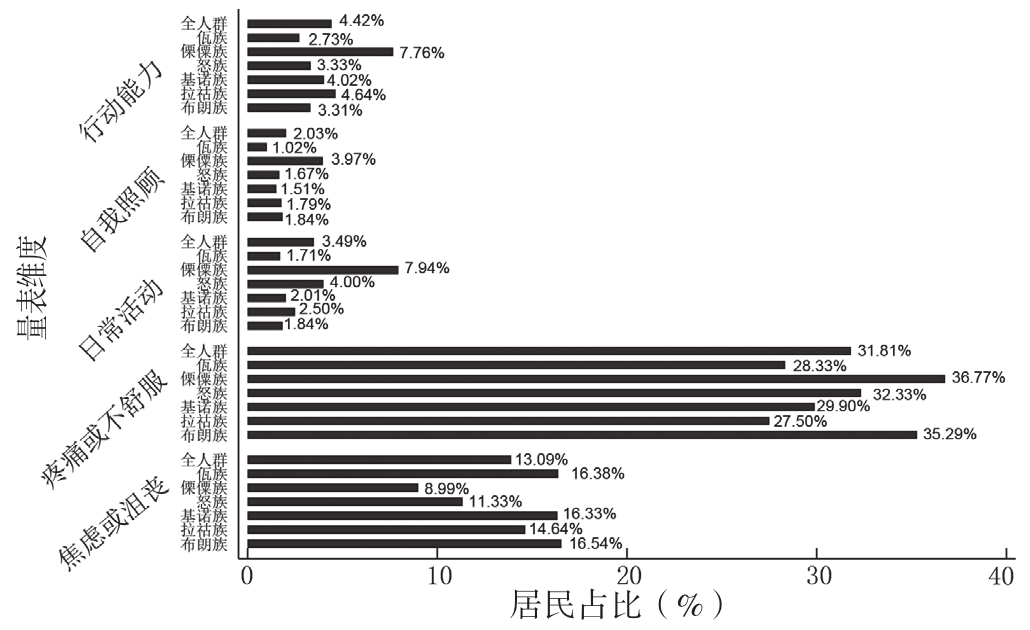
图1 全人群及六个"直过民族"在EQ-5D-5L各维度存在困难占比情况
Figure 1 Proportions of reported problems across EQ-5D-5L dimensions for the general population and six "Zhiguo ethnic minorities"
| 变量 | 赋值 |
|---|---|
| 年龄 | ≤40岁=1,>40~60岁=2,>60岁=3 |
| 性别 | 男=1,女=2 |
| 受教育程度 | 小学以下=1,小学=2,初中=3,高中及以上=4 |
| 婚姻状态 | 在婚=1,非在婚=2 |
| 职业 | 农民=1,其他=2 |
| 家庭月收入 | <3 000元=1,3 000~4 999元=2,≥5 000元=3 |
| 到最近医疗机构时间 | ≥15 min=1,<15 min=2 |
| 社会支持程度 | 一般=1,高=2 |
| 近两周患病情况 | 是=1,否=2 |
| 患慢性病数量 | 0种=1,1种=2,≥2种=3 |
| 抑郁情况 | 是=1,否=2 |
| 睡眠障碍情况 | 是=1,否=2 |
| BMI分级 | 正常/消瘦=1,超重=2,肥胖=3 |
| 吸烟情况 | 是=1,否=2 |
| 饮酒情况 | 是=1,否=2 |
| 运动情况 | 否=1,是=2 |
表2 变量赋值情况
Table 2 Variable coding scheme
| 变量 | 赋值 |
|---|---|
| 年龄 | ≤40岁=1,>40~60岁=2,>60岁=3 |
| 性别 | 男=1,女=2 |
| 受教育程度 | 小学以下=1,小学=2,初中=3,高中及以上=4 |
| 婚姻状态 | 在婚=1,非在婚=2 |
| 职业 | 农民=1,其他=2 |
| 家庭月收入 | <3 000元=1,3 000~4 999元=2,≥5 000元=3 |
| 到最近医疗机构时间 | ≥15 min=1,<15 min=2 |
| 社会支持程度 | 一般=1,高=2 |
| 近两周患病情况 | 是=1,否=2 |
| 患慢性病数量 | 0种=1,1种=2,≥2种=3 |
| 抑郁情况 | 是=1,否=2 |
| 睡眠障碍情况 | 是=1,否=2 |
| BMI分级 | 正常/消瘦=1,超重=2,肥胖=3 |
| 吸烟情况 | 是=1,否=2 |
| 饮酒情况 | 是=1,否=2 |
| 运动情况 | 否=1,是=2 |
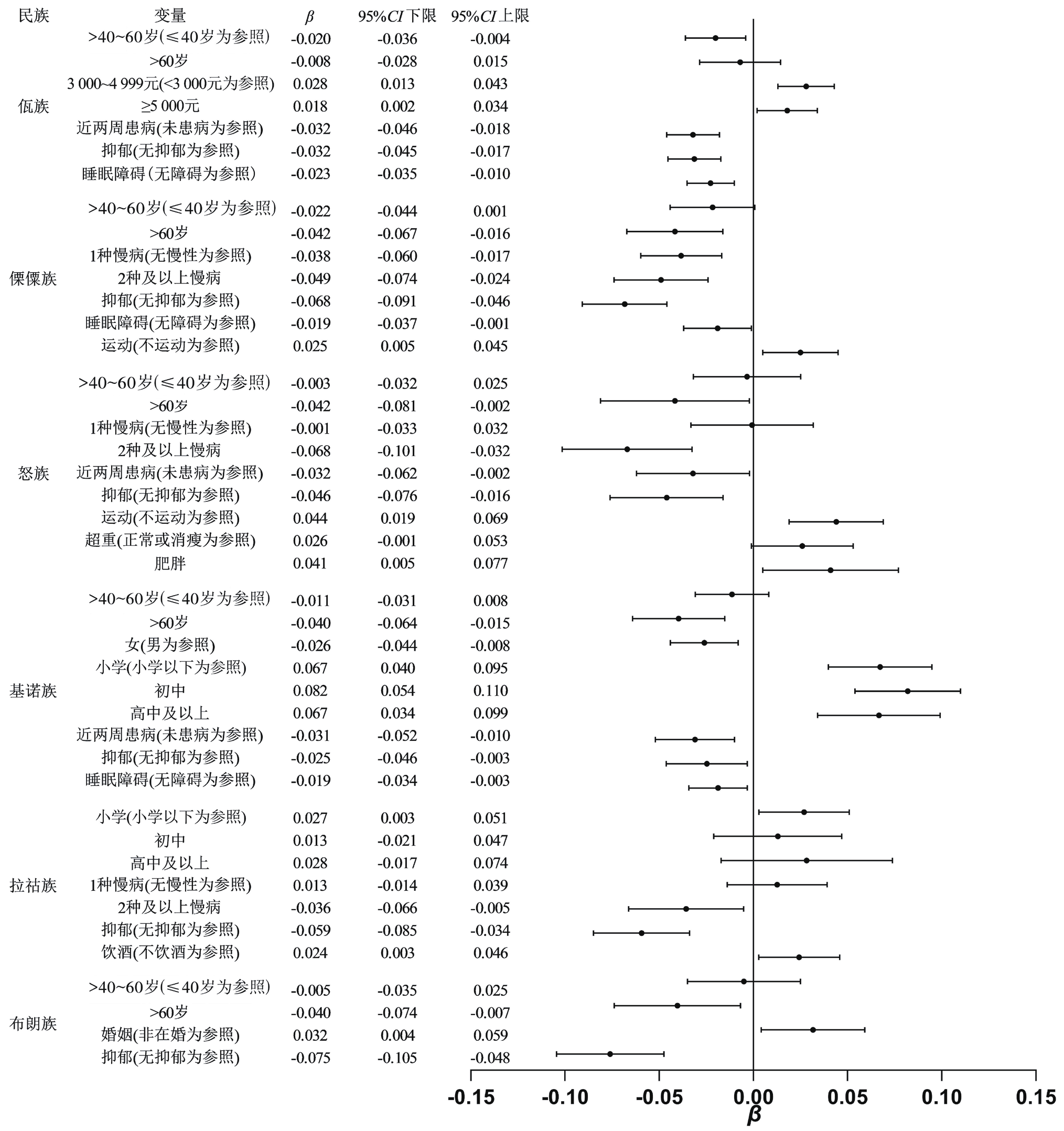
图2 六个"直过民族"居民健康效用值影响因素的多因素Tobit回归分析森林图
Figure 2 Proportions of reported problems in EQ-5D-5L dimensions for the entire study population and six "Zhiguo ethnic minorities"
| [1] |
李永松,孙燕. "直过民族"从"千年直过"迈向"百年跨越" [J]. 社会主义论坛, 2019(9): 22-23.
|
| [2] |
杜泰平. 勐海县"直过民族"精准扶贫问题研究[D]. 昆明: 云南财经大学, 2017.
|
| [3] |
王晓雯. 预防HIV母婴传播(PMTCT)干预的卫生经济学实证[D]. 昆明: 昆明医科大学, 2018.
|
| [4] |
康敏. 广西少数民族地区农村老年人生命质量状况及其影响因素分析[D]. 桂林: 桂林医学院, 2016.
|
| [5] |
|
| [6] |
夏静,吴念韦,马天佩, 等. 基于西南地区居民EQ-5D-5L量表信效度评价[J]. 四川大学学报(医学版), 2020, 51(5): 691-694.
|
| [7] |
秦廷廷,刘思琦,苏明珠, 等. 基于EQ-5D-5L量表的山东省农村地区胃癌患者健康效用值测量及影响因素分析[J]. 中国卫生经济, 2021, 40(3): 43-45.
|
| [8] |
李明晖,罗南. 欧洲五维健康量表(EQ-5D)中文版应用介绍[J]. 中国药物经济学, 2009, 4(1): 49-57.
|
| [9] |
|
| [10] |
陈丹滢,许欢,付忠泽, 等. 基于潜在类别分析的共病模式与新发抑郁症状的纵向关联研究[J]. 现代预防医学, 2025, 52(12): 2120-2125, 2264. DOI: 10.20043/j.cnki.MPM.202412368.
|
| [11] |
中国医疗保健国际交流促进会营养与代谢管理分会,中国营养学会临床营养分会,中华医学会糖尿病学分会, 等. 中国超重/肥胖医学营养治疗指南(2021)[J]. 中国医学前沿杂志(电子版), 2021, 13(11): 1-55.
|
| [12] |
马晓莉. 急诊科护士社会支持及心理压力的相关性研究[J]. 河北医药, 2019, 41(2): 296-299.
|
| [13] |
李月娥,卢珊. 安德森模型的理论构建及分析路径演变评析[J]. 中国卫生事业管理, 2017, 34(5): 324-327, 334.
|
| [14] |
|
| [15] |
|
| [16] |
|
| [17] | |
| [18] |
骆焕园,刘慧芳,吴艳乔, 等. 根据重复观察数据分析临床病人转归的统计学问题和实践[J]. 中国卫生统计, 2017, 34(5): 749-752.
|
| [19] |
|
| [20] |
刘梅,李灵清. 云南省居民健康相关生命质量及影响因素研究[J]. 中国健康教育, 2021, 37(3): 199-204. DOI: 10.16168/j.cnki.issn.1002-9982.2021.03.002.
|
| [21] |
中共中央党史和文献研究院. "直过民族"实现第二次历史性跨越的深刻启示[EB/OL]. (2021-03-02) [2024-04-23].
|
| [22] |
桑舒平. 少数民族地区人群健康相关生命质量及其影响因素的研究[D]. 武汉: 武汉大学, 2014.
|
| [23] |
李明晖,刘国恩,马爱霞. 中国城乡居民健康相关生存质量研究[J]. 中国药物经济学, 2010, 5(3): 22-34. DOI: 10.3969/j.issn.1673-5846.2010.03.003.
|
| [24] |
桑圣祥. 农村成年人群生命质量的流行特征及其与高血压的关系研究[D]. 郑州: 郑州大学, 2022.
|
| [25] |
孙秀娜,梅佳,徐静, 等. 抑郁在老年人睡眠障碍与躯体、心理健康相关生命质量的中介作用[J]. 现代预防医学, 2024, 51(3): 500-506. DOI: 10.20043/j.cnki.MPM.202308070.
|
| [26] |
杨中华,李顺平,扎西达娃, 等. 西藏居民健康相关生命质量:基于3国EQ-5D-3L量表效用值积分体系[J]. 中国药物经济学, 2019, 14(6): 13-17, 22.
|
| [27] |
王晓辉,胡文品,吕萌, 等. 基于EQ-5D-5L量表的兰州市居民健康相关生命质量及影响因素研究[J]. 中国农村卫生事业管理, 2021, 41(6): 435-440.
|
| [28] |
曹鑫志,谭晓婷. 城乡居民医保整合与农村中老年人健康:基于CHARLS数据的经验研究[J]. 农业技术经济, 2022(12): 56-70. DOI: 10.13246/j.cnki.jae.20220214.002.
|
| [29] |
司俊霄,姚依松,何景波, 等. 老年慢性病患者生命质量现状及影响因素研究[J]. 卫生经济研究, 2024, 41(4): 39-42. DOI: 10.14055/j.cnki.33-1056/f.2024.04.009.
|
| [30] |
史盼盼,刘慧君,任延平, 等. 中国老年慢性病患者生命质量现状及影响因素研究:基于CHARLS数据的实证分析[J]. 中国社会医学杂志, 2024, 41(1): 49-53.
|
| [31] |
吴楷雯,唐娴,黄源, 等. 2015—2019年云南省"直过民族"居民死因分析[J]. 中国预防医学杂志, 2021, 22(12): 920-925. DOI: 10.16506/j.1009-6639.2021.12.006.
|
| [32] |
耿新,陈诺,胡鹏. 铸牢中华民族共同体意识视域下人口较少民族实现共同富裕的模式与经验研究[J]. 广西民族研究, 2022(5): 63-70.
|
| [33] |
赖庆奎. 怒江州世居民族传统生态观及其演变研究[J]. 西南林业大学学报(社会科学), 2017, 1(3): 17-20.
|
| [34] |
云南网. 从橡胶村到生态文旅"打卡"点:基诺山热带雨林修复记[EB/OL]. (2023-07-29)[2024-04-23].
|
| [35] |
孙广宇. 体育强国战略下云南省运动休闲特色乡村建设研究[D]. 昆明: 云南大学, 2021.
|
| [36] |
高瑞,张建华. 新形势下少数民族田径运动与健身的融合探究[J]. 贵州民族研究, 2019, 40(6): 116-120.
|
| [37] |
高婧,周尚成,高三德, 等. 基于欧洲五维健康量表的中医治未病门诊就诊患者健康相关生命质量及影响因素研究[J]. 中国全科医学, 2023, 26(32): 4043-4050, 4056. DOI: 10.12114/j.issn.1007-9572.2023.0154.
|
| [38] |
钟宇,孙秀林. "借酒消愁"抑或"饮酒为乐":居民生活满意度与饮酒行为、醉酒频率[J]. 消费经济, 2024, 40(2): 63-76.
|
| [39] |
李秀霞,王皓,孙琦, 等. 山东省某高校新生焦虑情绪现状及其关联因素研究[J]. 现代预防医学, 2019, 46(12): 2205-2208, 2212.
|
| [40] |
王惠雪,赵梅,汪苗, 等. 孤独感在我国老年人健康自评与焦虑关系中的中介效应分析[J]. 景德镇学院学报, 2022, 37(3): 57-61.
|
| [41] |
周琴,陈爱琴,吴金玉, 等. 孟德尔随机化研究在衰弱病人病因探索中应用的研究进展[J]. 护理研究, 2024, 38(20): 3659-3662. DOI: 10.12102/j.issn.1009-6493.2024.20.016.
|
| [42] |
王艺潼. 澜沧县拉祜族民族影像的文化阐释与建构研究[D]. 昆明: 云南师范大学, 2020.
|
| [1] | 李明月, 李述刚, 吴浩, 赵亚利, 于照祥, 孙力光. 中国农村地区基层医疗卫生机构医生培训现状、培训需求及影响因素研究[J]. 中国全科医学, 2027, 30(01): 38-49. |
| [2] | 池廖婧, 李娜, 李雅方. 体育锻炼对抑郁症患者工作记忆干预效果及影响因素的Meta分析[J]. 中国全科医学, 2026, 29(36): 5428-5441. |
| [3] | 刘文静, 刘婷, 董林培, 杨梦洁, 张梦繁. 时限性自我调节理论视角下炎症性肠病患者饮食管理行为影响因素的混合方法研究[J]. 中国全科医学, 2026, 29(36): 5376-5384. |
| [4] | 赵阳, 杨颖, 刘玉, 高冰洁, 梅娜, 尹雪梅. 基于实施性研究综合框架的正常分娩中非必要干预实施的影响因素:一项质性研究[J]. 中国全科医学, 2026, 29(35): 5235-5241. |
| [5] | 曾庆秋, 王红义, 叶静雪, 刘丹, 蒋莉华. 成都市村(居)民委员会公共卫生委员会人员结构化能力的潜在剖面及其影响因素研究[J]. 中国全科医学, 2026, 29(35): 5197-5202. |
| [6] | 李珊珊, 苗彩云, 毛佩芝, 沈珑慧. 高危妊娠患者药品不良反应的临床特征及影响因素研究[J]. 中国全科医学, 2026, 29(33): 4885-4890. |
| [7] | 杨新颖, 王凯蓉, 李俊, 叶凡婷, 王梦瑶, 李宾宾. 机会性筛查人群胃癌前状态检出现状及影响因素研究[J]. 中国全科医学, 2026, 29(32): 4716-4720. |
| [8] | 翟佳燚, 张雪艳, 时峰, 顾沁乐, 万和平, 陆媛. 不同类型功能社区人群的焦虑现状及影响因素差异研究[J]. 中国全科医学, 2026, 29(32): 4730-4737. |
| [9] | 闫梓薇, 聂佳桦, 石妍, 魏立民. 白蛋白/γ-谷氨酰转移酶比值与2型糖尿病合并代谢相关脂肪性肝病的相关性研究[J]. 中国全科医学, 2026, 29(30): 4431-4437. |
| [10] | 孙秀芹, 冯振龙, 魏兰萱, 曾宇欣, 刘金波, 马林, 安占天, 王宏宇. 北京市石景山区中老年居民代谢综合征患病现状及行为生活方式影响因素研究[J]. 中国全科医学, 2026, 29(30): 4424-4430. |
| [11] | 黄嘉婷, 柳玲娜, 宁艳花, 史晶, 李欣锦, 杨彩玲, 姚静. 农村老年人家庭医生签约服务的表达需要和感知需要一致性:对宁夏回族自治区456名常住居民的问卷调查[J]. 中国全科医学, 2026, 29(29): 4217-4225. |
| [12] | 黎婉钰, 金花, 张倩倩, 于德华. 上海市社区全科医生实施主动健康管理知信行现状及其影响因素[J]. 中国全科医学, 2026, 29(28): 4157-4163. |
| [13] | 张帆, 常建华, 杨娟, 乔慧, 谢永鑫. 宁夏回族自治区农村居民慢性病共病的流行趋势及关联规则分析[J]. 中国全科医学, 2026, 29(27): 3956-3968. |
| [14] | 付梦茹, 薛梅启旸, 蒋雨桐, 陈鸣声, 钱东福, 李忠. 农村心房颤动患者自我管理能力影响因素研究[J]. 中国全科医学, 2026, 29(27): 3947-3955. |
| [15] | 焦姝婷, 井浩然, 赵亚利. 北京市城区社区就诊老年患者慢性瘙痒症状强度及影响因素研究[J]. 中国全科医学, 2026, 29(25): 3655-3663. |
| 阅读次数 | ||||||
|
全文 |
|
|||||
|
摘要 |
|
|||||