
中国全科医学 ›› 2025, Vol. 28 ›› Issue (36): 4605-4618.DOI: 10.12114/j.issn.1007-9572.2024.0706
肖俊杰1, 何佳玮1, 曾潇1, 向红霞1, 雷茂1, 郑如意1, 郑川1, 任益锋1, 由凤鸣1,2, 付西1,*( ), 马琼1,*()
收稿日期:2024-10-28
修回日期:2025-02-17
出版日期:2025-12-20
发布日期:2025-12-04
通讯作者:
付西, 马琼
作者贡献:
肖俊杰、何佳玮负责论文撰写及绘图;曾潇、向红霞负责文献查阅与提取;雷茂、郑如意负责数据处理与分析;郑川、任益锋负责论文的初步修改;由凤鸣负责稿件校对;付西、马琼负责研究思路的制订及最终版本修订,对论文整体负责。
基金资助:
XIAO Junjie1, HE Jiawei1, ZENG Xiao1, XIANG Hongxia1, LEI Mao1, ZHENG Ruyi1, ZHENG Chuan1, REN Yifeng1, YOU Fengming1,2, FU Xi1,*(), MA Qiong1,*()
Received:2024-10-28
Revised:2025-02-17
Published:2025-12-20
Online:2025-12-04
Contact:
FU Xi, MA Qiong
摘要: 背景 肺癌作为发病率及死亡率均居首位的恶性肿瘤,其预防和治疗已成为研究热点,昼夜节律紊乱(CRD)被认为是肺癌发生的重要危险因素,但二者的因果关联尚不明确。 目的 探讨昼夜节律紊乱与肺癌发生风险之间的因果关系及可能机制,并进行潜在干预中药预测。 方法 通过UK Biobank等网站获取白天小睡、白天嗜睡、短睡眠时间、长睡眠时间、时间型、失眠及早起的全基因组关联研究(GWAS)数据,通过IEU Open GWAS数据库获取总体肺癌、肺腺癌(LUAD)、肺鳞状细胞癌(LUSC)、小细胞肺癌(SCLC)的GWAS数据,进行孟德尔随机化(MR)分析,以逆方差加权法(IVW)作为主要分析方法评估昼夜节律紊乱与肺癌发生的因果关系。根据单核苷酸多态性(SNPs)定位,并通过蛋白质互作(PPI)网络分析筛选核心基因,进行功能富集分析及生存分析。将核心基因上传至Coremine数据库查找具有潜在干预作用的中药,统计中药性味归经及功效,并筛选出核心中药,使用TCMSP及BATMAN-TCM数据库获得核心中药的关键成分,运用分子对接验证潜在中药关键成分与核心基因的结合能力。 结果 失眠(OR=1.149,95%CI=1.074~1.232,P=0.013)、短睡眠时间(OR=1.462,95%CI=1.033~2.061,P=0.031)与肺癌,失眠(OR=1.181,95%CI=1.061~1.322,P=0.001)、短睡眠时间(OR=1.563,95%CI=1.024~2.401,P=0.038)、白天嗜睡(OR=4.033,95%CI=1.062~15.434,P=0.042)与LUAD,失眠(OR=1.152,95%CI=1.028~1.281,P=0.001)与LUSC,短睡眠时间(OR=1.952,95%CI=1.120~3.383,P=0.017)与SCLC存在因果关联;筛选出139个核心基因,主要富集在G蛋白偶联受体(GPCR)、丝裂原活化蛋白激酶(MAPK)、磷脂酰肌醇-3-激酶(PI3K)/蛋白激酶B(Akt)等通路,排名前5的核心基因包括:组蛋白乙酰转移酶P300(EP300)、甘油醛-3-磷酸脱氢酶(GAPDH)、G蛋白亚基β1(GNB1)、G蛋白亚基γ13(GNG13)、肿瘤坏死因子(TNF),其中EP300表达量与LUAD、LUSC、SCLC患者生存时间呈正相关(P<0.05);CNB1表达量与LUAD患者生存时间呈负相关,与SCLC患者生存时间呈正相关(P<0.05);GAPDH、GNG13、TNF表达量与LUAD患者生存时间呈负相关(P<0.05)。筛选出水牛角、丹参、鱼脑石、黄芩、郁金、黄芪、灵芝、人参等共40味中药,药味以甘为主,苦、辛次之,药性寒为主,温、平次之,归经多归肝、脾、肺、胃、心、肾经,功效以补气、活血化瘀、清热解毒为主;筛选出水牛角、丹参、三七、黄芩、郁金、姜黄、玉米须、灵芝共8味核心中药,分子对接显示,与核心靶基因有良好的结合效能(结合能<-4 kcal/mol)。 结论 昼夜节律紊乱与肺癌存在因果关系,其作用机制与GCPR、MAPK、PI3K/Akt等通路相关,所预测中药可为中医药调复昼夜节律防治肺癌提供参考依据。
中图分类号:
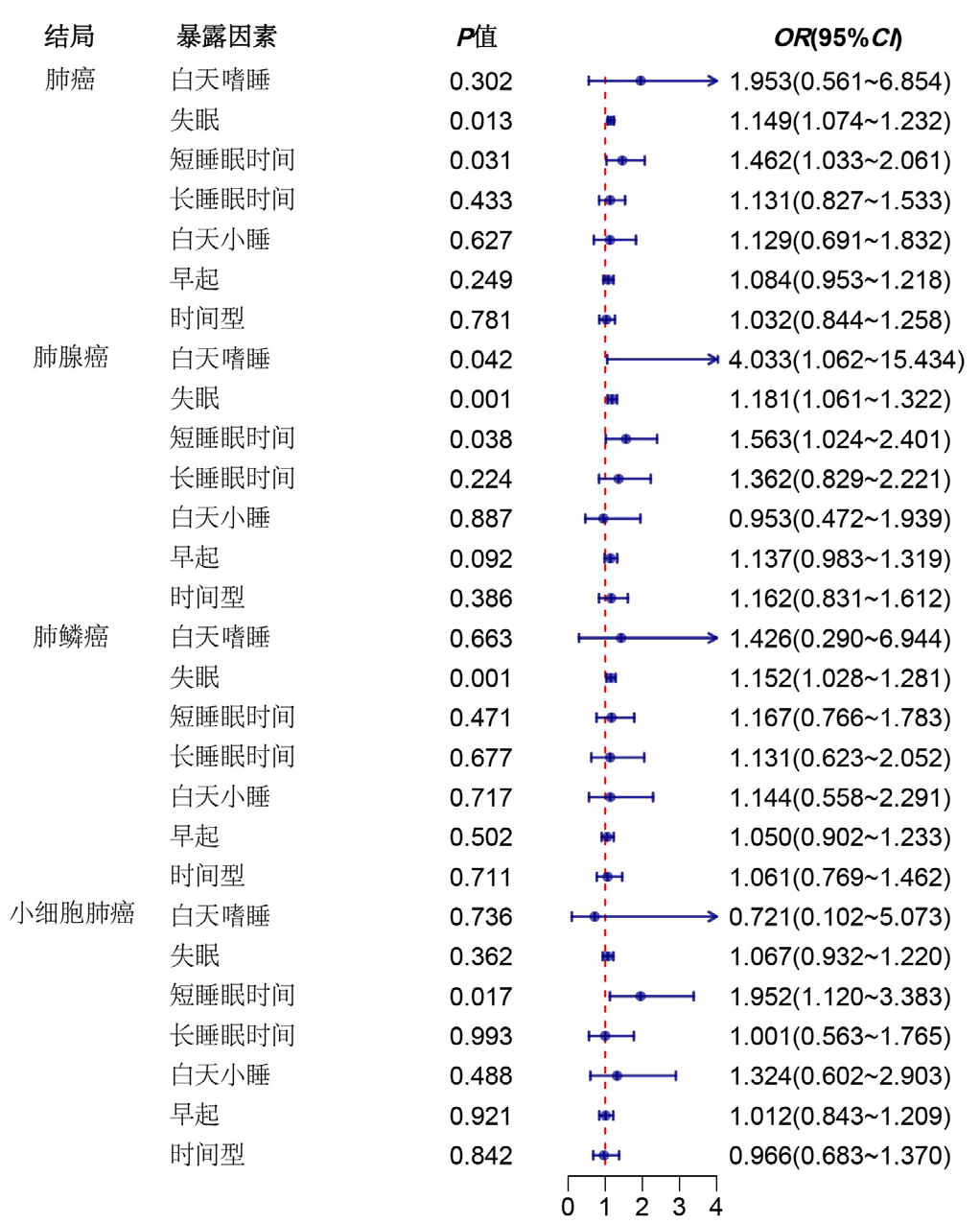
图1 CRD与肺癌MR分析森林图
Figure 1 Forest plot of MR analysis between CRD and lung cancer
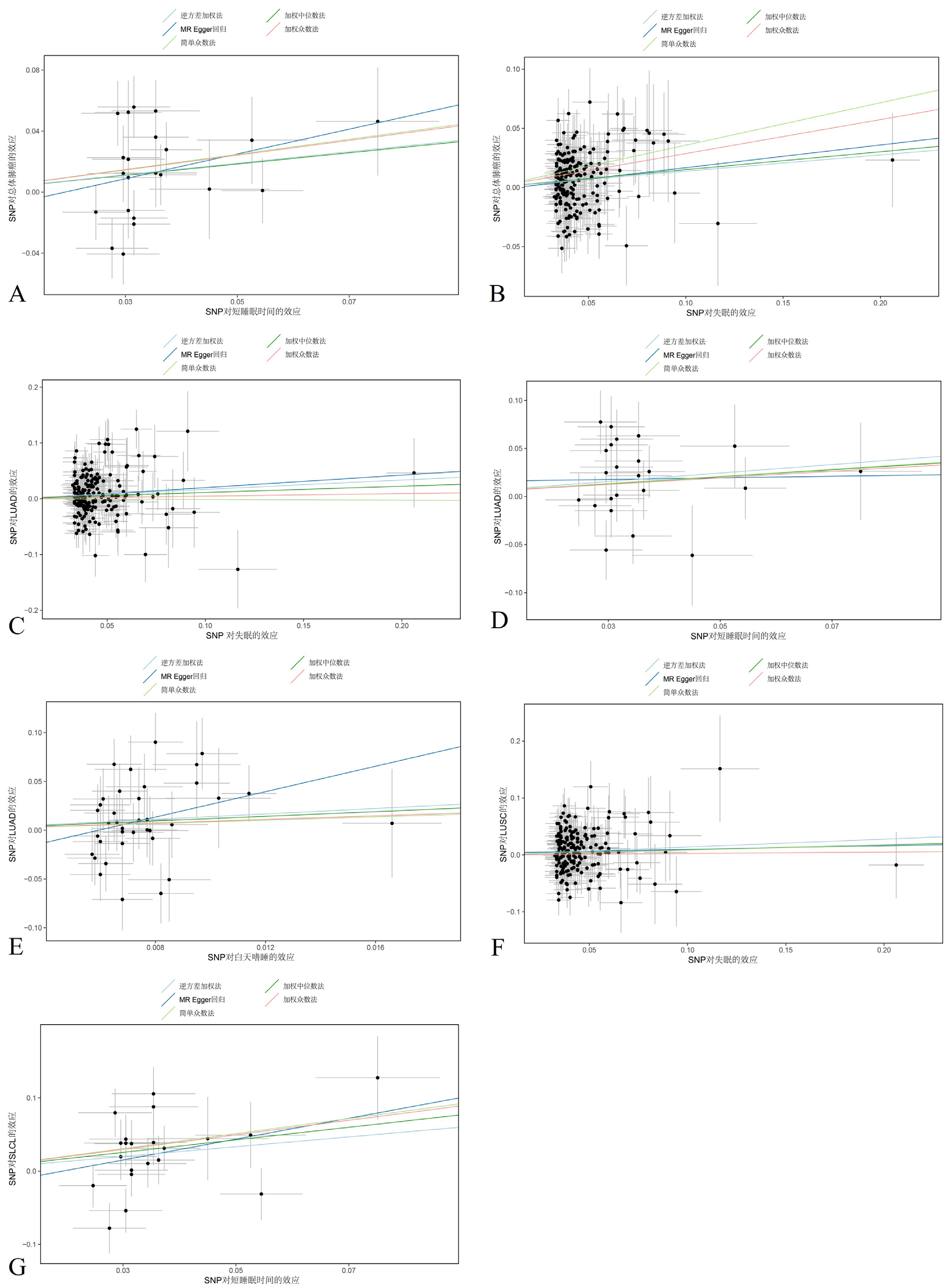
图2 CRD与肺癌MR分析散点图注:A为短睡眠时间与总体肺癌MR分析散点图,B为失眠与总体肺癌MR分析散点图,C为失眠对LUAD的MR分析散点图,D为短睡眠时间对LUAD的MR分析散点图,E为白天嗜睡与LUAD的MR分析散点图,F为失眠与LUSC的MR分析散点图,G为短睡眠时间与SCLC的MR分析散点图;图中黑点代表SNP;LUAD=肺腺癌,LUSC=肺鳞状细胞癌,SCLC=小细胞肺癌,SNP=单核苷酸多态性。
Figure 2 Scatter plot of MR analysis between CRD and lung cancer
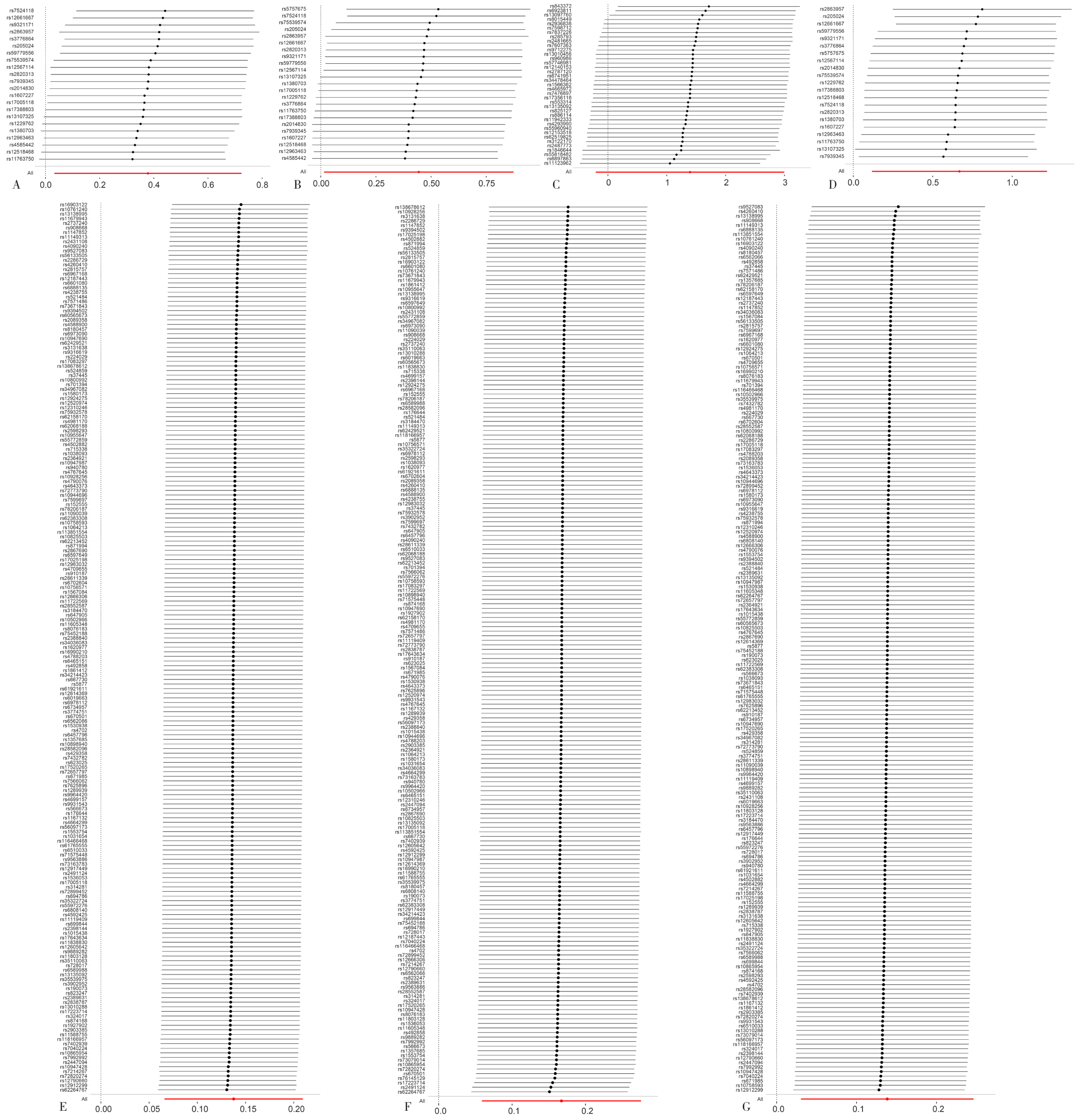
图3 MR分析LOO结果注:A为短睡眠时间对总体肺癌MR分析的LOO森林图,B为短睡眠时间对LUAD MR分析的LOO森林图,C为白天嗜睡对LUAD MR分析的LOO森林图,D为短睡眠时间对SCLC MR分析的LOO森林图,E为失眠对总体肺癌MR分析的LOO森林图,F为失眠对LUAD MR分析的LOO森林图,G为失眠对LUSC MR分析的LOO森林图。
Figure 3 Results of LOO test in MR analysis
| 结局 | 暴露因素 | IVW分析 | MR-Egger检验 | IVW mre分析P值 | ||
|---|---|---|---|---|---|---|
| Q值 | P值 | Q值 | P值 | |||
| 肺癌 | 失眠 | 225.032 | 0.048 | 224.851 | 0.036 | 0.001 |
| 白天小睡 | 142.118 | 0.008 | 142.414 | 0.001 | 0.758 | |
| 短睡眠时间 | 40.827 | 0.024 | 40.107 | 0.001 | 0.031 | |
| 白天嗜睡 | 771.563 | 0.003 | 71.352 | 0.006 | 0.302 | |
| 肺腺癌 | 时间型 | 190.811 | 0.035 | 193.104 | 0.032 | 0.390 |
| 白天小睡 | 156.066 | 0.001 | 154.286 | 0.003 | 0.886 | |
| 肺鳞癌 | 失眠 | 238.634 | 0.034 | 238.612 | 0.034 | 0.001 |
| 小细胞肺癌 | 失眠 | 262.855 | 0.001 | 262.160 | 0.010 | 0.363 |
| 早起 | 193.160 | 0.011 | 191.878 | 0.001 | 0.924 | |
| 白天小睡 | 129.221 | 0.036 | 129.106 | 0.041 | 0.491 | |
| 短睡眠时间 | 35.763 | 0.020 | 34.952 | 0.001 | 0.021 | |
| 嗜睡 | 69.049 | 0.004 | 63.103 | 0.005 | 0.759 | |
表1 异质性检验及矫正
Table 1 Heterogeneity test and IVW mre results
| 结局 | 暴露因素 | IVW分析 | MR-Egger检验 | IVW mre分析P值 | ||
|---|---|---|---|---|---|---|
| Q值 | P值 | Q值 | P值 | |||
| 肺癌 | 失眠 | 225.032 | 0.048 | 224.851 | 0.036 | 0.001 |
| 白天小睡 | 142.118 | 0.008 | 142.414 | 0.001 | 0.758 | |
| 短睡眠时间 | 40.827 | 0.024 | 40.107 | 0.001 | 0.031 | |
| 白天嗜睡 | 771.563 | 0.003 | 71.352 | 0.006 | 0.302 | |
| 肺腺癌 | 时间型 | 190.811 | 0.035 | 193.104 | 0.032 | 0.390 |
| 白天小睡 | 156.066 | 0.001 | 154.286 | 0.003 | 0.886 | |
| 肺鳞癌 | 失眠 | 238.634 | 0.034 | 238.612 | 0.034 | 0.001 |
| 小细胞肺癌 | 失眠 | 262.855 | 0.001 | 262.160 | 0.010 | 0.363 |
| 早起 | 193.160 | 0.011 | 191.878 | 0.001 | 0.924 | |
| 白天小睡 | 129.221 | 0.036 | 129.106 | 0.041 | 0.491 | |
| 短睡眠时间 | 35.763 | 0.020 | 34.952 | 0.001 | 0.021 | |
| 嗜睡 | 69.049 | 0.004 | 63.103 | 0.005 | 0.759 | |
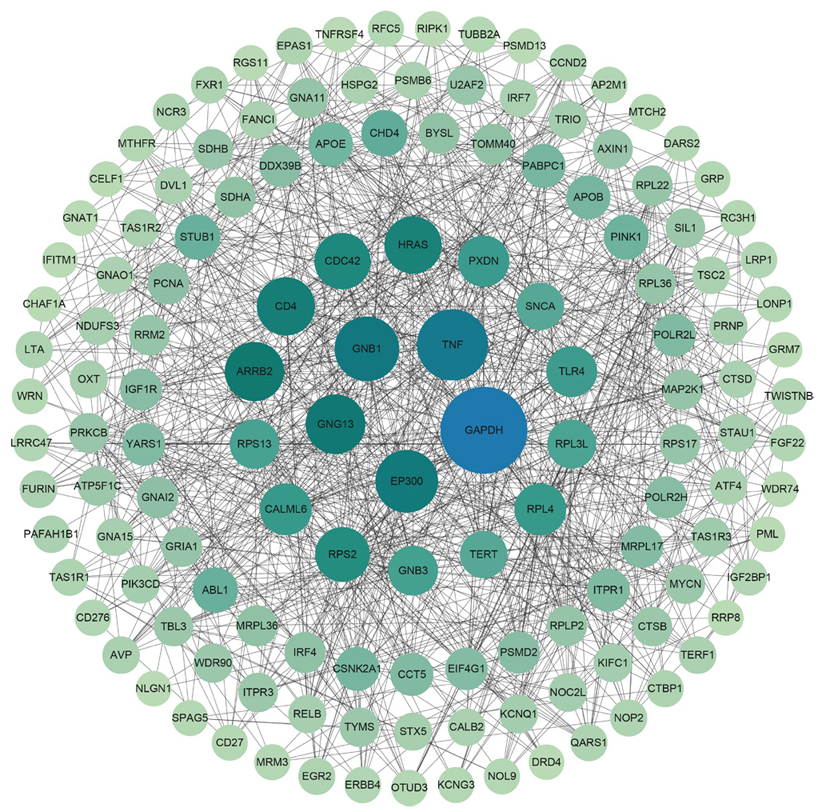
图4 CRD介导肺癌发生的核心基因网络图
Figure 4 Core gene network diagram of CRD-mediated lung cancer development
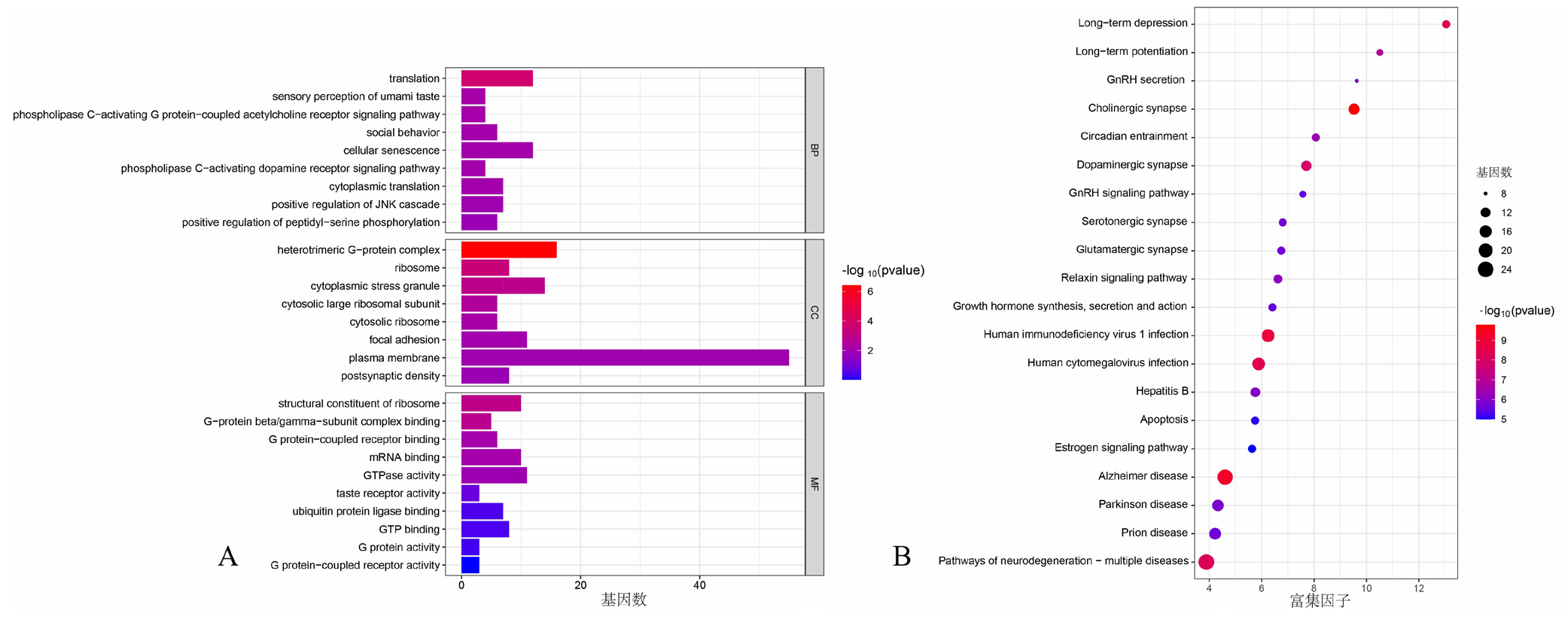
图5 核心基因GO功能及KEGG通路富集分析注:A为核心基因GO功能分析,B为核心基因KEGG通路富集分析。
Figure 5 GO function enrichment analysis results and KEGG enrichment analysis results of core genes
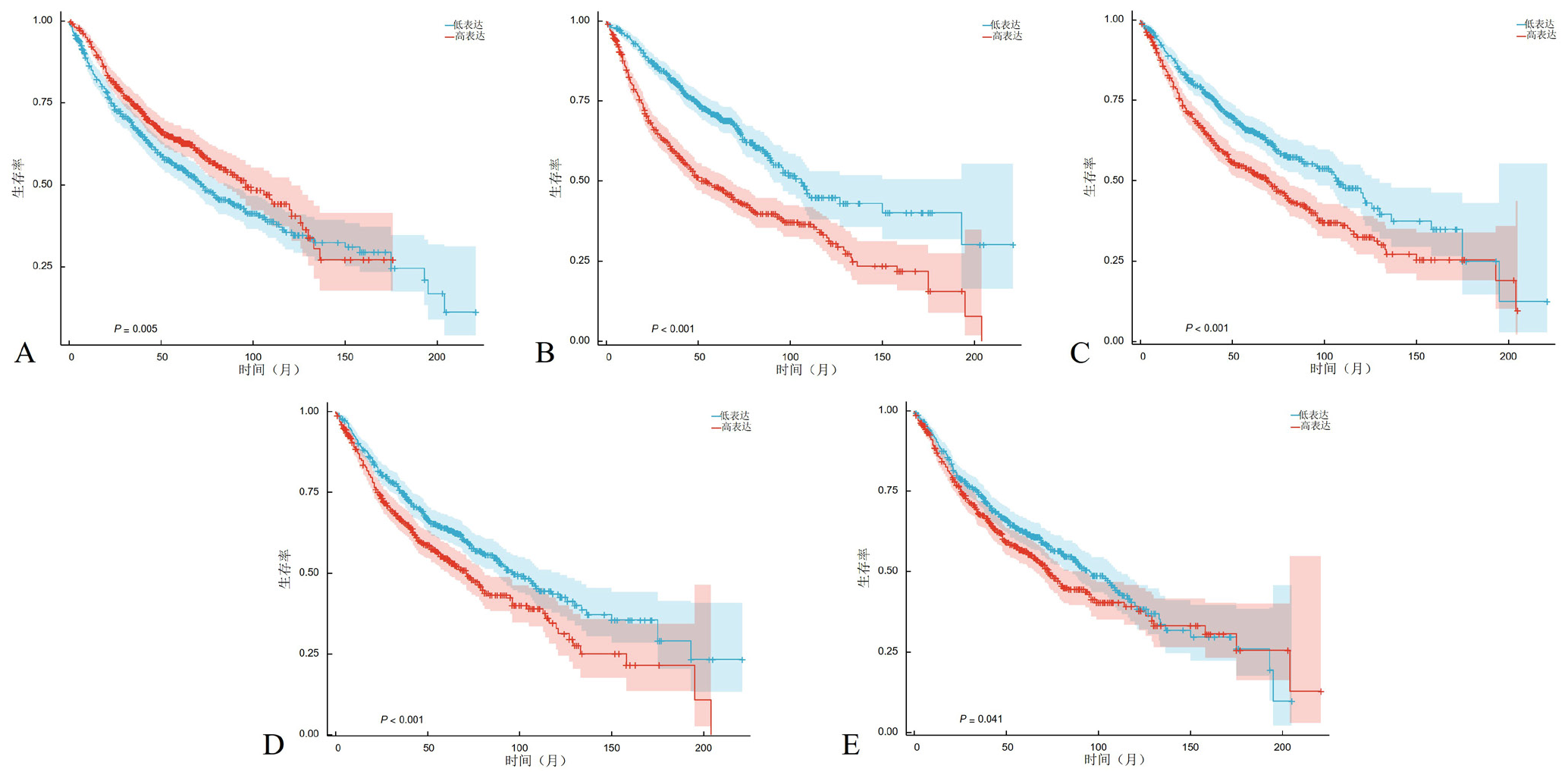
图6 关键基因与LUAD患者的Kaplan-Meier生存曲线注:A为不同EP300表达水平LUAD患者的Kaplan-Meier生存曲线,B为不同GAPDH表达水平LUAD患者的Kaplan-Meier生存曲线,C为GNB1不同表达水平LUAD患者的Kaplan-Meier生存曲线,D为GNG13不同表达水平LUAD患者的Kaplan-Meier生存曲线,E为TNF不同表达水平LUAD患者的Kaplan-Meier生存曲线;图中蓝色背景表示低表达组生存曲线的95%CI,红色背景表示高表达组生存曲线的95%CI。
Figure 6 Kaplan-Meier survival curves of core genes in LUAD patients
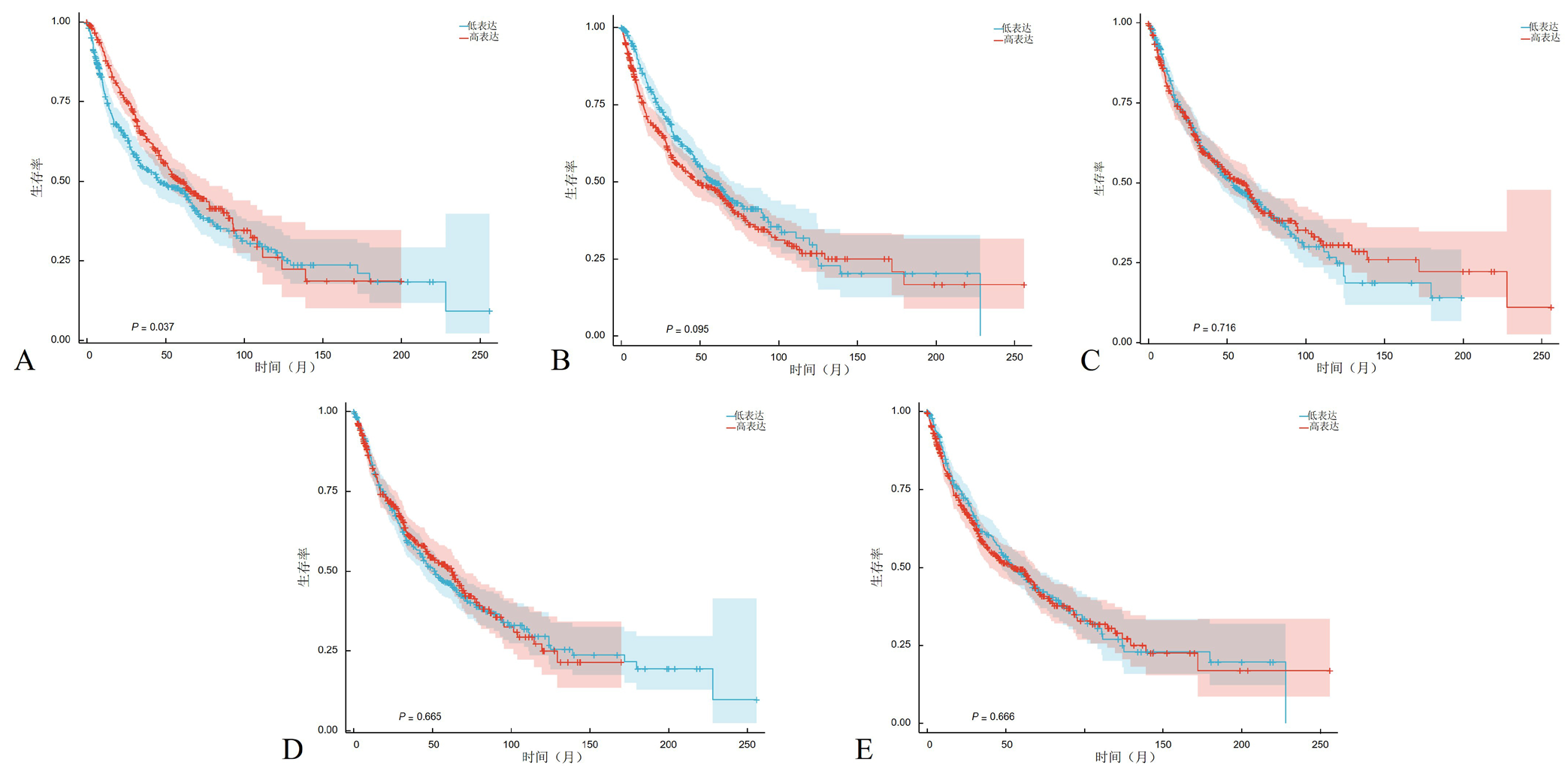
图7 关键基因与LUSC患者的Kaplan-Meier生存曲线注:A为不同EP300表达水平LUSC患者的Kaplan-Meier生存曲线,B为不同GAPDH表达水平LUSC患者的Kaplan-Meier生存曲线,C为GNB1不同表达水平LUSC患者的Kaplan-Meier生存曲线,D为GNG13不同表达水平LUSC患者的Kaplan-Meier生存曲线,E为TNF不同表达水平LUSC患者的Kaplan-Meier生存曲线;图中蓝色背景表示低表达组生存曲线的95%CI,红色背景表示高表达组生存曲线的95%CI。
Figure 7 Kaplan-Meier survival curves of core genes in LUSC patients
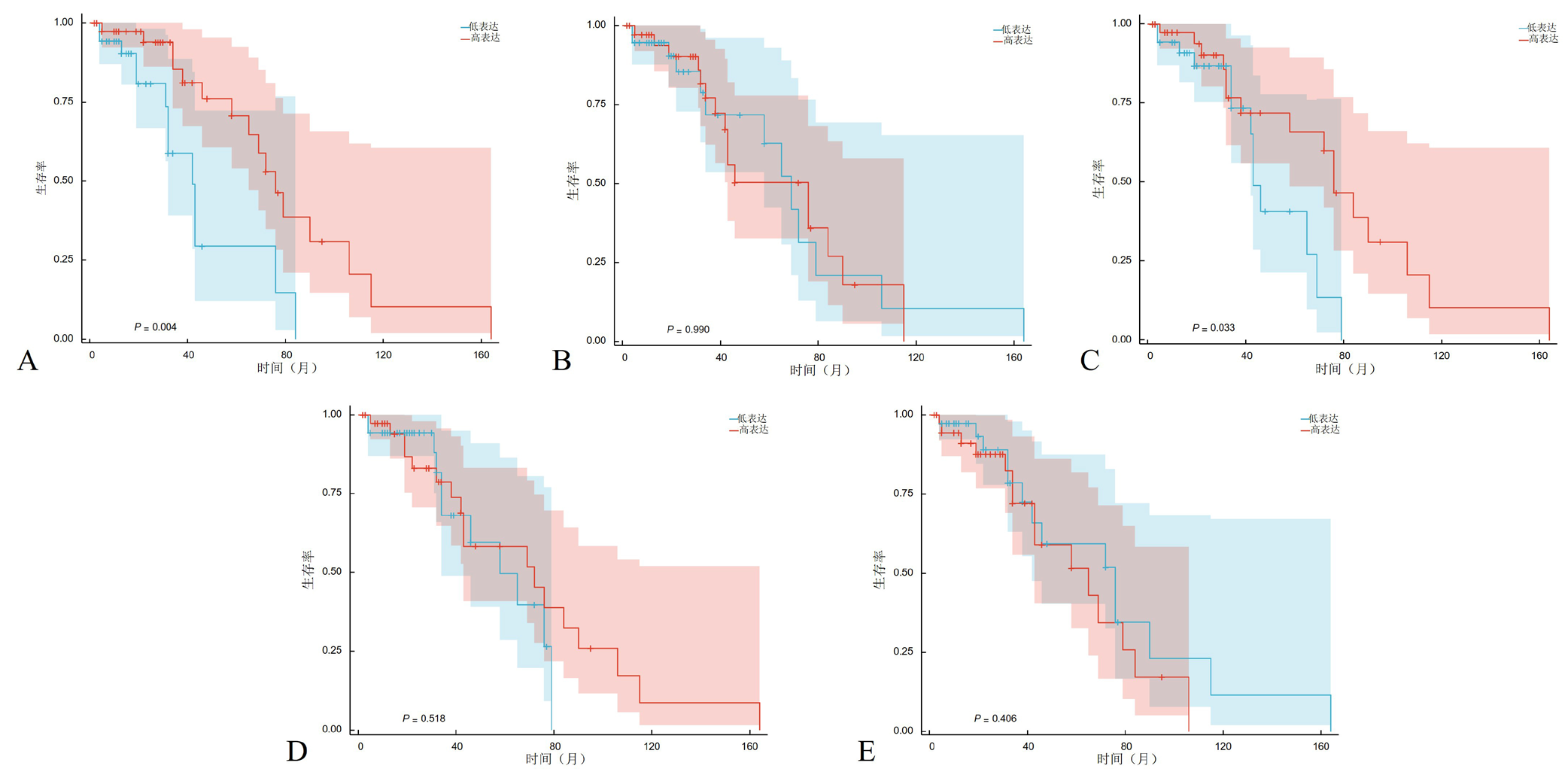
图8 关键基因与SCLC患者的Kaplan-Meier生存曲线注:A为不同EP300表达水平SCLC患者的Kaplan-Meier生存曲线,B为不同GAPDH表达水平SCLC患者的Kaplan-Meier生存曲线,C为GNB1不同表达水平SCLC患者的Kaplan-Meier生存曲线,D为GNG13不同表达水平SCLC患者的Kaplan-Meier生存曲线,E为TNF不同表达水平SCLC患者的Kaplan-Meier生存曲线;图中蓝色背景表示低表达生存曲线的95%CI,红色背景表示高表达组生存曲线的95%CI。
Figure 8 Kaplan-Meier survival curves of core genes in SCLC patients

图9 "中药-核心基因"网络图注:图中箭头形状为核心基因,周围圆形为筛选出的中药。
Figure 9 Network diagram of "traditional Chinese medicines-core genes"
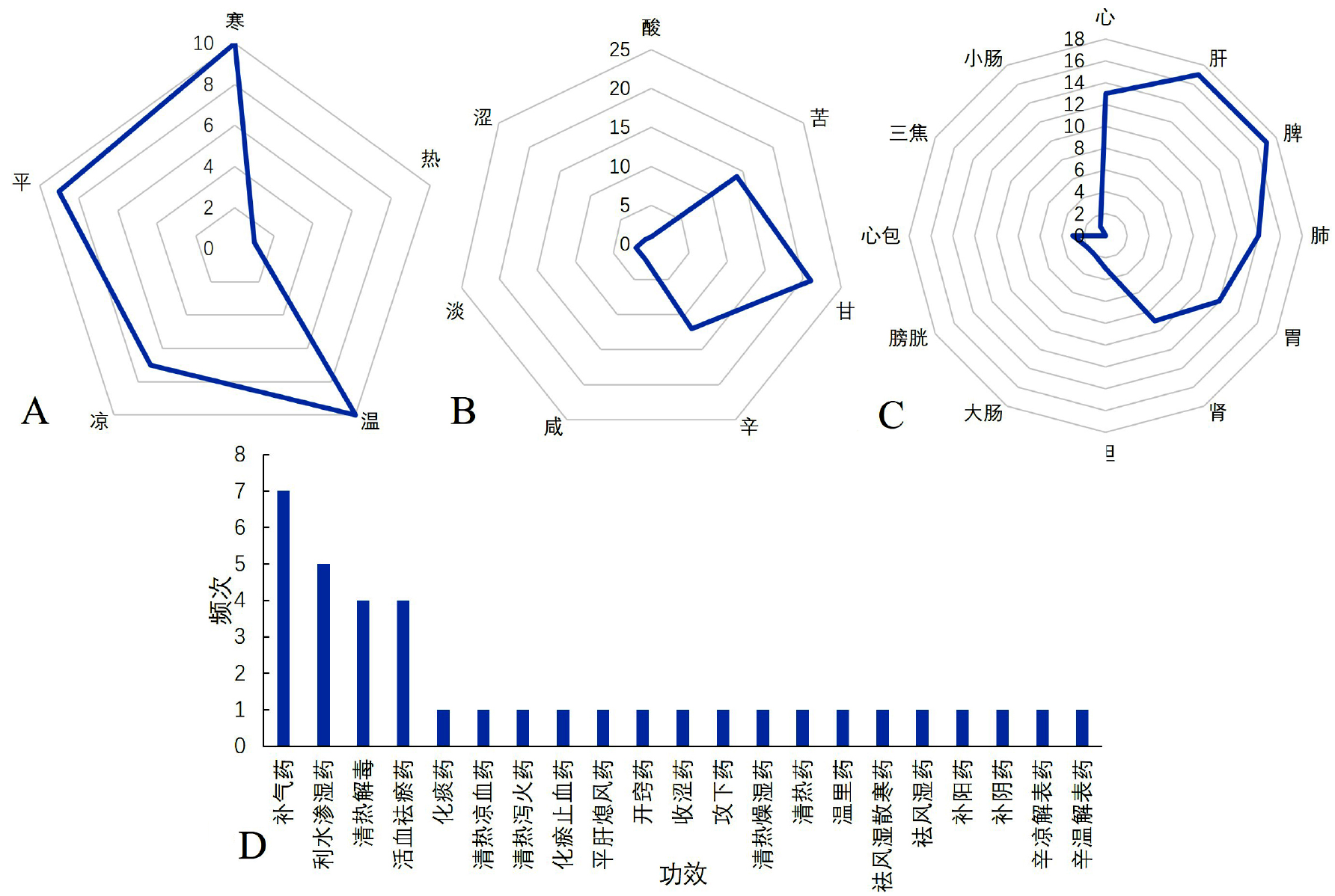
图10 预测中药的药味、药性、归经及功效分布图注:A为预测中药药性分布图,B为药味分布图,C为归经分布图,D为功效分布图。图中数字代表该种药性、药味、归经或功效出现的次数。
Figure 10 Distribution map of five flavors,four qi,meridian tropismand efficacy of potential traditional Chinese medicines
| 中药 | 靶点 | 中药 | 靶点 |
|---|---|---|---|
| 鱼脑石 | IRF7/KIFC1/RIPK1/IFITM1/PIK3CD/CTSB/GAPDH/TNF/LRP1/IRF4 | 黄芪 | TNF/TLR4/RPL22/TERT/IRF4/CD4/PINK1 |
| 鱼鳔胶 | IRF7/KIFC1/RIPK1/IFITM1/PIK3CD/CTSB/GAPDH/TNF/LRP1/IRF4 | 郁金 | TNF/RPS17/GNB1/EP300/TLR4/TERT/PCNA/TSC2/ABL1 |
| 益智仁 | RPL36/RPL22/TNF/PML/TLR4 | 姜黄 | TNF/RPS17/GNB1/EP300/TLR4/TERT/PCNA/TSC2/ABL1 |
| 牡丹皮 | RPL36/RPL22/AP2M1/TNF/GAPDH/TLR4 | 三七叶 | PINK1/TLR4/TNF/APOE/PCNA/ITPR3/ITPR1/EPAS1 |
| 茯苓 | GNB1/TLR4/TNF/LRP1/HRAS | 三七花 | PINK1/TLR4/TNF/APOE/PCNA/ITPR3 |
| 原麝香 | HSPG2/ERBB4/CSNK2A1/DVL1/NLGN1/RPL22/ABL1 | 大黄 | CSNK2A1/TLR4/TNF/RIPK1/HRAS/PCNA |
| 高良姜 | NOC2L/STAU1/GRM7/AXIN1/TSC2/ITPR1 | 三七 | PINK1/TLR4/TNF/APOE/PCNA/ITPR3 |
| 灵芝 | GNG13/TLR4/TNF/GAPDH/PCNA/CD4/EIF4G1/GRM7 | 枸杞子 | RPS13/TLR4/GAPDH/TNF/NCR3/CTSB |
| 芜菁 | PABPC1/PSMD13/RPLP2/EIF4G1/RPS2 | 葛花 | RPLP2/RPS2/SDHA/SDHB/TNF/TLR4 |
| 三白草根 | PML/TNF/CCND2/RIPK1/MAP2K1 | 葛根 | RPLP2/RPS2/SDHA/SDHB/TNF/TLR4 |
| 三白草 | PML/TNF/CCND2/RIPK1/MAP2K1 | 甘草 | NOC2L/STAU1/GRM7/AXIN1/TLR4 |
| 玉米须 | CSNK2A1/RPS13/RPS2/CTSB/CD4/TNF/GAPDH | 水牛角 | GAPDH/PCNA/IGF1R/NOC2L/TLR4/DVL1/STAU1/RPL22/RPL22/CCND2/PRNP/GRM7/AXIN1 |
| 黄芩 | TNF/TLR4/ATF4/LONP1/MAP2K1/IRF4/PML/PINK1 | 猕猴桃根 | RPS2/STUB1/LRP1/CCND2/CTSB |
| 人参花 | TNF/TLR4/RGS11/ITPR3/ITPR1/ATF4/RPS13/GNB1 | 鱼腥草 | TNF/TLR4/ITPR3/PINK1/ITPR1 |
| 人参芦 | TNF/TLR4/RGS11/ITPR3/ITPR1/ATF4/RPS13/GNB1 | 蛇蜕 | CSNK2A1/ITPR3/PINK1/ITPR1/ATF4/TNF |
| 人参叶 | TNF/TLR4/RGS11/ITPR3/ITPR1/ATF4/RPS13/GNB1 | 浮小麦 | RPS2/LRP1/GAPDH/CTSB/TNF |
| 人参 | TNF/TLR4/RGS11/ITPR3/ITPR1/ATF4/RPS13/GNB1 | 桔梗 | PABPC1/TNF/TLR4/TERT/PINK1 |
| 丹参 | TNF/TLR4/RIPK1/PXDN/CTBP1/MAP2K1/APOE/ATF4/PCNA | 茶树根 | PCNA/TERT/KCNQ1/TNF/GAPDH/CD4/TLR4 |
| 白术 | TLR4/TNF/ITPR3/PINK1/ITPR1/ATF4 | 木瓜 | CTSD/SNCA/SNCA/PCNA/TNF |
| 钩藤 | ITPR3/ITPR1/SNCA/SNCA/TLR4/CTSD | 川芎 | GAPDH/TAS1R3/TNF/SDHA/TAS1R1/RRM2 |
表2 预测中药及有效靶点
Table 2 Potential interventional traditional Chinese medicine and targets
| 中药 | 靶点 | 中药 | 靶点 |
|---|---|---|---|
| 鱼脑石 | IRF7/KIFC1/RIPK1/IFITM1/PIK3CD/CTSB/GAPDH/TNF/LRP1/IRF4 | 黄芪 | TNF/TLR4/RPL22/TERT/IRF4/CD4/PINK1 |
| 鱼鳔胶 | IRF7/KIFC1/RIPK1/IFITM1/PIK3CD/CTSB/GAPDH/TNF/LRP1/IRF4 | 郁金 | TNF/RPS17/GNB1/EP300/TLR4/TERT/PCNA/TSC2/ABL1 |
| 益智仁 | RPL36/RPL22/TNF/PML/TLR4 | 姜黄 | TNF/RPS17/GNB1/EP300/TLR4/TERT/PCNA/TSC2/ABL1 |
| 牡丹皮 | RPL36/RPL22/AP2M1/TNF/GAPDH/TLR4 | 三七叶 | PINK1/TLR4/TNF/APOE/PCNA/ITPR3/ITPR1/EPAS1 |
| 茯苓 | GNB1/TLR4/TNF/LRP1/HRAS | 三七花 | PINK1/TLR4/TNF/APOE/PCNA/ITPR3 |
| 原麝香 | HSPG2/ERBB4/CSNK2A1/DVL1/NLGN1/RPL22/ABL1 | 大黄 | CSNK2A1/TLR4/TNF/RIPK1/HRAS/PCNA |
| 高良姜 | NOC2L/STAU1/GRM7/AXIN1/TSC2/ITPR1 | 三七 | PINK1/TLR4/TNF/APOE/PCNA/ITPR3 |
| 灵芝 | GNG13/TLR4/TNF/GAPDH/PCNA/CD4/EIF4G1/GRM7 | 枸杞子 | RPS13/TLR4/GAPDH/TNF/NCR3/CTSB |
| 芜菁 | PABPC1/PSMD13/RPLP2/EIF4G1/RPS2 | 葛花 | RPLP2/RPS2/SDHA/SDHB/TNF/TLR4 |
| 三白草根 | PML/TNF/CCND2/RIPK1/MAP2K1 | 葛根 | RPLP2/RPS2/SDHA/SDHB/TNF/TLR4 |
| 三白草 | PML/TNF/CCND2/RIPK1/MAP2K1 | 甘草 | NOC2L/STAU1/GRM7/AXIN1/TLR4 |
| 玉米须 | CSNK2A1/RPS13/RPS2/CTSB/CD4/TNF/GAPDH | 水牛角 | GAPDH/PCNA/IGF1R/NOC2L/TLR4/DVL1/STAU1/RPL22/RPL22/CCND2/PRNP/GRM7/AXIN1 |
| 黄芩 | TNF/TLR4/ATF4/LONP1/MAP2K1/IRF4/PML/PINK1 | 猕猴桃根 | RPS2/STUB1/LRP1/CCND2/CTSB |
| 人参花 | TNF/TLR4/RGS11/ITPR3/ITPR1/ATF4/RPS13/GNB1 | 鱼腥草 | TNF/TLR4/ITPR3/PINK1/ITPR1 |
| 人参芦 | TNF/TLR4/RGS11/ITPR3/ITPR1/ATF4/RPS13/GNB1 | 蛇蜕 | CSNK2A1/ITPR3/PINK1/ITPR1/ATF4/TNF |
| 人参叶 | TNF/TLR4/RGS11/ITPR3/ITPR1/ATF4/RPS13/GNB1 | 浮小麦 | RPS2/LRP1/GAPDH/CTSB/TNF |
| 人参 | TNF/TLR4/RGS11/ITPR3/ITPR1/ATF4/RPS13/GNB1 | 桔梗 | PABPC1/TNF/TLR4/TERT/PINK1 |
| 丹参 | TNF/TLR4/RIPK1/PXDN/CTBP1/MAP2K1/APOE/ATF4/PCNA | 茶树根 | PCNA/TERT/KCNQ1/TNF/GAPDH/CD4/TLR4 |
| 白术 | TLR4/TNF/ITPR3/PINK1/ITPR1/ATF4 | 木瓜 | CTSD/SNCA/SNCA/PCNA/TNF |
| 钩藤 | ITPR3/ITPR1/SNCA/SNCA/TLR4/CTSD | 川芎 | GAPDH/TAS1R3/TNF/SDHA/TAS1R1/RRM2 |
| 中药 | degree | BC | CC |
|---|---|---|---|
| 水牛角 | 15 | 1 322.748 | 0.407 |
| 丹参 | 9 | 610.638 | 0.380 |
| 郁金 | 9 | 493.456 | 0.395 |
| 姜黄 | 9 | 493.456 | 0.395 |
| 灵芝 | 8 | 608.940 | 0.385 |
| 三七 | 8 | 356.556 | 0.380 |
| 玉米须 | 7 | 353.532 | 0.391 |
| 黄芩 | 8 | 412.299 | 0.377 |
表3 核心中药拓扑参数
Table 3 Topological parameters of key traditional Chinese medicines
| 中药 | degree | BC | CC |
|---|---|---|---|
| 水牛角 | 15 | 1 322.748 | 0.407 |
| 丹参 | 9 | 610.638 | 0.380 |
| 郁金 | 9 | 493.456 | 0.395 |
| 姜黄 | 9 | 493.456 | 0.395 |
| 灵芝 | 8 | 608.940 | 0.385 |
| 三七 | 8 | 356.556 | 0.380 |
| 玉米须 | 7 | 353.532 | 0.391 |
| 黄芩 | 8 | 412.299 | 0.377 |
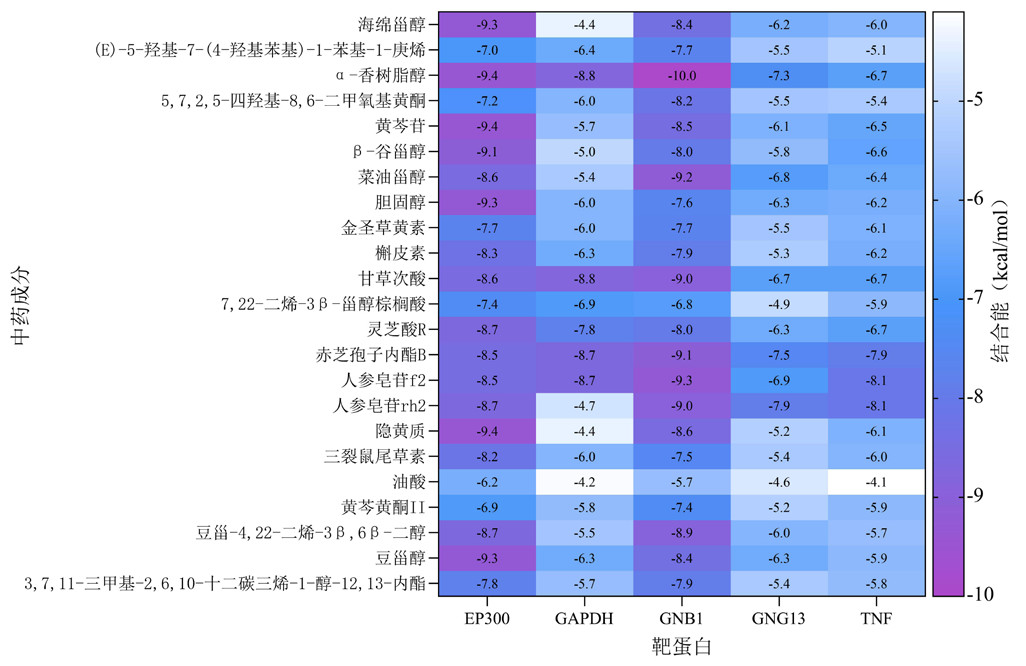
图11 核心中药关键成分与核心基因(靶蛋白)分子对接结合能热图注:EP300=组蛋白乙酰转移酶P300,GAPDH=甘油醛-3-磷酸脱氢酶,GNB1=G蛋白亚基β1,GNG13=G蛋白亚基γ13,TNF=肿瘤坏死因子。
Figure 11 Heatmap of the binding affinity between the key components of core TCMs and the core genes(target proteins) through molecular docking

图12 核心中药关键成分与核心基因(靶蛋白)分子对接三维视图注:A为EP300与黄芩苷三维视图,B为GAPDH与甘草次酸三维视图,C为GNB1与人参皂苷f2三维视图,D为GNG13与人参皂苷rh2三维视图,E为TNF与赤芝孢子内酯B三维视图。
Figure 12 3D molecular docking view of key components from core traditional Chinese medicines and core genes(target proteins)
| 中药 | 有效成分 | Mol ID |
|---|---|---|
| 丹参 | 海绵甾醇(poriferasterol) | MOL001659 |
| α-香树脂醇(α-amyrin) | MOL006824 | |
| 黄芩苷(baicalin) | MOL002776 | |
| 郁金 | 3,7,11-三甲基-2,6,10-十二碳三烯-1-醇-12,13-内酯(zedoarolide A) | MOL004311 |
| (E)-5-羟基-7-(4-羟基苯基)-1-苯基-1-庚烯((E)-5-hydroxy-7-(4-hydroxyphenyl)-1-phenyl-1-heptene) | MOL004263 | |
| β-谷甾醇(β-sitosterol) | MOL000359 | |
| 黄芩 | 5,7,2,5-四羟基-8,6-二甲氧基黄酮(5,7,2,5-tetrahydroxy-8,6-dimethoxyflavone) | MOL002909 |
| 黄芩黄酮II(skullcapflavone II) | MOL002927 | |
| 三裂鼠尾草素(salvigenin) | MOL002915 | |
| 三七 | 人参皂苷f2(ginsenoside f2) | MOL007475 |
| 人参皂苷rh2(ginsenoside rh2) | MOL007475 | |
| 槲皮素(quercetin) | MOL000098 | |
| 灵芝 | 赤芝孢子内酯B(ganosporelactone B) | MOL011258 |
| 灵芝酸R(ganodermic acid R) | MOL011245 | |
| 7,22-二烯-3β-甾醇棕榈酸(ergosta-7,22-diene-3beta-yl palmitate) | MOL011166 | |
| 水牛角 | 胆固醇(cholesterol) | MOL000953 |
| 油酸(oleic acid) | MOL000675 | |
| 甘草次酸(enoxolone) | MOL004804 | |
| 玉米须 | 隐黄质(kryptoxanthin) | MOL003059 |
| 豆甾-4,22-二烯-3β,6β-二醇(stigmasta-4,22-diene-3β,6β-diol) | MOL013356 | |
| 金圣草黄素(chrysoeriol) | MOL003044 | |
| 姜黄 | 菜油甾醇(campesterol) | MOL000493 |
| 豆甾醇(stigmasterol) | MOL000449 |
表4 中药关键成分
Table 4 Key components of traditional Chinese medicine
| 中药 | 有效成分 | Mol ID |
|---|---|---|
| 丹参 | 海绵甾醇(poriferasterol) | MOL001659 |
| α-香树脂醇(α-amyrin) | MOL006824 | |
| 黄芩苷(baicalin) | MOL002776 | |
| 郁金 | 3,7,11-三甲基-2,6,10-十二碳三烯-1-醇-12,13-内酯(zedoarolide A) | MOL004311 |
| (E)-5-羟基-7-(4-羟基苯基)-1-苯基-1-庚烯((E)-5-hydroxy-7-(4-hydroxyphenyl)-1-phenyl-1-heptene) | MOL004263 | |
| β-谷甾醇(β-sitosterol) | MOL000359 | |
| 黄芩 | 5,7,2,5-四羟基-8,6-二甲氧基黄酮(5,7,2,5-tetrahydroxy-8,6-dimethoxyflavone) | MOL002909 |
| 黄芩黄酮II(skullcapflavone II) | MOL002927 | |
| 三裂鼠尾草素(salvigenin) | MOL002915 | |
| 三七 | 人参皂苷f2(ginsenoside f2) | MOL007475 |
| 人参皂苷rh2(ginsenoside rh2) | MOL007475 | |
| 槲皮素(quercetin) | MOL000098 | |
| 灵芝 | 赤芝孢子内酯B(ganosporelactone B) | MOL011258 |
| 灵芝酸R(ganodermic acid R) | MOL011245 | |
| 7,22-二烯-3β-甾醇棕榈酸(ergosta-7,22-diene-3beta-yl palmitate) | MOL011166 | |
| 水牛角 | 胆固醇(cholesterol) | MOL000953 |
| 油酸(oleic acid) | MOL000675 | |
| 甘草次酸(enoxolone) | MOL004804 | |
| 玉米须 | 隐黄质(kryptoxanthin) | MOL003059 |
| 豆甾-4,22-二烯-3β,6β-二醇(stigmasta-4,22-diene-3β,6β-diol) | MOL013356 | |
| 金圣草黄素(chrysoeriol) | MOL003044 | |
| 姜黄 | 菜油甾醇(campesterol) | MOL000493 |
| 豆甾醇(stigmasterol) | MOL000449 |
| [1] |
|
| [2] |
|
| [3] |
|
| [4] |
|
| [5] |
|
| [6] |
|
| [7] |
|
| [8] |
|
| [9] |
|
| [10] |
|
| [11] |
|
| [12] |
|
| [13] |
|
| [14] |
|
| [15] |
|
| [16] |
|
| [17] |
|
| [18] |
|
| [19] |
|
| [20] |
|
| [21] |
|
| [22] |
|
| [23] |
|
| [24] |
|
| [25] |
|
| [26] |
关念波,刘浩,林洪生. 肺癌中医药治疗的研究进展及展望[J]. 临床肿瘤学杂志,2013,18(3):264-267. DOI:10.3969/j.issn.1009-0460.2013.03.017.
|
| [27] |
黄文博,潘丽,黄娅,等. 基于能量代谢重编程论"阴火"与中医肿瘤发生学[J]. 中医杂志,2022,63(10):905-909. DOI:10.13288/j.11-2166/r.2022.10.002.
|
| [28] | |
| [29] |
姜雨乔. 基于数据挖掘的刘渡舟教授治疗不寐临床经验研究[D]. 北京:北京中医药大学,2023.
|
| [30] |
卢健棋,庞延,黄舒培,等. 中医药治疗高血压病异常血压昼夜节律的研究近况[J]. 中华中医药学刊,2018,36(2):371-373. DOI:10.13193/j.issn.1673-7717.2018.02.030.
|
| [31] |
史佳宁,柴瑞佳,黄瑶,等. 益神宁心方对原发性失眠心脾两虚型患者唾液褪黑素、皮质醇水平的影响[J]. 中医杂志,2021,62(24):2157-2163. DOI:10.13288/j.11-2166/r.2021.24.009.
|
| [32] |
|
| [33] |
|
| [34] |
|
| [35] |
郭英,庞秋菊,贺凡,等. 黄芩苷调节miR-15b-3p与PTPRJ表达在非小细胞肺癌细胞增殖与凋亡中的作用研究[J/OL].中医学报,1-15. [2025-10-10].
|
| [36] |
侯从岭,雷小婷,芦晓帆,等. 黄芩苷对肺癌H460细胞生物学特性及Wnt/β-catenin信号通路的影响[J]. 中国老年学杂志,2022,42(2):426-430.
|
| [37] |
|
| [38] |
张志宏,王春梅,李贺,等. 黄芪甲苷通过JAK/STAT3信号通路抑制肺癌细胞增殖和迁移的作用机制研究[J]. 北华大学学报:自然科学版,2022,23(6):775-779.
|
| [39] |
|
| [40] |
贾力维,沃晓嫚,王谦博,等. 黄芪甲苷对非小细胞肺癌A549细胞增殖及凋亡相关蛋白表达的影响[J]. 黑龙江大学自然科学学报,2019,36(1):84-89. DOI:10.13482/j.issn1001-7011.2018.12.138.
|
| [41] |
庄梦婕,刘丹,陈彦文,等. 黄芪多糖联合顺铂对小鼠Lewis肺癌移植瘤Caspase-3、Smac/Diablo表达的影响[J]. 解剖学报,2018,49(1):63-69. DOI:10.16098/j.issn.0529-1356.2018.01.010.
|
| [42] |
|
| [43] |
|
| [44] |
|
| [45] |
|
| [46] |
|
| [1] | 冯贞贞, 刘文瑞, 李建生, 关徐涛, 全建峰, 高宏, 田建辉, 荣震, 侯炜, 周洵. 全国不同区域的2 340例肺癌患者临床特征及基础证候分布差异研究[J]. 中国全科医学, 2026, 29(20): 2860-2866. |
| [2] | 房彬彬, 单春方, 刘芬, 田婷, 谢骞, 冀伟, 李艳红, 杨毅宁, 李晓梅. Stanford A型主动脉夹层病变关键基因筛选与免疫浸润研究[J]. 中国全科医学, 2026, 29(18): 2523-2531. |
| [3] | 张馨文, 魏光成, 张解玉, 石金杰, 李晓旭, 马锐, 押玉珑, 彭九程, 曹炜. 睡眠特征与血清尿酸水平的因果效应:一项双向孟德尔随机化研究[J]. 中国全科医学, 2026, 29(17): 2354-2360. |
| [4] | 熊思玉, 芦兵, 蒋汶宏, 俞婷婷. 肺腺癌靶向药物耐药前后果糖二磷酸醛缩酶A的表达及其与患者预后关系研究[J]. 中国全科医学, 2026, 29(14): 1883-1889. |
| [5] | 罗秀, 麻钊丽, 黄梦宇, 任茜. 肠道微生物群对代谢综合征的遗传预测因果效应研究[J]. 中国全科医学, 2026, 29(05): 612-622. |
| [6] | 周文超, 梁佳琪, 姚尚满, 薛朝, 刘龙, 郭相杰. 高血压与帕金森病的共享基因位点识别研究[J]. 中国全科医学, 2026, 29(02): 201-206. |
| [7] | 杨清惠, 胡映雪, 倪萍蔚, 刘晓. 1990—2021年中国肺癌发病和死亡趋势分析及2035年预测研究[J]. 中国全科医学, 2026, 29(02): 256-263. |
| [8] | 张书岑, 徐积兄. 多发性硬化症与自身免疫性甲状腺疾病的关系研究[J]. 中国全科医学, 2025, 28(33): 4159-4165. |
| [9] | 刘振宇, 魏云鹏, 王江敏, 邢彦. 睡眠时间与心力衰竭的因果关联研究[J]. 中国全科医学, 2025, 28(27): 3441-3446. |
| [10] | 王亚静, 段晓阳, 侯冉, 黄娅婕, 史健. 表皮生长因子受体阳性非小细胞肺癌脑转移患者靶向联合治疗研究进展[J]. 中国全科医学, 2025, 28(26): 3328-3337. |
| [11] | 王爽, 吴树法, 令垚, 谭茜蔚, 曹汝岱, 曾慧婷, 孔丹莉, 丁元林, 于海兵. 基于代谢组学探究非脂质代谢物在肥胖与糖尿病视网膜病变间的中介作用:孟德尔随机化研究[J]. 中国全科医学, 2025, 28(21): 2625-2634. |
| [12] | 史健, 王亚静, 侯冉, 黄娅婕, 段晓阳. 表皮生长因子受体酪氨酸激酶抑制剂联合化疗一线治疗表皮生长因子受体突变晚期非小细胞肺癌疗效及安全性的Meta分析[J]. 中国全科医学, 2025, 28(11): 1383-1394. |
| [13] | 郭玉梦, 崔杨霖, 张宪忠. 基于孟德尔随机化探讨肠道菌群与失眠的因果关联研究[J]. 中国全科医学, 2025, 28(08): 954-961. |
| [14] | 檀紫瑞, 申青, 刘俊英, 陈砚凝, 姚继方. 表皮生长因子受体非热点突变型非小细胞肺癌一线应用表皮生长因子受体酪氨酸激酶抑制剂及化疗的疗效对比研究[J]. 中国全科医学, 2024, 27(35): 4426-4434. |
| [15] | 柴梅梅, 包信娟, 曾梅, 李芙兰, 汉瑞娟. 肺癌术后患者持续性咳嗽发生率及影响因素的Meta分析[J]. 中国全科医学, 2024, 27(34): 4350-4352. |
| 阅读次数 | ||||||
|
全文 |
|
|||||
|
摘要 |
|
|||||