
中国全科医学 ›› 2027, Vol. 30 ›› Issue (03): 336-347.DOI: 10.12114/j.issn.1007-9572.2026.0176
• 论著 • 上一篇
季娟1, 周良2, 倪丽丽1, 黄佐1, 高虹3,*( )
收稿日期:2026-02-20
修回日期:2026-10-25
出版日期:2027-01-20
发布日期:2026-11-26
通讯作者:
高虹
作者贡献:
季娟提出主要研究目标,负责研究的构思与设计,以及论文的撰写;周良负责统计学处理,图、表的绘制与展示;黄佐、倪丽丽负责数据的搜集与整理;高虹负责论文的修订,质量控制与审查,对文章整体负责,监督管理。
基金资助:
JI Juan1, ZHOU Liang2, NI Lili1, HUANG Zuo1, GAO Hong3,*()
Received:2026-02-20
Revised:2026-10-25
Published:2027-01-20
Online:2026-11-26
Contact:
GAO Hong
摘要: 背景 甘油三酯-葡萄糖(TyG)指数是胰岛素抵抗的替代标志物,与2型糖尿病(T2DM)风险密切相关。然而,现有研究多基于基线单次测量的TyG指数,无法反映TyG指数长期暴露的真实模式,且未充分控制药物使用等时变混杂因素,限制了TyG指数长期暴露与T2DM发病之间因果推断的可靠性。 目的 评估社区人群TyG指数长期暴露水平与新发T2DM风险的关联,并采用时间依存Cox比例风险回归模型框架控制药物使用的时变混杂效应。 方法 回顾性纳入2018年苏州市某社区卫生服务中心参加社区体检的965例无糖尿病成年居民,随访至2024年(中位随访时间为6年)。采用函数型主成分分析(FPCA)结合K-means聚类方法识别TyG指数长期暴露水平,并分为低、中、高暴露组。按照相关标准确认T2DM发病。建立时间依存Cox比例风险回归模型,TyG指数及药物使用(降糖药、降压药、降脂药、抗血小板药)均按年更新为时变协变量。主效应量为TyG指数每增加1个标准差(SD,1 SD≈0.63 TyG指数单位)对应的新发T2DM风险比(HR)。采用自然立方样条评估连续TyG指数与新发T2DM风险的剂量-反应关系,并进行预设亚组分析与Bootstrap中介分析。 结果 随访期间共523例发生T2DM,累积发病率为54.2%。低暴露组339例(35.1%),基线TyG指数为8.51(8.18,8.78);中暴露组385例(39.9%),基线TyG指数为9.02(8.76,9.32);高暴露组241例(25.0%),基线TyG指数为9.39(9.09,9.69)。Log-rank检验显示3组无T2DM生存率比较,差异有统计学意义(χ2=19.91,P<0.001)。时间依存Cox比例风险回归模型显示,连续TyG指数增加1个SD对应新发T2DM的HR为1.21(95%CI=1.09~1.34,P<0.001)。逐类纳入药物变量后HR保持稳定在1.21,证实药物使用不构成混杂。自然立方样条分析显示呈线性剂量-反应关系(P非线性=0.479)。肥胖路径具有显著中介效应(中介比例=6.9%,P<0.001),血压和血脂路径的中介效应均不显著,总中介比例为9.4%(P=0.213)。亚组分析显示关联在年龄、性别、BMI等18个分层中方向一致(HR均>1),除高尿酸血症(P交互=0.049)外,其余7个亚组维度的P交互均>0.05。 结论 在社区人群中,TyG指数长期暴露水平与T2DM发病风险呈正向线性关联。时间依存Cox比例风险回归模型有效控制了药物使用的时变混杂。中介分析表明约90%的TyG指数效应独立于经典心血管代谢风险因子,主要反映未被当前纳入的经典风险因子所解释的剩余效应。未来应在不同代谢风险水平的人群中验证关联的普适性,并探索整合TyG指数与其他代谢指标的综合风险评估模型。
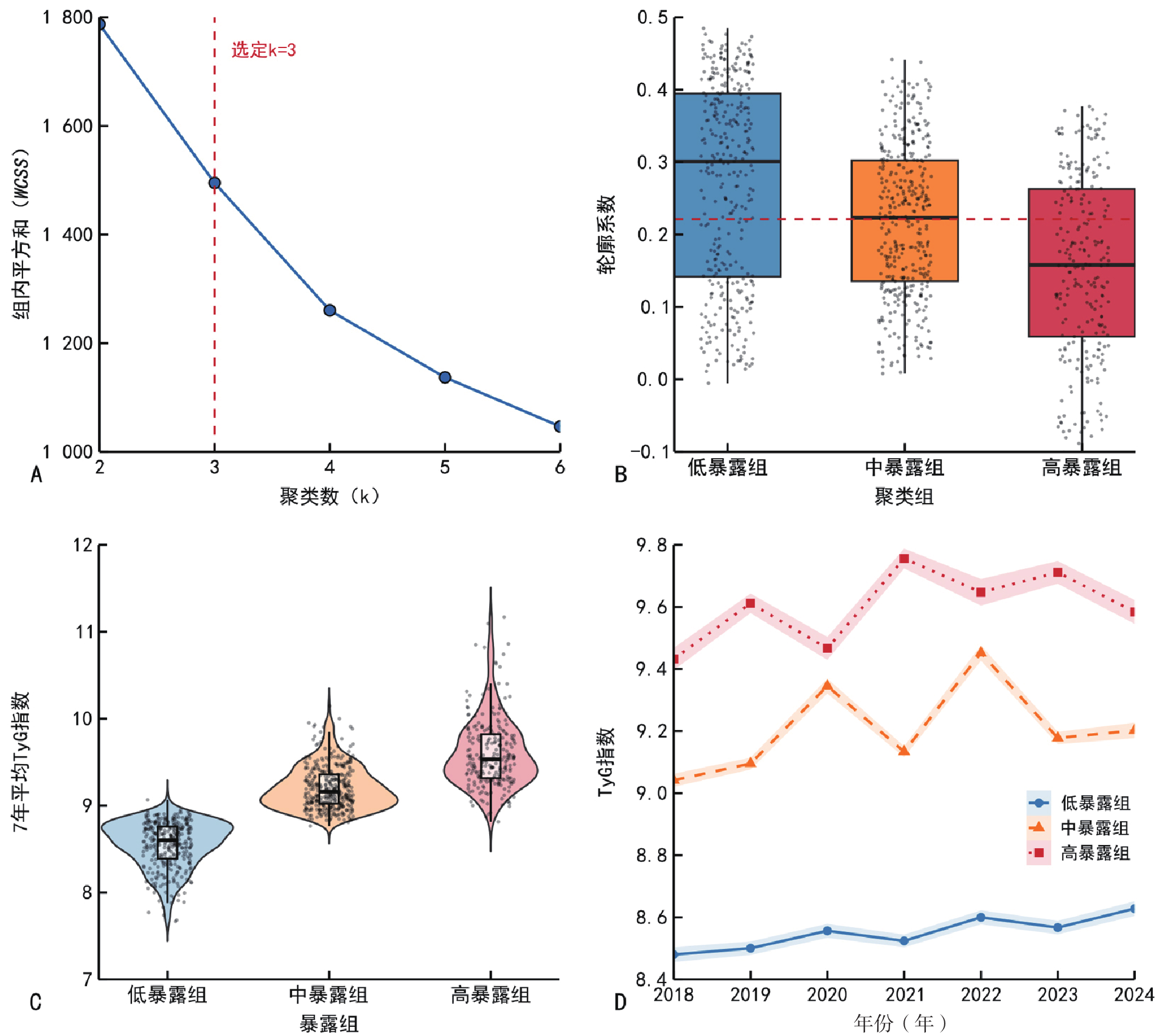
图1 函数型主成分分析结合K-means聚类的TyG指数长期暴露水平分层结果注:A按聚类数绘制的组内平方和(WCSS)肘部图,虚线处为选定的k=3;B各聚类组轮廓系数;C三个暴露组的样本分布;D各组7年甘油三酯-葡萄糖(TyG)指数轨迹。
Figure 1 Identification of long-term TyG index exposure trajectories by functional principal component analysis (FPCA) with K-means clustering
| 组别 | 例数 | 性别[例(%)] | 年龄[M(P25,P75),岁] | 年龄[例(%)] | BMI [M(P25,P75),kg/m2] | |||||
|---|---|---|---|---|---|---|---|---|---|---|
| 男性 | 女性 | ≤56岁 | >56~63岁 | >63~68岁 | >68岁 | |||||
| 低暴露组 | 339 | 163(48.1) | 176(51.9) | 64.00(58.00,69.00) | 90(26.5) | 94(27.7) | 77(22.7) | 78(23.0) | 25.3(23.2,27.2) | |
| 中暴露组 | 385 | 151(39.2)a | 234(60.8)a | 64.00(57.00,69.00) | 106(27.5) | 98(25.5) | 95(24.7) | 86(22.3) | 26.1(24.2,28.6)a | |
| 高暴露组 | 241 | 98(40.7)b | 143(59.3)b | 64.00(58.00,69.00) | 65(27.0) | 61(25.3) | 58(24.1) | 57(23.7) | 26.2(24.2,28.7)a | |
| 检验统计量值 | 6.328 | 0.020c | 0.934 | 23.553c | ||||||
| P值 | 0.042 | 0.990 | 0.988 | <0.001 | ||||||
| 组别 | 腰围[M(P25,P75),cm] | 收缩压[M(P25,P75),mmHg] | 舒张压[M(P25,P75),mmHg] | 心率[M(P25,P75),次/min] | TyG指数(基线) [M(P25,P75)] | FBG[M(P25,P75),mmol/L] | ||||
| 低暴露组 | 85.00(80.00,91.00) | 130(119,141) | 76(69,84) | 75(69,81) | 8.51(8.18,8.78) | 6.03(5.45,6.46) | ||||
| 中暴露组 | 89.00(84.00,95.00)a | 131(122,143) | 78(71,84) | 76(70,82) | 9.02(8.76,9.32)a | 6.15(5.71,6.55)a | ||||
| 高暴露组 | 89.00(82.00,95.00)a | 134(124,145)a | 79(71,86) | 76(70,83)a | 9.39(9.09,9.69)ab | 6.26(5.74,6.66)a | ||||
| 检验统计量值 | 31.095c | 9.137c | 4.503c | 8.774c | 402.447c | 18.435c | ||||
| P值 | <0.001 | 0.010 | 0.105 | 0.012 | <0.001 | <0.001 | ||||
| 组别 | 甘油三酯[M(P25,P75),mmol/L] | 总胆固醇[M(P25,P75),mmol/L] | HDL-C[M(P25,P75),mmol/L] | LDL-C ( | 尿酸[M(P25,P75),μmol/L] | ALT [M(P25,P75),U/L] | ||||
| 低暴露组 | 1.05(0.76,1.37) | 4.63(4.05,5.31) | 1.32(1.15,1.55) | 2.88±0.79 | 312.10(272.30,371.35) | 19.20(15.40,26.15) | ||||
| 中暴露组 | 1.69(1.31,2.26)a | 4.96(4.40,5.62)a | 1.19(1.04,1.37)a | 3.23±0.80a | 339.20(291.40,407.20)a | 22.10(17.14,30.80)a | ||||
| 高暴露组 | 2.42(1.84,3.32)ab | 5.15(4.40,5.75)a | 1.08(0.96,1.25)ab | 3.12±0.76a | 356.70(298.30,421.60)a | 22.61(17.20,35.30)a | ||||
| 检验统计量值 | 393.244c | 31.838c | 119.952c | 17.987d | 30.533c | 21.254c | ||||
| P值 | <0.001 | <0.001 | <0.001 | <0.001 | <0.001 | <0.001 | ||||
| 组别 | AST [M(P25,P75),U/L] | 尿素氮[M(P25,P75),mmol/L] | 肌酐[M(P25,P75),μmol/L] | 高血压[例(%)] | 高尿酸血症[例(%)] | 脂肪肝[例(%)] | 心血管疾病[例(%)] | 降糖药[例(%)] | ||
| 低暴露组 | 19.20(16.60,23.35) | 5.72(4.85,6.66) | 64.70(56.32,75.10) | 238(70.2) | 175(51.6) | 260(76.7) | 69(20.4) | 136(40.1) | ||
| 中暴露组 | 19.88(16.90,24.70) | 5.56(4.78,6.43) | 63.10(54.20,75.80) | 295(76.6) | 245(63.6)a | 357(92.7)a | 70(18.2) | 109(28.3)a | ||
| 高暴露组 | 20.20(16.60,25.49) | 5.55(4.71,6.51) | 65.30(55.60,77.40) | 190(78.8)a | 182(75.5)ab | 234(97.1)a | 30(12.4)a | 98(40.7)b | ||
| 检验统计量值 | 3.783c | 4.683c | 1.474c | 6.572 | 34.705 | 68.943 | 6.293 | 14.643 | ||
| P值 | 0.151 | 0.096 | 0.478 | 0.037 | <0.001 | <0.001 | 0.043 | <0.001 | ||
| 组别 | 降压药[例(%)] | 降脂药[例(%)] | 抗血小板药[例(%)] | 吸烟状态[例(%)] | 饮酒频率[例(%)] | |||||
| 从不吸烟 | 曾经吸烟 | 当前吸烟 | 从不饮酒 | 偶尔 | 经常 | 每天 | ||||
| 低暴露组 | 184(54.3) | 10(2.9) | 18(5.3) | 253(74.6) | 11(3.2) | 75(22.1) | 271(79.9) | 24(7.1) | 3(0.9) | 41(12.1) |
| 中暴露组 | 238(61.8)a | 6(1.6) | 12(3.1) | 295(76.6) | 9(2.3) | 81(21.0) | 310(80.5) | 28(7.3) | 6(1.6) | 41(10.6) |
| 高暴露组 | 153(63.5)a | 0a | 4(1.7) | 172(71.4) | 4(1.7) | 65(27.0) | 185(76.8) | 19(7.9) | 6(2.5) | 31(12.9) |
| 检验统计量值 | 6.286 | — | 5.832 | 4.444 | — | |||||
| P值 | 0.043 | 0.012 | 0.054 | 0.349 | 0.753 | |||||
表1 按TyG指数长期暴露水平分组的队列人群基线特征
Table 1 Baseline characteristics of the cohort population stratified by long-term triglyceride-glucose index exposure level
| 组别 | 例数 | 性别[例(%)] | 年龄[M(P25,P75),岁] | 年龄[例(%)] | BMI [M(P25,P75),kg/m2] | |||||
|---|---|---|---|---|---|---|---|---|---|---|
| 男性 | 女性 | ≤56岁 | >56~63岁 | >63~68岁 | >68岁 | |||||
| 低暴露组 | 339 | 163(48.1) | 176(51.9) | 64.00(58.00,69.00) | 90(26.5) | 94(27.7) | 77(22.7) | 78(23.0) | 25.3(23.2,27.2) | |
| 中暴露组 | 385 | 151(39.2)a | 234(60.8)a | 64.00(57.00,69.00) | 106(27.5) | 98(25.5) | 95(24.7) | 86(22.3) | 26.1(24.2,28.6)a | |
| 高暴露组 | 241 | 98(40.7)b | 143(59.3)b | 64.00(58.00,69.00) | 65(27.0) | 61(25.3) | 58(24.1) | 57(23.7) | 26.2(24.2,28.7)a | |
| 检验统计量值 | 6.328 | 0.020c | 0.934 | 23.553c | ||||||
| P值 | 0.042 | 0.990 | 0.988 | <0.001 | ||||||
| 组别 | 腰围[M(P25,P75),cm] | 收缩压[M(P25,P75),mmHg] | 舒张压[M(P25,P75),mmHg] | 心率[M(P25,P75),次/min] | TyG指数(基线) [M(P25,P75)] | FBG[M(P25,P75),mmol/L] | ||||
| 低暴露组 | 85.00(80.00,91.00) | 130(119,141) | 76(69,84) | 75(69,81) | 8.51(8.18,8.78) | 6.03(5.45,6.46) | ||||
| 中暴露组 | 89.00(84.00,95.00)a | 131(122,143) | 78(71,84) | 76(70,82) | 9.02(8.76,9.32)a | 6.15(5.71,6.55)a | ||||
| 高暴露组 | 89.00(82.00,95.00)a | 134(124,145)a | 79(71,86) | 76(70,83)a | 9.39(9.09,9.69)ab | 6.26(5.74,6.66)a | ||||
| 检验统计量值 | 31.095c | 9.137c | 4.503c | 8.774c | 402.447c | 18.435c | ||||
| P值 | <0.001 | 0.010 | 0.105 | 0.012 | <0.001 | <0.001 | ||||
| 组别 | 甘油三酯[M(P25,P75),mmol/L] | 总胆固醇[M(P25,P75),mmol/L] | HDL-C[M(P25,P75),mmol/L] | LDL-C ( | 尿酸[M(P25,P75),μmol/L] | ALT [M(P25,P75),U/L] | ||||
| 低暴露组 | 1.05(0.76,1.37) | 4.63(4.05,5.31) | 1.32(1.15,1.55) | 2.88±0.79 | 312.10(272.30,371.35) | 19.20(15.40,26.15) | ||||
| 中暴露组 | 1.69(1.31,2.26)a | 4.96(4.40,5.62)a | 1.19(1.04,1.37)a | 3.23±0.80a | 339.20(291.40,407.20)a | 22.10(17.14,30.80)a | ||||
| 高暴露组 | 2.42(1.84,3.32)ab | 5.15(4.40,5.75)a | 1.08(0.96,1.25)ab | 3.12±0.76a | 356.70(298.30,421.60)a | 22.61(17.20,35.30)a | ||||
| 检验统计量值 | 393.244c | 31.838c | 119.952c | 17.987d | 30.533c | 21.254c | ||||
| P值 | <0.001 | <0.001 | <0.001 | <0.001 | <0.001 | <0.001 | ||||
| 组别 | AST [M(P25,P75),U/L] | 尿素氮[M(P25,P75),mmol/L] | 肌酐[M(P25,P75),μmol/L] | 高血压[例(%)] | 高尿酸血症[例(%)] | 脂肪肝[例(%)] | 心血管疾病[例(%)] | 降糖药[例(%)] | ||
| 低暴露组 | 19.20(16.60,23.35) | 5.72(4.85,6.66) | 64.70(56.32,75.10) | 238(70.2) | 175(51.6) | 260(76.7) | 69(20.4) | 136(40.1) | ||
| 中暴露组 | 19.88(16.90,24.70) | 5.56(4.78,6.43) | 63.10(54.20,75.80) | 295(76.6) | 245(63.6)a | 357(92.7)a | 70(18.2) | 109(28.3)a | ||
| 高暴露组 | 20.20(16.60,25.49) | 5.55(4.71,6.51) | 65.30(55.60,77.40) | 190(78.8)a | 182(75.5)ab | 234(97.1)a | 30(12.4)a | 98(40.7)b | ||
| 检验统计量值 | 3.783c | 4.683c | 1.474c | 6.572 | 34.705 | 68.943 | 6.293 | 14.643 | ||
| P值 | 0.151 | 0.096 | 0.478 | 0.037 | <0.001 | <0.001 | 0.043 | <0.001 | ||
| 组别 | 降压药[例(%)] | 降脂药[例(%)] | 抗血小板药[例(%)] | 吸烟状态[例(%)] | 饮酒频率[例(%)] | |||||
| 从不吸烟 | 曾经吸烟 | 当前吸烟 | 从不饮酒 | 偶尔 | 经常 | 每天 | ||||
| 低暴露组 | 184(54.3) | 10(2.9) | 18(5.3) | 253(74.6) | 11(3.2) | 75(22.1) | 271(79.9) | 24(7.1) | 3(0.9) | 41(12.1) |
| 中暴露组 | 238(61.8)a | 6(1.6) | 12(3.1) | 295(76.6) | 9(2.3) | 81(21.0) | 310(80.5) | 28(7.3) | 6(1.6) | 41(10.6) |
| 高暴露组 | 153(63.5)a | 0a | 4(1.7) | 172(71.4) | 4(1.7) | 65(27.0) | 185(76.8) | 19(7.9) | 6(2.5) | 31(12.9) |
| 检验统计量值 | 6.286 | — | 5.832 | 4.444 | — | |||||
| P值 | 0.043 | 0.012 | 0.054 | 0.349 | 0.753 | |||||
| 模型 | 调整变量 | HR | 95%CI | P值 | AIC |
|---|---|---|---|---|---|
| Model 1 | 仅TyG指数 | 1.25 | 1.16~1.36 | <0.001 | 6 806 |
| Model 2 | Model 1+年龄、性别 | 1.25 | 1.15~1.35 | <0.001 | 6 806 |
| Model 3 | Model 2+吸烟状态、饮酒频率 | 1.25 | 1.15~1.35 | <0.001 | 6 810 |
| Model 4 | Model 3+BMI、腰围 | 1.23 | 1.13~1.34 | <0.001 | 6 799 |
| Model 5 | Model 4+收缩压、总胆固醇、HDL-C、LDL-C、尿酸 | 1.21 | 1.10~1.34 | <0.001 | 6 788 |
| Model 6 | Model 5+高血压、高尿酸血症、心血管疾病、脂肪肝 | 1.21 | 1.09~1.34 | <0.001 | 6 792 |
| Model 7 | Model 6+降糖药+降压药+降脂药+抗血小板药 | 1.21 | 1.09~1.34 | <0.001 | 6 176 |
表2 TyG指数与T2DM发病风险的时间依存Cox回归递进调整模型(n=965)
Table 2 Progressive adjustment models of time-dependent Cox regression for the association between TyG index and incident T2DM
| 模型 | 调整变量 | HR | 95%CI | P值 | AIC |
|---|---|---|---|---|---|
| Model 1 | 仅TyG指数 | 1.25 | 1.16~1.36 | <0.001 | 6 806 |
| Model 2 | Model 1+年龄、性别 | 1.25 | 1.15~1.35 | <0.001 | 6 806 |
| Model 3 | Model 2+吸烟状态、饮酒频率 | 1.25 | 1.15~1.35 | <0.001 | 6 810 |
| Model 4 | Model 3+BMI、腰围 | 1.23 | 1.13~1.34 | <0.001 | 6 799 |
| Model 5 | Model 4+收缩压、总胆固醇、HDL-C、LDL-C、尿酸 | 1.21 | 1.10~1.34 | <0.001 | 6 788 |
| Model 6 | Model 5+高血压、高尿酸血症、心血管疾病、脂肪肝 | 1.21 | 1.09~1.34 | <0.001 | 6 792 |
| Model 7 | Model 6+降糖药+降压药+降脂药+抗血小板药 | 1.21 | 1.09~1.34 | <0.001 | 6 176 |
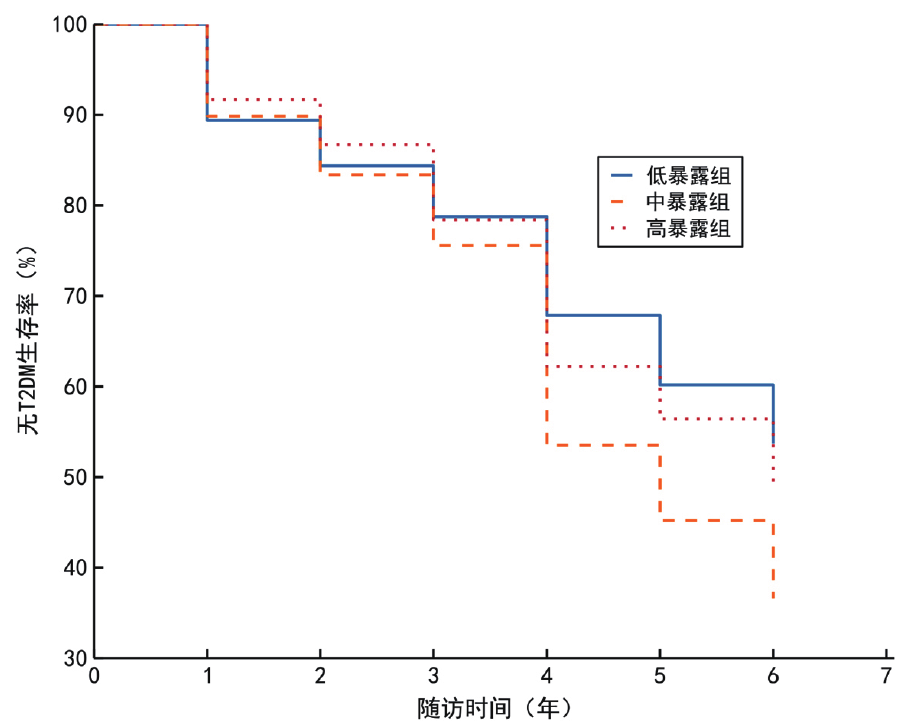
图2 按TyG指数长期暴露水平分组的无T2DM生存率Kaplan-Meier曲线注:T2DM=2型糖尿病。
Figure 2 Kaplan-Meier curves of T2DM-free survival stratified by long-term TyG index exposure groups
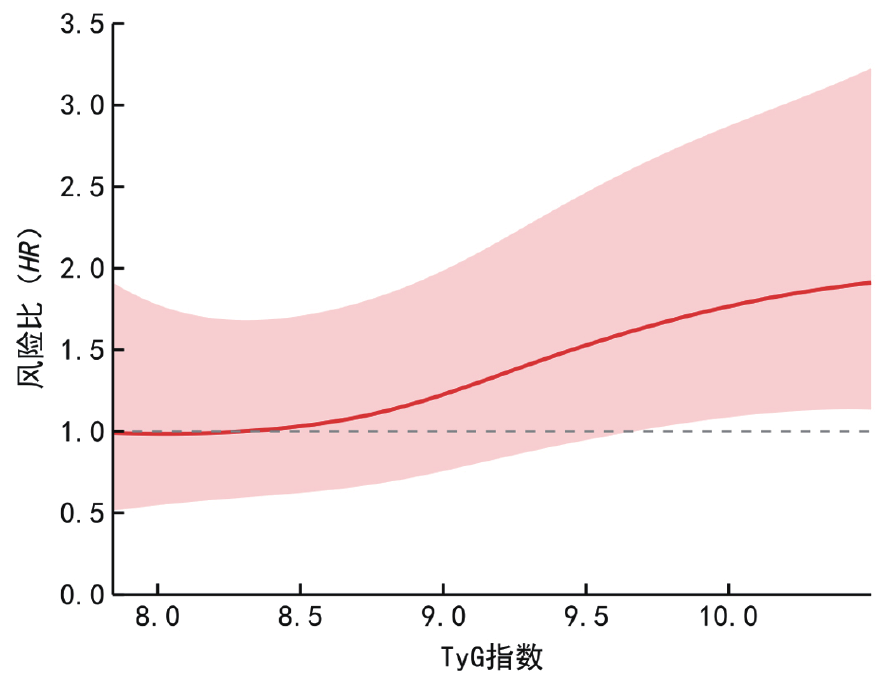
图3 连续TyG指数与新发T2DM风险的RCS剂量-反应曲线(Model 6)
Figure 3 Restricted cubic spline analysis of the dose-response relationship between time-varying TyG index and incident T2DM risk (Model 6)
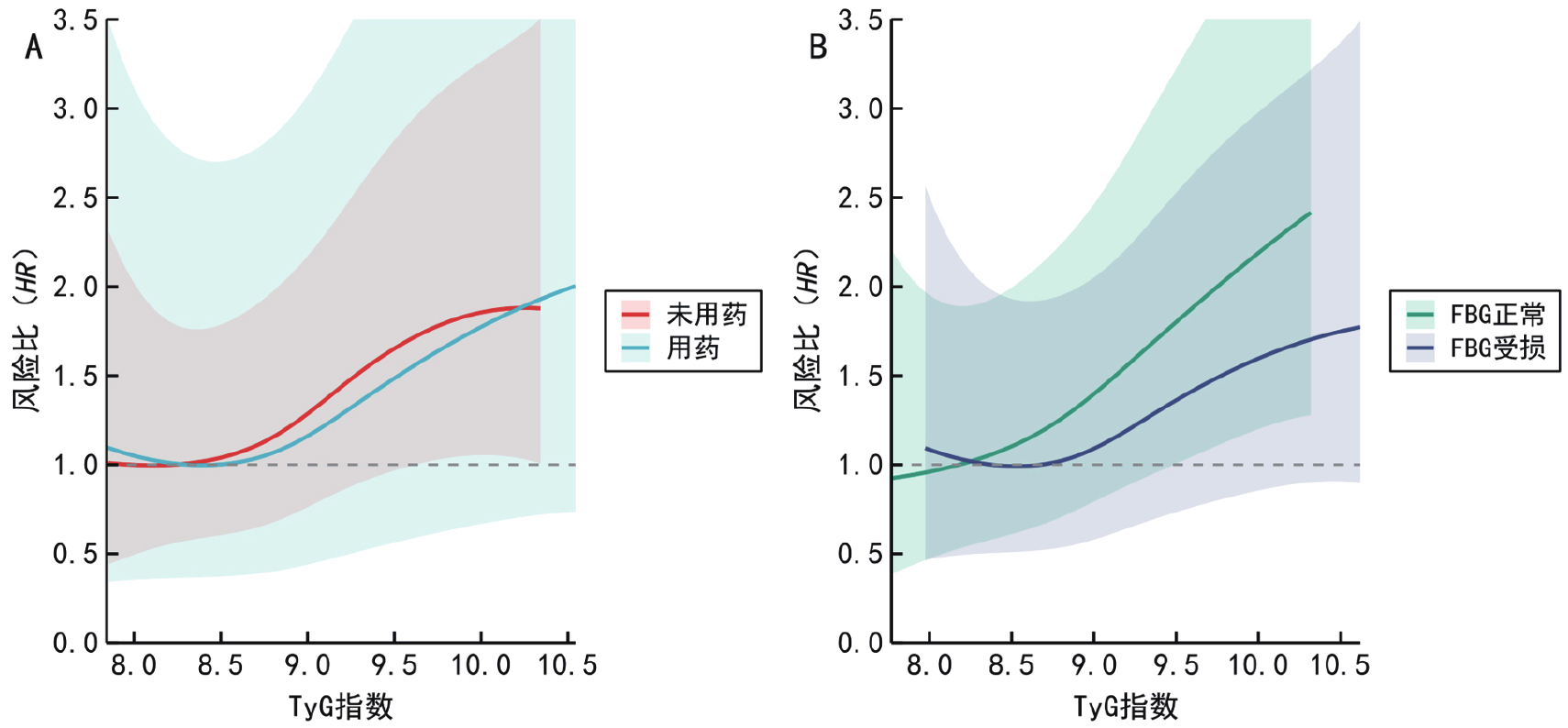
图4 分层RCS剂量-反应曲线注:A按基线用药状态分层:未用药组与用药组;B按基线FBG分层:FBG <6.1 mmol/L组与FBG ≥6.1 mmol/L组;FBG=空腹血糖。
Figure 4 Stratified RCS analyses
| 亚组 | 分层 | 基线例数 | 事件数 | HR(95%CI) | P值 | P交互值 |
|---|---|---|---|---|---|---|
| 性别 | 男性 | 412 | 208 | 1.26(1.09~1.47) | 0.003 | 0.297 |
| 女性 | 553 | 315 | 1.15(1.00~1.31) | 0.049 | ||
| 年龄 | ≤56岁 | 261 | 146 | 1.24(1.04~1.48) | 0.016 | 0.262 |
| >56~63岁 | 253 | 137 | 1.17(0.94~1.44) | 0.157 | ||
| >63~68岁 | 230 | 124 | 1.05(0.84~1.30) | 0.686 | ||
| >68岁 | 221 | 116 | 1.31(1.03~1.65) | 0.024 | ||
| BMI | <24 kg/m2 | 262 | 120 | 1.17(0.95~1.45) | 0.141 | 0.436 |
| ≥24 kg/m2 | 703 | 403 | 1.23(1.10~1.38) | <0.001 | ||
| 腰围 | 正常腰围 | 420 | 195 | 1.10(0.94~1.29) | 0.236 | 0.126 |
| 中心性肥胖 | 545 | 328 | 1.29(1.13~1.47) | <0.001 | ||
| FBG | <6.1 mmol/L | 454 | 253 | 1.29(1.12~1.49) | <0.001 | 0.249 |
| ≥6.1 mmol/L | 511 | 270 | 1.15(1.00~1.33) | 0.051 | ||
| 高血压 | 非高血压 | 242 | 135 | 1.16(0.95~1.42) | 0.155 | 0.795 |
| 高血压 | 723 | 388 | 1.23(1.10~1.39) | <0.001 | ||
| 高尿酸血症 | 非高尿酸血症 | 363 | 174 | 1.35(1.14~1.59) | <0.001 | 0.049 |
| 高尿酸血症 | 602 | 349 | 1.14(1.01~1.29) | 0.038 | ||
| 脂肪肝 | 非脂肪肝 | 114 | 43 | 1.41(0.93~2.13) | 0.102 | 0.177 |
| 脂肪肝 | 851 | 480 | 1.20(1.08~1.33) | <0.001 |
表3 TyG指数与新发T2DM风险(Model 6)的时间依存Cox比例风险回归亚组分析
Table 3 Subgroup analyses of time-dependent Cox proportional hazards regression for the TyG index and risk of type 2 diabetes mellitus (Model 6 )
| 亚组 | 分层 | 基线例数 | 事件数 | HR(95%CI) | P值 | P交互值 |
|---|---|---|---|---|---|---|
| 性别 | 男性 | 412 | 208 | 1.26(1.09~1.47) | 0.003 | 0.297 |
| 女性 | 553 | 315 | 1.15(1.00~1.31) | 0.049 | ||
| 年龄 | ≤56岁 | 261 | 146 | 1.24(1.04~1.48) | 0.016 | 0.262 |
| >56~63岁 | 253 | 137 | 1.17(0.94~1.44) | 0.157 | ||
| >63~68岁 | 230 | 124 | 1.05(0.84~1.30) | 0.686 | ||
| >68岁 | 221 | 116 | 1.31(1.03~1.65) | 0.024 | ||
| BMI | <24 kg/m2 | 262 | 120 | 1.17(0.95~1.45) | 0.141 | 0.436 |
| ≥24 kg/m2 | 703 | 403 | 1.23(1.10~1.38) | <0.001 | ||
| 腰围 | 正常腰围 | 420 | 195 | 1.10(0.94~1.29) | 0.236 | 0.126 |
| 中心性肥胖 | 545 | 328 | 1.29(1.13~1.47) | <0.001 | ||
| FBG | <6.1 mmol/L | 454 | 253 | 1.29(1.12~1.49) | <0.001 | 0.249 |
| ≥6.1 mmol/L | 511 | 270 | 1.15(1.00~1.33) | 0.051 | ||
| 高血压 | 非高血压 | 242 | 135 | 1.16(0.95~1.42) | 0.155 | 0.795 |
| 高血压 | 723 | 388 | 1.23(1.10~1.39) | <0.001 | ||
| 高尿酸血症 | 非高尿酸血症 | 363 | 174 | 1.35(1.14~1.59) | <0.001 | 0.049 |
| 高尿酸血症 | 602 | 349 | 1.14(1.01~1.29) | 0.038 | ||
| 脂肪肝 | 非脂肪肝 | 114 | 43 | 1.41(0.93~2.13) | 0.102 | 0.177 |
| 脂肪肝 | 851 | 480 | 1.20(1.08~1.33) | <0.001 |
| 分析场景 | 例数 | 事件数 | HR | 95%CI | P值 |
|---|---|---|---|---|---|
| 主分析(Model 6,7年随访) | 965 | 523 | 1.21 | 1.09~1.34 | <0.001 |
| 排除早期T2DM(随访≤2年发病) | 870 | 428 | 1.27 | 1.14~1.42 | <0.001 |
| 3年随访窗口 | 965 | 149 | 1.08 | 0.88~1.33 | 0.450 |
| 5年随访窗口 | 965 | 379 | 1.18 | 1.05~1.33 | 0.006 |
| 严格队列(基线FBG<6.1 mmol/L) | 454 | 253 | 1.29 | 1.12~1.49 | <0.001 |
表4 敏感性分析汇总
Table 4 Summary of sensitivity analyses
| 分析场景 | 例数 | 事件数 | HR | 95%CI | P值 |
|---|---|---|---|---|---|
| 主分析(Model 6,7年随访) | 965 | 523 | 1.21 | 1.09~1.34 | <0.001 |
| 排除早期T2DM(随访≤2年发病) | 870 | 428 | 1.27 | 1.14~1.42 | <0.001 |
| 3年随访窗口 | 965 | 149 | 1.08 | 0.88~1.33 | 0.450 |
| 5年随访窗口 | 965 | 379 | 1.18 | 1.05~1.33 | 0.006 |
| 严格队列(基线FBG<6.1 mmol/L) | 454 | 253 | 1.29 | 1.12~1.49 | <0.001 |
| 模型 | HR | 95%CI | P值 | AIC |
|---|---|---|---|---|
| Model 6 | 1.21 | 1.09~1.34 | <0.001 | 6 792 |
| Model 7(+降压药) | 1.21 | 1.10~1.34 | <0.001 | 6 793 |
| Model 7(+降脂药) | 1.21 | 1.09~1.34 | <0.001 | 6 793 |
| Model 7(+抗血小板药) | 1.21 | 1.09~1.34 | <0.001 | 6 793 |
| Model 7(全药物同时纳入) | 1.21 | 1.09~1.34 | <0.001 | 6 795 |
表5 逐类药物递进调整后连续TyG指数增加与新发T2DM风险的关联
Table 5 Association between TyG index and incident T2DM after progressive adjustment for each drug class
| 模型 | HR | 95%CI | P值 | AIC |
|---|---|---|---|---|
| Model 6 | 1.21 | 1.09~1.34 | <0.001 | 6 792 |
| Model 7(+降压药) | 1.21 | 1.10~1.34 | <0.001 | 6 793 |
| Model 7(+降脂药) | 1.21 | 1.09~1.34 | <0.001 | 6 793 |
| Model 7(+抗血小板药) | 1.21 | 1.09~1.34 | <0.001 | 6 793 |
| Model 7(全药物同时纳入) | 1.21 | 1.09~1.34 | <0.001 | 6 795 |
| 中介路径 | 中介变量 | 中介比例(%) | Bootstrap 95%CI | P值 |
|---|---|---|---|---|
| ①肥胖 | BMI +腰围 | 6.9 | 1.5~16.1 | <0.001 |
| ②血压 | SBP | 1.4 | -2.6~6.2 | 0.260 |
| ③血脂 | HDL-C+LDL-C | -1.5 | -20.2~15.7 | 0.573 |
| ④共病 | 高尿酸血症+脂肪肝+高血压 | 2.6 | -7.4~12.2 | 0.247 |
| 合计(M0→M4) | 9.4 | -11.7~34.0 | 0.213 |
表6 Bootstrap差值法中介分析结果(连续TyG指数,4条生物学路径)
Table 6 Results of mediation analysis using the bootstrap difference method (continuous TyG index four biological pathways)
| 中介路径 | 中介变量 | 中介比例(%) | Bootstrap 95%CI | P值 |
|---|---|---|---|---|
| ①肥胖 | BMI +腰围 | 6.9 | 1.5~16.1 | <0.001 |
| ②血压 | SBP | 1.4 | -2.6~6.2 | 0.260 |
| ③血脂 | HDL-C+LDL-C | -1.5 | -20.2~15.7 | 0.573 |
| ④共病 | 高尿酸血症+脂肪肝+高血压 | 2.6 | -7.4~12.2 | 0.247 |
| 合计(M0→M4) | 9.4 | -11.7~34.0 | 0.213 |
| [1] |
International Diabetes Federation. IDF Diabetes Atlas[M]. 11th ed. Brussels: International Diabetes Federation, 2024.
|
| [2] |
中华医学会糖尿病学分会. 中国糖尿病防治指南(2024版)[J]. 中华糖尿病杂志, 2025,17(1):16-139. DOI: 10.3760/cma.j.cn115791-20241203-00705.
|
| [3] |
|
| [4] |
|
| [5] |
中华医学会内分泌学分会,中华医学会糖尿病学分会,中国医师协会内分泌代谢科医师分会. 中国成人糖尿病前期干预的专家共识(2023版)[J]. 中华糖尿病杂志, 2023, 15(6): 484-494. DOI: 10.3760/cma.j.cn115791-20230509-00188.
|
| [6] |
|
| [7] |
|
| [8] |
|
| [9] |
|
| [10] |
|
| [11] |
|
| [12] |
杨宇祥,苑弘弢,唐增煦, 等. 正常空腹血糖人群中甘油三酯葡萄糖指数与糖尿病发病风险的关系[J]. 卫生研究, 2025, 54(4): 557-565. DOI: 10.19813/j.cnki.weishengyanjiu.2025.04.005.
|
| [13] |
|
| [14] |
|
| [15] |
中国高血压防治指南修订委员会,高血压联盟(中国),中国医疗保健国际交流促进会高血压病学分会, 等. 中国高血压防治指南(2024年修订版)[J]. 中华高血压杂志(中英文), 2024, 32(7): 603-700. DOI:10.16439/j.issn.1673-7245.2024.07.002.
|
| [16] |
World Health Organization. International Statistical Classification of Diseases and Related Health Problems, 10th Revision (ICD-10)[M]. Geneva: World Health Organization, 2019.
|
| [17] |
国家卫生健康委办公厅. 关于印发中国脑卒中防治指导规范(2021年版)的通知:国卫办医函〔2021〕468号[Z]. 2021.
|
| [18] |
中华医学会肝病学分会. 代谢相关(非酒精性)脂肪性肝病防治指南(2024年版)[J]. 中华肝脏病杂志, 2024, 32(5): 418-434. DOI: 10.3760/cma.j.cn501113-20240327-00163.
|
| [19] |
中华医学会内分泌学分会. 中国高尿酸血症与痛风诊疗指南(2019)[J]. 中华内分泌代谢杂志, 2020, 36(1): 1-13. DOI: 10.3760/cma.j.issn.1000-6699.2020.01.001.
|
| [20] |
国家卫生和计划生育委员会. 国家基本公共卫生服务规范(第三版)[EB/OL]. (2017-03-27)[2025-11-10].
|
| [21] |
向蔚婷,吴胜利,张梅玉, 等. 克拉玛依健康体检人群甘油三酯葡萄糖生成指数与2型糖尿病发病风险的队列分析研究[J]. 中华肥胖与代谢病电子杂志, 2022, 8(2): 109-115. DOI: 10.3877/cma.j.issn.2095-9605.2022.02.007.
|
| [22] |
|
| [23] |
|
| [24] |
|
| [25] |
张彭燕,刘振球,樊虹, 等. 限制性立方样条Cox比例风险模型在肿瘤预后分析中的应用[J]. 复旦学报(医学版), 2023, 50(2): 280-285. DOI: 10.3969/j.issn.1672-8467.2023.02.019.
|
| [26] |
|
| [27] |
|
| [28] |
|
| [29] |
|
| [30] |
|
| [31] |
邬秋俊,向茜. 甘油三酯-葡萄糖指数与2型糖尿病微血管并发症相关性的研究进展[J]. 中华临床医师杂志(电子版), 2023, 17(10): 1109-1112. DOI: 10.3877/cma.j.issn.1674-0785.2023.10.014.
|
| [32] |
周君珺,孔维敏,陈进, 等. 甘油三酯葡萄糖乘积指数和食物摄入量与2型糖尿病综合达标率相关性[J]. 卫生研究, 2024, 53(5): 755-762. DOI: 10.19813/j.cnki.weishengyanjiu.2024.05.011.
|
| [33] |
努尔吉马·阿合尼牙孜,刘一佳,梁灿灿, 等. 甘油三酯葡萄糖指数与非酒精性脂肪性肝病脂肪变程度及肝纤维化的相关性研究[J]. 海南医学院学报, 2023, 29(23): 1794-1800. DOI: 10.13210/j.cnki.jhmu.20231017.002.
|
| [34] |
|
| [35] | |
| [36] |
| [1] | 单年春, 唐文彬, 罗扬, 周薇. 预后营养指数轨迹与高尿酸血症发病风险的关联:一项回顾性队列研究[J]. 中国全科医学, 2027, 30(02): 235-241. |
| [2] | 张璐, 张洲, 于从从, 巢怡宁, 杨思珏, 吴天宇, 赵声易, 毕艳. 嗅觉评估对2型糖尿病患者轻度认知功能障碍发生风险的预测价值研究[J]. 中国全科医学, 2027, 30(01): 66-72. |
| [3] | 刘涛, 李瑞斌, 王玮. 甘油三酯-葡萄糖指数、红细胞分布宽度及其衍生指标对不同糖代谢状态冠心病患者冠状动脉狭窄程度评估价值的研究[J]. 中国全科医学, 2027, 30(01): 73-82. |
| [4] | 胡若萌, 刘志栋, 陈俊岚, 王淼, 周时高. 代谢方联合二甲双胍干预2型糖尿病合并肥胖患者的多中心、双盲随机对照研究[J]. 中国全科医学, 2026, 29(33): 4854-4860. |
| [5] | 李纪新, 邱林杰, 任燕, 李美洁, 邹姹姹, 吴梓敬, 王文茹, 杨振宇, 刘峰兆, 张晋. 相位角与超重/肥胖患者糖脂代谢异常的相关性及其预测价值研究[J]. 中国全科医学, 2026, 29(33): 4876-4884. |
| [6] | 兰博, 王振伟, 李想, 张金盈, 唐俊楠. 老年心力衰竭合并2型糖尿病共病的研究进展[J]. 中国全科医学, 2026, 29(33): 4973-4980. |
| [7] | 文俊欣, 石挺皇, 秦庆新, 梁妍语, 孟凡莉. 健康体检成人不同体质量变化与新发高尿酸血症的关联[J]. 中国全科医学, 2026, 29(33): 4868-4875. |
| [8] | 闫梓薇, 聂佳桦, 石妍, 魏立民. 白蛋白/γ-谷氨酰转移酶比值与2型糖尿病合并代谢相关脂肪性肝病的相关性研究[J]. 中国全科医学, 2026, 29(30): 4431-4437. |
| [9] | 王琳, 曹晨晨, 黄逸憧, 刘静. 基于离散选择实验的高血压与2型糖尿病共病患者家庭医生签约服务偏好属性及水平开发[J]. 中国全科医学, 2026, 29(29): 4232-4240. |
| [10] | 余新艳, 张芳, 顾志乐, 王艳芳, 苏鹏, 张海澄. 社区老年人空腹血糖与体质指数及腰围的相关性研究[J]. 中国全科医学, 2026, 29(28): 4132-4140. |
| [11] | 薛翠荣, 魏巍, 吴任远, 薛雅琴, 徐辉江, 吕惟江, 蒋丹丹. 高血压和2型糖尿病人群慢性肾脏病患病率及管理现状:一项社区横断面研究[J]. 中国全科医学, 2026, 29(25): 3650-3654. |
| [12] | 李文哲, 杨宇青, 杨廷杰, 郭一鸣, 陈璐琳, 曹煜栋, 袁江淑, 杨宏辉, 王澈. 甘油三酯-葡萄糖指数和甘油三酯-葡萄糖-BMI与急性冠脉综合征患者易损斑块的相关性研究[J]. 中国全科医学, 2026, 29(23): 3287-3293. |
| [13] | 王洋, 赵诗婷, 陈盈盈, 孙子林, 邱山虎. 2型糖尿病并发症人群的运动干预与实施要点[J]. 中国全科医学, 2026, 29(21): 2989-2994. |
| [14] | 李佳威, 高欣怡, 葛奥淇, 李娟娟, 袁蓓蓓. 2型糖尿病患者的医防融合服务需求及其影响因素研究[J]. 中国全科医学, 2026, 29(21): 3028-3039. |
| [15] | 刘帅, 苑世朝, 刘琰, 贾硕贤, 赵岩, 王紫怡, 周春华, 于静. 两性霉素B治疗侵袭性真菌病的疗效、安全性及经济性评价:一项回顾性队列研究[J]. 中国全科医学, 2026, 29(21): 2967-2974. |
| 阅读次数 | ||||||
|
全文 |
|
|||||
|
摘要 |
|
|||||