
中国全科医学 ›› 2027, Vol. 30 ›› Issue (01): 73-82.DOI: 10.12114/j.issn.1007-9572.2026.0040
• 论著 • 上一篇
刘涛1, 李瑞斌2,*( ), 王玮1,*()
收稿日期:2026-01-14
修回日期:2026-06-27
出版日期:2027-01-05
发布日期:2026-11-17
通讯作者:
李瑞斌, 王玮
作者贡献:
刘涛负责数据的收集与整理、统计学处理、图表绘制与展示,撰写论文;李瑞斌参与研究方案设计,负责文章质量控制与审查;王玮提出研究思路,负责设计研究方案,修订论文。所有作者阅读并同意最终文本,对文章整体负责。
基金资助:
LIU Tao1, LI Ruibin2,*(), WANG Wei1,*()
Received:2026-01-14
Revised:2026-06-27
Published:2027-01-05
Online:2026-11-17
Contact:
LI Ruibin, WANG Wei
摘要: 背景 心血管疾病(CVD)仍是近年来全球死亡的主要原因,在中低收入地区尤为突出。其中,冠状动脉粥样硬化性心脏病(CHD)的发病率更是居高不下。然而,在基层医疗中,对冠状动脉狭窄程度的早期识别难度较大,致使防治策略的制定受限。 目的 评估CHD患者不同糖代谢状态下甘油三酯-葡萄糖指数(TyG)、红细胞分布宽度(RDW)及其衍生指标与冠状动脉狭窄程度的相关性,为CHD的风险评估工作补充新的循证依据。 方法 选取2023—2024年在内蒙古科技大学包头医学院第一附属医院心内科住院,首次行冠状动脉造影(CAG)并诊断为CHD的患者(n=240)。按其是否合并2型糖尿病(T2DM)分为2组(各120例)。收集一般资料、实验室资料及CAG结果。采用单因素Logistic回归探究冠状动脉狭窄程度的影响因素;采用Spearman秩相关分析主要研究指标与冠状动脉狭窄程度的相关性;采用受试者工作特征(ROC)曲线评估主要研究指标对冠状动脉狭窄程度的判断效能,并通过DeLong检验比较各指标ROC曲线下面积(AUC)的差异。 结果 Gensini评分≥65分的患者红细胞分布宽度标准差(RDW-SD)、平均红细胞体积(MCV)、空腹血糖(FBG)、甘油三酯(TG)、总胆固醇(TC)、低密度脂蛋白胆固醇(LDL-C)及TyG更高,T2DM人群占比更高(P<0.05)。按照代谢相关指标与RDW-SD相乘、其余指标与TyG相乘的原则,获取相应衍生指标。合并T2DM的CHD患者TyG、TyG×RDW-SD、TyG×MCV显著高于不合并T2DM的患者(P<0.05);单因素Logistic回归分析显示,RDW-SD仅为合并T2DM组冠状动脉狭窄程度的影响因素,而TyG、TyG×RDW-SD、TyG×MCV、RDW-SD×TC、RDW-SD×LDL-C为合并T2DM和不合并T2DM两组的影响因素(P<0.05);对TyG、RDW-SD及在P<0.001水平相关的衍生指标建立ROC曲线,结果显示,不合并T2DM的CHD组中,TyG×MCV的AUC最大[0.684(95%CI=0.578~0.790)];合并T2DM的CHD组中,TyG×RDW-SD的AUC最大[0.801(95%CI=0.724~0.878)]。 结论 TyG、RDW-SD及其衍生指标对CHD患者冠状动脉狭窄程度具有一定评估价值,且其评估效能可能受糖代谢状态影响。TyG×MCV和TyG×RDW-SD分别在不合并T2DM和合并T2DM患者中表现出较好的评估潜力,可为冠状动脉狭窄风险分层提供参考。
| 血管狭窄程度 | 基础评分(分) | 病变部位 | 相应系数 |
|---|---|---|---|
| 1%~25% | 1 | 左主干 | 5.0 |
| 26%~50% | 2 | 左前降支或回旋支近段 | 2.5 |
| 51%~75% | 4 | 左前降支中段 | 1.5 |
| 76%~90% | 8 | 左前降支远段 | 1.0 |
| 91%~99% | 16 | 左回旋支中、远段 | 1.0 |
| 100% | 32 | 右冠状动脉 | 1.0 |
| 其余小分支 | 0.5 |
表1 GS计算细则
Table 1 GS calculation rules
| 血管狭窄程度 | 基础评分(分) | 病变部位 | 相应系数 |
|---|---|---|---|
| 1%~25% | 1 | 左主干 | 5.0 |
| 26%~50% | 2 | 左前降支或回旋支近段 | 2.5 |
| 51%~75% | 4 | 左前降支中段 | 1.5 |
| 76%~90% | 8 | 左前降支远段 | 1.0 |
| 91%~99% | 16 | 左回旋支中、远段 | 1.0 |
| 100% | 32 | 右冠状动脉 | 1.0 |
| 其余小分支 | 0.5 |
| 组别 | 例数 | 性别(男/女) | 年龄[例(%)] | 吸烟史[例(%)] | 饮酒史[例(%)] | 高血压[例(%)] | T2DM [例(%)] | BMI[M(P25,P75),kg/m2] | |
|---|---|---|---|---|---|---|---|---|---|
| <55岁 | ≥55岁 | ||||||||
| GS<65分组 | 169 | 126/43 | 60(35.50) | 109(64.50) | 57(33.73) | 21(12.43) | 111(65.68) | 77(45.56) | 26.7(24.6,27.7) |
| GS≥65分组 | 71 | 58/13 | 33(46.48) | 38(53.52) | 29(40.85) | 8(11.27) | 41(57.75) | 43(60.56) | 26.7(24.5,27.7) |
| 检验统计量值 | 1.422a | 2.538a | 1.101a | 0.063a | 1.355a | 4.500a | -0.038 | ||
| P值 | 0.233 | 0.111 | 0.294 | 0.802 | 0.244 | 0.034 | 0.790 | ||
| 组别 | WBC计数[M(P25,P75),×109/L] | Hb ( | PLT计数( | RDW-SD[M(P25,P75),fL] | RDW-CV[M(P25,P75),%] | MCV ( | Scr[M(P25,P75),μmol/L] | ||
| GS<65分组 | 7.53 (6.25,9.21) | 149.01±13.49 | 222.53±54.46 | 41.40 (39.85,42.50) | 12.60 (12.20,13.00) | 89.26±4.13 | 73.00 (63.00,83.00) | ||
| GS≥65分组 | 8.53 (7.06,10.77) | 149.69±16.25 | 229.69±52.95 | 41.90 (40.80,43.70) | 12.70 (12.30,13.00) | 90.93±3.80 | 75.00 (64.00,85.00) | ||
| 检验统计量值 | -3.161 | -0.334b | -0.938b | -3.299 | -0.952 | -2.936b | -1.031 | ||
| P值 | 0.002 | 0.739 | 0.349 | 0.001 | 0.341 | 0.004 | 0.302 | ||
| 组别 | ALB ( | FBG[M(P25,P75),mmol/L] | TG[M(P25,P75),mmol/L] | TC( | HDL-C[M(P25,P75),mmol/L] | LDL-C ( | TyG ( | ||
| GS<65分组 | 41.73±3.39 | 5.8(5.1,7.9) | 1.71(1.29,2.13) | 4.16±0.92 | 0.99(0.85,1.16) | 2.60±0.80 | 9.07±0.52 | ||
| GS≥65分组 | 42.36±2.93 | 7.4(5.4,10.1) | 2.08(1.69,2.92) | 4.83±1.03 | 0.99(0.86,1.24) | 3.05±0.89 | 9.51±0.57 | ||
| 检验统计量值 | -1.356b | -3.537 | -4.193 | -4.921b | -0.511 | -3.836b | -5.806b | ||
| P值 | 0.176 | <0.001 | <0.001 | <0.001 | 0.609 | <0.001 | <0.001 | ||
表2 GS<65分组与GS≥65分组临床资料比较
Table 2 Comparison of clinical data between the GS<65 group and the GS≥65 group
| 组别 | 例数 | 性别(男/女) | 年龄[例(%)] | 吸烟史[例(%)] | 饮酒史[例(%)] | 高血压[例(%)] | T2DM [例(%)] | BMI[M(P25,P75),kg/m2] | |
|---|---|---|---|---|---|---|---|---|---|
| <55岁 | ≥55岁 | ||||||||
| GS<65分组 | 169 | 126/43 | 60(35.50) | 109(64.50) | 57(33.73) | 21(12.43) | 111(65.68) | 77(45.56) | 26.7(24.6,27.7) |
| GS≥65分组 | 71 | 58/13 | 33(46.48) | 38(53.52) | 29(40.85) | 8(11.27) | 41(57.75) | 43(60.56) | 26.7(24.5,27.7) |
| 检验统计量值 | 1.422a | 2.538a | 1.101a | 0.063a | 1.355a | 4.500a | -0.038 | ||
| P值 | 0.233 | 0.111 | 0.294 | 0.802 | 0.244 | 0.034 | 0.790 | ||
| 组别 | WBC计数[M(P25,P75),×109/L] | Hb ( | PLT计数( | RDW-SD[M(P25,P75),fL] | RDW-CV[M(P25,P75),%] | MCV ( | Scr[M(P25,P75),μmol/L] | ||
| GS<65分组 | 7.53 (6.25,9.21) | 149.01±13.49 | 222.53±54.46 | 41.40 (39.85,42.50) | 12.60 (12.20,13.00) | 89.26±4.13 | 73.00 (63.00,83.00) | ||
| GS≥65分组 | 8.53 (7.06,10.77) | 149.69±16.25 | 229.69±52.95 | 41.90 (40.80,43.70) | 12.70 (12.30,13.00) | 90.93±3.80 | 75.00 (64.00,85.00) | ||
| 检验统计量值 | -3.161 | -0.334b | -0.938b | -3.299 | -0.952 | -2.936b | -1.031 | ||
| P值 | 0.002 | 0.739 | 0.349 | 0.001 | 0.341 | 0.004 | 0.302 | ||
| 组别 | ALB ( | FBG[M(P25,P75),mmol/L] | TG[M(P25,P75),mmol/L] | TC( | HDL-C[M(P25,P75),mmol/L] | LDL-C ( | TyG ( | ||
| GS<65分组 | 41.73±3.39 | 5.8(5.1,7.9) | 1.71(1.29,2.13) | 4.16±0.92 | 0.99(0.85,1.16) | 2.60±0.80 | 9.07±0.52 | ||
| GS≥65分组 | 42.36±2.93 | 7.4(5.4,10.1) | 2.08(1.69,2.92) | 4.83±1.03 | 0.99(0.86,1.24) | 3.05±0.89 | 9.51±0.57 | ||
| 检验统计量值 | -1.356b | -3.537 | -4.193 | -4.921b | -0.511 | -3.836b | -5.806b | ||
| P值 | 0.176 | <0.001 | <0.001 | <0.001 | 0.609 | <0.001 | <0.001 | ||
| 组别 | 例数 | RDW-SD [M(P25,P75),fL] | TyG[M(P25,P75)] | TyG×RDW-SD( | TyG×MCV ( | RDW-SD×TC( | RDW-SD×LDL-C( |
|---|---|---|---|---|---|---|---|
| 不合并T2DM的CHD组 | 120 | 41.55(40.00,42.50) | 8.90(8.58,9.22) | 368.92±30.11 | 796.29±56.47 | 179.50±42.29 | 112.98±34.69 |
| 合并T2DM的CHD组 | 120 | 41.55(40.30,43.05) | 9.47(9.21,9.86) | 396.98±31.57 | 855.70±62.44 | 184.11±47.03 | 115.32±39.42 |
| t(Z)值 | -1.382a | -7.883a | -7.046 | -7.730 | -0.797 | -0.488 | |
| P值 | 0.167 | <0.001 | <0.001 | <0.001 | 0.426 | 0.626 |
表3 不合并T2DM的CHD组与合并T2DM的CHD组主要研究指标比较
Table 3 Comparison of main research indicators between CHD group without T2DM and CHD group with T2DM
| 组别 | 例数 | RDW-SD [M(P25,P75),fL] | TyG[M(P25,P75)] | TyG×RDW-SD( | TyG×MCV ( | RDW-SD×TC( | RDW-SD×LDL-C( |
|---|---|---|---|---|---|---|---|
| 不合并T2DM的CHD组 | 120 | 41.55(40.00,42.50) | 8.90(8.58,9.22) | 368.92±30.11 | 796.29±56.47 | 179.50±42.29 | 112.98±34.69 |
| 合并T2DM的CHD组 | 120 | 41.55(40.30,43.05) | 9.47(9.21,9.86) | 396.98±31.57 | 855.70±62.44 | 184.11±47.03 | 115.32±39.42 |
| t(Z)值 | -1.382a | -7.883a | -7.046 | -7.730 | -0.797 | -0.488 | |
| P值 | 0.167 | <0.001 | <0.001 | <0.001 | 0.426 | 0.626 |
| 变量 | 赋值 |
|---|---|
| GS | <65分=0,≥65分=1 |
| 性别 | 女=0,男=1 |
| 年龄 | <55岁=0,≥55岁=1 |
| 吸烟史 | 否=0,是=1 |
| 饮酒史 | 否=0,是=1 |
| 高血压 | 否=0,是=1 |
| 糖尿病 | 否=0,是=1 |
| 计量资料 | 实测值 |
表4 各研究变量与赋值情况
Table 4 Assignment of each study variable
| 变量 | 赋值 |
|---|---|
| GS | <65分=0,≥65分=1 |
| 性别 | 女=0,男=1 |
| 年龄 | <55岁=0,≥55岁=1 |
| 吸烟史 | 否=0,是=1 |
| 饮酒史 | 否=0,是=1 |
| 高血压 | 否=0,是=1 |
| 糖尿病 | 否=0,是=1 |
| 计量资料 | 实测值 |
| 因素 | 不合并T2DM的CHD组 | 合并T2DM的CHD组 | ||
|---|---|---|---|---|
| OR(95%CI) | P值 | OR(95%CI) | P值 | |
| 性别 | 0.779(0.263~2.308) | 0.653 | 0.571(0.229~1.425) | 0.230 |
| 年龄 | 0.965(0.919~1.014) | 0.160 | 0.935(0.882~0.993) | 0.027 |
| 吸烟史 | 0.838(0.349~2.013) | 0.693 | 0.693(0.381~1.509) | 0.355 |
| 饮酒史 | 1.073(0.277~4.161) | 0.919 | 1.625(0.484~5.454) | 0.432 |
| 高血压 | 0.792(0.321~1.952) | 0.612 | 2.386(1.098~5.184) | 0.028 |
| BMI | 0.963(0.827~1.123) | 0.634 | 0.980(0.855~1.124) | 0.775 |
| WBC计数 | 1.247(1.061~1.466) | 0.007 | 1.127(0.993~1.280) | 0.064 |
| Hb | 1.011(0.980~1.043) | 0.496 | 0.996(0.971~1.022) | 0.762 |
| PLT计数 | 1.009(1.001~1.017) | 0.031 | 0.998(0.991~1.005) | 0.641 |
| RDW-SD | 1.162(0.949~1.422) | 0.146 | 1.271(1.056~1.529) | 0.011 |
| RDW-CV | 1.047(0.513~2.137) | 0.900 | 1.284(0.722~2.283) | 0.395 |
| MCV | 1.104(0.981~1.241) | 0.100 | 1.091(0.997~1.194) | 0.058 |
| Scr | 1.028(0.996~1.060) | 0.087 | 1.012(0.993~1.032) | 0.221 |
| ALB | 1.121(0.977~1.286) | 0.103 | 1.024(0.912~1.149) | 0.690 |
| FBG | 1.475(0.999~2.180) | 0.051 | 1.193(1.041~1.368) | 0.011 |
| TG | 1.537(1.019~2.318) | 0.040 | 2.315(1.404~3.817) | 0.001 |
| TC | 2.108(1.256~3.538) | 0.005 | 1.997(1.316~3.030) | 0.001 |
| HDL-C | 2.467(0.371~16.425) | 0.350 | 1.193(0.296~4.810) | 0.804 |
| LDL-C | 1.936(1.092~3.433) | 0.024 | 1.853(1.178~2.914) | 0.008 |
| TyG | 2.934(1.203~7.158) | 0.018 | 10.448(3.501~31.178) | <0.001 |
| TyG×RDW-SD | 1.019(1.004~1.034) | 0.011 | 1.048(1.027~1.070) | <0.001 |
| TyG×MCV | 1.011(1.003~1.019) | 0.005 | 1.018(1.010~1.027) | <0.001 |
| RDW-SD×TC | 1.017(1.006~1.029) | 0.003 | 1.018(1.008~1.028) | <0.001 |
| RDW-SD×LDL-C | 1.016(1.003~1.030) | 0.015 | 1.016(1.006~1.027) | 0.003 |
表5 冠状动脉狭窄程度的单因素Logistic回归分析
Table 5 Univariate Logistic regression analysis of coronary artery stenosis severity
| 因素 | 不合并T2DM的CHD组 | 合并T2DM的CHD组 | ||
|---|---|---|---|---|
| OR(95%CI) | P值 | OR(95%CI) | P值 | |
| 性别 | 0.779(0.263~2.308) | 0.653 | 0.571(0.229~1.425) | 0.230 |
| 年龄 | 0.965(0.919~1.014) | 0.160 | 0.935(0.882~0.993) | 0.027 |
| 吸烟史 | 0.838(0.349~2.013) | 0.693 | 0.693(0.381~1.509) | 0.355 |
| 饮酒史 | 1.073(0.277~4.161) | 0.919 | 1.625(0.484~5.454) | 0.432 |
| 高血压 | 0.792(0.321~1.952) | 0.612 | 2.386(1.098~5.184) | 0.028 |
| BMI | 0.963(0.827~1.123) | 0.634 | 0.980(0.855~1.124) | 0.775 |
| WBC计数 | 1.247(1.061~1.466) | 0.007 | 1.127(0.993~1.280) | 0.064 |
| Hb | 1.011(0.980~1.043) | 0.496 | 0.996(0.971~1.022) | 0.762 |
| PLT计数 | 1.009(1.001~1.017) | 0.031 | 0.998(0.991~1.005) | 0.641 |
| RDW-SD | 1.162(0.949~1.422) | 0.146 | 1.271(1.056~1.529) | 0.011 |
| RDW-CV | 1.047(0.513~2.137) | 0.900 | 1.284(0.722~2.283) | 0.395 |
| MCV | 1.104(0.981~1.241) | 0.100 | 1.091(0.997~1.194) | 0.058 |
| Scr | 1.028(0.996~1.060) | 0.087 | 1.012(0.993~1.032) | 0.221 |
| ALB | 1.121(0.977~1.286) | 0.103 | 1.024(0.912~1.149) | 0.690 |
| FBG | 1.475(0.999~2.180) | 0.051 | 1.193(1.041~1.368) | 0.011 |
| TG | 1.537(1.019~2.318) | 0.040 | 2.315(1.404~3.817) | 0.001 |
| TC | 2.108(1.256~3.538) | 0.005 | 1.997(1.316~3.030) | 0.001 |
| HDL-C | 2.467(0.371~16.425) | 0.350 | 1.193(0.296~4.810) | 0.804 |
| LDL-C | 1.936(1.092~3.433) | 0.024 | 1.853(1.178~2.914) | 0.008 |
| TyG | 2.934(1.203~7.158) | 0.018 | 10.448(3.501~31.178) | <0.001 |
| TyG×RDW-SD | 1.019(1.004~1.034) | 0.011 | 1.048(1.027~1.070) | <0.001 |
| TyG×MCV | 1.011(1.003~1.019) | 0.005 | 1.018(1.010~1.027) | <0.001 |
| RDW-SD×TC | 1.017(1.006~1.029) | 0.003 | 1.018(1.008~1.028) | <0.001 |
| RDW-SD×LDL-C | 1.016(1.003~1.030) | 0.015 | 1.016(1.006~1.027) | 0.003 |
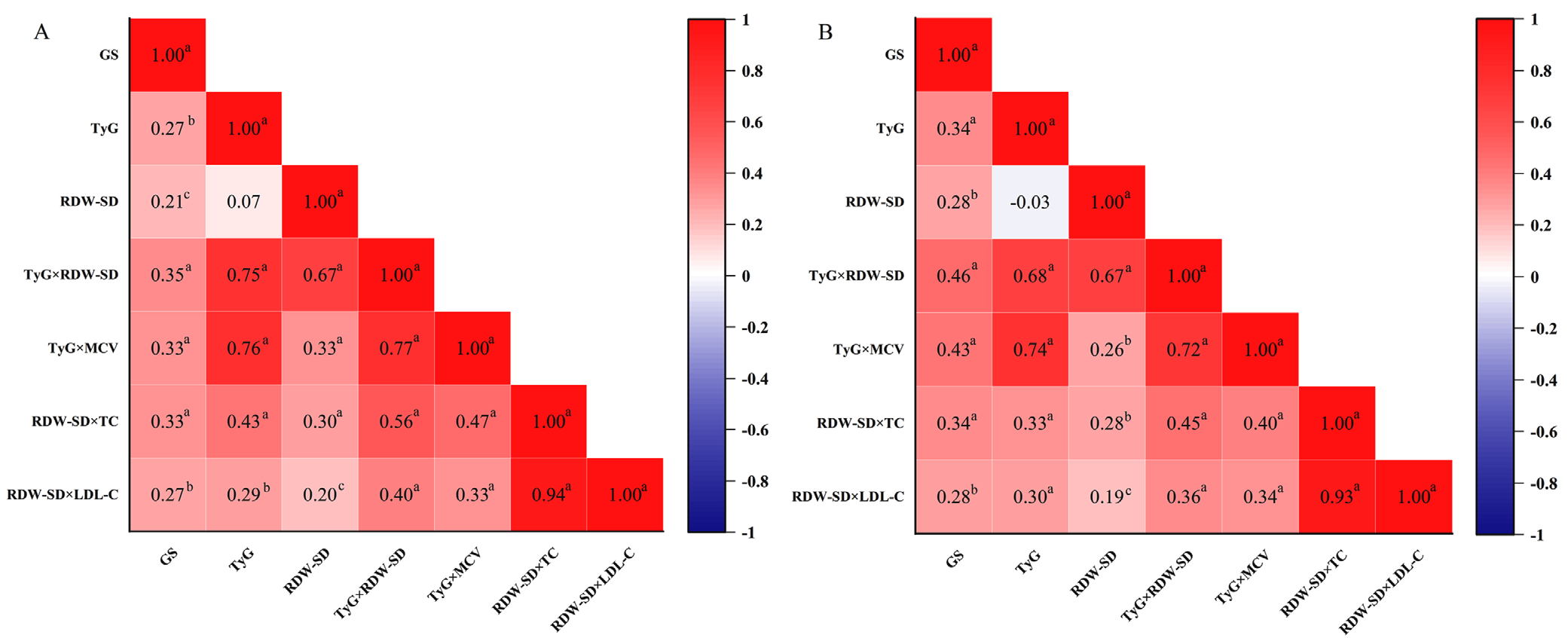
图1 不同糖代谢状态下各指标与GS的相关性热图注:图A为不合并2型糖尿病(T2DM)的冠状动脉粥样硬化性心脏病(CHD)组,图B为合并T2DM的CHD组;a表示与GS在P<0.001水平相关,b表示与GS在P<0.01水平相关,c表示与GS在P<0.05水平相关;GS=Gensini评分,TyG=甘油三酯-葡萄糖指数,RDW-SD=红细胞分布宽度标准差,TyG×RDW-SD=甘油三酯-葡萄糖指数与红细胞分布宽度标准差的乘积,TyG×MCV=甘油三酯-葡萄糖指数与平均红细胞体积的乘积,RDW-SD×TC=红细胞分布宽度标准差与总胆固醇的乘积,RDW-SD×LDL-C=红细胞分布宽度标准差与低密度脂蛋白胆固醇的乘积。
Figure 1 Correlation heatmap of various indicators and GS under different glucose metabolism statuses
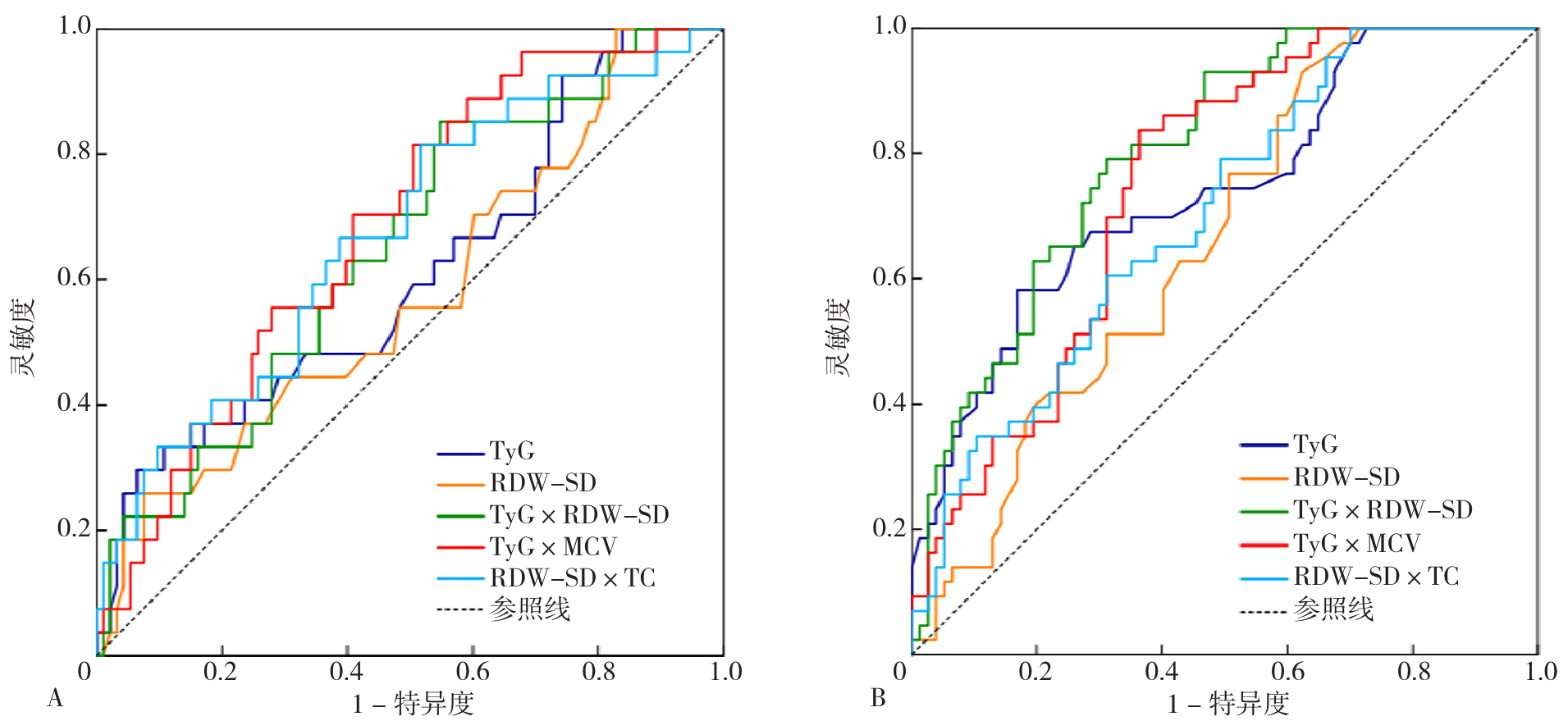
图2 不同糖代谢状态下各指标评估冠状动脉狭窄程度的ROC曲线注:图A为不合并T2DM的CHD组,图B为合并T2DM的CHD组;ROC=受试者工作特征。
Figure 2 ROC curves of various indicators for evaluating the degree of coronary artery stenosis under different glucose metabolism statuses
| 组别 | 指标 | AUC(95%CI) | 灵敏度(%) | 特异度(%) | 最佳截断值 | P值 | DeLong检验 | |
|---|---|---|---|---|---|---|---|---|
| P值 | Z值 | |||||||
| 不合并T2DM的CHD组 | TyG | 0.610(0.485~0.734) | 29.6 | 93.5 | 9.59 | 0.083 | ||
| RDW-SD | 0.578(0.454~0.702) | 25.9 | 92.5 | 43.60 | 0.220 | |||
| TyG×RDW-SD | 0.650(0.536~0.763) | 85.2 | 45.2 | 359.44 | 0.018 | 0.343 | -0.949 | |
| TyG×MCV | 0.684(0.578~0.790) | 81.5 | 49.5 | 779.88 | 0.004 | |||
| RDW-SD×TC | 0.672(0.556~0.788) | 81.5 | 48.4 | 168.21 | 0.007 | 0.854 | -0.184 | |
| 合并T2DM的CHD组 | TyG | 0.742(0.649~0.834) | 58.1 | 83.1 | 9.72 | <0.001 | 0.153 | -1.429 |
| RDW-SD | 0.660(0.564~0.756) | 93.0 | 37.7 | 40.35 | 0.004 | <0.001 | -3.491 | |
| TyG×RDW-SD | 0.801(0.724~0.878) | 79.1 | 68.8 | 398.67 | <0.001 | |||
| TyG×MCV | 0.748(0.663~0.834) | 83.7 | 63.6 | 853.19 | <0.001 | 0.176 | -1.354 | |
| RDW-SD×TC | 0.701(0.608~0.795) | 95.3 | 33.8 | 148.21 | <0.001 | 0.057 | -1.903 | |
表6 不同糖代谢状态下各指标对冠状动脉狭窄程度的判断效能
Table 6 Diagnostic efficacy of various indicators for judging the degree of coronary artery stenosis under different glucose metabolism statuses
| 组别 | 指标 | AUC(95%CI) | 灵敏度(%) | 特异度(%) | 最佳截断值 | P值 | DeLong检验 | |
|---|---|---|---|---|---|---|---|---|
| P值 | Z值 | |||||||
| 不合并T2DM的CHD组 | TyG | 0.610(0.485~0.734) | 29.6 | 93.5 | 9.59 | 0.083 | ||
| RDW-SD | 0.578(0.454~0.702) | 25.9 | 92.5 | 43.60 | 0.220 | |||
| TyG×RDW-SD | 0.650(0.536~0.763) | 85.2 | 45.2 | 359.44 | 0.018 | 0.343 | -0.949 | |
| TyG×MCV | 0.684(0.578~0.790) | 81.5 | 49.5 | 779.88 | 0.004 | |||
| RDW-SD×TC | 0.672(0.556~0.788) | 81.5 | 48.4 | 168.21 | 0.007 | 0.854 | -0.184 | |
| 合并T2DM的CHD组 | TyG | 0.742(0.649~0.834) | 58.1 | 83.1 | 9.72 | <0.001 | 0.153 | -1.429 |
| RDW-SD | 0.660(0.564~0.756) | 93.0 | 37.7 | 40.35 | 0.004 | <0.001 | -3.491 | |
| TyG×RDW-SD | 0.801(0.724~0.878) | 79.1 | 68.8 | 398.67 | <0.001 | |||
| TyG×MCV | 0.748(0.663~0.834) | 83.7 | 63.6 | 853.19 | <0.001 | 0.176 | -1.354 | |
| RDW-SD×TC | 0.701(0.608~0.795) | 95.3 | 33.8 | 148.21 | <0.001 | 0.057 | -1.903 | |
| [1] |
|
| [2] |
|
| [3] |
|
| [4] |
|
| [5] |
|
| [6] |
|
| [7] |
|
| [8] |
|
| [9] |
|
| [10] |
|
| [11] |
|
| [12] |
|
| [13] |
|
| [14] |
|
| [15] |
|
| [16] |
|
| [17] |
|
| [18] |
|
| [19] |
|
| [20] |
|
| [21] |
|
| [22] |
|
| [23] |
|
| [24] |
|
| [25] |
|
| [26] |
|
| [27] |
|
| [28] |
|
| [29] |
|
| [30] |
|
| [31] |
|
| [32] |
|
| [33] |
|
| [34] |
|
| [35] |
|
| [36] |
|
| [37] |
|
| [38] |
|
| [39] |
|
| [40] |
|
| [41] |
|
| [1] | 张璐, 张洲, 于从从, 巢怡宁, 杨思珏, 吴天宇, 赵声易, 毕艳. 嗅觉评估对2型糖尿病患者轻度认知功能障碍发生风险的预测价值研究[J]. 中国全科医学, 2027, 30(01): 66-72. |
| [2] | 胡若萌, 刘志栋, 陈俊岚, 王淼, 周时高. 代谢方联合二甲双胍干预2型糖尿病合并肥胖患者的多中心、双盲随机对照研究[J]. 中国全科医学, 2026, 29(33): 4854-4860. |
| [3] | 李纪新, 邱林杰, 任燕, 李美洁, 邹姹姹, 吴梓敬, 王文茹, 杨振宇, 刘峰兆, 张晋. 相位角与超重/肥胖患者糖脂代谢异常的相关性及其预测价值研究[J]. 中国全科医学, 2026, 29(33): 4876-4884. |
| [4] | 兰博, 王振伟, 李想, 张金盈, 唐俊楠. 老年心力衰竭合并2型糖尿病共病的研究进展[J]. 中国全科医学, 2026, 29(33): 4973-4980. |
| [5] | 闫梓薇, 聂佳桦, 石妍, 魏立民. 白蛋白/γ-谷氨酰转移酶比值与2型糖尿病合并代谢相关脂肪性肝病的相关性研究[J]. 中国全科医学, 2026, 29(30): 4431-4437. |
| [6] | 王琳, 曹晨晨, 黄逸憧, 刘静. 基于离散选择实验的高血压与2型糖尿病共病患者家庭医生签约服务偏好属性及水平开发[J]. 中国全科医学, 2026, 29(29): 4232-4240. |
| [7] | 余新艳, 张芳, 顾志乐, 王艳芳, 苏鹏, 张海澄. 社区老年人空腹血糖与体质指数及腰围的相关性研究[J]. 中国全科医学, 2026, 29(28): 4132-4140. |
| [8] | 薛翠荣, 魏巍, 吴任远, 薛雅琴, 徐辉江, 吕惟江, 蒋丹丹. 高血压和2型糖尿病人群慢性肾脏病患病率及管理现状:一项社区横断面研究[J]. 中国全科医学, 2026, 29(25): 3650-3654. |
| [9] | 李文哲, 杨宇青, 杨廷杰, 郭一鸣, 陈璐琳, 曹煜栋, 袁江淑, 杨宏辉, 王澈. 甘油三酯-葡萄糖指数和甘油三酯-葡萄糖-BMI与急性冠脉综合征患者易损斑块的相关性研究[J]. 中国全科医学, 2026, 29(23): 3287-3293. |
| [10] | 王洋, 赵诗婷, 陈盈盈, 孙子林, 邱山虎. 2型糖尿病并发症人群的运动干预与实施要点[J]. 中国全科医学, 2026, 29(21): 2989-2994. |
| [11] | 李佳威, 高欣怡, 葛奥淇, 李娟娟, 袁蓓蓓. 2型糖尿病患者的医防融合服务需求及其影响因素研究[J]. 中国全科医学, 2026, 29(21): 3028-3039. |
| [12] | 安艳红, 王世东, 李潇然, 郭家扬, 王哲, 沙培林, 孟怡珺, 李小萱, 石雪, 于泽兴, 肖永华. 糖尿病肾病影响因素及列线图预测模型研究:基于超声造影技术[J]. 中国全科医学, 2026, 29(21): 2995-3003. |
| [13] | 葛丹, 王智, 丁群, 郭同兰, 徐同道. 2型糖尿病患者残余胆固醇与非酒精性脂肪性肝病及进展性肝纤维化的关系研究[J]. 中国全科医学, 2026, 29(20): 2854-2859. |
| [14] | 李亚婵, 杨阳, 徐千婷, 柯亭羽. 中国内脏脂肪指数与2型糖尿病合并左心室舒张功能障碍的关联性研究[J]. 中国全科医学, 2026, 29(18): 2482-2488. |
| [15] | 付铭源, 于潇漪, 葛彩英, 孔慜. 2型糖尿病患者低血糖感知受损现状及影响因素研究[J]. 中国全科医学, 2026, 29(16): 2252-2258. |
| 阅读次数 | ||||||
|
全文 |
|
|||||
|
摘要 |
|
|||||