中国全科医学 ›› 2026, Vol. 29 ›› Issue (36): 5360-5367.DOI: 10.12114/j.issn.1007-9572.2025.0151

• 论著 • 上一篇    

分层应变技术联合非传统脂质参数对2型糖尿病合并高脂血症患者左心室收缩功能的评估研究

孔翼婷, 刘蓉*(), 余姝琦, 董芝芝, 涂一凡, 闫玉莲, 付奇环, 张月, 周雅东   

  1. 443003 湖北省宜昌市,三峡大学第一临床医学院 宜昌市中心人民医院超声科
  • 收稿日期:2025-10-12 修回日期:2026-05-30 出版日期:2026-12-20 发布日期:2026-10-30
  • 通讯作者: 刘蓉

  • 作者贡献:

    孔翼婷负责研究实施、撰写文章;余姝琦、董芝芝负责图像处理;涂一凡、闫玉莲、付奇环负责统计分析;张月、周雅东负责查阅文献;刘蓉负责研究设计、指导、修改文章。所有作者确认了论文的终稿。

Evaluation of Left Ventricular Systolic Function in Patients with Type 2 Diabetes Mellitus Complicated by Hyperlipidemia Using Layer-specific Strain Technology Combined with Non-traditional Lipid Parameters

KONG Yiting, LIU Rong*(), YU Shuqi, DONG Zhizhi, TU Yifan, YAN Yulian, FU Qihuan, ZHANG Yue, ZHOU Yadong   

  1. Department of Ultrasound, the First Clinical Medical College of China Three Gorges University/Yichang Central People's Hospital, Yichang 443003, China
  • Received:2025-10-12 Revised:2026-05-30 Published:2026-12-20 Online:2026-10-30
  • Contact: LIU Rong

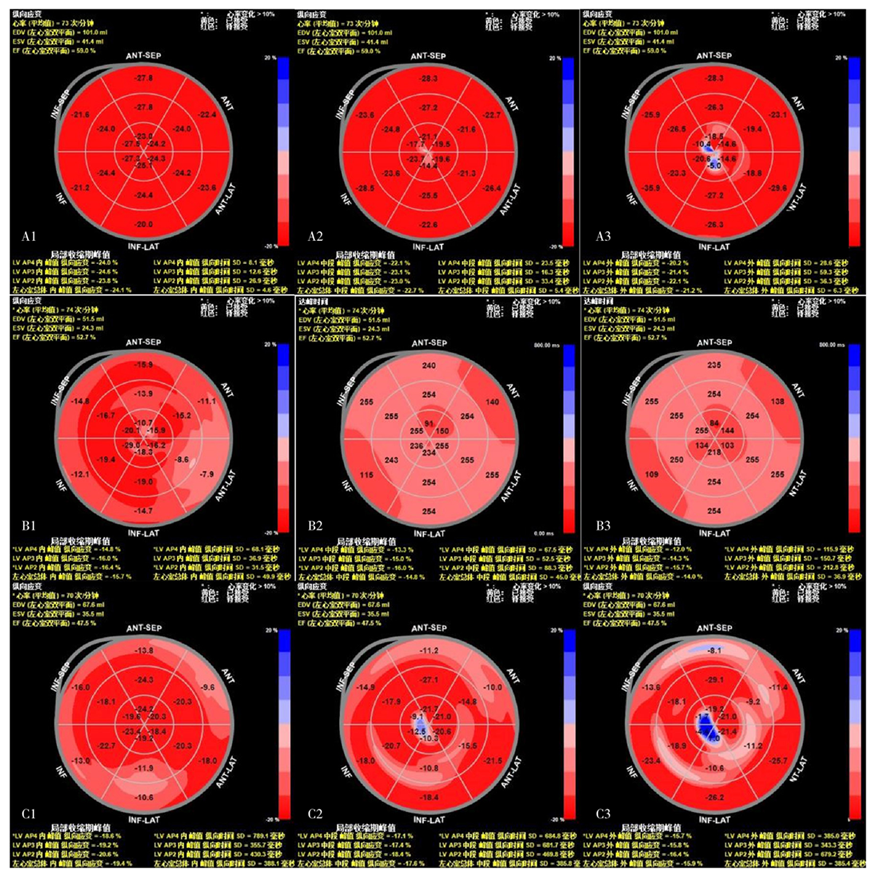
摘要: 背景 高脂血症会增加动脉粥样硬化性心血管疾病(ASCVD)的发生率,是2型糖尿病(T2DM)患者发病和死亡的主要原因。非传统脂质参数在T2DM风险评估和预测方面表现优异,且水平异常与ASCVD的发生密切相关。基于二维斑点追踪成像(2D-STI)的分层应变成像可以进一步区分心肌的不同层和段,并提供有关心肌运动的更多信息。 目的 应用分层应变技术联合非传统脂质参数评估T2DM伴高脂血症患者左心室的结构和功能变化。 方法 收集2021年1月—2023年6月在宜昌市中心人民医院内分泌科住院的左心室射血分数(LVEF)正常的T2DM患者共100例,其中伴有高脂血症的患者50例,同时纳入50例年龄性别相符的健康体检人群。T2DM患者按照是否伴有高脂血症分为T2DM组(n=50)和T2DM伴高脂血症组(n=50),以健康体检人群为对照组(n=50)。收集患者基线资料,根据传统脂质参数计算非传统脂质参数。收集超声心动图结果,通过软件计算左心室整体纵向应变(GLS)和整体圆周应变(GCS),得出左心室心内膜下、中层及心外膜下心肌纵向应变(GLSendo、GLSmid、GLSepi)及左心室心内膜下、中层、心外膜下圆周应变(GCSendo、GCSmid、GCSepi)的数值,计算左心室心内膜下与心外膜下心肌纵向应变值差值(ΔGLS)和左心室心内膜下与心外膜下圆周应变差值(ΔGCS)。采用Pearson相关性分析或Spearman秩相关分析评估非传统脂质参数与LVEF的相关性。采用多元线性分层回归分析探讨T2DM合并高脂血症患者左心室收缩功能的影响因素。 结果 与对照组相比,T2DM组收缩压、舒张压、空腹血糖(FPG)、糖化血红蛋白(HbA1c)、非高密度脂蛋白胆固醇(non-HDL-C)、非高密度脂蛋白胆固醇与高密度脂蛋白胆固醇之比(non-HDL-C/HDL-C)、脂蛋白联合指数(LCI)升高(P<0.05),T2DM伴高脂血症组收缩压、舒张压、FPG、HbA1c、总胆固醇(TC)、甘油三酯(TG)、低密度脂蛋白胆固醇(LDL-C)、血浆致动脉粥样硬化指数(AIP)、Castelli风险指数(CRI)、non-HDL-C/HDL-C、LCI升高(P<0.05);与T2DM组相比,T2DM伴高脂血症组TC、TG、LDL-C、AIP、CRI、残余脂蛋白胆固醇(RLP-C)、non-HDL-C、LCI升高(P<0.05)。超声心动图结果显示,T2DM组与T2DM伴高脂血症组左心房内径(LAD)高于对照组,左心室射血分数(LVEF)、左房室瓣的早期舒张速度和晚期舒张速度比值(E/A)低于对照组,T2DM组左房室瓣的早期舒张速度和左房室瓣前环的早期舒张速度比值(E/e')高于对照组(P<0.05);各组研究对象舒张期左心室后壁厚度(LVPW)比较,差异有统计学意义(P<0.05)。应变参数比较结果显示,T2DM组、T2DM伴高脂血症组GLS、GCS低于对照组,PSD高于对照组(P<0.05);T2DM组、T2DM伴高脂血症组GLSendo、GLSmid、GLSepi、GCSendo、GCSmid、GCSepi、ΔGCS低于对照组,T2DM伴高脂血症组GLSendo、GLSmid、GLSepi、GCSendo、GCSmid、ΔGLS、ΔGCS低于T2DM组(P<0.05)。相关性分析显示,T2DM伴高脂血症患者LVEF与AIP、CRI、RLP-C、non-HDL-C、non-HDL-C/HDL-C、LCI呈负相关(P<0.05)。多元线性分层回归分析结果显示,LCI对LVEF有负向影响作用(β=-0.564,P=0.034),GLSendo对LVEF有正向影响作用(β=0.807,P=0.006),纳入LCI和GLSendo后模型拟合度最优。 结论 分层应变技术可特异性评估T2DM伴高脂血症患者左心室各层心肌机械力学改变,明确血糖控制不良的T2DM伴高脂血症患者左心室收缩功能受损情况,且GLSendo联合非传统脂质参数对T2DM伴高脂血症患者左心室收缩功能受损具有较高的诊断价值。

关键词: 2型糖尿病, 高脂血症, 斑点追踪超声心动图, 非传统脂质参数

Abstract:

Background

Hyperlipidemia increases the risk of atherosclerotic cardiovascular disease (ASCVD), a leading cause of morbidity and mortality among patients with type 2 diabetes mellitus (T2DM). Non-traditional lipid parameters show strong performance in T2DM risk assessment and prediction and are closely associated with ASCVD. Layer-specific strain imaging based on two-dimensional speckle-tracking imaging (2D-STI) differentiates myocardial layers and segments, providing additional information on myocardial motion.

Objective

To evaluate structural and functional changes of the left ventricle (LV) in patients with T2DM and hyperlipidemia using layer-specific strain imaging in combination with non-traditional lipid parameters.

Methods

A total of 100 patients with T2DM and normal left ventricular ejection fraction (LVEF) who were hospitalized in the Department of Endocrinology at Yichang Central People's Hospital between January 2021 and June 2023 were included, 50 of whom had hyperlipidemia. An additional 50 age- and sex-matched healthy individuals served as controls. Patients were categorized into a T2DM group (n=50) and a T2DM with hyperlipidemia group (n=50); healthy participants formed the control group (n=50). Baseline data were collected, and nontraditional lipid parameters were calculated based on traditional lipid profiles. Echocardiographic results were gathered; software was utilized to calculate left ventricular global longitudinal strain (GLS) and global circumferential strain (GCS). Values for subendocardial, mid-myocardial, and subepicardial longitudinal strain (GLSendo, GLSmid, GLSepi) as well as subendocardial, mid-myocardial, and subepicardial circumferential strain (GCSendo, GCSmid, GCSepi) were derived. The differences between subendocardial and subepicardial longitudinal strain (ΔGLS) and between subendocardial and subepicardial circumferential strain (ΔGCS) were also calculated. Correlations between nontraditional lipid parameters and LVEF were assessed using Pearson or Spearman rank correlation analysis. Multivariable hierarchical regression analysis was performed to identify factors associated with left ventricular systolic function in patients with T2DM and hyperlipidemia.

Results

Compared with the control group, the T2DM group had higher SBP, DBP, FPG, HbA1c, non-HDL-C, non-HDL-C/HDL-C ratio, and LCI (all P<0.05). The T2DM with hyperlipidemia group had higher SBP, DBP, FPG, HbA1c, TC, TG, LDL-C, AIP, CRI, non-HDL-C/HDL-C ratio, and LCI than the control group (all P<0.05). Compared with the T2DM group, the T2DM with hyperlipidemia group had higher TC, TG, LDL-C, AIP, CRI, RLP-C, non-HDL-C, and LCI (all P<0.05). Echocardiographic findings showed that LAD was higher, whereas LVEF and the E/A ratio were lower, in both the T2DM and T2DM with hyperlipidemia groups than in the control group. The E/e' ratio was higher in the T2DM group than in the control group (P<0.05). LVPW also differed significantly among the three groups (P<0.05). Strain analysis showed that GLS and GCS were lower and peak strain dispersion (PSD) was higher in both the T2DM and T2DM with hyperlipidemia groups than in the control group (P<0.05). GLSendo, GLSmid, GLSepi, GCSendo, GCSmid, GCSepi, and ΔGCS were reduced in both T2DM groups compared with controls; moreover, GLSendo, GLSmid, GLSepi, GCSendo, GCSmid, ΔGLS, and ΔGCS were lower in the T2DM with hyperlipidemia group than in the T2DM group (all P<0.05). In patients with T2DM and hyperlipidemia, LVEF correlated negatively with AIP, CRI, RLP-C, non-HDL-C, the non-HDL-C/HDL-C ratio, and LCI (all P<0.05). In multivariable hierarchical regression, LCI was independently and negatively associated with LVEF (β= -0.564, P=0.034), whereas GLSendo was positively associated with LVEF (β=0.807, P=0.006); the model including both variables provided the best fit.

Conclusion

Layer-specific strain imaging enables layer-targeted assessment of LV myocardial mechanics and detects early impairment of LV systolic function in patients with T2DM and hyperlipidemia, even when conventional LVEF is preserved. The combination of GLSendo and nontraditional lipid parameters showed high diagnostic value for detecting impaired left ventricular systolic function in patients with T2DM and hyperlipidemia.

Key words: Type 2 diabetes, Hyperlipidemia, Speckle-tracking echocardiography, Non-traditional lipid parameters