中国全科医学 ›› 2026, Vol. 29 ›› Issue (36): 5313-5325.DOI: 10.12114/j.issn.1007-9572.2026.0169
• 指南·共识·解读 •
湖北省内分泌与代谢病临床医学研究中心, 武汉市预防医学会代谢健康与疾病防治专委会, 同济内分泌亚专科联盟, 彭婷1, 张彦超2, 刘旭3, 李婵4
收稿日期:2026-05-10
修回日期:2026-07-28
出版日期:2026-12-20
发布日期:2026-10-30
执笔人:
执笔人:
执笔人:
执笔人:
基金资助:Hubei Provincial Clinical Medical Research Center for Endocrinology and Metabolic Diseases, Metabolic Health and Disease Prevention & Professional Committee, Wuhan Preventive Medicine Association, Tongji Hospital Endocrine Subspecialty Alliance, PENG Ting1, ZHANG Yanchao2, LIU Xu3, LI Chan4
Received:2026-05-10
Revised:2026-07-28
Published:2026-12-20
Online:2026-10-30
About author:Writers:
Writers:
Writers:
Writers:
摘要: 糖尿病相关认知功能障碍(DACD)是糖尿病常见慢性并发症之一,其发病率随糖尿病患病率上升及人口老龄化加剧而逐年增高。DACD显著降低患者生活质量,增加家庭照护负担及社会医疗支出,且与糖尿病患者自我管理依从性下降密切相关。现有DACD相关专家共识多侧重于临床诊断与治疗策略,而对患者日常自我管理、健康教育实施、认知功能训练及综合照护等核心环节的实践规范尚缺乏系统性指导。鉴于此,本工作组制订了《糖尿病患者相关认知功能障碍综合管理专家共识(2026版)》(以下简称《共识》)。《共识》的制订基于对国内外DACD相关指南、共识及原始研究的全面系统检索与循证整合,并通过开展2轮专家函询和1轮专家论证,采用改编版证据质量与推荐分级方法。最终形成的《共识》系统阐述了DACD的筛查评估方法及危险因素、分级管理、DACD专项管理(药物安全管理、血糖管理、生活方式干预)、认知干预与数字管理技术、中医适宜技术、DACD并发症管理(环境安全管理、行为与精神症状、游走与走失防范)以及DACD教育与支持,旨在为临床管理提供一套科学、全面、实用的实践参考依据。
中图分类号:
| 级别 | 详细说明 |
|---|---|
| 证据等级 | |
| 高(A) | 非常确信真实值接近观察值 |
| 中(B) | 对观察值有中等程度信心:真实值有可能接近观察值,但仍存在两者不同的可能性 |
| 低(C) | 对观察值的确信程度有限:真实值可能与观察值不同 |
| 极低(D) | 对观察值几乎没有信心:真实值很可能与观察值不同 |
| 推荐等级 | |
| 强推荐使用(1) | 充分考虑了证据质量、综合医疗服务水平、患者可能的预后情况和治疗成本形成最终的推荐意见 |
| 弱推荐使用(2) | 证据价值存在一定不确定性,或可能存在较高的技术要求和治疗成本,倾向于低级推荐 |
表1 GRADE证据和推荐质量分级与定义
Table 1 Definitions and grading of GRADE evidence quality and recommendation strength
| 级别 | 详细说明 |
|---|---|
| 证据等级 | |
| 高(A) | 非常确信真实值接近观察值 |
| 中(B) | 对观察值有中等程度信心:真实值有可能接近观察值,但仍存在两者不同的可能性 |
| 低(C) | 对观察值的确信程度有限:真实值可能与观察值不同 |
| 极低(D) | 对观察值几乎没有信心:真实值很可能与观察值不同 |
| 推荐等级 | |
| 强推荐使用(1) | 充分考虑了证据质量、综合医疗服务水平、患者可能的预后情况和治疗成本形成最终的推荐意见 |
| 弱推荐使用(2) | 证据价值存在一定不确定性,或可能存在较高的技术要求和治疗成本,倾向于低级推荐 |
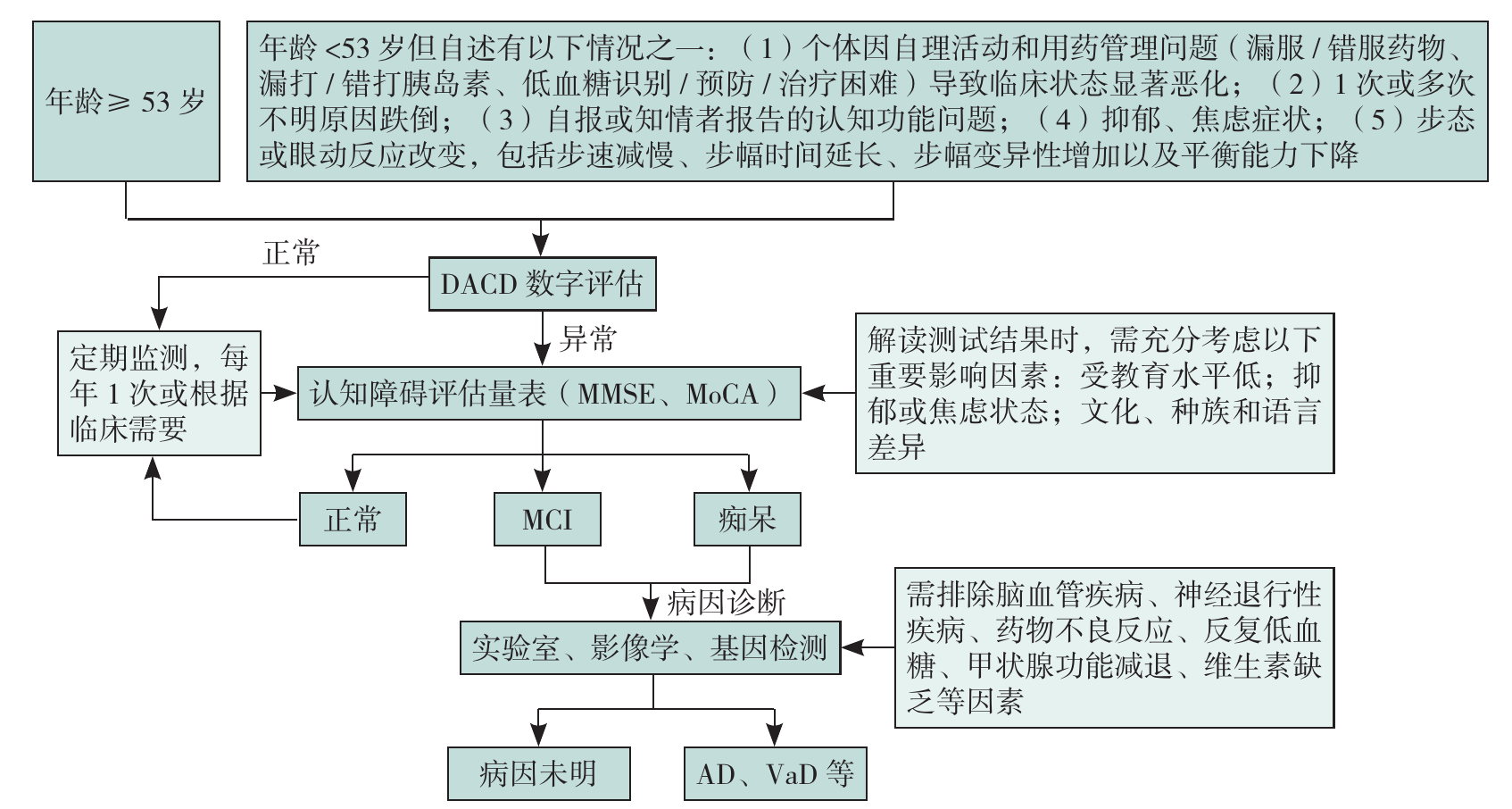
图1 DACD筛查与评估流程注:DACD=糖尿病相关认知功能障碍,MMSE=简易精神状态检查量表,MoCA=蒙特利尔认知评估量表,MCI=轻度认知功能障碍,AD=阿尔茨海默病,VaD=血管性痴呆。
Figure 1 Screening and assessment protocol for DACD
| 使用技术 | 推荐工具/方法 | 临床目的 | 使用条件 |
|---|---|---|---|
| 神经心理评估量表 | 简易精神状态检查量表(MMSE) | 目前临床应用最广泛的认知功能评估量表,常用于痴呆筛查 | 适用于初步认知筛查,但对早期执行功能损害不敏感,DACD早期筛查需联合MoCA |
| 蒙特利尔认知评估量表(MoCA) | 常用于MCI筛查,MoCA区分正常认知和MCI更为敏感 | 适用于执行功能、注意力检测 | |
| 临床痴呆评定量表(CDR) | 痴呆严重程度临床分级 | 适用于已确诊痴呆者的严重程度评估,需由经过培训的专业人员评定 | |
| AD评估量表-认知部分(ADAS-cog) | 轻中度AD药物疗效评估 | 适用于AD临床试验或药物疗效评价,耗时较长 | |
| 日常生活能力评分(ADL) | 日常生活能力评定 | 适用于评估功能状态,DACD应用时需侧重糖尿病自我管理能力(用药、血糖监测、饮食等) | |
| 认知功能筛查量表(CASI) | AD的严重程度以及鉴别诊断 | 适用于跨文化认知评估,可用于AD鉴别 | |
| 神经精神症状问卷(NPI)/汉密尔顿焦虑量表(HAMA)/汉密尔顿抑郁量表(HAMD) | 精神行为症状评估 | 适用于伴精神行为症状或情绪障碍者,DACD患者抑郁共病率高,建议常规筛查 | |
| 影像学检查 | MRI | 适用于脑部成像,常用于检测糖尿病患者的脑结构异常 | 适用于疑似DACD者,优先排查脑白质病变、腔隙性梗死、脑微出血 |
| fMRI | 反映大脑血流量、血氧饱和度,间接揭示神经元的活动 | 适用于疑难病例,需专业影像科支持,基层非必需 | |
| PET | AD的诊断,精确检测大脑中的(Aβ)斑块和tau蛋白缠结 | 可用于判断AD病理是否存在并辅助病因鉴别,区分AD与DACD;费用高、需专科评估后使用 | |
| 实验室检查 | 脑脊液(CSF)生物标志物 | 诊断认知功能障碍的可靠方法 | 适用于疑难病例,不推荐常规临床使用 |
| 血浆生物标志物 | 早期预警价值(尚未常规应用) | 目前为研究阶段,技术有限,不推荐常规临床使用 | |
| P-tau181,P-tau217,P-tau231 | 可在CSF/PET异常前数年达异常水平 | 适用于AD早期筛查或高危人群 | |
| GFAP | 反映星形胶质细胞增生和Aβ病理 | 适用于AD病理研究,DACD特异性不足,不推荐常规使用 | |
| 基因筛查 | PS1、PS2、APP基因检测 | 用于有痴呆家族史、早发型或特殊表型患者 | 适用于早发型痴呆或明确家族史者,排除常染色体显性遗传AD;散发性DACD不推荐常规筛查 |
| 风险预测模型 | 多变量评分模型(数字技术评分) | 高危人群识别、早期筛查、动态监测 | 适用于普通快速初筛及社区或基层大规模筛查 |
表2 糖尿病相关认知功能筛查与评估方法
Table 2 Screening and assessment methods for diabetes-associated cognitive function
| 使用技术 | 推荐工具/方法 | 临床目的 | 使用条件 |
|---|---|---|---|
| 神经心理评估量表 | 简易精神状态检查量表(MMSE) | 目前临床应用最广泛的认知功能评估量表,常用于痴呆筛查 | 适用于初步认知筛查,但对早期执行功能损害不敏感,DACD早期筛查需联合MoCA |
| 蒙特利尔认知评估量表(MoCA) | 常用于MCI筛查,MoCA区分正常认知和MCI更为敏感 | 适用于执行功能、注意力检测 | |
| 临床痴呆评定量表(CDR) | 痴呆严重程度临床分级 | 适用于已确诊痴呆者的严重程度评估,需由经过培训的专业人员评定 | |
| AD评估量表-认知部分(ADAS-cog) | 轻中度AD药物疗效评估 | 适用于AD临床试验或药物疗效评价,耗时较长 | |
| 日常生活能力评分(ADL) | 日常生活能力评定 | 适用于评估功能状态,DACD应用时需侧重糖尿病自我管理能力(用药、血糖监测、饮食等) | |
| 认知功能筛查量表(CASI) | AD的严重程度以及鉴别诊断 | 适用于跨文化认知评估,可用于AD鉴别 | |
| 神经精神症状问卷(NPI)/汉密尔顿焦虑量表(HAMA)/汉密尔顿抑郁量表(HAMD) | 精神行为症状评估 | 适用于伴精神行为症状或情绪障碍者,DACD患者抑郁共病率高,建议常规筛查 | |
| 影像学检查 | MRI | 适用于脑部成像,常用于检测糖尿病患者的脑结构异常 | 适用于疑似DACD者,优先排查脑白质病变、腔隙性梗死、脑微出血 |
| fMRI | 反映大脑血流量、血氧饱和度,间接揭示神经元的活动 | 适用于疑难病例,需专业影像科支持,基层非必需 | |
| PET | AD的诊断,精确检测大脑中的(Aβ)斑块和tau蛋白缠结 | 可用于判断AD病理是否存在并辅助病因鉴别,区分AD与DACD;费用高、需专科评估后使用 | |
| 实验室检查 | 脑脊液(CSF)生物标志物 | 诊断认知功能障碍的可靠方法 | 适用于疑难病例,不推荐常规临床使用 |
| 血浆生物标志物 | 早期预警价值(尚未常规应用) | 目前为研究阶段,技术有限,不推荐常规临床使用 | |
| P-tau181,P-tau217,P-tau231 | 可在CSF/PET异常前数年达异常水平 | 适用于AD早期筛查或高危人群 | |
| GFAP | 反映星形胶质细胞增生和Aβ病理 | 适用于AD病理研究,DACD特异性不足,不推荐常规使用 | |
| 基因筛查 | PS1、PS2、APP基因检测 | 用于有痴呆家族史、早发型或特殊表型患者 | 适用于早发型痴呆或明确家族史者,排除常染色体显性遗传AD;散发性DACD不推荐常规筛查 |
| 风险预测模型 | 多变量评分模型(数字技术评分) | 高危人群识别、早期筛查、动态监测 | 适用于普通快速初筛及社区或基层大规模筛查 |
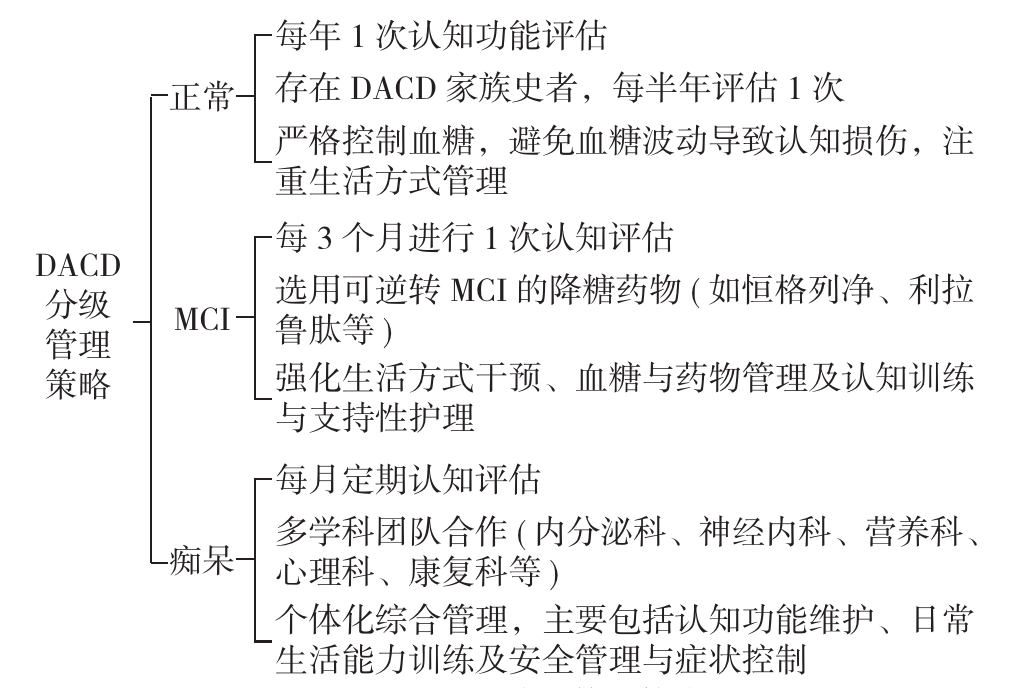
图2 DACD分级管理策略
Figure 2 Stratified management strategies for DACD
| 不同治疗方案人群 | 监测原则 | |
|---|---|---|
| 认知功能正常 | 生活方式干预者 | 可根据需要有目的地通过血糖监测了解饮食控制和运动对血糖的影响,从而调整饮食和运动方案 |
| 使用口服降糖药者 | 可每周监测2~4次空腹血糖或餐后2 h血糖 | |
| 基础胰岛素治疗者 | 应监测空腹血糖 | |
| 预混胰岛素治疗者 | 应监测空腹和晚餐前血糖 | |
| 轻度认知障碍者 | 个体化调整监测频率,可继续使用SMBG,需加强照护者教育,保留患者自主参与 | |
| 中重度认知障碍者 | 简化方案减少指尖血糖监测次数并引入照护者支持,需个体化调整监测频率 | |
表3 不同治疗方案人群毛细血管血糖监测的原则
Table 3 Principles of capillary blood glucose monitoring for different treatment regimens
| 不同治疗方案人群 | 监测原则 | |
|---|---|---|
| 认知功能正常 | 生活方式干预者 | 可根据需要有目的地通过血糖监测了解饮食控制和运动对血糖的影响,从而调整饮食和运动方案 |
| 使用口服降糖药者 | 可每周监测2~4次空腹血糖或餐后2 h血糖 | |
| 基础胰岛素治疗者 | 应监测空腹血糖 | |
| 预混胰岛素治疗者 | 应监测空腹和晚餐前血糖 | |
| 轻度认知障碍者 | 个体化调整监测频率,可继续使用SMBG,需加强照护者教育,保留患者自主参与 | |
| 中重度认知障碍者 | 简化方案减少指尖血糖监测次数并引入照护者支持,需个体化调整监测频率 | |
| 空腹血糖(mmol/L) | 睡前血糖(mmol/L) | HbA1c(%) | TIR | TBR | |
|---|---|---|---|---|---|
| 认知完好 | 4.4~7.2 | 4.4~10.0 | <7.0~7.5 | ≥70% | <4% |
| 合并MCI | 5.0~8.3 | 5.6~10.0 | <8.0% | ≥50% | <1% |
| 中重度痴呆 | 5.6~10.0 | 6.1~11.1 |
表4 不同认知状态患者血糖控制目标
Table 4 Glycemic control targets for patients with different cognitive statuses
| 空腹血糖(mmol/L) | 睡前血糖(mmol/L) | HbA1c(%) | TIR | TBR | |
|---|---|---|---|---|---|
| 认知完好 | 4.4~7.2 | 4.4~10.0 | <7.0~7.5 | ≥70% | <4% |
| 合并MCI | 5.0~8.3 | 5.6~10.0 | <8.0% | ≥50% | <1% |
| 中重度痴呆 | 5.6~10.0 | 6.1~11.1 |
| 维度 | 核心内容 |
|---|---|
| 疾病认知 | 糖尿病与认知障碍的双向关系;低血糖对脑功能的急性损害和长期影响;血糖波动与认知衰退的关联;DACD的自然病程 |
| 认知功能保护 | 认知障碍的早期识别信号及重要性;心血管风险因素对认知功能的影响及其管理;认知训练和脑力活动(如阅读、益智游戏)的重要性;充足睡眠的益处及改善睡眠障碍的方法 |
| 血糖管理 | 个体化血糖目标设定;血糖监测技术;高低血糖识别、预防及应急处理 |
| 药物管理 | 口服降糖药和胰岛素的正确使用方法、剂量、注射技巧、储存要求及不良反应识别 |
| 饮食管理 | 护脑饮食,均衡膳食;建立定时定量进餐习惯 |
| 运动管理 | 安全运动环境选择;低强度有氧运动(快走、坐位操、太极拳)配合抗阻运动;平衡与协调训练;运动前后血糖监测与低血糖预防 |
| 并发症预防 | 足部日常检查与护理;心血管风险因素控制;视力和听力保护;跌倒预防策略 |
| 心理支持 | 保持积极乐观心态的重要性;情绪识别、应对策略、社会支持 |
| 照护者支持 | 照护者负担识别与应对;紧急联系人设置与医疗信息卡准备;社区资源与长期照护规划 |
表5 DACD患者健康教育内容
Table 5 Health education content for DACD patients
| 维度 | 核心内容 |
|---|---|
| 疾病认知 | 糖尿病与认知障碍的双向关系;低血糖对脑功能的急性损害和长期影响;血糖波动与认知衰退的关联;DACD的自然病程 |
| 认知功能保护 | 认知障碍的早期识别信号及重要性;心血管风险因素对认知功能的影响及其管理;认知训练和脑力活动(如阅读、益智游戏)的重要性;充足睡眠的益处及改善睡眠障碍的方法 |
| 血糖管理 | 个体化血糖目标设定;血糖监测技术;高低血糖识别、预防及应急处理 |
| 药物管理 | 口服降糖药和胰岛素的正确使用方法、剂量、注射技巧、储存要求及不良反应识别 |
| 饮食管理 | 护脑饮食,均衡膳食;建立定时定量进餐习惯 |
| 运动管理 | 安全运动环境选择;低强度有氧运动(快走、坐位操、太极拳)配合抗阻运动;平衡与协调训练;运动前后血糖监测与低血糖预防 |
| 并发症预防 | 足部日常检查与护理;心血管风险因素控制;视力和听力保护;跌倒预防策略 |
| 心理支持 | 保持积极乐观心态的重要性;情绪识别、应对策略、社会支持 |
| 照护者支持 | 照护者负担识别与应对;紧急联系人设置与医疗信息卡准备;社区资源与长期照护规划 |
| [1] |
湖北省内分泌与代谢病临床医学研究中心, 湖北省医学会内分泌学分会, 糖尿病脑病联盟, 等. 糖尿病患者相关认知功能障碍诊治专家共识(2025版)[J]. 临床内科杂志, 2025, 42(10): 867-874.
|
| [2] |
|
| [3] |
|
| [4] |
The Joanna Briggs Institute. Joanna Briggs Institute reviewers,manual: 2017 edition[EB/OL]. (2016-10-02)[2025-05-01].
|
| [5] |
|
| [6] |
|
| [7] |
|
| [8] |
|
| [9] |
|
| [10] |
|
| [11] |
|
| [12] |
|
| [13] |
|
| [14] |
|
| [15] |
American Diabetes Association Professional Practice Committee. 13. older adults: standards of care in diabetes-2024[J]. Diabetes Care, 2024, 47(Suppl 1): S244-S257. DOI: 10.2337/dc24-S013.
|
| [16] |
|
| [17] |
|
| [18] |
|
| [19] |
|
| [20] |
|
| [21] |
中华医学会糖尿病学分会. 中国2型糖尿病防治指南(2013年版)[J]. 中华糖尿病杂志, 2014, 6(7): 447-498. DOI: 10.3760/cma.j.issn.1674-5809.2014.07.004.
|
| [22] |
|
| [23] |
|
| [24] |
|
| [25] |
|
| [26] |
|
| [27] |
|
| [28] |
|
| [29] |
|
| [30] |
|
| [31] |
|
| [32] |
|
| [33] |
中国康复医学会社区康复工作委员会, 贾杰, 金海鹏. 认知障碍患者居家康复管理的中国专家共识(2026版)[J]. 中国全科医学, 2026, 29(14): 1793-1802, 1810. DOI: 10.12114/j.issn.1007-9572.2025.0466.
|
| [34] |
|
| [35] |
|
| [36] |
|
| [37] |
|
| [38] |
|
| [39] |
DB4401/T 317-2025.养老机构认知障碍照护专区建设规范[S].
|
| [40] |
中国社区卫生协会社区老年健康专委会, 中华预防医学会老年病预防与控制专委会. 认知障碍患者居家管理中国专家共识(2026年)[J]. 中华老年医学杂志, 2026, 45(1): 1-14. DOI: 10.3760/cma.j.issn.0254-9026.2026.01.001.
|
| [41] |
中华医学会神经病学分会睡眠障碍学组, 中国医师协会神经内科分会睡眠障碍专业委员会, 中国睡眠研究会睡眠障碍专业委员会. 认知功能损害患者睡眠障碍评估和管理的专家共识[J]. 中华医学杂志, 2018, 98(33): 2619-2627. DOI: 10.3760/cma.j.issn.0376-2491.2018.33.002.
|
| [42] |
|
| [43] |
|
| [44] |
|
| [45] |
中华医学会心身医学分会数字心身医学协作学组, 失眠症数字疗法的中国专家共识写作组. 失眠症数字疗法的中国专家共识(2024版)[J]. 中华医学杂志, 2024, 104(9): 650-661. DOI: 10.3760/cma.j.cn112137-20230904-00386.
|
| [46] |
|
| [47] |
|
| [48] |
|
| [49] |
|
| [50] |
马睛雅. 老年轻度认知障碍非药物干预患者指南及患者决策辅助工具的构建[D]. 北京: 北京协和医学院, 2023.
|
| [51] |
|
| [52] |
|
| [53] |
中华医学会神经病学分会痴呆与认知障碍学组. 阿尔茨海默病源性轻度认知障碍诊疗中国专家共识2024[J]. 中华神经科杂志, 2024, 57(7): 715-737. DOI: 10.3760/cma.j.cn113694-20240320-00172.
|
| [54] |
何晴, 王静, 周晓丽. 轻度认知障碍干预策略的研究进展[J]. 中国医药指南, 2025, 23(8): 38-41.
|
| [55] |
|
| [56] |
|
| [57] |
WS/T 875 2026老年人认知障碍预防干预技术标准[S].
|
| [58] |
|
| [59] |
|
| [60] |
|
| [61] |
|
| [62] |
|
| [63] |
|
| [64] |
|
| [65] |
|
| [66] |
|
| [67] |
|
| [68] |
|
| [69] |
艾亚婷, 王云翠, 胡慧. 生命历程视角下认知障碍的风险因素管理:来自柳叶刀痴呆症委员会和最新的循证证据[J]. 中华老年医学杂志, 2025, 44(1): 1-9. DOI: 10.3760/cma.j.issn.0254-9026.2025.01.001.
|
| [70] |
|
| [71] |
|
| [1] | 胡若萌, 刘志栋, 陈俊岚, 王淼, 周时高. 代谢方联合二甲双胍干预2型糖尿病合并肥胖患者的多中心、双盲随机对照研究[J]. 中国全科医学, 2026, 29(33): 4854-4860. |
| [2] | 李纪新, 邱林杰, 任燕, 李美洁, 邹姹姹, 吴梓敬, 王文茹, 杨振宇, 刘峰兆, 张晋. 相位角与超重/肥胖患者糖脂代谢异常的相关性及其预测价值研究[J]. 中国全科医学, 2026, 29(33): 4876-4884. |
| [3] | 兰博, 王振伟, 李想, 张金盈, 唐俊楠. 老年心力衰竭合并2型糖尿病共病的研究进展[J]. 中国全科医学, 2026, 29(33): 4973-4980. |
| [4] | 李天姿, 姜岳. 澳大利亚全科医生学会《全科医学的预防活动指南》解读与讨论:视力问题[J]. 中国全科医学, 2026, 29(33): 4847-4853. |
| [5] | 陈莱, 余雨枫, 周欣, 冉明慧, 舒思为, 张庭轩, 赵金锁. 中国成年人高血压、糖尿病、血脂异常三病共患患病率及相关因素的Meta分析[J]. 中国全科医学, 2026, 29(33): 4951-4959. |
| [6] | 易珊烨, 杨荣, 廖晓阳, 周伊恒, 刘力滴, 杨梓钰, 白佳欣, 贾禹, 张欣. 2024年《动脉压力、结构及功能评估》专家共识解读[J]. 中国全科医学, 2026, 29(32): 4690-4694. |
| [7] | 王延赏, 何平. 整合服务对糖尿病和抑郁共病人群的影响研究[J]. 中国全科医学, 2026, 29(32): 4783-4785. |
| [8] | 汤皓晴, 李明月, 龙仁, 朱胤博, 梁伟欢, 朱萍, 赵炜, 赵洋, 刘晓云. 45岁及以上中老年糖尿病共病的治疗负担:基于6所基层医院患者的横断面调查[J]. 中国全科医学, 2026, 29(32): 4786-4797. |
| [9] | 肖智利, 卢晨霞, 朱绘, 张佳, 陈壮壮, 孙巍, 刘向楚煊, 罗成, 肖明中, 李晓东. 持续葡萄糖监测技术在糖肝共管中的应用现状与展望[J]. 中国全科医学, 2026, 29(31): 4521-4527. |
| [10] | 田向阳, 周迎生, 高莹. 糖尿病行为与生活方式干预展望[J]. 中国全科医学, 2026, 29(31): 4513-4520. |
| [11] | 谢远玲, 程丽, 龙湘玉, 苏政欣, 苏毅仪, 张人月, 孙国强, 陈旭霞, 周继兰. 人工智能眼科远程医疗诊断平台在社区眼健康筛查中的应用效果研究[J]. 中国全科医学, 2026, 29(31): 4641-4649. |
| [12] | 闫梓薇, 聂佳桦, 石妍, 魏立民. 白蛋白/γ-谷氨酰转移酶比值与2型糖尿病合并代谢相关脂肪性肝病的相关性研究[J]. 中国全科医学, 2026, 29(30): 4431-4437. |
| [13] | 郭治宏, 陈盈盈, 刘德伍. 抗生素骨水泥联合负压封闭引流技术治疗糖尿病足有效性和安全性的Meta分析[J]. 中国全科医学, 2026, 29(30): 4503-4512. |
| [14] | 赵聪娟, 金田田, 梁婕, 王贝宁, 高燕. 胰高血糖素样肽1受体激动剂对糖尿病肾脏病患者治疗效果比较:一项网状Meta分析[J]. 中国全科医学, 2026, 29(29): 4326-4336. |
| [15] | 王琳, 曹晨晨, 黄逸憧, 刘静. 基于离散选择实验的高血压与2型糖尿病共病患者家庭医生签约服务偏好属性及水平开发[J]. 中国全科医学, 2026, 29(29): 4232-4240. |
| 阅读次数 | ||||||
|
全文 |
|
|||||
|
摘要 |
|
|||||