中国全科医学 ›› 2027, Vol. 30 ›› Issue (02): 186-191.DOI: 10.12114/j.issn.1007-9572.2025.0550

• 全科医疗/社区卫生服务工作研究 • 上一篇    

老龄化背景下社区慢性病综合防控模式的效果评价实证研究

苑莹之1, 孙丽娜2, 李建合3, 李苹1, 楚男1, 石晓峰1,*(), 张清华4   

  1. 1.274000 山东省菏泽市,菏泽医学专科学校健康管理教研室
    2.274000 山东省菏泽市,菏泽医学专科学校附属医院健康管理部
    3.274000 山东省菏泽市疾病预防控制中心办公室
    4.250100 山东省济南市,山东省临床公共卫生中心神经内科
  • 收稿日期:2026-06-15 修回日期:2026-10-15 出版日期:2027-01-15 发布日期:2026-11-26
  • 通讯作者: 石晓峰

  • 作者贡献:

    苑莹之提出研究核心命题与整体思路,参与研究方案设计,负责论文框架搭建与初稿起草;孙丽娜负责数据收集与筛选,协助核查信息,参与研究实施;李建合承担数据清洗与标准化处理,协助核对医疗服务利用指标统计数据;李苹参与研究方案细化,负责部分干预效果跟踪,协助补充论文初稿内容;楚男负责数据统计分析,绘制图表并验证结果;石晓峰主导研究设计,监督研究全程质量,审核统计方法,主导论文终稿修订与质量控制,对稿件整体负责;张清华参与研究背景分析与讨论撰写,结合临床实践提出建议,协助修订论文。

Evaluation of the Effectiveness of a Comprehensive Community-based Chronic Disease Prevention and Control Model in the Context of an Aging Population: an Empirical Study

YUAN Yingzhi1, SUN Lina2, LI Jianhe3, LI Ping1, CHU Nan1, SHI Xiaofeng1,*(), ZHANG Qinghua4   

  1. 1. Health Management Teaching and Research Section, Heze Medical College, Heze 274000, China
    2. Health Management Department, Affiliated Hospital of Heze Medical College, Heze 274000, China
    3. Administrative Office, Heze Center for Disease Control and Prevention, Heze 274000, China
    4. Department of Neurology, Shandong Provincial Clinical Public Health Center, Jinan 250100, China
  • Received:2026-06-15 Revised:2026-10-15 Published:2027-01-15 Online:2026-11-26
  • Contact: SHI Xiaofeng

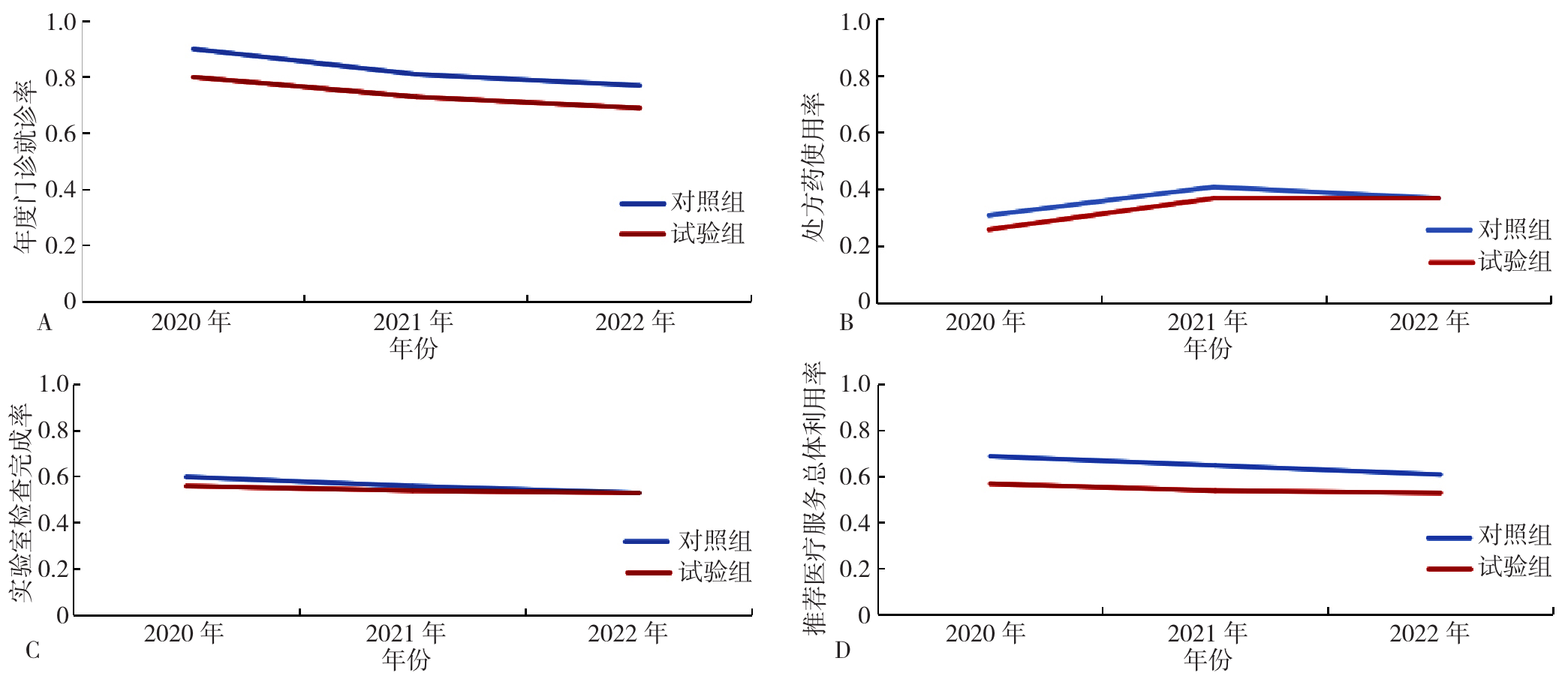
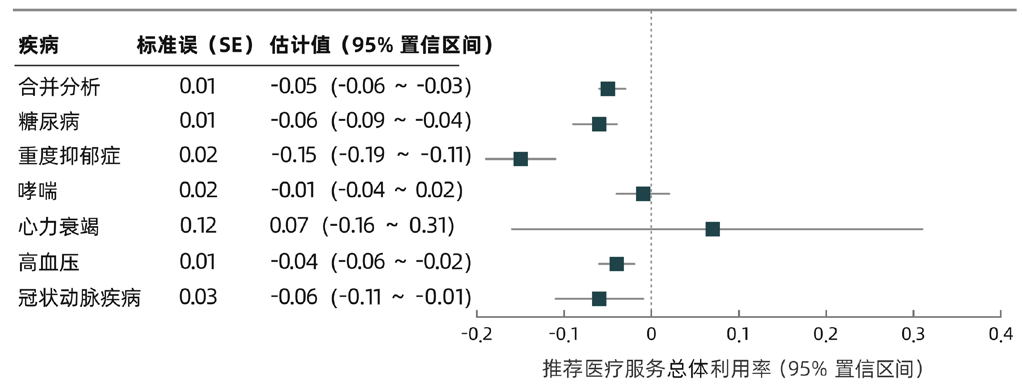
摘要: 背景 我国人口老龄化进程持续加速,老年人作为高血压、糖尿病、冠心病等慢性病的高发群体,相关疾病病程长、需持续干预,给家庭和社会带来沉重负担。传统医疗模式以疾病治疗为核心,缺乏社区层面有效的跟踪与延续性护理,难以满足慢性病长期系统性管理的需求,优化慢性病管理策略成为应对老龄化的关键举措。 目的 评估老龄化背景下社区慢性病综合防控模式创新对老年慢性病患者医疗服务利用的影响,为优化慢性病管理政策提供依据。 方法 本研究数据来源于菏泽市慢性病管理数据库,该数据库整合了菏泽市各级医疗机构门诊/住院临床数据、基本公共卫生服务慢性病随访数据、社区健康管理档案数据,收集2020—2022年库中60~85岁,确诊糖尿病、高血压等6类慢性病的343 137名老年人为研究对象,2020年设定为研究对象的干预前基线时段,2021—2022年为干预期。试验组(n=8 969)为菏泽市8个试点社区中2021年1月起接受社区慢性病综合防控创新管理的患者;对照组(n=334 168)为菏泽市非试点社区中,2020—2022年全程接受常规社区慢性病管理的患者。通过双重差分模型(DID)分析干预效果,并采用熵平衡法控制基线混杂因素,主要评估年度门诊就诊率、处方药使用率和实验室检查完成率等医疗服务利用情况。 结果 干预前,两组的门诊就诊率、处方药使用率和年度实验室检查完成率均保持平行发展趋势(P>0.05),满足DID模型的前提假设。干预后,经DID模型(因变量定义为未发生医疗服务利用)和熵平衡法调整,试验组年度门诊就诊率(72.1%)较对照组(75.2%)降低3.1个百分点(P<0.001);试验组处方药使用率(30.9%)较对照组(39.8%)下降8.9个百分点(P<0.001);试验组年度实验室检查完成率(49.1%)较对照组(54.9%)降低5.8个百分点(P<0.001)。复合指标分析显示,试验组推荐医疗服务总体利用率(56.6%)较对照组(61.6%)降低5.0个百分点(P<0.001)。社区慢性病综合防控创新模式对不同疾病类型的影响存在显著差异(P<0.05)。高血压、糖尿病和冠状动脉疾病患者的推荐医疗服务总体利用率分别降低4%(95%CI=-0.06~-0.02,P<0.05)、6%(95%CI=-0.09~-0.04,P≤0.05)和6%(95%CI=-0.11~-0.01,P<0.05)。重度抑郁症患者的降幅最大,达15%(95%CI=-0.19~-0.11,P<0.05)。 结论 社区慢性病综合防控创新模式可显著降低老年慢性病患者的医疗服务利用率,为优化慢性病管理政策、应对老龄化带来的慢性病防控挑战提供了实践依据。

关键词: 慢性病, 老龄化, 慢性病防控, 社区健康管理, 模式创新

Abstract:

Background

As a high-risk group for chronic diseases such as hypertension, diabetes, and coronary heart disease, older adults often have longer disease courses and require continuous intervention, leading to a heavy burden on families and society. These challenges are compounded by the accelerated aging population in China. Traditional healthcare models focus primarily on disease treatment but lack effective community-level follow-up and continuity of care, making it difficult to meet the needs of long-term and systematic chronic disease management. Optimizing chronic disease management strategies has thus become a key measure in addressing population aging.

Objective

To evaluate the impact of innovative community-based comprehensive prevention and control models for chronic diseases on the utilization of healthcare services by older patients with chronic diseases in the context of an aging population, thereby providing a basis for optimizing chronic disease management policies.

Methods

Data were sourced from the Heze Chronic Disease Management Database, which covers outpatient/ inpatient clinical data, chronic disease follow-up data from basic public health services, and community health management records. The study included 343 137 older adults aged from 60 to 85 years who were with confirmed diagnoses of one or more of six chronic diseases, including diabetes and hypertension, in the database from 2020 to 2022. The year 2020 was designated as the pre-intervention baseline period for the study participants, with January 2021 through December 2022 designated as the intervention period. The intervention group (n=8 969) consisted of patients in eight pilot communities in Heze City who received innovative comprehensive community-based chronic disease prevention and control management intervention starting in January 2021; The control group (n=334 168) consisted of patients in non-pilot communities in Heze City who received routine community chronic disease management from 2020 to 2022. The intervention's effectiveness was analyzed using a difference-in-differences (DID) model, with baseline confounding factors controlled using the entropy balancing method. The primary outcomes assessed were healthcare service utilization, including annual outpatient visit rates, prescription drug usage rates, and laboratory test completion rates.

Results

Prior to the intervention, the annual outpatient visit rates, prescription drug usage rates, and annual laboratory test completion rates in both groups followed parallel trends (P>0.05), satisfying the prerequisite assumptions of the DID model. After the intervention, following adjustment via the DID model (with the dependent variable defined as the absence of healthcare service utilization) and the entropy balancing method, the annual outpatient visit rate in the intervention group (72.1%) was 3.1 percentage points lower than that in the control group (75.2%) (P<0.001); the prescription drug utilization rate in the intervention group (30.9%) decreased by 8.9 percentage points compared with the control group (39.8%) (P<0.001); and the annual laboratory test completion rate in the intervention group (49.1%) decreased by 5.8 percentage points compared with the control group (54.9%) (P<0.001). Analysis of composite indicators showed that the overall utilization rate of recommended medical services in the intervention group (56.6%) was 5.0 percentage points lower than that in the control group (61.6%) (P<0.001). The impact of the innovative community-based comprehensive chronic disease prevention and control model differed significantly across different disease types (P<0.05). The rates of utilization of recommended medical services among patients with hypertension, diabetes, and coronary artery disease decreased by 4 percentage points (95%CI=-0.06 to -0.02, P<0.05), 6 percentage points (95%CI=-0.09 to -0.04, P<0.05), and 6 percentage points (95%CI=-0.11 to -0.01, P<0.05), respectively. Patients with major depressive disorder showed the largest decrease, reaching 15 percentage points (95%CI=-0.19 to -0.11, P<0.05).

Conclusion

An innovative community-based integrated prevention and control model for chronic diseases can significantly reduce healthcare utilization among older patients with chronic diseases, and provides optimizing chronic disease management policies and addressing the challenges of chronic disease prevention and control posed by an aging population.

Key words: Chronic disease, Aging, Prevention and control of chronic diseases, Community health management, Model innovation