
中国全科医学 ›› 2027, Vol. 30 ›› Issue (01): 50-59.DOI: 10.12114/j.issn.1007-9572.2026.0219
• 全科医学教育研究 • 上一篇
巩璞玥1, 王培成2, 张涵博3, 朱纪明4,*( ), 梁万年5,6,*()
收稿日期:2026-04-02
修回日期:2026-09-04
出版日期:2027-01-05
发布日期:2026-11-17
通讯作者:
朱纪明, 梁万年
作者贡献:
巩璞玥负责提出研究思路、设计研究方案和研究方法,开展数据分析及论文初稿撰写,并提供研究经费支持;王培成参与数据分析及论文初稿撰写;张涵博参与数据分析;朱纪明负责研究思路提出、研究方案设计、研究数据提供、论文审阅与修改,并提供研究经费支持;梁万年负责研究数据提供、论文审阅、修改及研究指导。
基金资助:
GONG Puyue1, WANG Peicheng2, ZHANG Hanbo3, ZHU Jiming4,*(), LIANG Wannian5,6,*()
Received:2026-04-02
Revised:2026-09-04
Published:2027-01-05
Online:2026-11-17
Contact:
ZHU Jiming, LIANG Wannian
摘要: 背景 农村订单定向医学生培养项目是缓解基层全科医生短缺的重要制度安排,但部分定向毕业生在住院医师规范化培训结束后不愿返回基层服务,基层卫生人才流失风险仍然存在。职业倦怠被认为是影响医生离职意向的重要因素,其作用机制仍有待进一步探讨。工作韧性和政策认同可能分别从个体心理资源和政策认知层面在职业倦怠与离职意向之间发挥中介作用,但相关证据仍较有限。 目的 分析农村订单定向住院医师职业倦怠与离职意向之间的关系,并检验工作韧性和政策认同在职业倦怠与离职意向之间的中介效应。 方法 于2021年12月—2022年2月,采用分层整群抽样法在全国抽取9个省份,在各省份卫生健康委员会科教处协助下,通过电子问卷对农村订单定向住院医师开展调查,调查内容包括离职意向、职业倦怠、工作韧性水平、政策认同水平等。将离职意向分为无离职意向、有离职意向和不确定,采用多分类Logistic回归分析离职意向的影响因素,并利用Bootstrap法检验中介效应。 结果 纳入5 604份农村订单定向住院医师的有效问卷,职业倦怠检出率为51.86%(2 906/5 604),15.61%(875/5 604)的农村订单定向住院医师明确不愿留任基层,14.29%(801/5 604)的农村订单定向住院医师处于不确定状态。职业倦怠与离职意向处于不确定状态和明确离职意向呈正相关[RRR(95%CI)=1.29 (1.08~1.54)、1.40 (1.16~1.68),P<0.05],而工作韧性水平、政策认同水平与离职意向处于不确定状态[RRR(95%CI)=0.83 (0.72~0.94)、0.35 (0.31~0.40)]和明确离职意向[RRR(95%CI)=0.75 (0.66~0.86)、0.20 (0.17~0.23)]呈负相关(P<0.05)。中介效应分析显示,工作韧性和政策认同在职业倦怠与离职意向之间均存在显著中介效应,其中介效应值分别为0.051 1和0.059 7。 结论 职业倦怠、工作韧性、政策认同是影响农村订单定向住院医师离职意向的重要因素,工作韧性与政策认同在职业倦怠与离职意向之间发挥中介作用。
| 变量 | 人数 | 百分比(%) |
|---|---|---|
| 性别 | ||
| 男 | 2 252 | 40.19 |
| 女 | 3 352 | 59.81 |
| 年龄 | ||
| ≤28岁 | 5 498 | 98.11 |
| >28岁 | 106 | 1.89 |
| 婚姻状况 | ||
| 已婚 | 515 | 9.19 |
| 其他 | 5 089 | 90.81 |
| 高考前生活所在地 | ||
| 城市 | 627 | 11.19 |
| 县城 | 1 428 | 25.48 |
| 农村 | 3 549 | 63.33 |
| 月收入 | ||
| ≤3 000元 | 697 | 12.44 |
| 3 001~4 000元 | 763 | 13.62 |
| 4 001~ 5000元 | 1 697 | 30.28 |
| >5 000元 | 2 447 | 43.67 |
| 执业医师考试 | ||
| 未通过或未参加 | 2 550 | 45.50 |
| 已通过 | 3 054 | 54.50 |
| 每周工作时长 | ||
| <40 h | 516 | 9.21 |
| 40~48 h | 2 599 | 46.38 |
| >48 h | 2 489 | 44.41 |
| 住培年级 | ||
| 一年级 | 2 068 | 36.90 |
| 二年级 | 1 872 | 33.40 |
| 三年级 | 1 664 | 29.69 |
| 轮转基层实践基地 | ||
| 是 | 3 685 | 65.76 |
| 否 | 1 919 | 34.24 |
表1 农村订单定向住院医师的基本情况(n=5 604)
Table 1 Basic characteristics of rural-oriented medical residents
| 变量 | 人数 | 百分比(%) |
|---|---|---|
| 性别 | ||
| 男 | 2 252 | 40.19 |
| 女 | 3 352 | 59.81 |
| 年龄 | ||
| ≤28岁 | 5 498 | 98.11 |
| >28岁 | 106 | 1.89 |
| 婚姻状况 | ||
| 已婚 | 515 | 9.19 |
| 其他 | 5 089 | 90.81 |
| 高考前生活所在地 | ||
| 城市 | 627 | 11.19 |
| 县城 | 1 428 | 25.48 |
| 农村 | 3 549 | 63.33 |
| 月收入 | ||
| ≤3 000元 | 697 | 12.44 |
| 3 001~4 000元 | 763 | 13.62 |
| 4 001~ 5000元 | 1 697 | 30.28 |
| >5 000元 | 2 447 | 43.67 |
| 执业医师考试 | ||
| 未通过或未参加 | 2 550 | 45.50 |
| 已通过 | 3 054 | 54.50 |
| 每周工作时长 | ||
| <40 h | 516 | 9.21 |
| 40~48 h | 2 599 | 46.38 |
| >48 h | 2 489 | 44.41 |
| 住培年级 | ||
| 一年级 | 2 068 | 36.90 |
| 二年级 | 1 872 | 33.40 |
| 三年级 | 1 664 | 29.69 |
| 轮转基层实践基地 | ||
| 是 | 3 685 | 65.76 |
| 否 | 1 919 | 34.24 |
| 变量 | 人数 | 职业倦怠 | 工作韧性 | 政策认同 | 离职意向 | ||||||
|---|---|---|---|---|---|---|---|---|---|---|---|
| 低水平 | 中水平 | 高水平 | 低水平 | 中水平 | 高水平 | 无 | 不确定 | 有 | |||
| 性别 | |||||||||||
| 男 | 2 252 | 1 222(54.26) | 984(43.69) | 557(24.73) | 711(31.57) | 773(34.33) | 765(33.97) | 714(31.71) | 1 614(71.67) | 301(13.37) | 337(14.96) |
| 女 | 3 352 | 1 684(50.24) | 1 533(45.73) | 898(26.79) | 921(27.48) | 1 179(35.17) | 1 235(36.84) | 938(27.98) | 2 314(69.03) | 500(14.92) | 538(16.05) |
| χ2值 | 8.74 | 11.20 | 9.73 | 4.62 | |||||||
| P值 | 0.003 | 0.004 | 0.008 | 0.099 | |||||||
| 年龄 | |||||||||||
| ≤28岁 | 5 498 | 2 856(51.95) | 2 479(45.09) | 1 421(25.85) | 1 598(29.07) | 1 917(34.87) | 1 978(35.98) | 1 603(29.16) | 3 854(70.10) | 784(14.26) | 860(15.64) |
| >28岁 | 106 | 50(47.17) | 38(35.85) | 34(32.08) | 34(32.08) | 35(33.02) | 22(20.75) | 49(46.23) | 74(69.81) | 17(16.04) | 15(14.15) |
| χ2值 | 0.95 | 3.85 | 17.13 | 0.38 | |||||||
| P值 | 0.330 | 0.146 | <0.001 | 0.827 | |||||||
| 婚姻状况 | |||||||||||
| 已婚 | 515 | 241(46.80) | 211(40.97) | 137(26.60) | 167(32.43) | 180(34.95) | 168(32.62) | 167(32.43) | 346(67.18) | 69(13.40) | 100(19.42) |
| 其他 | 5 089 | 2 665(52.37) | 2 306(45.31) | 1 318(25.90) | 1 465(28.79) | 1 772(34.82) | 1 832(36.00) | 1 485(29.18) | 3 582(70.39) | 732(14.38) | 775(15.23) |
| χ2值 | 5.82 | 4.18 | 3.17 | 6.26 | |||||||
| P值 | 0.016 | 0.124 | 0.205 | 0.044 | |||||||
| 高考前生活所在地 | |||||||||||
| 城市 | 627 | 335(56.62) | 272(43.38) | 166(26.48) | 189(30.14) | 260(41.47) | 198(31.58) | 169(26.95) | 396(63.16) | 106(16.91) | 125(19.94) |
| 县城 | 1 428 | 765(53.57) | 651(45.59) | 367(25.70) | 410(28.71) | 529(37.04) | 501(35.08) | 398(27.87) | 919(64.36) | 237(16.60) | 272(19.05) |
| 农村 | 3 549 | 1 806(50.89) | 1 594(44.91) | 922(25.98) | 1 033(29.11) | 1 163(32.77) | 1 301(36.66) | 1 085(30.57) | 2 613(73.63) | 458(12.91) | 478(13.46) |
| χ2值 | 11.68 | 0.88 | 22.36 | 59.16 | |||||||
| P值 | 0.009 | 0.927 | <0.001 | <0.001 | |||||||
| 月收入 | |||||||||||
| ≤3000元 | 697 | 380(54.52) | 346(49.64) | 172(24.68) | 179(25.68) | 275(39.45) | 225(32.28) | 197(28.26) | 446(63.99) | 131(18.79) | 120(17.22) |
| 3 001~4 000元 | 763 | 422(55.31) | 388(50.85) | 189(24.77) | 186(24.38) | 285(37.35) | 263(34.47) | 215(28.18) | 549(71.95) | 114(14.94) | 100(13.11) |
| 4 001~5 000元 | 1 697 | 876(51.62) | 799(47.08) | 416(24.51) | 482(28.40) | 565(33.29) | 625(36.83) | 507(29.88) | 1 200(70.71) | 239(14.08) | 258(15.20) |
| >5 000元 | 2 447 | 1 228(50.18) | 984(40.21) | 678(27.71) | 785(32.08) | 827(33.80) | 887(36.25) | 733(29.96) | 1 733(70.82) | 317(12.95) | 397(16.22) |
| χ2值 | 8.40 | 44.76 | 12.06 | 22.57 | |||||||
| P值 | 0.038 | <0.001 | 0.061 | <0.001 | |||||||
| 执业医师考试 | |||||||||||
| 未通过或未参加 | 2 550 | 1 292(50.67) | 1 110(43.53) | 642(25.18) | 798(31.29) | 841(32.98) | 915(35.88) | 794(31.14) | 1 886(73.96) | 357(14.00) | 307(12.04) |
| 已通过 | 3 054 | 1 614(52.85) | 1 407(46.07) | 813(26.62) | 834(27.31) | 1 111(36.38) | 1 085(35.53) | 858(28.09) | 2 042(66.86) | 444(14.54) | 568(18.60) |
| χ2值 | 2.65 | 10.70 | 9.02 | 48.56 | |||||||
| P值 | 0.104 | 0.005 | 0.011 | <0.001 | |||||||
| 每周工作时长 | |||||||||||
| <40 h | 516 | 237(45.93) | 182(35.27) | 145(28.10) | 189(36.63) | 144(27.91) | 191(37.02) | 181(35.08) | 376(72.87) | 66(12.79) | 74(14.34) |
| 40~48 h | 2 599 | 1 216(46.79) | 1 018(39.17) | 707(27.20) | 874(33.63) | 882(33.94) | 903(34.74) | 814(31.32) | 1 849(71.14) | 358(13.77) | 392(15.08) |
| >48 h | 2 489 | 1 453(58.38) | 1 317(52.91) | 603(24.23) | 569(22.86) | 926(37.20) | 906(36.40) | 657(26.40) | 1 703(68.42) | 377(15.15) | 409(16.43) |
| χ2值 | 76.40 | 132.19 | 29.48 | 6.61 | |||||||
| P值 | <0.001 | <0.001 | <0.001 | 0.158 | |||||||
| 住培年级 | |||||||||||
| 一年级 | 2 068 | 1 053(50.92) | 898(43.42) | 527(25.48) | 643(31.09) | 661(31.96) | 743(35.93) | 664(32.11) | 1 562(75.53) | 281(13.59) | 225(10.88) |
| 二年级 | 1 872 | 1 005(53.69) | 889(47.49) | 467(24.95) | 516(27.56) | 686(36.65) | 678(36.22) | 508(27.14) | 1 266(67.63) | 268(14.32) | 338(18.06) |
| 三年级 | 1 664 | 848(50.96) | 730(43.87) | 461(27.70) | 473(28.43) | 605(36.36) | 579(34.80) | 480(28.85) | 1 100(66.11) | 252(15.14) | 312(18.75) |
| χ2值 | 3.77 | 11.66 | 16.88 | 63.00 | |||||||
| P值 | 0.152 | 0.020 | 0.002 | <0.001 | |||||||
| 轮转基层实践基地 | |||||||||||
| 是 | 3 685 | 1 863(50.56) | 1 573(42.69) | 963(26.13) | 1 149(31.18) | 1 257(34.11) | 1 317(35.74) | 1 111(30.15) | 2 562(69.53) | 531(14.41) | 592(16.07) |
| 否 | 1 919 | 1 043(54.35) | 944(49.19) | 492(25.64) | 483(25.17) | 695(36.22) | 683(35.59) | 541(28.19) | 1 366(71.18) | 270(14.07) | 283(14.75) |
| χ2值 | 7.28 | 27.67 | 3.25 | 2.00 | |||||||
| P值 | 0.007 | <0.001 | 0.197 | 0.368 | |||||||
表2 不同特征农村订单定向住院医师的职业倦怠、工作韧性、政策认同、离职意向比较[名(%)]
Table 2 Burnout, work resilience, policy identification, and turnover intention by participant characteristics
| 变量 | 人数 | 职业倦怠 | 工作韧性 | 政策认同 | 离职意向 | ||||||
|---|---|---|---|---|---|---|---|---|---|---|---|
| 低水平 | 中水平 | 高水平 | 低水平 | 中水平 | 高水平 | 无 | 不确定 | 有 | |||
| 性别 | |||||||||||
| 男 | 2 252 | 1 222(54.26) | 984(43.69) | 557(24.73) | 711(31.57) | 773(34.33) | 765(33.97) | 714(31.71) | 1 614(71.67) | 301(13.37) | 337(14.96) |
| 女 | 3 352 | 1 684(50.24) | 1 533(45.73) | 898(26.79) | 921(27.48) | 1 179(35.17) | 1 235(36.84) | 938(27.98) | 2 314(69.03) | 500(14.92) | 538(16.05) |
| χ2值 | 8.74 | 11.20 | 9.73 | 4.62 | |||||||
| P值 | 0.003 | 0.004 | 0.008 | 0.099 | |||||||
| 年龄 | |||||||||||
| ≤28岁 | 5 498 | 2 856(51.95) | 2 479(45.09) | 1 421(25.85) | 1 598(29.07) | 1 917(34.87) | 1 978(35.98) | 1 603(29.16) | 3 854(70.10) | 784(14.26) | 860(15.64) |
| >28岁 | 106 | 50(47.17) | 38(35.85) | 34(32.08) | 34(32.08) | 35(33.02) | 22(20.75) | 49(46.23) | 74(69.81) | 17(16.04) | 15(14.15) |
| χ2值 | 0.95 | 3.85 | 17.13 | 0.38 | |||||||
| P值 | 0.330 | 0.146 | <0.001 | 0.827 | |||||||
| 婚姻状况 | |||||||||||
| 已婚 | 515 | 241(46.80) | 211(40.97) | 137(26.60) | 167(32.43) | 180(34.95) | 168(32.62) | 167(32.43) | 346(67.18) | 69(13.40) | 100(19.42) |
| 其他 | 5 089 | 2 665(52.37) | 2 306(45.31) | 1 318(25.90) | 1 465(28.79) | 1 772(34.82) | 1 832(36.00) | 1 485(29.18) | 3 582(70.39) | 732(14.38) | 775(15.23) |
| χ2值 | 5.82 | 4.18 | 3.17 | 6.26 | |||||||
| P值 | 0.016 | 0.124 | 0.205 | 0.044 | |||||||
| 高考前生活所在地 | |||||||||||
| 城市 | 627 | 335(56.62) | 272(43.38) | 166(26.48) | 189(30.14) | 260(41.47) | 198(31.58) | 169(26.95) | 396(63.16) | 106(16.91) | 125(19.94) |
| 县城 | 1 428 | 765(53.57) | 651(45.59) | 367(25.70) | 410(28.71) | 529(37.04) | 501(35.08) | 398(27.87) | 919(64.36) | 237(16.60) | 272(19.05) |
| 农村 | 3 549 | 1 806(50.89) | 1 594(44.91) | 922(25.98) | 1 033(29.11) | 1 163(32.77) | 1 301(36.66) | 1 085(30.57) | 2 613(73.63) | 458(12.91) | 478(13.46) |
| χ2值 | 11.68 | 0.88 | 22.36 | 59.16 | |||||||
| P值 | 0.009 | 0.927 | <0.001 | <0.001 | |||||||
| 月收入 | |||||||||||
| ≤3000元 | 697 | 380(54.52) | 346(49.64) | 172(24.68) | 179(25.68) | 275(39.45) | 225(32.28) | 197(28.26) | 446(63.99) | 131(18.79) | 120(17.22) |
| 3 001~4 000元 | 763 | 422(55.31) | 388(50.85) | 189(24.77) | 186(24.38) | 285(37.35) | 263(34.47) | 215(28.18) | 549(71.95) | 114(14.94) | 100(13.11) |
| 4 001~5 000元 | 1 697 | 876(51.62) | 799(47.08) | 416(24.51) | 482(28.40) | 565(33.29) | 625(36.83) | 507(29.88) | 1 200(70.71) | 239(14.08) | 258(15.20) |
| >5 000元 | 2 447 | 1 228(50.18) | 984(40.21) | 678(27.71) | 785(32.08) | 827(33.80) | 887(36.25) | 733(29.96) | 1 733(70.82) | 317(12.95) | 397(16.22) |
| χ2值 | 8.40 | 44.76 | 12.06 | 22.57 | |||||||
| P值 | 0.038 | <0.001 | 0.061 | <0.001 | |||||||
| 执业医师考试 | |||||||||||
| 未通过或未参加 | 2 550 | 1 292(50.67) | 1 110(43.53) | 642(25.18) | 798(31.29) | 841(32.98) | 915(35.88) | 794(31.14) | 1 886(73.96) | 357(14.00) | 307(12.04) |
| 已通过 | 3 054 | 1 614(52.85) | 1 407(46.07) | 813(26.62) | 834(27.31) | 1 111(36.38) | 1 085(35.53) | 858(28.09) | 2 042(66.86) | 444(14.54) | 568(18.60) |
| χ2值 | 2.65 | 10.70 | 9.02 | 48.56 | |||||||
| P值 | 0.104 | 0.005 | 0.011 | <0.001 | |||||||
| 每周工作时长 | |||||||||||
| <40 h | 516 | 237(45.93) | 182(35.27) | 145(28.10) | 189(36.63) | 144(27.91) | 191(37.02) | 181(35.08) | 376(72.87) | 66(12.79) | 74(14.34) |
| 40~48 h | 2 599 | 1 216(46.79) | 1 018(39.17) | 707(27.20) | 874(33.63) | 882(33.94) | 903(34.74) | 814(31.32) | 1 849(71.14) | 358(13.77) | 392(15.08) |
| >48 h | 2 489 | 1 453(58.38) | 1 317(52.91) | 603(24.23) | 569(22.86) | 926(37.20) | 906(36.40) | 657(26.40) | 1 703(68.42) | 377(15.15) | 409(16.43) |
| χ2值 | 76.40 | 132.19 | 29.48 | 6.61 | |||||||
| P值 | <0.001 | <0.001 | <0.001 | 0.158 | |||||||
| 住培年级 | |||||||||||
| 一年级 | 2 068 | 1 053(50.92) | 898(43.42) | 527(25.48) | 643(31.09) | 661(31.96) | 743(35.93) | 664(32.11) | 1 562(75.53) | 281(13.59) | 225(10.88) |
| 二年级 | 1 872 | 1 005(53.69) | 889(47.49) | 467(24.95) | 516(27.56) | 686(36.65) | 678(36.22) | 508(27.14) | 1 266(67.63) | 268(14.32) | 338(18.06) |
| 三年级 | 1 664 | 848(50.96) | 730(43.87) | 461(27.70) | 473(28.43) | 605(36.36) | 579(34.80) | 480(28.85) | 1 100(66.11) | 252(15.14) | 312(18.75) |
| χ2值 | 3.77 | 11.66 | 16.88 | 63.00 | |||||||
| P值 | 0.152 | 0.020 | 0.002 | <0.001 | |||||||
| 轮转基层实践基地 | |||||||||||
| 是 | 3 685 | 1 863(50.56) | 1 573(42.69) | 963(26.13) | 1 149(31.18) | 1 257(34.11) | 1 317(35.74) | 1 111(30.15) | 2 562(69.53) | 531(14.41) | 592(16.07) |
| 否 | 1 919 | 1 043(54.35) | 944(49.19) | 492(25.64) | 483(25.17) | 695(36.22) | 683(35.59) | 541(28.19) | 1 366(71.18) | 270(14.07) | 283(14.75) |
| χ2值 | 7.28 | 27.67 | 3.25 | 2.00 | |||||||
| P值 | 0.007 | <0.001 | 0.197 | 0.368 | |||||||
| 变量 | 人数 | 离职意向 | χ2值 | P值 | ||
|---|---|---|---|---|---|---|
| 有 | 无 | 不确定 | ||||
| 工作韧性 | 230.94 | <0.001 | ||||
| 低水平 | 2 517 | 535(21.26) | 1 533(60.91) | 449(17.84) | ||
| 中水平 | 1 455 | 202(13.88) | 1 046(71.89) | 207(14.23) | ||
| 高水平 | 1 632 | 138(8.46) | 1 349(82.66) | 145(8.88) | ||
| 政策认同 | 807.25 | <0.001 | ||||
| 低水平 | 1 952 | 595(30.48) | 957(49.03) | 400(20.49) | ||
| 中水平 | 2 000 | 201(10.05) | 1 487(74.35) | 312(15.60) | ||
| 高水平 | 1 652 | 79(4.78) | 1 484(89.83) | 89(5.39) | ||
| 职业倦怠 | 174.07 | <0.001 | ||||
| 否 | 2 698 | 280(10.38) | 2 113(78.32) | 305(11.30) | ||
| 是 | 2 906 | 595(20.47) | 1 815(62.46) | 496(17.07) | ||
| 情绪衰竭 | 298.79 | <0.001 | ||||
| 轻度 | 2 065 | 178(8.62) | 1 683(81.50) | 204(9.88) | ||
| 中度 | 1 681 | 248(14.75) | 1 193(70.97) | 240(14.28) | ||
| 重度 | 1 858 | 449(24.17) | 1 052(56.62) | 357(19.21) | ||
| 去人格化 | 159.56 | <0.001 | ||||
| 轻度 | 1 758 | 164(9.33) | 1 403(79.81) | 191(10.86) | ||
| 中度 | 1 209 | 167(13.81) | 872(72.13) | 170(14.06) | ||
| 重度 | 2 637 | 544(20.63) | 1 653(62.68) | 440(16.69) | ||
| 个人成就感 | 17.10 | 0.002 | ||||
| 轻度 | 3 949 | 657(16.64) | 2 709(68.60) | 583(14.76) | ||
| 中度 | 914 | 123(13.46) | 662(72.43) | 129(14.11) | ||
| 重度 | 741 | 95(12.82) | 557(75.17) | 89(12.01) | ||
表3 工作韧性、政策认同及职业倦怠水平与住培医生离职意向关联分析[名(%)]
Table 3 Turnover intention by work resilience, policy identification, and burnout
| 变量 | 人数 | 离职意向 | χ2值 | P值 | ||
|---|---|---|---|---|---|---|
| 有 | 无 | 不确定 | ||||
| 工作韧性 | 230.94 | <0.001 | ||||
| 低水平 | 2 517 | 535(21.26) | 1 533(60.91) | 449(17.84) | ||
| 中水平 | 1 455 | 202(13.88) | 1 046(71.89) | 207(14.23) | ||
| 高水平 | 1 632 | 138(8.46) | 1 349(82.66) | 145(8.88) | ||
| 政策认同 | 807.25 | <0.001 | ||||
| 低水平 | 1 952 | 595(30.48) | 957(49.03) | 400(20.49) | ||
| 中水平 | 2 000 | 201(10.05) | 1 487(74.35) | 312(15.60) | ||
| 高水平 | 1 652 | 79(4.78) | 1 484(89.83) | 89(5.39) | ||
| 职业倦怠 | 174.07 | <0.001 | ||||
| 否 | 2 698 | 280(10.38) | 2 113(78.32) | 305(11.30) | ||
| 是 | 2 906 | 595(20.47) | 1 815(62.46) | 496(17.07) | ||
| 情绪衰竭 | 298.79 | <0.001 | ||||
| 轻度 | 2 065 | 178(8.62) | 1 683(81.50) | 204(9.88) | ||
| 中度 | 1 681 | 248(14.75) | 1 193(70.97) | 240(14.28) | ||
| 重度 | 1 858 | 449(24.17) | 1 052(56.62) | 357(19.21) | ||
| 去人格化 | 159.56 | <0.001 | ||||
| 轻度 | 1 758 | 164(9.33) | 1 403(79.81) | 191(10.86) | ||
| 中度 | 1 209 | 167(13.81) | 872(72.13) | 170(14.06) | ||
| 重度 | 2 637 | 544(20.63) | 1 653(62.68) | 440(16.69) | ||
| 个人成就感 | 17.10 | 0.002 | ||||
| 轻度 | 3 949 | 657(16.64) | 2 709(68.60) | 583(14.76) | ||
| 中度 | 914 | 123(13.46) | 662(72.43) | 129(14.11) | ||
| 重度 | 741 | 95(12.82) | 557(75.17) | 89(12.01) | ||
| 变量 | 赋值情况 |
|---|---|
| 职业倦怠 | 否=0,是=1 |
| 工作韧性 | 以连续变量纳入 |
| 政策认同 | 以连续变量纳入 |
| 性别 | 男=1,女=2 |
| 年龄 | ≤28岁=1,>28岁=2 |
| 婚姻状况 | 已婚=1,其他=2 |
| 高考前主要生活所在地 | 城市=1,县城=2,农村=3 |
| 月收入 | ≤3 000元=1,3 001~4 000元=2,4 001~5 000元=3,>5 000元=4 |
| 执业医师考试 | 未通过或未参加=0,已通过=1 |
| 每周工作时长 | <40 h=1,40~48 h=2,>48 h=3 |
| 住培年级 | 一年级=1,二年级=2,三年级=3 |
| 轮转基层实践基地 | 否=0,是=1 |
表4 自变量赋值情况
Table 4 Assignment of independent variables
| 变量 | 赋值情况 |
|---|---|
| 职业倦怠 | 否=0,是=1 |
| 工作韧性 | 以连续变量纳入 |
| 政策认同 | 以连续变量纳入 |
| 性别 | 男=1,女=2 |
| 年龄 | ≤28岁=1,>28岁=2 |
| 婚姻状况 | 已婚=1,其他=2 |
| 高考前主要生活所在地 | 城市=1,县城=2,农村=3 |
| 月收入 | ≤3 000元=1,3 001~4 000元=2,4 001~5 000元=3,>5 000元=4 |
| 执业医师考试 | 未通过或未参加=0,已通过=1 |
| 每周工作时长 | <40 h=1,40~48 h=2,>48 h=3 |
| 住培年级 | 一年级=1,二年级=2,三年级=3 |
| 轮转基层实践基地 | 否=0,是=1 |
| 变量 | 不确定(以无离职意向为参照) | 有离职意向(以无离职意向为参照) | ||
|---|---|---|---|---|
| RRR(95%CI) | P值 | RRR(95%CI) | P值 | |
| 职业倦怠(以否为参照) | ||||
| 是 | 1.29(1.08~1.54) | 0.005 | 1.40(1.16~1.68) | <0.001 |
| 工作韧性水平 | 0.83(0.72~0.94) | 0.005 | 0.75(0.66~0.86) | <0.001 |
| 政策认同水平 | 0.35(0.31~0.40) | <0.001 | 0.20(0.17~0.23) | <0.001 |
| 性别(以男为参照) | ||||
| 女 | 1.15(0.97~1.35) | 0.102 | 1.11(0.94~1.31) | 0.240 |
| 年龄(以≤28岁为参照) | ||||
| >28岁 | 1.26(0.71~2.24) | 0.431 | 0.91(0.48~1.71) | 0.773 |
| 婚姻状况(以已婚为参照) | ||||
| 其他 | 0.97(0.72~1.29) | 0.820 | 0.74(0.57~0.97) | 0.031 |
| 高考前主要生活所在地(以城市为参照) | ||||
| 县城 | 1.00(0.76~1.31) | 1.000 | 1.00(0.76~1.31) | 0.984 |
| 农村 | 0.71(0.55~0.91) | 0.006 | 0.66(0.52~0.85) | 0.001 |
| 月收入(以≤3 000元为参照) | ||||
| 3 001~4 000元 | 0.65(0.48~0.88) | 0.005 | 0.55(0.40~0.77) | <0.001 |
| 4 001~5 000元 | 0.63(0.49~0.83) | <0.001 | 0.65(0.49~0.87) | 0.003 |
| >5 000元 | 0.58(0.45~0.75) | <0.001 | 0.69(0.53~0.91) | 0.008 |
| 执业医师考试(以未通过或未参加为参照) | ||||
| 已通过 | 0.98(0.77~1.25) | 0.852 | 1.29(1.00~1.65) | 0.047 |
| 每周工作时长(以<40 h为参照) | ||||
| 40~48 h | 1.01(0.75~1.35) | 0.957 | 0.95(0.71~1.28) | 0.752 |
| >48 h | 1.06(0.78~1.42) | 0.720 | 0.96(0.71~1.30) | 0.784 |
| 住培年级(以一年级为参照) | ||||
| 二年级 | 1.25(0.96~1.63) | 0.100 | 1.64(1.24~2.17) | <0.001 |
| 三年级 | 1.44(1.06~1.96) | 0.019 | 1.77(1.29~2.43) | <0.001 |
| 轮转基层实践基地(以否为参照) | ||||
| 是 | 1.08(0.89~1.30) | 0.444 | 0.97(0.80~1.18) | 0.757 |
表5 农村订单定向住院医师离职意向影响因素的多分类Logistic回归分析
Table 5 Multinomial Logistic regression of factors associated with turnover intention
| 变量 | 不确定(以无离职意向为参照) | 有离职意向(以无离职意向为参照) | ||
|---|---|---|---|---|
| RRR(95%CI) | P值 | RRR(95%CI) | P值 | |
| 职业倦怠(以否为参照) | ||||
| 是 | 1.29(1.08~1.54) | 0.005 | 1.40(1.16~1.68) | <0.001 |
| 工作韧性水平 | 0.83(0.72~0.94) | 0.005 | 0.75(0.66~0.86) | <0.001 |
| 政策认同水平 | 0.35(0.31~0.40) | <0.001 | 0.20(0.17~0.23) | <0.001 |
| 性别(以男为参照) | ||||
| 女 | 1.15(0.97~1.35) | 0.102 | 1.11(0.94~1.31) | 0.240 |
| 年龄(以≤28岁为参照) | ||||
| >28岁 | 1.26(0.71~2.24) | 0.431 | 0.91(0.48~1.71) | 0.773 |
| 婚姻状况(以已婚为参照) | ||||
| 其他 | 0.97(0.72~1.29) | 0.820 | 0.74(0.57~0.97) | 0.031 |
| 高考前主要生活所在地(以城市为参照) | ||||
| 县城 | 1.00(0.76~1.31) | 1.000 | 1.00(0.76~1.31) | 0.984 |
| 农村 | 0.71(0.55~0.91) | 0.006 | 0.66(0.52~0.85) | 0.001 |
| 月收入(以≤3 000元为参照) | ||||
| 3 001~4 000元 | 0.65(0.48~0.88) | 0.005 | 0.55(0.40~0.77) | <0.001 |
| 4 001~5 000元 | 0.63(0.49~0.83) | <0.001 | 0.65(0.49~0.87) | 0.003 |
| >5 000元 | 0.58(0.45~0.75) | <0.001 | 0.69(0.53~0.91) | 0.008 |
| 执业医师考试(以未通过或未参加为参照) | ||||
| 已通过 | 0.98(0.77~1.25) | 0.852 | 1.29(1.00~1.65) | 0.047 |
| 每周工作时长(以<40 h为参照) | ||||
| 40~48 h | 1.01(0.75~1.35) | 0.957 | 0.95(0.71~1.28) | 0.752 |
| >48 h | 1.06(0.78~1.42) | 0.720 | 0.96(0.71~1.30) | 0.784 |
| 住培年级(以一年级为参照) | ||||
| 二年级 | 1.25(0.96~1.63) | 0.100 | 1.64(1.24~2.17) | <0.001 |
| 三年级 | 1.44(1.06~1.96) | 0.019 | 1.77(1.29~2.43) | <0.001 |
| 轮转基层实践基地(以否为参照) | ||||
| 是 | 1.08(0.89~1.30) | 0.444 | 0.97(0.80~1.18) | 0.757 |
| 变量 | 效应 | 效应值 | BootSE | LL95%CI | UL95%CI | 相对效应值(%) |
|---|---|---|---|---|---|---|
| 工作韧性 | 总效应 | 0.097 3 | 0.009 6 | 0.078 4 | 0.116 1 | |
| 直接效应 | 0.046 2 | 0.009 5 | 0.027 6 | 0.064 8 | 47.49 | |
| 中介效应 | 0.051 1 | 0.005 2 | 0.040 9 | 0.061 2 | 52.51 | |
| 政策认同 | 总效应 | 0.097 9 | 0.009 5 | 0.079 3 | 0.116 5 | |
| 直接效应 | 0.038 2 | 0.008 0 | 0.022 4 | 0.053 9 | 38.97 | |
| 中介效应 | 0.059 7 | 0.004 1 | 0.051 7 | 0.067 8 | 61.03 |
表6 工作韧性和政策认同的中介效应
Table 6 Mediation effects of work resilience and policy identification
| 变量 | 效应 | 效应值 | BootSE | LL95%CI | UL95%CI | 相对效应值(%) |
|---|---|---|---|---|---|---|
| 工作韧性 | 总效应 | 0.097 3 | 0.009 6 | 0.078 4 | 0.116 1 | |
| 直接效应 | 0.046 2 | 0.009 5 | 0.027 6 | 0.064 8 | 47.49 | |
| 中介效应 | 0.051 1 | 0.005 2 | 0.040 9 | 0.061 2 | 52.51 | |
| 政策认同 | 总效应 | 0.097 9 | 0.009 5 | 0.079 3 | 0.116 5 | |
| 直接效应 | 0.038 2 | 0.008 0 | 0.022 4 | 0.053 9 | 38.97 | |
| 中介效应 | 0.059 7 | 0.004 1 | 0.051 7 | 0.067 8 | 61.03 |
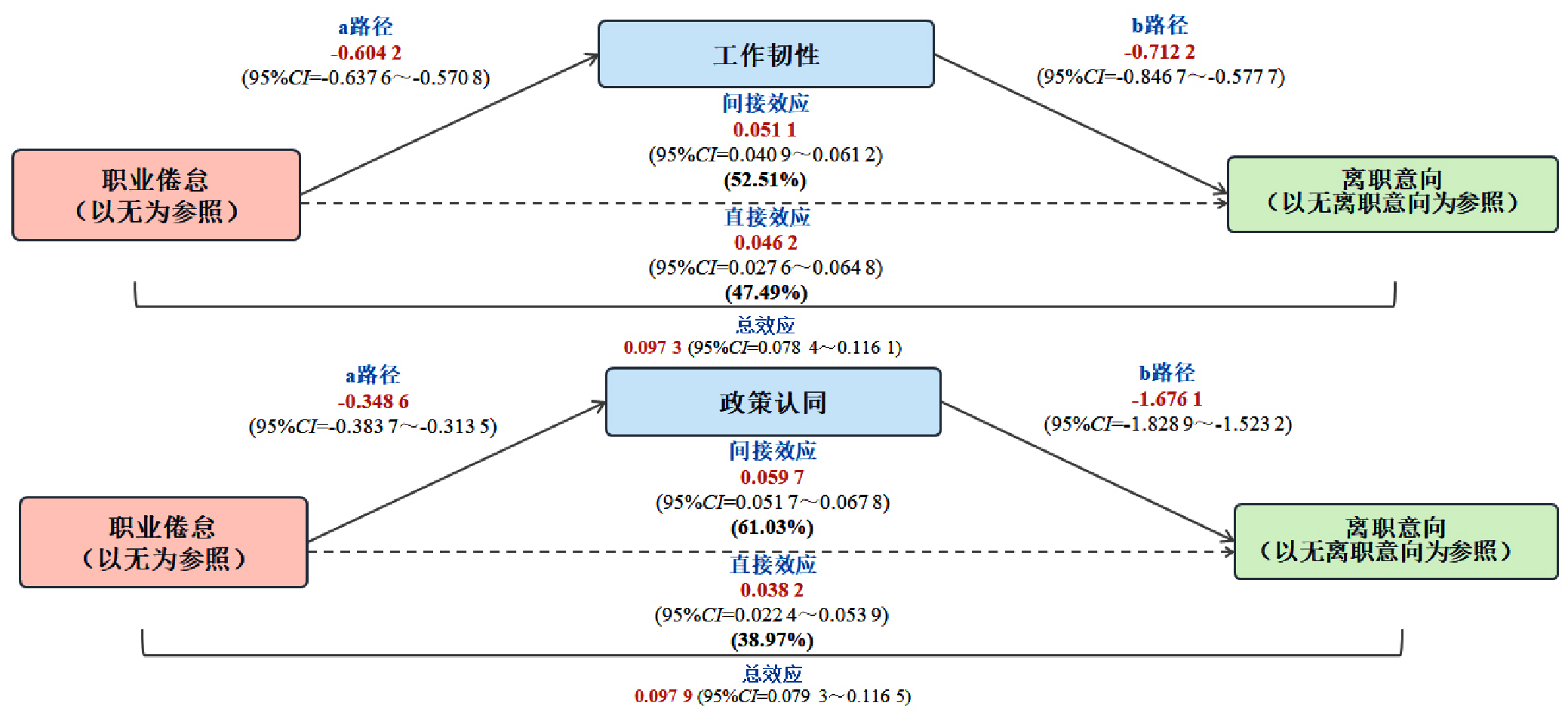
图1 工作韧性与政策认同在职业倦怠与离职意向关系中的中介作用
Figure 1 Proposed mediation pathways linking burnout to turnover intention through work resilience and policy identification
| [1] |
国家发展改革委,原卫生部,教育部,等.关于印发开展农村订单定向医学生免费培养工作实施意见的通知:发改社会〔2010〕1198号[A]. 2010.
|
| [2] |
黄星,左延莉,唐琦,等.广西农村订单定向免费医学生培养项目实施效果调查分析[J].中国卫生事业管理, 2019, 36(3): 204-207.
|
| [3] |
申丽君,李晗歌,王培成,等.农村订单定向医学毕业生工作场所患者源暴力、职业倦怠与离职意向的关系研究[J].中国全科医学, 2024, 27(22): 2766-2772.
|
| [4] |
郑艳玲,余芳,陈艳黎,等.我国全科医生离职意愿及其影响因素分析[J].中华全科医学, 2019, 17(9): 1543-1546. DOI: 10.16766/j.cnki.issn.1674-4152.000993.
|
| [5] |
刘芳,唐大龙,刘伟楠,等.全科专业住院医师规范化培训学员职业倦怠及其影响因素研究[J].中国全科医学, 2020, 23(9): 1151-1157. DOI: 10.12114/j.issn.1007-9572.2019.00.713.
|
| [6] |
陈皓阳,穆林,莫雯茜,等.我国住院医师规范化培训现状的系统评价[J].卫生经济研究2022, 39(1): 73-77. DOI: 10.14055/j.cnki.33-1056/f.2022.01.020.
|
| [7] |
曹胡玲,王丽华,丁爱明,等.三级甲等医院规范化培训期护士心理韧性水平及影响因素分析[J].江苏医药, 2014, 40(16): 1979-1980. DOI: 10.19460/j.cnki.0253-3685.2014.16.055.
|
| [8] |
文超,蒋春雷,谭莉娜,等.精神科医护人员心理韧性、工作压力与焦虑抑郁情绪关系[J].中国职业医学, 2014, 41(6): 697-700.
|
| [9] |
|
| [10] |
田小雨.我国基层医务人员离职意向状况与分析[J].基层医学论坛, 2021, 25(22): 3240-3241.
|
| [11] |
|
| [12] |
|
| [13] |
陈涛,田怀谷,卢红,等.基于CiteSpace可视化分析我国医生职业倦怠研究热点与趋势[J].医学信息, 2022, 35(7): 5-9.
|
| [14] |
沙蔚然,尹梅.中美医师职业倦怠状况对比分析[J].中国医学伦理学, 2017, 30(1): 38-44.
|
| [15] |
|
| [16] |
|
| [17] | |
| [18] |
若从彬,司建平,王先菊.中医学专业农村订单定向医学生留任基层意愿的影响因素分析[J].时珍国医医药, 2024, 35(6): 1536-1538.
|
| [19] |
|
| [20] |
|
| [21] |
|
| [22] |
冯玲莉,李雪迎,田君叶,等.规范化培训阶段轮转护士离职意向调查[J].医院管理论坛, 2024, 41(11): 43-50, 81.
|
| [23] |
|
| [24] |
徐心怡,朱平华,陈会方,等.南宁市基层卫生人员离职意向及其影响因素研究:基于Logistic回归和随机森林模型[J]. 卫生经济研究, 2023, 40(5): 64-67, 71. DOI: 10.14055/j.cnki.33-1056/f.2023.05.011.
|
| [25] |
唐文华,李颖,莫海萍,等.广西某高校农村订单定向毕业生职业倦怠影响因素分析[J].卫生职业教育, 2026, 44(6): 130-133. DOI: 10.20037/j.issn.1671-1246.2026.06.32.
|
| [26] |
张萌,崔倩,朱长才.医护人员职业倦怠影响因素的结构方程模型分析[J].中华疾病控制杂志, 2022, 26(7): 808-814.
|
| [27] | |
| [28] |
申鑫,姜恒,冯晶,等.国内外全科医生离职意愿研究进展[J].中国全科医学, 2021, 24(22): 2770-2776.
|
| [1] | 申丽君, 李晗歌, 王培成, 朱纪明. 农村订单定向医学毕业生工作场所患者源暴力、职业倦怠与离职意向的关系研究[J]. 中国全科医学, 2024, 27(22): 2766-2772. |
| [2] | 关彦, 林泽华, 罗桢妮. 基层医务人员付出-回报失衡与职业倦怠的关系研究[J]. 中国全科医学, 2024, 27(19): 2305-2311. |
| [3] | 贺玲玲,蒲川,黄礼平,白钧琪,刘茜,黄锐,何雨芯. 重庆市家庭医生团队职业倦怠与隐性缺勤关联性研究[J]. 中国全科医学, 2021, 24(19): 2452-2458. |
| [4] | 刘美星, 丁静, 季燕, 陈雪. 北京市西城区家庭医生职业倦怠现状及影响因素研究[J]. 中国全科医学, 2021, 24(13): 1656-1664. |
| [5] | 郑艳玲,余芳,陈艳黎,余旻毅,刘玲,甘勇,李丽清,杨宇迪,卢祖洵. 我国全科医生职业倦怠状况及影响因素研究[J]. 中国全科医学, 2019, 22(7): 764-769. |
| [6] | 甘勇,杨婷婷,杨宇迪,刘建新,卢祖洵. 国内外全科医生职业吸引力研究进展[J]. 中国全科医学, 2019, 22(28): 3490-3494. |
| [7] | 卢慧敏,黄琦,杨丹丹,苗春霞,高修银. 家庭医生团队职业倦怠现状及影响因素研究[J]. 中国全科医学, 2019, 22(10): 1223-1228. |
| [8] | 沈冰洁,胡琳琳,尤莉莉,刘远立. 国中部地区乡村医生的离职意向及影响因素研究[J]. 中国全科医学, 2018, 21(34): 4183-4187. |
| [9] | 张志军,刘朝杰. 北京市社区护士职业倦怠现状调查及其影响因素分析[J]. 中国全科医学, 2018, 21(2): 232-238. |
| [10] | 陈曲,刘旭,孟开. 北京市三级甲等医院青年医护人员职业倦怠现状及其影响因素分析[J]. 中国全科医学, 2018, 21(2): 223-231. |
| [11] | 宋丽萍,都菁,蔡晶,李新影. 职业倦怠与抑郁的关系及社会支持的调节作用研究[J]. 中国全科医学, 2018, 21(1): 93-97. |
| [12] | 尹绍雅,赵静波,陈熔宁. 临床医生共情疲劳现况及其影响因素分析[J]. 中国全科医学, 2016, 19(02): 206-209. |
| 阅读次数 | ||||||
|
全文 |
|
|||||
|
摘要 |
|
|||||